The market does not only reference characters: it also references training. X-Factor #71 is a textbook case, and Quicksilver is an excellent thread to observe it. Identified on August 30, 2026 on a general auction site oriented to the American market, the query “Quicksilver Verified copies, counted separately, are only 4, from $49.95 to $125.00. These are amounts requested by sellers on a single date, not completed transactions. No character mentioned in these advertisements debuts there: it is the composition of the team which is sold as new.
When a collector opens a quotation guide, he finds lines built on a unique model: a booklet, a character, a “first appearance” mention. This pattern is so dominant that it ends up looking like the entire subject. He is not. An entire part of the vocabulary used by sellers designates something other than the birth of a character: the first time a group appears in a given composition. This pattern has its advertisements, its formulations, its buyers, and almost never its line in the guides.
Quicksilver offers a convenient angle of observation, because his editorial career has taken him from one team to another without ever being a new character. Each time he joins a group, he brings a story that has already been written. The booklet which records his arrival somewhere cannot therefore be sold as a first appearance of a character: it is sold as a first appearance of a team. The statement of August 30, 2026 on X-Factor #71 shows exactly this shift in discourse, and what it is worth, or not worth, to the wallet.
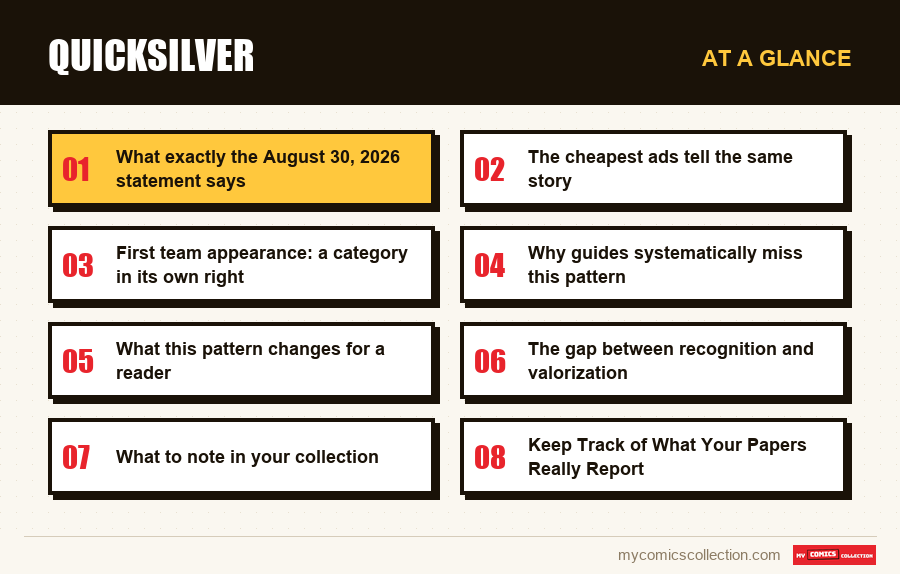
What exactly the August 30, 2026 statement says
Let's start by stating the figures and their nature, because all reasoning depends on them. As of the survey date, the query “Quicksilver X-Factor 71” returns 174 listings for unverified copies. The lowest amount claimed is $0.99, the median is $7.38, and the most expensive ad asks for $99.99. At the same time, only 4 advertisements concern copies verified by an organization, in a range going from $49.95 to $125.00.
These amounts are claimed, not collected. A seller sets the price he wishes to obtain; nothing in a listing guarantees that a buyer has accepted it. The maximum at $99.99 therefore does not measure a market level: it measures a person's optimism on a given day. The median at $7.38 is much more telling, because it summarizes where the bulk of the volume is held, but it describes a supply, not a flow of sales.
Second precaution, just as important: this statement is from a single day. A single measurement does not draw any trajectory. It would be wrong to write that this issue “goes up” or “goes down”: I don't have two points, I don't have a curve, I only have a photograph. All I can say is the status of the offer on August 30, 2026 on this specific marketplace, for a predominantly American audience.
Third precaution, on verified copies. Four announcements are too few to establish anything. With such a thin workforce, a single seller at an unusual price moves the entire range. I therefore note the existence of these four advertisements, between $49.95 and $125.00, and I stop there: no conclusion on a “price level of verified copies” is based on four observations.
The cheapest ads tell the same story
The interest of the survey is not only in the figures: it is in the text of the advertisements. The five cheapest ads all match the specification you're looking for: there's no noise, no mismatches, no disguised prizes. And four of them explicitly sell the team's makeup. The labels noted are as follows: « X-Factor #71 [...] 1st App. of New X-factor Team » to $0.99; « X-Factor #71 VF/NM Marvel 1991 » to $1.80; « X-Factor #71 1st All New All Different Team 1991 » at $1.95; « X-FACTOR #71 A New Team! [...] Havok, Wolfsbane NM » at $1.99; and « X-Factor #71 (1991) VF3B124 VERY FINE VF 8.0 » at $1.99, the wording of which ends with an internal storage code of the seller.
The pattern is named, not standardized
Three different formulations designate the same fact in the same announcement package: “new team”, “entirely new team”, “a new team! ". No common vocabulary is required. Two announcements in the same issue can therefore appear to speak of two distinct events.
Personne n'y débute
None of the characters mentioned in these descriptions appear for the first time in this booklet. They all existed before. What the seller presents as new is the assembly, in other words a date of composition: not a creation.
Identified but not valued
174 ads and a median under eight dollars: the market knows perfectly well what it is, and is not paying for it. Recognizing a booklet and paying a lot for it are two independent actions, which most guides confuse.
Only four copies verified
The scarcity of documented copies confirms the message of the price: no one incurs verification fees on a booklet that costs two dollars. The absence of verification is here an economic consequence, not an indicator of scarcity.
One detail deserves to be highlighted, because it poisons automated searches: the $1.99 ad ends with "VF3B124", which is neither a state, nor a variant, nor an edition number. This is a classification code specific to the seller, pasted in the title to find the box in its stock. Anyone who builds a keyword search on this kind of suffix gets noise. The ad labels mix three registers (editorial description, condition, internal logistics) without separators.
A copy advertised as “VF/NM” costs $1.80; a copy advertised as “VF 8.0” costs $1.99. At this price level, the difference in declared condition translates into almost nothing: nineteen cents separate two descriptions that the grading theory clearly distinguishes.
The lesson is simple: the state is only monetized above a certain threshold of value. Below, it becomes reading information again: is the copy pleasant to handle? and ceases to be a financial variable. Paying more for a half state point on a two-dollar issue makes no economic sense.
First team appearance: a category in its own right
We must name precisely what we are talking about, because the confusion with the first appearance of a character distorts everything. A first appearance of a character refers to a creation: before this issue, the entity did not exist. A first appearance of a team refers to a composition: the members all existed, and it is their meeting under this configuration which is new. The first motif designates an origin; the second designates a date.
This difference has immediate practical consequences. A creation is unique by definition: there is only one per character. A composition is replayed with each editorial redesign. A team series that spans several decades mechanically produces several “first appearances” of successive formations, each likely to be announced as an event. The category is therefore much more populated than that of creations, which partly explains why it is less expensive.
It is also much more vague. A creation is dated without discussion. A composition, no: should we count the booklet where the team is announced, the one where they are brought together for the first time on a board, or the one where they act together? The sellers each decide in their own way, and this dispersion can be read directly in the wordings noted. The reader who seeks to understand the circulation of Quicksilver between teams will find in the inventory of its crossovers enough to measure how frequent these passages are for him.
Finally, the category is structurally poorly served by reference tools. An index built on characters does not have a box for “formation X from such number”. The information therefore exists only in the free text of the advertisements, that is to say in the least reliable and least searchable place in the chain. This is exactly what the survey shows: knowledge circulates, but in the form of sentences, not data.
Why guides systematically miss this pattern
A search by character does not find it
Searching for "first appearance of Quicksilver" brings up a unique and old answer. The booklet which records your entry into a training course does not appear anywhere in this result, even though it is the one that the sellers describe as new.
A date, not an origin
The guides index origins. A team composition is a recomposition date: it does not enter into the diagram, and finds itself relegated to a footnote when it is mentioned.
Aucun libellé standard
“New team”, “completely new team”, “a new team!” »: three ways of saying the same thing in the same sample of five ads. No aggregator can neatly group these variants together.
Logistical noise in the titles
The sellers' internal storage codes are included in the labels, next to the states and years. This mixture makes automatic extractions unreliable and discourages the creation of clean data series.
Trop peu d'exemplaires vérifiés
Guides readily rely on documented examples. With only four announcements, there is nothing to aggregate: the pattern remains invisible to methods which only look at the certified part of the market.
Reading interest, not speculation
A redial number introduces its characters, since that is its narrative function. Its true value is an entry point for reading. The guides, which are rating-oriented, do not have a column for this quality.
Collecting this series?
Track what you own, what you are missing and what your collection is worth. 7 day trial.
Start my trial →What this pattern changes for a reader
There is an optimistic reading of these figures, and it has nothing to do with speculation. A team recomposition booklet is written to be understood without history. This is its narrative function: it must present each member, explain why this formation is formed, set a tone. The author can't assume the reader already knows everyone, otherwise the build-up scene doesn't work.
Simply put, these numbers are excellent entry points, and the market is selling them at a median of $7.38. There are few such cheap gateways to such a dense universe. For those who want to discover a team without buying twenty years of backlog, aiming for a recomposition rather than a historic number 1 is a rational reading strategy, and not just a budget strategy.
This logic generalizes beyond the observed case. The major team series are built on an alternation of stable phases and reshuffles; the reshuffles are, by construction, the moments where the series re-explains itself. A reader who wants to approach the X-Men will find in the story of their editorial history the identification of these caesuras, and the same reasoning applies to the trajectory of the Avengers, whose successive recompositions are a feature of operation more than an accident.
However, a misunderstanding must be avoided. To say that a redial number is a good entry point is not to say that it is a good investment. The reading shows precisely the opposite: the pattern is recognized by the market and left at less than eight dollars. These two facts do not contradict each other, they complement each other. A booklet can have a high use value and a low market value, and this is even the most common case.
The gap between recognition and valorization
Perhaps the most instructive point of this whole survey is here. One hundred and seventy-four ads is a lot. It is not a booklet forgotten in a cardboard box: it circulates, it is identified, it is described with precision by sellers who know what they are getting. Four of them, among the five least expensive, take the time to write in the title what makes the issue interesting. Knowledge is therefore widely shared.
And yet, the median of the amounts claimed remains under eight dollars. The market integrated the information without assigning a premium to it. This is a useful reminder: knowledge of an editorial fact does not automatically create value. For a pattern to pay off, there must be demand greater than the available supply, and here the supply is abundant: 174 simultaneous announcements are enough to establish this.
The low number of verified copies says the same thing in another way. Having a booklet documented has a cost, in money and time. This cost only makes sense if it is recovered on resale. On a booklet for a few dollars, it is never recovered. The four verified advertisements noted therefore probably exist for reasons specific to their owners; they do not constitute a usable sample, and I am careful not to draw a reference range from them.
This gap between recognition and valuation is found in characters built on a shared archetype. Compare the editorial trajectories of runners, for example by browsing the history of Flash in comics, shows to what extent the notoriety of a pattern and its price follow independent curves. What the market calls for and what it pays for are two separate inventories.
What to note in your collection
The exact nature of the preserved pattern. Write in black and white, next to the copy, if it is a first appearance of a character, a first appearance of a team or a first wearing of a costume. These three mentions look the same in an ad and do not have the same status at all. Without this clarification, your own sheet will reproduce in six months the ambiguity of the sales descriptions.
The exact composition quoted by the seller. Copy the names appearing in the advert, as they are. The wording raised to $1.99 mentions Havok and Wolfsbane: this list is provenance information, it documents what the seller claimed at the time of the transaction. If the announced composition differs from what you notice when reading, the note will allow you to know where the difference comes from.
The condition observed by yourself. The statement shows a “VF/NM” copy at $1.80 and a “VF 8.0” copy at $1.99: the states declared by the sellers are neither harmonized nor discriminating at this price level. So write down your own assessment, with your criteria, rather than copying the mention from the ad. This is the only status line that will actually be useful to you later.
The series and its volume. A number 71 does not exist in absolute terms: it exists in a specific volume of a specific series. Team titles are relaunched, renumbered, duplicated; without mention of the volume and the year, your reference will become ambiguous as soon as the series undergoes a new numbering. The year 1991 also appears in three of the five labels noted, proof that the sellers themselves feel this need for disambiguation.
The price paid, shipping included. On a booklet with a median claimed amount of around $7.38, shipping costs often weigh as much as the item. A sheet that only records the displayed price structurally underestimates what the collection cost. Note the total actually debited, and the date: it is this pair that will give meaning to any subsequent comparison.
The August 30, 2026 statement does not allow the two categories to be compared with each other, due to lack of measurement for the second. What it does show, however, is that a booklet sold explicitly for its team composition commanded a median of $7.38, with 174 ads available simultaneously. Such abundance is not compatible with a scarcity premium.
Because no authority standardizes this vocabulary. In the five cheapest listings found, we find “1st App. of New X-factor Team”, “1st All New All Different Team” and “A New Team! » to designate the same fact. Each seller formulates in their own way, which makes automatic groupings unreliable and requires reading the labels one by one.
Nothing solid, and that’s important to say. Four listings, between $49.95 and $125.00, are far too small: a single atypical seller would move the entire range. This figure is better interpreted as an indirect signal, incurring verification costs on a booklet costing a few dollars does not pay off, than as a price indication.
No, not from this data. The survey was taken on a single date, August 30, 2026, and a single observation contains no movement information. It would take at least two spaced surveys, carried out under the same conditions and on the same market place, to start talking about evolution. Any trend claims made from these figures would be an invention.
Yes, and this is even its narrative function: it must present the members and justify their meeting, so it is aimed at a reader who arrives without any history. Add to that median claimed amounts under eight dollars, and you have one of the least expensive gateways to a dense universe. This argument is about reading, not placement.
Keep Track of What Your Papers Really Report
Character, team, costume: three different patterns, three different lines in a well-organized collection. My Comics Collection allows you to record for each copy the series, the volume, the year, the condition you noted and the price actually paid, including shipping, then find the information months later without depending on the wording of a missing ad.