On the French market, on August 30, 2026, the same number Strange Spécial Origines- the 172 bis, published by Lug in 1984, described in the same condition by the two sellers: was asked for €3.00 without its cardboard cards and €8.00 with it. Two announcements do not make a law, but the difference is too clear to be put down to chance, and the three other announcements noted go in the same direction: those who declare the cards present ask €7.50 and €8.00, those who declare them absent €3.00 and €7.00. Please note: these amounts are prices displayed in euros by individual sellers on a general auction site on a single date, not completed transactions, and the complete statement only includes eighteen advertisements: far too few to deduce a market price level.
The collector who follows Quicksilver in French quickly comes up against a particularity of French publishing: the character has never had a magazine in his name, he circulates within collections which bring together several American series and which add, on top of that, their own editorial material. This added material was not decorative. For years, French magazines included cardboard inserts, printed on both sides, pre-cut or simply stapled in the center of the issue, which the reader was supposed to detach to store in a binder. This was the purchasing argument of the moment: we weren't just buying translated episodes, we were putting together a kit encyclopedia, issue after issue.
Thirty years later, this invitation to detach turns against the object. A booklet from which the cards have been removed is incomplete, but its incompleteness is not visible in any cover photograph: from the outside, it is identical to the one which has retained its insert. The statement below is rare in that it allows us to chiffrer this invisible difference. The same number, the same year, the same declared condition, offered by two different sellers on the same day, with and without its cards. This is the clearest demonstration that one can hold of this simple principle: an insert designed to be removed is part of the object, and its absence costs.
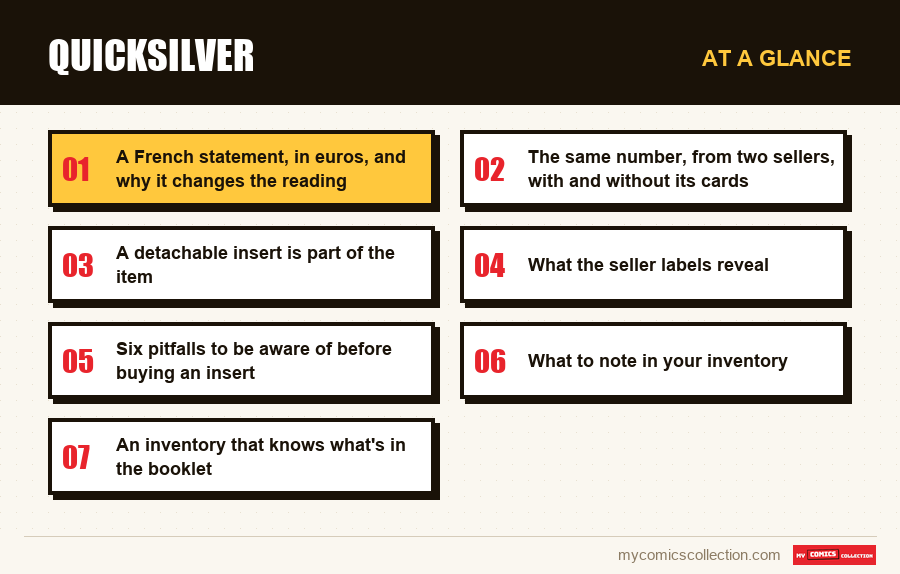
A French statement, in euros, and why it changes the reading
Most of the statements published here relate to the American market and are expressed in dollars. This one no. The five advertisements cited were observed on August 30, 2026 on a general auction site, with French-speaking sellers, and all amounts are denominated in euros. The precision is not cosmetic: it prohibits any direct comparison with the orders of magnitude to which a reader accustomed to American figures could refer by reflex. Lug magazines were printed, distributed and read in France; they are resold in France, between individuals, at prices which have no mechanical relationship with those of a period American booklet.
Second precaution, even more important: what was noted were the sums demandées, not sums cashed. An online ad records the intention of a seller, never the agreement of a buyer. As long as no transaction has come to confirm the amount, a displayed price remains a hypothesis made by a single person. And as the reading was taken at a single moment, it cannot describe any trend: a photograph taken only once does not show movement, it shows a state. Nothing in these figures says whether these issues were worth less last year or will be worth more next year, and it would be dishonest to suggest so.
Third point: the workforce. The query relating to these magazines and their files only found eighteen advertisements in total, with a minimum of €3.00, a median of €9.90 and a maximum of €59.89. Eighteen is very few. On this scale, a single oddball listing moves the median, and the maximum measures nothing other than the optimism of the seller who posted it: certainly not a price anyone would be willing to pay. I therefore explicitly refuse to derive a price level for these magazines. What eighteen advertisements allow, on the other hand, is an internal comparison: when two of them relate to the same object and differ only in one detail, the comparison remains valid even if the overall sample is small.
Fourth point, purely factual: among these eighteen announcements, none concerned a copy verified by an independent organization. Zero. On French magazines of this period, certification is simply not an established practice, and the prices recorded are therefore all prices for raw copies, described by their seller in his own words. This has a direct consequence on the subject of the day: the presence of the files is attested by no one other than the seller himself.
The same number, from two sellers, with and without its cards
172 bis, without the sheets: €3.00
The ad “Strange Special Origins n° 172 bis LUG 1984 BE WITHOUT the Files” displays €3.00. The seller declares good condition and indicates himself, in capital letters, what is missing. This is the lowest amount on the entire statement.
172 bis, sheets attached: €8.00
The ad “Strange Special Origins n° 172 bis LUG 1984 BE with Attached Files” displays €8.00. Same number, same publisher, same year, same state abbreviation. The only difference stated is the insert, and it is specified that it has not been detached.
Three other announcements, same meaning
The two advertisements which declare the files present: a 175 bis "complete with super hero files" and a 178 bis "WITH THE FICHES" from October 1984 - ask €7.50 and €8.00. The one who declares an absence, a 184 bis of April 1985 “Without FICHE”, asks €7.00.
Five out of five mention it
None of the five announcements remains silent on the issue. Each indicates, in its title and not in the body of the text, whether the insert is there or not. On this specific publication, the presence of the files became a spontaneous criterion of description.
The central comparison deserves attention, because it is cleaner than what we usually get. Two independent sellers offer the same issue of the same publication, from the same year, with the same state abbreviation on the same day. Everything that could confuse the comparison (the edition, the vintage, the declared preservation) is aligned. What remains as a variable is the insert. And the ratio is not a few percent: the asking price goes from €3.00 to €8.00, more than double. Two announcements alone do not demonstrate anything, it must be said again, and I am not claiming that a coefficient of two and a half would apply to other issues or other publications. But the gap is too stark to ignore, and the three remaining announcements lean in the same direction.
What makes this case instructive is not the amount: a five euro difference on a booklet costing less than ten euros will interest no one in absolute terms. This is the report: the seller who kept the insert asks more than twice as much as the one who lost it, for an object that nothing can distinguish on a cover photo.
Now transpose the principle to a booklet that trades two orders of magnitude higher, and you understand why the inventory of a collection cannot be satisfied with a number and a condition. He needs a third piece of information: what is still inside.
A detachable insert is part of the item
Cardstock cards are just one particular case of a much larger family. Magazines and booklets have housed, depending on the era and country, posters folded in four, sheets of cutting cards, stickers, return vouchers, supplements stapled in the center. All of these items share one characteristic: they were designed to be removed. The publisher wanted them to be detached, he sometimes wrote it in black and white, and a considerable part of the readers obeyed. This is precisely what makes them rare today in their intact state.
The paradox can be summed up in one sentence: the more an insert was intended to be torn out, the more unusual the copy that kept it becomes. And since the removal leaves no trace visible from the outside, the buyer who relies on a cover image cannot tell the difference. He buys what he believes to be a complete copy, he receives a booklet missing an element that he perhaps did not know he had to look for. The seller did not necessarily lie: he simply described what he saw.
The survey provides here a valuable detail that many descriptions neglect. The €8.00 advert doesn't just say "with cards", it says "with attached cards". The nuance is real. An insert may be present but already separated from the booklet, slipped inside, or even put back there by a later owner. An insert still attached to the stapling tells something else: it attests that no one ever started the operation. Between “present”, “detached but attached” and “originally attached”, there are three distinct situations that common language readily confuses under the same word.
This logic is not specific to a single publication. It applies to everything that is added to a booklet without being integral with it, and it explains why two copies strictly identical in number and condition can be found in two different categories of completeness. The reader who follows a character through the French collections, and this is the lot of those who are interested in Quicksilver, whose appearances are distributed between several editorial contexts, both on the side of mutant series that on the side of superhero teams: will necessarily cross insert collections. You might as well know from the start that the number alone is not enough to identify what you own.
Collecting this series?
Track what you own, what you are missing and what your collection is worth. 7 day trial.
Start my trial →What the seller labels reveal
One thing is striking when reading the five titles: all mention the files. Not a single one forgets the question. On this specific publication, the sellers have clearly understood that the buyer is going to ask for it, and they take the lead: sometimes in capital letters, sometimes with a formula as explicit as "complete with superhero files". This is the sign of a market where the criterion is known to all participants.
Above all, we must not generalize this discipline. It exists here because the publication is renowned for its inserts and the community which exchanges it has made it a reflex. Out of thousands of other titles, a booklet which has lost its poster or its sheet of cards will be described without a word on the subject, not out of malice but because the seller is unaware that there was anything there. The absence of a mention is never a guarantee of presence: it is missing information, and it must be treated as such by asking the question before purchasing.
Second lesson, more down to earth: the spelling varies. Three advertisements write “files” in the plural, one writes “FICHE” in the singular, with or without capital letters depending on the case. Anyone who systematically searches for the plural will miss the singular wordings, and vice versa. This applies to any search based on a criterion of completeness: the word which describes the missing element is not standardized, it is typed by hand by each seller, with its accents, its abbreviations and its mistakes. Effective research multiplies forms rather than favoring one.
Third lesson, the one which has the most practical consequences: all the numbers noted bear the suffix “bis”. 172 bis, 175 bis, 178 bis, 184 bis. This is not a typo, it is the real numbering of these collections, distinct from the numbering of the main journal. A non-numeric suffix does not fit in any box provided for an integer. The collector who notes his acquisitions in a list in the “number, condition” format therefore finds himself having to accommodate two pieces of information that neither of these two fields expects: an identifier which is not a number, and a completeness which is not a state of conservation.
Six pitfalls to be aware of before buying an insert
The cover photo proves nothing
The absence of an interior insert is invisible from the outside. A nice front cover image says nothing about what's inside, yet that's the only thing most ads show.
A dated price is not a trend
The amounts cited were raised on August 30, 2026, only once. A single measurement describes an instant, never an evolution. Any sentence like “it’s going up” or “it’s going down” would be a pure invention here.
Price asked ≠ price obtained
A listing records what a seller expects, not what a buyer paid. The maximum of €59.89 noted in this research reflects an individual expectation and should not be read as any reference.
“With files” covers several cases
Present, detached but joined, or originally attached: three different situations that the same word designates. Only one announcement in the statement specifies “attached”. Ask for precision when it is lacking.
The number is not an integer
All observed numbers have a “bis” suffix. Storing it as a number truncates it and confuses it with the corresponding ordinary number, two distinct objects that we end up believing we have in duplicate.
Eighteen ads is not a deal
The total research population is too small to establish a price level. It is enough to compare two ads with each other when everything else is aligned; it is not enough to say what the publication is worth.
What to note in your inventory
The presence or absence of the cards, and their state of attachment. Don't just check a box. Note which of the three situations applies: insert absent, insert present but detached, insert still attached to the booklet. This is exactly the distinction that the €8.00 advert makes by specifying “cards attached”, and it is the one that separates two copies whose requested value varies from a single to double and a half. If you haven't checked it yourself, note this too: "declared present by the seller, not inspected" is honest and useful information.
The number with its suffix, copied as is. Write “172 bis”, not “172”. The suffix is not a typographical detail, it is what distinguishes the collection from the ordinary issue bearing the same number. An inventory that normalizes everything creates phantom duplicates and makes it impossible to know which of the two items you actually have on the shelf. The same rule applies to all the non-numeric suffixes that the periodical press has used over time.
The exact title of the publication.“Strange Special Origins” is not “Strange”. These are two different editorial objects, and confusing them in an inventory amounts to mixing two collections that are not stored or searched in the same way. Copy the title as it appears on the cover, including accents, and keep this form consistent from one entry to another rather than abbreviating it differently each time you enter.
The year, and the publisher that goes with it. The advertisements noted bear 1984 and 1985, and mention Lug. These two pieces of information together are enough to locate a copy without ambiguity, including when a title has had several publishers or several numbering series. A single year, without a publisher, leaves the door open to confusion as soon as the same title has been used elsewhere.
The price paid, shipping included. On booklets costing a few euros, shipping costs often weigh as much as the item, sometimes more. An inventory that only records the price of the ad systematically underestimates what the collection cost, and the discrepancy becomes considerable over several hundred issues purchased individually. Note the total actually debited, and the date of purchase with it.
The statement shows a case where the asking price increases from €3.00 to €8.00 between two copies of the same issue, one without an insert and the other with it. It's more than double, but these are two isolated announcements and amounts claimed, not sales concluded. We can conclude that the gap is real and significant; we cannot derive a coefficient applicable to other issues or other publications.
Because the observation was made on the French market, with French-speaking sellers, on a publication published and distributed in France. This is an exception to the usual American readings on this site. The orders of magnitude cannot be transposed from one market to another, and you should definitely not compare these figures to those of a vintage American booklet.
By simply asking for it, and asking for a photograph of the interior rather than just the cover. Specify your question: are the cards present, and are they still attached or already detached? The five advertisements noted all dealt with the subject spontaneously, but this is a usage specific to this publication, not a general rule of the second-hand market.
There is nothing to confirm this. An isolated maximum within a sample of eighteen advertisements reflects the hope of a seller, not an observed price. No buyer validated this amount at the time of the statement, and no announcement in this search related to a copy verified by an independent organization. This figure should not be used as a reference for anyone.
Because the word is not written the same way everywhere. The statement shows “fiches” in the plural in some titles and “FICHE” in the singular in another, with variable capital letters. Look for both forms, and also remember to query the number with and without its “bis” suffix: sellers type it by hand, with their own habits.
An inventory that knows what's in the booklet
Non-entire number, exact title, state of conservation, completeness of the insert, price paid including shipping: these five pieces of information must fit together in the same file, otherwise you will never know which of your copies is the complete one. My Comics Collection allows you to follow each issue with its particularities and find in an instant what you really own.