
In short
Quality Comics was founded in 1937 by printer Everett M. "Busy" Arnold as Comic Favorites, Inc., and its first title was Feature Funnies. Its best-known features were Plastic Man (Police Comics #1, 1941), the Blackhawks (Military Comics #1, 1941), Doll Man and Uncle Sam, plus comic book reprints of Will Eisner's Spirit. The company stopped publishing with comics dated December 1956, and its characters passed to National Comics, today's DC, which later gathered many of them as the Freedom Fighters.
Quality is the Golden Age publisher that collectors meet through its characters rather than through its name. A Plastic Man story, a Blackhawk war title and a DC team of 1970s heroes all trace back to one printer's comic book company that closed in the middle of the 1950s.
Every date, issue number and credit below was checked against published histories of the company and of each character, and cover months appear only where one was read; the reading of each era is our own analysis, and no story or artwork is reproduced.
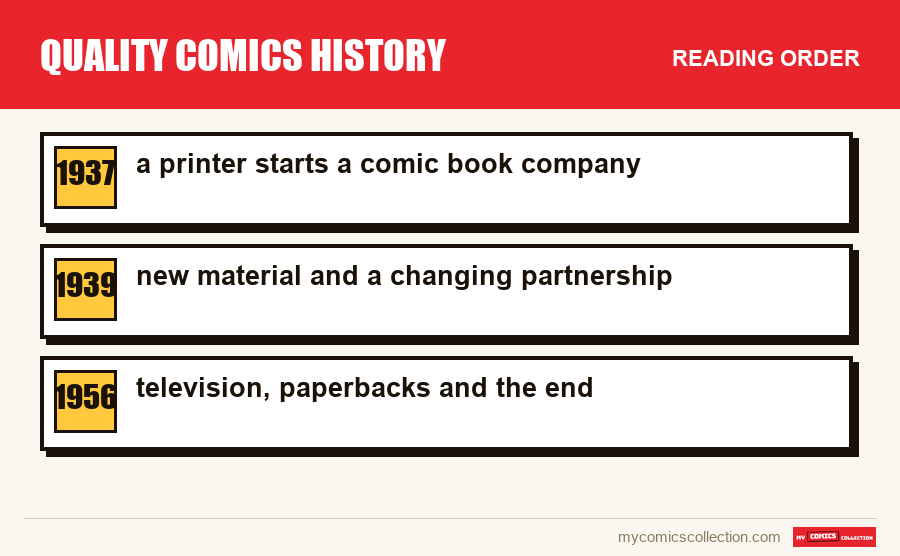
1937: a printer starts a comic book company
Everett M. "Busy" Arnold worked as a printer, and that trade explains the company's first move. In 1937 Arnold founded Comic Favorites, Inc. with three newspaper syndicates as partners: McNaught, Frank J. Markey, and Register and Tribune. The partners supplied what a printer needed most, which was ready material from Sunday and daily strips.
The first title was Feature Funnies, which ran twenty issues from 1937 to 1939. It reprinted syndicate strips and added original features, with new pages coming from in-house staff, freelancers and, from #3, the Eisner and Iger shop. That mix of reprint and original work is the best way to read the first two years. Quality began as a printer's outlet for existing strips and only slowly became a house of its own characters.
The "Quality" name itself arrives later. It first appears on the cover of Crack Comics #5, dated September 1940, with a cover credited to Gill Fox. A Connecticut historical society tied the name to Stamford's nickname, the Quality City, and described the Quality Comics Group as a trademarked name instead of an official corporate title. For anyone cataloging early issues, that matters: the earliest books carry no Quality logo.
1939: new material and a changing partnership
The year 1939 reshaped the company. Arnold and the Cowles brothers bought out the McNaught and Markey interests, and Arnold became half owner of Comic Magazines, Inc. The title list moved with the ownership. Smash Comics #1, dated August 1939, was the first Quality comic made entirely of new material, and Feature Funnies continued as Feature Comics beginning with #21, keeping the old numbering.
That numbering detail is a first trap for collectors. Feature Funnies #1 to #20 and Feature Comics #21 onward are one continuous run under two names, and Feature Comics then ran until 1950. A buyer searching only one spelling of the title will miss half the sequence.
Doll Man belongs to this transition. Darrel Dane debuted in Feature Comics #27, dated December 1939, in the four-page story "Meet the Doll Man." Will Eisner created the character and wrote the early stories under the pen name William Erwin Maxwell, with Lou Fine drawing the first art and Reed Crandall following later. Doll Man stayed the lead feature of Feature Comics through #139 in October 1949, and a self-titled series ran 47 issues from 1941 to 1953.
1940 and 1941: the heroes arrive
Quality's superhero wave landed in 1940 and 1941, and the anthology format drove it. National Comics began in 1940 and ran 75 issues until 1949. Uncle Sam, the patriotic hero who later stood among the founders of DC's Freedom Fighters, also had a solo book: Uncle Sam Quarterly ran for eight issues from 1941 to 1943.
The same book carries a numbering lesson. Uncle Sam Quarterly was not abandoned; its numbering continued under the Blackhawk name from #9, so a Quality Blackhawk #9 is the ninth issue of a run that began with a patriotic hero's title.
1941 is the crowded year. Police Comics began with #1 and ran 127 issues until 1953. Doll Man debuted as its own book that year. Military Comics began with #1 and ran 43 issues until 1945, then continued as Modern Comics from #44. Two of Quality's lasting characters came out of those anthologies, and each is covered in its own section below.
Read Quality's early catalog as shelves of anthologies, each carrying several features, and the 1941 list makes sense. In 1941 the headliner was the title, and the features inside it were the product.
Police Comics #1 and the birth of Plastic Man
Plastic Man debuted in Police Comics #1, dated August 1941, created by Jack Cole. A night burglary goes wrong for the crook Eel O'Brian, and the chemical bath he takes during the escape turns him into an elastic crimefighter. Quality ran the feature in an anthology first and gave Plastic Man a book of its own later: Plastic Man ran 64 issues from 1943 to 1956, a run that lasted until the company's last year.
The hero soon acquired a comic-relief sidekick, Woozy Winks, who shaped the strip's comedy. The character's detailed history sits on our Plastic Man history page; this article only needs the point that Quality's flagship comic character was a humor feature, which made the company unusual among superhero publishers of the period.
The company's character list was therefore split in two. Plastic Man carried the humor and the art-driven page design, while Blackhawk carried the war adventure. Both lasted until the company closed, and both continued under DC afterward.
Military Comics #1 and the Blackhawks
Blackhawk first appeared in Military Comics #1, dated August 1941. The team was primarily created by Chuck Cuidera, with input from Bob Powell and Will Eisner; Cuidera later argued that his share of the work was far larger than Eisner's, so the safest crediting for a catalog entry is to name all three. The familiar lineup of Blackhawk, Olaf, Chuck, Andre, Stanislaus, Hendrickson and Chop-Chop is in place by Military Comics #11, dated August 1942.
The art changed in 1942, when Cuidera joined the armed services and Reed Crandall took over as artist. Crandall stayed on the characters until 1953, and the series reached its sales peak during that run. For a collector who cares about art rather than first appearances, the Crandall years are the reason to pay attention to Quality's war titles.
The numbering again needs care. Military Comics was later renamed Modern Comics and ended with #102 in October 1950. The Blackhawk series began in Winter 1944 with #9, continuing the numbering of the cancelled Uncle Sam Quarterly. The last Quality issue is Blackhawk #107, and DC is listed as publisher beginning in 1957.
1944 to 1950: The Spirit, in Quality's pages
Quality also published comic book reprints of Will Eisner's The Spirit, a feature that first ran in a weekly newspaper insert. The Quality Spirit comic ran 22 issues, from 1944 to 1950. It reprinted material that readers had first met in newspapers, which is why the book fits the company's origins as a reprint outlet for syndicated work.
The Spirit is the Quality title whose creator casts the longest shadow over the rest of the line, since Eisner's shop and Eisner's characters run through the company's first decade. Collectors who want the Spirit's Quality reprints should treat them as a separate, self-contained run of 22 books.
Do you collect this series?
Track what you own, what you are missing and what your collection is worth. 7-day trial.
Start my trial →
The late 1940s: war, humor, romance and horror
As superheroes faded after the war, Quality moved with the market. The company diversified into war, humor, romance and horror comics. The romance line is the clearest evidence: Heart Throbs began with #1 in 1949 and reached #46 before DC took it over; Love Confessions ran 54 issues from 1949 to 1956; Love Letters ran 51 issues across the same years; Diary Loves continued the numbering of Love Diary #1, running from #2 to #31 between 1949 and 1953; and Bride's Romance ran 23 issues from 1953 to 1956.
Other late-1940s books show the same hunt for a new audience. Kid Eternity ran 18 issues from 1946 to 1949 before the title turned to Buccaneers from #19, and Torchy ran six issues in 1949 and 1950. The catalog reads like a list of every genre that sold in a given season.
The creator roster in these years is strong. Jack Cole, Reed Crandall, Will Eisner, Lou Fine, Gill Fox, Paul Gustavson, Bob Powell and Wally Wood are all listed among the company's notable creators, and a collector tracing an artist through the 1940s will find a Quality book in most of those careers.
1956: television, paperbacks and the end
By the mid-1950s television and paperback books were drawing readers away from comics, and interest in Quality's superhero features had declined considerably. The company ceased operations with comics dated December 1956.
Many of Quality's character and title trademarks were sold to National Comics Publications, the company now known as DC Comics. DC kept four series running: Blackhawk, G.I. Combat, Heart Throbs and Robin Hood Tales. That list shows what National kept alive: an aviator war adventure, a war anthology, a romance title and a short-lived outlaw-hero book.
The result is an unusual publisher profile. Quality ended in 1956, yet Blackhawk kept its numbering across the change. DC took over as publisher in 1957, and the original numbering only came to its definitive end with #273, dated November 1984. Dick Dillin and Cuidera stayed on art through nearly the entire first DC run, which was cancelled in 1968.
Freedom Fighters, Earth-X and the DC years
DC treated the Quality heroes as a world of their own. Before Crisis on Infinite Earths, the Quality characters existed on Earth-Quality and Earth-X, a parallel earth where World War II continued until 1973 and let the Freedom Fighters keep fighting the Nazis. Doll Man joined the team when DC relaunched the Quality characters as the Freedom Fighters in Justice League of America #107, dated October 1973. The team had its own 15-issue series from 1976 to 1978.
Crisis on Infinite Earths in 1985 and 1986 folded those parallel worlds into one, and the Quality characters were transported into the main universe. Plastic Man followed a separate path: several short-lived series began in 1966, a Saturday morning cartoon ran from 1979 to 1981, and the hero joined the Justice League in the 1990s.
The rest of the revival record is modest. Successor versions of Black Condor and the Ray appeared in 1992, the new Ray had a 1994 to 1996 series, and another Ray was introduced in 2011. DC reprinted Blackhawk and Plastic Man, and AC Comics reprinted lesser-known Quality titles. A Blackhawks series for the New 52 ended with #8, dated April 2012, and a monthly Blackhawk series ran 16 issues from March 1989 to August 1990.
The pattern is clear. Quality's characters were never forgotten, but each DC revival was short, and the company's best sustained work remains the original Golden Age run.
The key issues across the line
- Feature Comics #27 (1939): the debut of Doll Man, Darrel Dane, in the story "Meet the Doll Man," created by Will Eisner with Lou Fine's first art.
- Smash Comics #1 (1939): the first Quality comic made entirely of new material.
- Crack Comics #5 (1940): the first cover to carry the Quality Comics name, with cover art by Gill Fox.
- Military Comics #1 (1941): the first appearance of the Blackhawks, primarily created by Chuck Cuidera with input from Bob Powell and Will Eisner.
- Police Comics #1 (1941): the debut of Plastic Man, created by Jack Cole.
- Blackhawk #9 (1944): the first issue under the Blackhawk title, continuing the Uncle Sam Quarterly numbering.
- Blackhawk #107 (1956): the last Quality issue of the series, published in the company's final year.
- Justice League of America #107 (1973): DC's relaunch of the Quality characters as the Freedom Fighters.
How to collect Quality Comics
Start from a character, not from the company name. The earliest Quality books carry no logo, so a want list built on the word Quality will miss most of what you need. List the title and feature you want, then check which of its numbering systems applies.
Three numbering problems recur. Feature Funnies and Feature Comics share one count, Uncle Sam Quarterly flows into Blackhawk #9, and Blackhawk continues into DC's #108. A run described as "Blackhawk #1 to #50" might be incomplete in either direction, so confirm which publisher and which number sequence a listing uses.
For reading rather than chasing originals, the DC reprints of Plastic Man and Blackhawk are the practical route into the material, and our Plastic Man starting guide picks the stories worth reading first. For the wider picture of what National did with the acquisition, see the DC history.
Finally, keep a shelf division between Quality-era books and DC-era books of the same character. A Blackhawk #107 and a Blackhawk #108 sit side by side in the number line, yet they belong to different publishers, different eras and different collecting questions.
Frequently asked questions
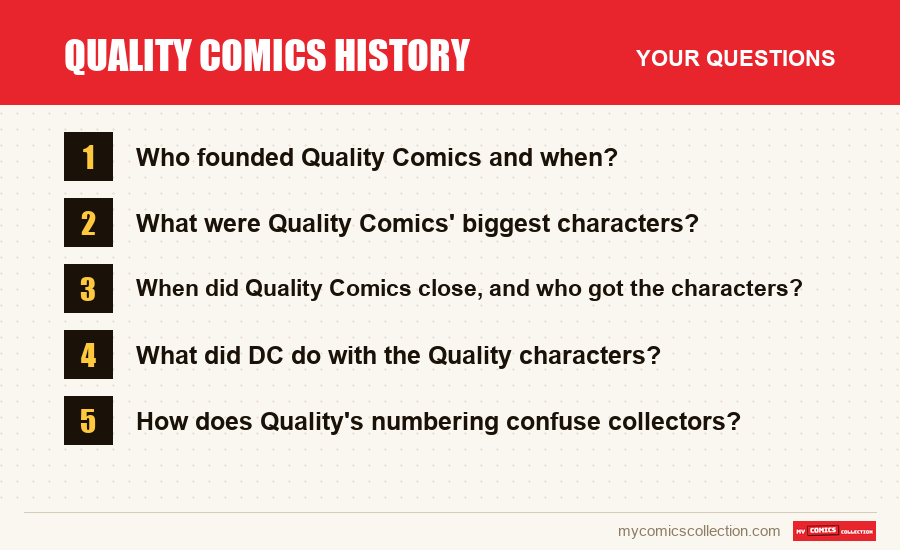
Everett M. "Busy" Arnold, a printer, founded the company in 1937 as Comic Favorites, Inc., with three newspaper syndicates as partners: McNaught, Frank J. Markey, and Register and Tribune. The first title was Feature Funnies. The Quality name first shows up on a cover with Crack Comics #5, dated September 1940.
Plastic Man, created by Jack Cole in Police Comics #1 (1941), and the Blackhawks, from Military Comics #1 (1941), were the best known. Doll Man, who debuted in Feature Comics #27 in 1939, and the patriotic hero Uncle Sam, star of Uncle Sam Quarterly, round out the list.
Quality stopped publishing with comics dated December 1956. Many of its character and title trademarks were sold to National Comics Publications, now DC Comics. DC kept four series running: Blackhawk, G.I. Combat, Heart Throbs and Robin Hood Tales.
DC placed them on Earth-X and Earth-Quality, and relaunched many as the Freedom Fighters in Justice League of America #107 (October 1973). The team had a 15-issue series from 1976 to 1978. Crisis on Infinite Earths later moved the characters into the main DC universe.
Three runs change names or publishers. Feature Funnies became Feature Comics at #21, Uncle Sam Quarterly became Blackhawk at #9, and Blackhawk passed to DC at #108. Always confirm the publisher and the number sequence before treating a listing as a complete run.
Own a Plastic Man or Blackhawk issue from the Quality years? Get an estimate of what your copy is worth.
Estimate my comic