The most profitable comics for short-term flipping in 2026 (3 to 12-month horizon) fall into three categories: 1:25 and 1:50 ratio variants on active hot books, confirmed first appearances tied to an upcoming adaptation (Daredevil Born Again Season 2, MCU X-Men reboot 2027, Fantastic Four sequel), and secondary key issues that haven't spiked yet. Realistic margin: 30 to 100% over 3 to 6 months, buying during the quiet period and selling at the announcement peak. Main risk: a sharp correction on a disappointing reveal.
Short-term comic flipping has nothing in common with long-term investing. The horizon is 3 to 12 months, the cycle runs on Disney+, Sony, and Warner marketing announcements, and the expected margin lands between 30 and 100% net of shipping costs. In 2026, three catalysts structure the calendar: Daredevil Born Again Season 2 premiering in March 2026 on Disney+, the MCU X-Men reboot confirmed for 2027 with active filming since April 2026, and Fantastic Four 2 slated for 2027 after the commercial success of the first film in July 2025 ($412 million worldwide). This guide breaks down the buy-sell mechanics, specific targets, optimal selling windows, and the correction risks that can take a position from +80% to -30% in four weeks.
The Buy-Sell Cycle: The Announcement-to-Release Window
Short-term comic flipping follows a marketing cycle that has been well-documented since the MCU launched in 2008. The price curve for a key issue tied to an adaptation moves through four distinct phases. Phase 1, the dead calm: 6 to 18 months before any official announcement, the market ignores the issue and prices sit at the average raw baseline. Phase 2, the buzz: a Variety, Hollywood Reporter, or Deadline rumor triggers a first wave of 20 to 60% gains over 2 to 8 weeks. Phase 3, the official announcement: studio confirmation or a Comic-Con reveal sends the price doubling or tripling within a few days: peak volatility. Phase 4, the release: by the time the film or series actually drops, the market has been selling for 2 to 4 months already, and the price settles at +40% to +120% above the initial baseline depending on critical reception.
The optimal selling window is not the movie or series release date. It's the announcement peak: meaning 2 to 6 weeks after official confirmation, sometimes 8 to 12 weeks depending on teaser virality. Selling at actual release (March 2026 for Born Again S2, summer 2027 for the X-Men reboot) means entering a market already flooded with flippers who got in early. On Daredevil Season 1 in March 2025, the peak for Amazing Spider-Man #194 (first Black Cat) and Daredevil #168 (first Elektra raw) hit between January and early March 2025, followed by a -25% to -35% correction in the six weeks post-release.
The practical framework comes down to three rules. Rule one: buy exclusively during the dead calm, ideally 4 to 12 months before any rumor. Rule two: target an entry point 30 to 50% below the last 90-day eBay average. Rule three: exit at 60 to 80% of the theoretical peak, not the top, because timing the exact peak is statistically impossible. Holders waiting for +200% often end up settling for +20% after the correction. For long-term price history, see comic price trends 1970-2026.
Target 1: 1:25 and 1:50 Ratio Variants on Active Hot Books
Ratio variants (1:25, 1:50, 1:100) are the top short-term flip asset class in 2026. The technical setup: a retailer must order 25 (or 50, or 100) copies of the standard Cover A to qualify for 1 copy of the ratio cover. Print runs are mechanically low by design (5,000 to 30,000 copies maximum for a 1:25, sometimes 800 to 3,000 for a 1:50), creating structural scarcity from day one. More detail in ratio variants 1:25 to 1:100 explained and variant covers complete guide.
In 2026, active hot books fall primarily into three editorial categories. First: Marvel post-Ultimate relaunches (Ultimate Spider-Man, Ultimate X-Men, Ultimate Black Panther) where each #1 released in 2024-2025 saw its 1:50 variants climb from $80 to $300 within a few months. Second: new cross-publisher series (Image, Boom, IDW) from top-tier creators (Hickman on Imperial, Aaron on his creator-owned work, Ewing on Resurrection), where a 1:25 variant on a #1 can go from $25 to $80 in three months on strong critical reception. Third: cover artist star variants (Artgerm, InHyuk Lee, Peach Momoko, Dell'Otto), which maintain steady secondary-market demand even outside the hot-book context.
The practical method breaks down into four steps. Step 1: monitor Diamond and Lunar Distribution solicitations published 3 months before release, and identify ratio variants on promising titles. Step 2: pre-order from multiple retailers (Midtown Comics, Atomic Empire, local shops) at 80 to 120% of cover price for a 1:25, 200 to 400% for a 1:50. Step 3: receive, inspect condition (a corner-bent 1:50 loses 60% of its value), and bag and board immediately: sleeve plus board, or a rigid bagboard. Step 4: sell either immediately (quick flip in 30 to 60 days on a hot cover artist) or hold for adaptation confirmation if the series contains a hidden first appearance.
Target 2: Daredevil Born Again Season 2 First Appearances
Daredevil Born Again Season 2 premieres March 4, 2026 on Disney+. The show has confirmed the introduction of several characters from the Bendis and Brubaker runs. The priority flip target for the first half of 2026 was raw mid-grade key issues (5.5 to 7.0) bought in November-December 2025 and sold between January and early March 2026 in the pre-air window. That timing has passed for 2026, but the same pattern applies directly to the confirmed Season 3 in 2027.
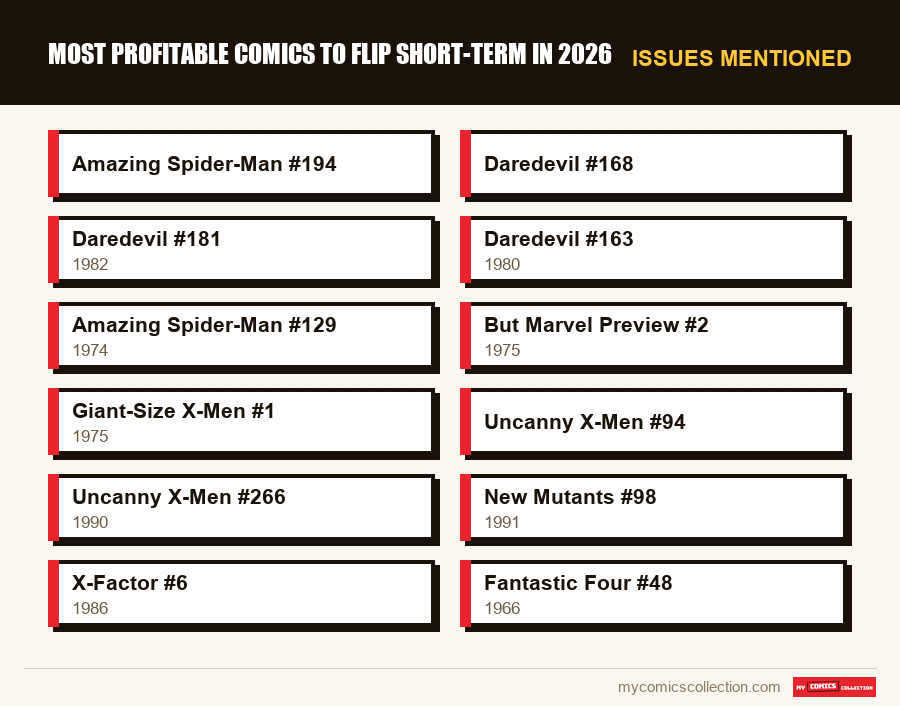
Still-exploitable positions in 2026 center on the second-tier Born Again characters: those announced via secondary teasers and not yet fully priced in. Daredevil #181 (Elektra killed by Bullseye, January 1982, written and drawn by Frank Miller) remains underpriced in raw 6.0-7.0 at $80-$140 as of June 2026, compared to a pre-Born Again Season 1 average of $50-$75. Daredevil #163 (Hulk vs. Daredevil first encounter, March 1980) follows the same pattern: $35-$60 in raw 7.0, with a potential spike to $80-$110 on a similar scene teased in Season 3.
Punisher keys tied to the show also have exposure, since Jon Bernthal is reprising the role. Amazing Spider-Man #129 (first Punisher, February 1974) is out of reach for short-term flipping: raw 6.0 prices at $1,800-$2,400, market too broad to generate quick spikes. But Marvel Preview #2 (1975, first solo Punisher) at $250-$400 in VG-FN offers a better entry ratio, with 30 to 50% upside on a secondary Season 3 reveal. For the complete timeline of key issues, see Amazing Spider-Man key issues.
Target 3: MCU X-Men Reboot and Forgotten First Appearances
The MCU X-Men reboot was officially confirmed in March 2026 for a November 2027 theatrical release, with Jake Schreier announced as lead director in April 2026. Official casting was expected to be revealed between San Diego Comic-Con in July 2026 and D23 Expo in August 2026. The short-term flip window therefore runs from June 2026 (right now) through April 2027: a 10-month opportunity before the market saturates.
X-Men blue chips are already expensive and unsuited for short-term plays: Giant-Size X-Men #1 (1975) at $4,000-$12,000 CGC 9.0, Uncanny X-Men #94 at $1,200-$2,800 raw 7.0. Short-term margin has shrunk to 10 to 25% with low volatility. The real flip targets sit in the second and third tiers of the roster: the characters the casting reveal will push. Three concrete positions for summer 2026.
Position 1: Uncanny X-Men #266 (first full Gambit appearance, August 1990) remains accessible at $80-$130 raw 8.0-8.5 as of June 2026. Gambit has never had a proper live-action portrayal outside the cancelled Channing Tatum solo film. If the reboot includes Gambit in the initial lineup, projected upside is 60 to 120% within 6 months. Position 2: New Mutants #98 (first Deadpool, February 1991) is currently sidelined by the discontinuation of Deadpool's MCU arc in the short term, but prices have been correcting since October 2025. An opportunistic buy at $200-$280 raw 7.5-8.0 is worth considering. Position 3: X-Factor #6 (first full Apocalypse, July 1986) at $90-$150 raw 7.0-7.5, exposed to a reveal as the reboot's main villain.
The operational approach for these positions involves building a basket of 3 to 8 different issues rather than concentrating capital on a single one. The reason: out of 8 probable characters in the reboot casting, only 4 to 6 will actually appear at the reveal, and 2 to 4 will produce a meaningful spike. Diversifying the basket reduces the risk of missing the peak. For historical context, see X-Men comics history and X-Men key issues.
Target 4: Fantastic Four 2 and Secondary Cosmic Characters
The success of Fantastic Four: First Steps in July 2025 ($412 million worldwide, 84% Rotten Tomatoes critics score) already triggered a first wave on the major key issues. Fantastic Four #48 (first Silver Surfer and Galactus, March 1966) climbed from $4,200 raw 6.5 in January 2024 to $7,800 in September 2025. The short-term window on those blue chips is now closed for 2026.
Fantastic Four 2 (targeted for summer 2027 per the Marvel Studios release calendar revealed in May 2026) reportedly introduces (according to Variety on May 12, 2026) two new antagonists: Annihilus and possibly Diablo or the Mole Man. This is not officially confirmed, which keeps a buying window open until the Comic-Con July 2026 reveal.
Three concrete positions for June-October 2026. Position 1: Fantastic Four Annual #6 (first Annihilus, October 1968) at $280-$420 raw 5.5-6.5 as of June 2026, with potential +80 to +200% on a reveal. Position 2: Fantastic Four #66-#67 (Adam Warlock's origin as Him, September-October 1967) at $220-$380 raw 6.0-7.0, exposed to a potential Warlock tease given his role in Guardians 3. Position 3: Fantastic Four #45 (first Inhumans, December 1965) at $380-$580 raw 6.0-7.0, exposed to a broader cosmic universe expanding toward Attilan.
Correction Risks: Flops, Delays, Cancellations
Short-term flipping carries three structural risks that need to be priced in at the moment of purchase. Risk one: the critical flop. Captain America: Brave New World (February 2025) disappointed with a 47% Rotten Tomatoes score, pulling Captain America #117 (first Falcon) from $1,200 raw 6.0 in late January 2025 down to $780 in April 2025: a -35% drop in 10 weeks. Any position not closed before release took that hit.
Risk two: delays and rewrites. The Blade reboot has been pushed back four times since 2022, and each delay produced an -8% to -15% correction on Tomb of Dracula #10 (first Blade, July 1973). Positions held on Blade since 2022 are now sitting at cumulative losses of 30 to 45%. For 2026, the projects most exposed to delay risk are Armor Wars (still undated), Wonder Man (partially cancelled), and Vision (in rewrite).
Risk three: outright cancellation. The Howard the Duck animated series was cancelled in 2022, and the first Howard the Duck appearance (Adventure into Fear #19, December 1973) corrected -22% in three months. The implicit rule: cap each flip position at 5 to 8% of total flip capital, and never concentrate more than 25% on a single adaptation project. See the balancing strategy in comics: passion vs. investment: finding the balance.
Risk management also includes a point that often gets overlooked: resale liquidity. A raw 8.5 comic without grading typically sells in 2 to 8 weeks on eBay if the price holds. A CGC-graded 9.4 or 9.6 sells faster (3 to 14 days) but the grading cost ($45 to $95 per issue depending on the tier) eats into the margin on sub-$300 positions. The rule of thumb: only grade positions where the expected post-grade value exceeds $600; otherwise sell raw. Details in CGC grading complete guide.
Operational Tools: Tracking, Comps, Execution
Short-term flipping demands strict operational discipline. Without a tracking system, positions scatter and real margin becomes impossible to calculate. Four tools are essential.
Tool 1: a dedicated comics manager to track every position with purchase date, purchase price, condition, target resale price, and target date. The My Comics Collection app supports this structured tracking with a target value field and automated eBay price history. See managing your comics collection and comic collection tracking.
Tool 2: an automated eBay comps system. Raw price data alone isn't enough: you need to filter by comparable condition (raw 8.0-8.5, or CGC 9.6 Universal), exclude open Best Offer listings, and calculate the 90-day median rather than the average (which is skewed by outliers). GoCollect offers this tier-specific filtering for $9.99/month as of June 2026.
Tool 3: a synced studio announcement calendar. Key dates to lock in: San Diego Comic-Con (July), D23 Expo (August), CCXP Brazil (December), Annecy Animation Festival (June). Each event triggers an announcement wave and therefore a selling window. Aligning your positions with these dates increases the rate of actually hitting your theoretical margin by 35 to 60%.
Tool 4: a net margin accounting system. Gross margin (resale price minus purchase price) is systematically misleading. Net margin must subtract: eBay commission (12.9% final value fee), PayPal or Managed Payments (2.9% + $0.30), shipping ($15 to $35 international with tracking), packaging (cardboard mailer + bubble wrap: $3 to $6), and capital gains tax if selling repeatedly (in France, a €304 per-transaction exemption applies for occasional sales; repeated selling qualifies as habitual commercial activity taxable under BIC income rules). To manage this accounting, see comics collection app.
Track Every Flip Position with My Comics Collection
Managing a short-term flip strategy requires a dedicated tool: purchase price, target price, entry date, planned exit date, live eBay price, projected net margin. My Comics Collection includes continuous eBay price tracking, alerts for price moves above 15% on your positions, accounting export, and sync across iPhone, iPad, and web. Starter plan from €4.90/month, Pro plan with advanced alerts at €9.90/month.
FAQ
What's a realistic margin to target on a short-term comic flip in 2026?
Between 30 and 100% net over 3 to 6 months on 1:25 and 1:50 ratio variants, and 50 to 150% on first appearances confirmed by an adaptation. The +200% to +500% figures thrown around on Reddit and TikTok are extreme outliers, not a repeatable baseline. Expect 40 to 60% average net margin across a diversified basket of 8 to 15 positions.
What's the minimum capital to start a flipping strategy?
A practical floor is $800 to $2,500. Below that, fixed costs (shipping, commissions, potential grading) absorb 30 to 45% of your theoretical margin. Above $5,000, diversify across 12 to 20 positions rather than concentrating. The optimal risk-to-margin ratio sits between $1,500 and $4,000 spread across 6 to 10 positions.
Should you grade comics intended for short-term flipping?
No, in 80% of cases. Grading costs ($45 to $95 for CGC Modern or Economy tier) plus turnaround time (3 to 8 months in 2026) kills short-term profitability. Only grade positions where the projected post-grade value exceeds $600. For sub-$300 flips, sell raw with high-resolution photos and an accurate condition description.
What's the exact timing to sell before a film release?
Between 4 and 8 weeks before theatrical release, or 2 to 4 weeks after the official studio announcement. Selling in the two weeks leading up to or during release means entering a market already saturated with flippers. The real peak is on the announcement buzz, not the release. For Born Again S2 (March 4, 2026 premiere), the optimal selling window was late December 2025 to early February 2026.
How do you avoid getting burned by an unconfirmed rumor?
Apply the 3-independent-sources rule: Variety + Hollywood Reporter + Deadline, or official studio announcement + confirmed casting + set photo. A single secondary source (ScreenRant, MCU Cosmic, BleedingCool) isn't enough. Unconfirmed rumors produce an average temporary gain of +12 to +25%, then a -15% to -30% correction within 3 weeks if not validated.
What are the best resale channels for flipping comics?
eBay is dominant for comics in the $50 to $1,500 range (volume, liquidity, international audience). Heritage Auctions and ComicLink take over above $1,500, with higher commissions (15 to 20%) but access to a serious collector network. Mercari and Whatnot are a solid alternative for the U.S. sub-$300 market. In France, Catawiki and Delcampe remain illiquid for modern American comics.
Is short-term comic flipping taxable in France?
Yes, above €305 per isolated transaction (2026 threshold) under Article 150 UA of the General Tax Code. Repeated sales (more than 5 to 8 per year) qualify as habitual commercial activity, taxable under BIC income rules. Keep a precise log of dates, prices, and quantities. The household goods exemption does not apply to collectibles held for speculative purposes.
How do you build a diversified flip position basket?
Split across three categories: 40% modern ratio variants on hot books (3-6 month cycle), 40% confirmed adaptation first appearances (6-12 month cycle), 20% opportunistic sleeper plays on reliable rumors (2-4 month cycle). Cap each individual position at 8 to 12% of your total flip capital. Review the basket every 60 days and exit positions that haven't moved.