Under number 58 of the series All Star Comics today two objects coexist which only have a series of characters in common: a booklet printed in 1976 and alternative covers manufactured in 2025, announced in an edition of five hundred copies, sold in opaque sleeves and often « vierges », that is to say devoid of logo and text. On a general auction site in the US market, on August 30, 2026, query « Power Girl All Star Comics 58 » returned 131 unverified listings, from $8.00 to $400.00, median $90.00. Four of the five cheapest listings were these recent variants, priced between $19.92 and $29.99. The fifth was a nearby original issue, number 62 from 1976 in fair condition, listed at $8.00. In other words: the new object costs more than the old one, and it has the same number. For an inventory, the consequence is immediate: a modern variant is never noted under its number alone.
There is a very common way to go wrong when looking for an old issue: type in a title and a number, sort by increasing price, and look at what goes back. The gesture seems safe. He is no longer. On this specific search, noted on August 30, 2026, the first lines of the list contained almost no issue from the seventies. They contained objects made last year, whose only relationship with the original publication is the number listed in their announcement title. The collector who thinks he has found a good deal is actually buying something entirely different from the one he was looking for.
This is not an isolated anomaly or a misclassification by an absent-minded salesperson. It is an established market, with its codes, its formats and its vocabulary. Alternative covers are produced today for issues published half a century ago, printed at a number announced in advance, marketed without the buyer knowing which one they will receive, and referenced under the number of the original issue because that is where buyers look. Two collection logics intersect in the same list of results without anything distinguishing them, other than careful reading of the title of the ad.
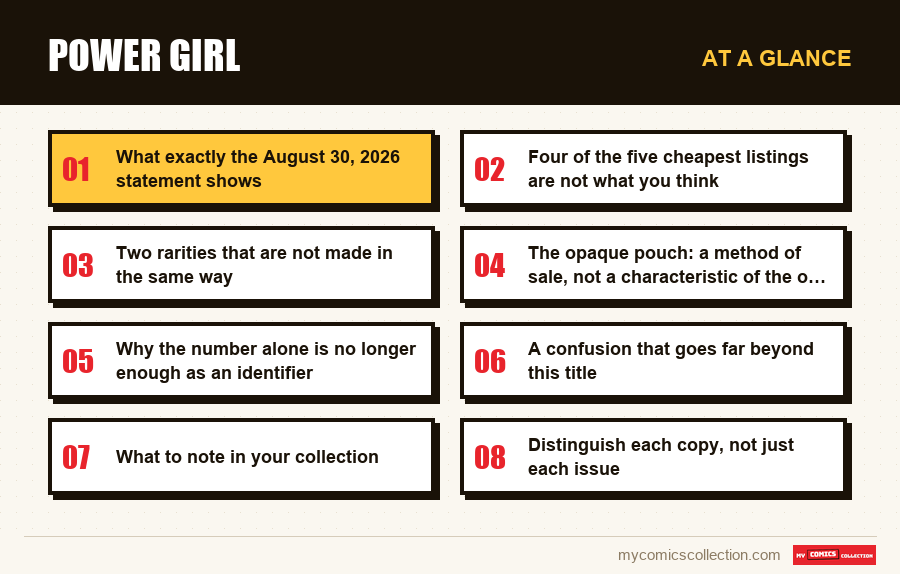
What exactly the August 30, 2026 statement shows
Let's first clarify what these figures are, because the nature of the data changes everything we can say about it. These are amounts claimed by sellers in current advertisements on a given date, on a general auction site oriented to the American market. None of these amounts were paid by anyone at the time of the statement. A displayed price is a request, not a transaction. This distinction is not a stylistic precaution: it separates two worlds of reliability. A request only binds the person who makes it, and nothing obliges a buyer to satisfy it.
Of the unverified total (copies sold as is, without going through a verification body) there were 131 advertisements. The lowest amount claimed was $8.00, the median amount was $90.00, the highest was $400.00. This maximum should not be read as nothing other than the hope of a particular seller: it only takes one person to put a number at the top of a list, and this person has no accountability to the rest of the market. The median says something more solid, because it resists the extremes of both sides.
The copies passed through certification were counted separately, and they must absolutely be kept separate from the others. They made up 52 listings, with a low of $137.86, a median of $295.00, and a high of $1,295.00. Mixing these two populations would produce an average which does not describe any real object: a booklet placed in a shell with an assigned grade and a raw booklet sent in an envelope do not sell on the same market, do not address the same buyers and do not bear the same intermediary costs.
Finally, and this is the decisive point: all of this was measured only once, on a single day. A photograph does not show movement. There is nothing in these numbers to suggest that anything is going up, down, or stabilizing, and so I won't write any sentences to that effect. To speak of evolution, we would need at least two comparable surveys, done in the same way, on different dates.
Four of the five cheapest listings are not what you think
$19.92: a « vierge » variant of 500 copies
The wording announces a number 58, but also an alternative cover without logo or text, a limited edition of five cents and a sale in an opaque sleeve, all dated 2025. Each of these mentions describes a new object. The number refers to 1976.
$29.99: same number, same sales format
A second ad repeats the exact structure: number 58, opaque cover, exclusive blank cover, limitation to five cents. Two different sellers, two different objects, one and the same apparent identification number.
$29.99: a third variation of the same number
Third blank variant in opaque sleeve announced under number 58, with the same limitation displayed. At this point, it becomes clear that this is not a single print but a family of objects produced in parallel.
$29.99: a fourth, with different framing
The fourth ad mentions a cropped image, still blank, still limited to five cents, still in an opaque sleeve. The catalog records the original number; the commercial wording stacks up the qualifiers that make the difference.
The fifth ad at the bottom of the list is of a completely different nature: a number 62 of the original series, dated 1976, described in good condition, asking for $8.00. It's an older issue, contemporary with what most buyers are looking for, and it's priced less than any of the four recent variants. The ratio is approximately one to two and a half between the issue from the 1970s and the alternative cover produced last year.
The observation deserves to be reversed, because it goes against the usual reflex. Sorting by ascending price is supposed to increase opportunities; here, this brings up recent production. The four 2025 variants are priced between $19.92 and $29.99, well below the unverified set's $90.00 median, but significantly above the neighboring original number noted at $8.00.
For the collector who wants a booklet from the seventies, these announcements are not good news: these are lines to be discarded before even comparing the states. They occupy the top of the sort without ever matching the search.
Two rarities that are not made in the same way
The expression “limited edition” and the word “rare” are similar to the point that they are confused, even though they describe opposite mechanisms. A modern variant announced at five hundred copies has a rarity decided before printing: someone chose this number, included it on the object, and transformed it into a sales argument. The figure is a production parameter, known to everyone from day one, and it will no longer change.
The rarity of a 1976 issue is not a parameter. It is the result of fifty years of use: copies read to the point of tearing, others thrown away, others forgotten in damp cellars, a handful preserved correctly by chance or care. No one has decided how many examples in good condition would exist today; this number formed itself, and no one really knows it. This is a rarity of attrition, opaque and unannounced.
These two phenomena cannot be deduced from each other. There is nothing to confirm that an announced print run of five hundred will produce the same effects as a survival of five hundred old copies, and I will not affirm it. These are different causes, on different objects, with populations of buyers who only partially overlap. Data measured on a single day says nothing about how each will behave.
It is also necessary to note a verification asymmetry. The announced print run of a variant is based on the word of the producer; the buyer usually has no independent means of controlling it. The condition of an old issue can be seen by eye or certified by an inspection body. In one case the promise concerns an unverifiable quantity, in the other an observable quality. It's not the same type of commitment.
The opaque pouch: a method of sale, not a characteristic of the object
The four recent announcements share a commercial detail that deserves to be understood before purchasing: the sale in opaque sleeves. The buyer orders an item of which he does not know the exact cover; the packaging prevents it from being seen, and the contents are only revealed upon opening. This device introduces a deliberate element of chance into a transaction which, elsewhere, relies entirely on the precise description of an identified copy.
It is neither a question of denouncing this format nor of recommending it, but of naming it. Many buyers know it perfectly and appreciate it for what it is. The problem arises when an ad in an opaque cover is found in the results of someone who was looking for a dated, described and photographed booklet: the two transactions do not offer the same guarantees, and yet they coexist in the same list, sorted by the same price criterion.
A practical consequence arises from this for the inventory. As long as the cover is not opened, the object has no complete identity: we know the number displayed, the edition announced and the year of production, but not the cover. Saving such an acquisition before opening amounts to creating an incomplete line. Better to wait, open, then enter the actual description.
Finally, the term “blank” designates a cover devoid of logo and text. It's a visual characteristic that distinguishes this object from all those that share its number, and it's precisely the kind of information that disappears if you just note a title and a number. Two blank variants of the same number, produced by different actors, remain two separate objects.
Collecting this series?
Track what you own, what you are missing and what your collection is worth. 7 day trial.
Start my trial →Why the number alone is no longer enough as an identifier
Search by number mixes eras
Typing a title and a number brings together in the same list a booklet from 1976 and impressions from 2025. The engine makes no difference: it compares character strings, not objects.
The year of production is missing from the number
A serial number does not bear any date. It is the year of printing which separates two categories of merchandise here, and it only appears in the body of the ad, when it appears there.
Sorting by price rewards the wrong row
On the August 30, 2026 statement, four of the five cheapest listings were recent variants. The increasing sorting, supposed to bring out business, first brings out new production.
The opaque cover hides the object
A purchase without a visual cannot be described before receipt. The corresponding inventory line remains provisional until the packaging has been opened and the cover identified.
The announced print run is not a state
“Five hundred copies” describes a quantity produced, not the physical condition of the issue received. These are two separate fields, and one never replaces the other in a record.
Verified copies form another market
With 52 certified advertisements noted separately, minimum $137.86 and median $295.00, the verified population is not comparable to either the raw fascicles or the new variants. It is counted separately.
The common thread of these six situations is contained in one sentence: the number identifies a place in a series, not a physical object. It was enough for decades because a place corresponded to an impression. As soon as several impressions claim the same place fifty years apart, the identifier becomes ambiguous, and a collection based on this identifier alone becomes false in both directions: it attributes to the old the value of the new, and vice versa.
A confusion that goes far beyond this title
The case noted here concerns a specific series and a specific number, but the mechanism has nothing particular to them. Any sufficiently researched old publication can be accompanied by alternative covers produced today and referenced under its number. The condition is not historical, it is commercial: a volume of buyers must regularly search for this number for it to become interesting to hang a new object there.
This is why vigilance is exercised primarily on the most consulted titles. A collector who follows several old series will encounter the phenomenon wherever demand is high, and he will encounter it even more the more he sorts by price. Guides dedicated to best Power Girl story arcs et aux crossovers in which the character participates help to know which numbers are actually searched for, and therefore which ones will attract the most modern variants in their search results.
The reasoning also applies outside this character. The most in-demand issues of other long-running series are under the same pressure, for the same reason, and a reader exploring the editorial history of Superman in comics will cross the same stacks of objects under a common identifier. The economical purchasing method described in the guides dedicated to fascicules Superman à petit prix also requires exactly this precaution: knowing how to discard what is not the booklet you are looking for before comparing the amounts.
One last point, purely practical. Since the number no longer discriminates, reading the entire ad wording becomes essential. The words that betray a recent production are visible: mention of a coded edition, of an exclusivity, of a blank cover, of opaque packaging, of a recent year. None of these terms appear on an old issue announcement. Simply locate them to sort correctly in a few seconds.
What to note in your collection
Record the year of production, never just the year of the series. A variant of 2025 tucked under a number from 1976 creates a line that will read like an old booklet the first time you read it again, including by yourself in two years. The actual printing date is the only information that unambiguously separates the two objects, and it must appear clearly in the file, not be deducted from the price paid.
Record the announced draw as a statement, not as an established fact.“Five hundred copies announced” is noted as is, with nuance. This is information provided by the producer, unverifiable by the buyer, and which does not have the same status as a state observed by eye. An honest record distinguishes what you observed from what you were told.
Describe the cover received, especially when it is blank. Several variants of the same issue can share the same announced print run and the same absence of logo while being distinct objects, published by different actors or with different framing. Without a visual description specific to the item, two acquisitions will be confused in the inventory and one of the two will end up disappearing from the count.
Wait for the pouch to open before finalizing the line. A purchase in opaque packaging has no complete identity until it is opened: the number and edition are known, the cover is not. Immediately entering a supposed description amounts to writing information in the inventory that has not been verified, and this information will never be corrected if the object goes directly into a box.
Separate your verified copies from raw copies in your own accounts. The August 30, 2026 statement had 52 certified listings apart from the 131 unverified, with unrelated claimed levels: median at $295.00 on one side, $90.00 on the other. If the market counts them separately, your inventory must do the same: a single total mixing the two would not correspond to any observable reality.
No, and this is precisely the source of the confusion. A reissue reproduces an existing publication; these objects are new covers, recently produced, which borrow the number of an old publication as a classification reference. They share a string, nothing more. Treat them as separate items in your tracking.
The statement shows that this is the case that day: $19.92 to $29.99 for the variants, compared to $8.00 charged for a nearby original issue in fair condition, but it doesn't say why. These are amounts requested by sellers, not closed sales, and a single measurement does not explain any variance. Observe it, don't draw a theory from it.
This is information given by the seller, without any independent means of control for the buyer. It is noted as a declaration, with the words “announced”. This does not mean that it is false, but it does not have the same status as a physical state that you can observe yourself or have certified.
Read the full wording rather than the number. The markers are explicit: a numbered edition, the word "exclusive", the mention of a cover without logo or text, opaque packaging, a recent year of production. None of these elements accompany the announcement of a booklet from the 1970s.
No. Everything comes from a single statement, carried out on August 30, 2026, on current announcements. A single observation describes a moment in time and contains no direction. The $400.00 maximum noted on unverified listings reflects an individual seller's expectation, not a market level.
Distinguish each copy, not just each issue
Year of production, announced print run, cover description, condition, verified status or not: it is this combination of fields that makes an inventory reliable when several objects share the same number. My Comics Collection allows you to keep this information copy by copy, without confusing a recent variant and the original booklet.