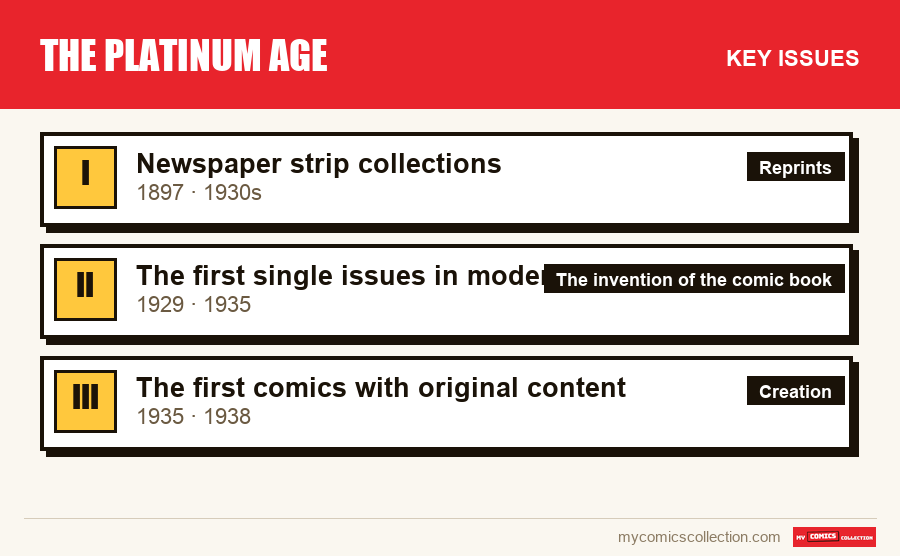
The Platinum Age designates the period of American comic publications prior to Action Comics #1 and Superman's arrival in 1938. Its boundaries vary by author: the most widespread periodization among collectors starts it in 1897, the year of a collection devoted to Richard F. Outcault's Yellow Kid, while others go back to 1882. You find three families of objects there: the newspaper strip collections of the early century, the first single issues in modern format, like Famous Funnies: A Carnival of Comics (1933), and the first comics with original content, like New Fun #1 (1935) and Detective Comics #1 (1937). Recognizing them means looking at format, publisher, date and the nature of the content: newspaper reprint or creation.
In collectors' imagination, comics history begins with Superman. Before June 1938, there would have been a kind of prehistory, vague and dusty, reserved for specialists. It is partly true: the publications of this era are rare, fragile, and long neglected. But it is also misleading. The comic book as we know it, with its soft cover, staples and color pages, exists from 1933, and several of the publishers who will make the Golden Age are already in place.
This article explains what the term covers, where it comes from, which titles are its landmarks, and how to identify an object from this period. It complements the site's article on Golden Age horror comics, which covers the following period.
Where the name comes from, and why its boundaries vary
American collectors divide comics history into metallic ages. The term Golden Age was first used in 1960 in a fanzine, and the pairing of Golden Age and Silver Age appears in a reader letter published in 1966. The gold, silver, bronze hierarchy, borrowed from Olympic medals, quickly took hold in the vocabulary of dealers and fans.
The Platinum Age is a later extension of this division. According to historian Shirrel Rhoades, it was the publisher of the main American comics price guide who added, to account for newspaper comics, two periods before the Golden Age: a Victorian Age, from 1828 to 1882, then a Platinum Age, from 1882 to 1938. Other presentations, more common in popular works, start this period in 1897, and reserve the Victorian Age for nineteenth-century albums and caricatures.
The boundaries therefore vary, but one point is unanimous: the end. The Platinum Age stops with Action Comics #1, dated June 1938, which introduces Superman and opens the Golden Age (see also its value). Everything before, and belonging to American comics published in volume or as single issues, falls into the category.
The Sunday newspapers, cradle of the period
At the end of the nineteenth century, American comics live in the Sunday supplements of the big dailies. Newspapers stand out less for their news than for their illustrated humor pages, which retain readers. In 1894, Joseph Pulitzer's New York World publishes a first color strip. The same year, Richard F. Outcault introduces Hogan's Alley there, a series of big images teeming with street kids, one of whom wears a nightshirt that turns yellow in 1895. Readers christen him the Yellow Kid.
On October 25, 1896, the Yellow Kid speaks his first words in a balloon, whereas they had until then been written on his shirt. Outcault had already used the device, but this date is often presented as the birth of American comics. The same year, William Randolph Hearst lures Outcault to his New York Journal, and a legal battle ends in a split: Pulitzer keeps Hogan's Alley, Hearst publishes the character under the title The Yellow Kid. In 1897 appears a collection of pages already published in the press, presented as the first of its kind. It is this publication that the most common starting date of the Platinum Age retains.
Three families of objects to know
Newspaper strip collections
For nearly forty years, most of what is published in volume reprints series that appeared in newspapers: the Yellow Kid, then characters like Buster Brown, Little Nemo or Mutt and Jeff. Formats vary enormously: landscape albums, hardbound volumes, stapled booklets, in color or black and white.
The first single issues in modern format
In 1929, Dell publishes The Funnies, a 16-page tabloid-format supplement, closer to a newspaper booklet than a comic. In 1933, printer Eastern Color produces Funnies on Parade, eight pages of licensed strips, distributed free in exchange for coupons cut from hygiene products. The same year, Maxwell Gaines and Harry Wildenberg of Eastern Color publish with Dell Famous Funnies: A Carnival of Comics, 36 pages: historians consider it the first true American comic book. Famous Funnies: Series 1 follows in 1934, then the regular series Famous Funnies, published from 1934 to 1955.
The first comics with original content
In 1935, National Allied Publications, DC's ancestor, launches New Fun, which does not reprint newspaper strips but publishes stories created for it. The title will become More Fun Comics. In 1937 appears Detective Comics #1, dated March, a detective anthology from the same group, which will later give DC its name and welcome Batman in 1939, in #27.
Detective Comics #1, the most telling example
Detective Comics #1 illustrates well the singular place of the end of the Platinum Age. Depending on the date used, it belongs to the period since it precedes Action Comics #1 by more than a year. But it comes from the same publisher as Superman, and the series it opens is one of the longest in history. It therefore combines the appeal of an object of prehistory and that of a direct ancestor of the big Golden Age titles.
This status is reflected in the market. According to a CGC communication published March 20, 2026, a copy graded 8.5 sold for 638,250 dollars at a public auction held March 15 to 18, 2026, against a previous record of 228,000 dollars for a copy graded 6.5, in April 2025. These figures concern exceptional copies and say nothing of the value of an average-condition copy; they mainly show, as our history of comic prices from 1970 to 2026 retraces, that demand for the founding pieces from before 1938 is now comparable to that for the big Golden Age issues.
How to recognize a Platinum Age publication
Date the object
Look for a printing, copyright or cover date. Everything prior to June 1938 belongs to the period, whatever its format. A missing date is not rare on old collections: you must then rely on the publisher and the series reproduced.
Identify the publisher
The names Eastern Color, Dell or National Allied point toward 1930s issues. The early-century collections carry the names of newspaper or children's book publishers.
Distinguish reprint from creation
A newspaper strip collection and an original-content comic have neither the same history nor the same collector audience. Spot the creators' signatures and the presence or absence of newspaper syndicate mentions.
Check that it is not a facsimile
Several publications of this period were reproduced, in whole or in part, for anniversaries or prestige editions. The paper, the printing and the legal notices generally let you tell the difference; in case of doubt, professional grading settles it.
Examine condition with indulgence and precision
An object nearly a century old is rarely intact. Yellowed pages, fragile spines, missing corners are the norm. Describing each defect precisely is better than a flattering overall assessment.
Why the period was long neglected
Several reasons explain the disinterest it suffered. First, the objects are heterogeneous: it is hard to compare a 1905 hardbound album and a 1935 single issue. Next, many of these publications reprint newspaper series their readers could find elsewhere, which made them less precious in their eyes. Finally, the dominant narrative of comics history long started the adventure with Superman, relegating the rest to the rank of preamble.
This situation has changed with historians' growing interest in newspaper comics, and with the increasingly evident scarcity of the big Golden Age issues, which pushes some collectors toward earlier decades. The result is a market narrower than that of superheroes, but where knowledge counts more than budget: knowing how to date, attribute and describe an object remains the decisive advantage.
Building a small collection of the period
For anyone wanting to take an interest without aiming at record pieces, a reasonable approach is to gather one representative of each family: a strip collection from the early century, an issue of Famous Funnies from the 1930s, and, if the budget allows, an issue of one of the first original-content titles. This small set alone tells the birth of the comic book, from newspaper page to single issue. Noting it carefully in a database, with date, publisher and condition, then lets you complete it as opportunities arise. To place a specific object, our method for estimating a comic's value also applies to this period.