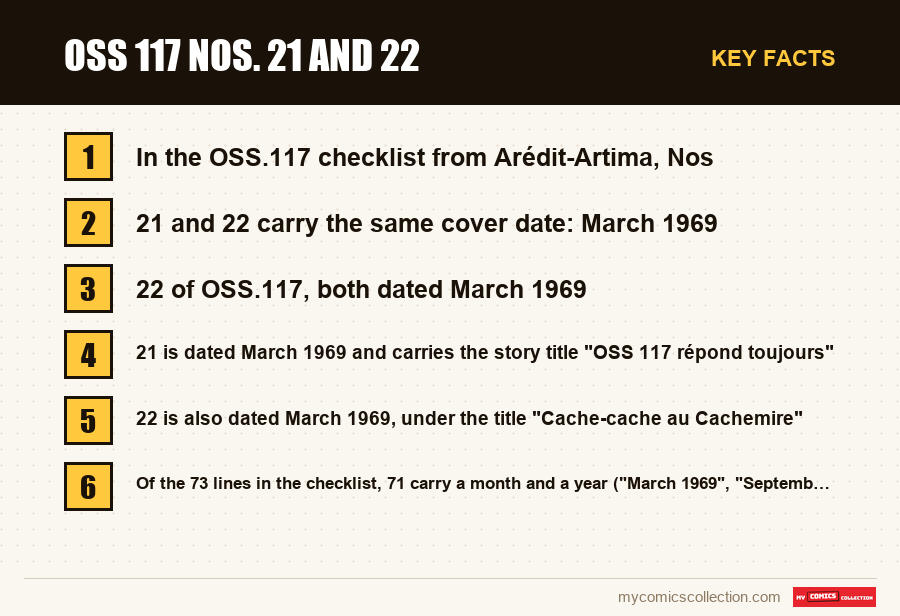
In the OSS.117 checklist from Arédit-Artima, Nos. 21 and 22 carry the same cover date: March 1969. The date is given by month, not by quarter, and the series was otherwise coming out every three months at that time, so this duplicate is a genuine irregularity. The checklist does not say which of the two dates is atypical. File these issues by number, never by date.
You sort your issues by date and two of them refuse to be separated: No. 21 and No. 22 of OSS.117, both dated March 1969. Is it a misdated number, an issue printed twice, or simply a publisher's habit? The data can frame the question, not settle it, and that is what this page sets out to do.
As always on this guide, only verified information (creators, issue numbers, dates) is stated as fact; the analysis is our own, with no reproduction of panels or protected dialogue.
What the checklist states about the two issues
No. 21 is dated March 1969 and carries the story title "OSS 117 répond toujours". No. 22 is also dated March 1969, under the title "Cache-cache au Cachemire". The two titles differ: we do not hold the same object twice, but two distinct issues that were assigned the same month.
On the credits, the checklist lists Carlo Jacono as artist on both, and leaves the writer field empty for each. These credits attach to the issue, not to the episode, and the checklist contains only one title per number: it says nothing about the rest of the contents, or about what these pages tell. For that, the copy in hand is needed.
A date by month: why this is not the "same quarter" case
A first hypothesis is to ask whether the date of these issues is a quarter date, in which case two numbers in the same quarter would be commonplace. The data rules out that reading. Of the 73 lines in the checklist, 71 carry a month and a year ("March 1969", "September 1969"). Only one carries the year alone, No. 53 ("1975"), and one is empty, No. 69.
The date format is therefore monthly. That the series came out every three months is a property of its rhythm, not of the way it is dated: each issue has its month. Two numbers sharing the same month, in a series where one expects one issue per quarter, form an irregularity to look into, not an accident of vocabulary.
The rhythm around it: a three-month grid
From No. 16 (December 1967) onward, the issues follow one another three months apart, and this holds almost without fault up to No. 38. Of the 22 intervals between Nos. 16 and 38, 19 are exactly three months. The other three are: the zero interval between 21 and 22, the six-month interval that follows, between 22 and 23, and a four-month interval between 27 and 28.
Before this regularity, the series had a tighter cadence: the first eight issues, from April to November 1966, are monthly, then the gaps swing between one and two months up to No. 15. The quarterly grid is therefore a settled position, reached after sixteen numbers, and it is against it that the 1969 duplicate stands out.
What the grid suggests, and what it does not prove
Extend the grid: No. 20 is dated December 1968, No. 21 March 1969, so the next should fall in June 1969, then No. 23 in September. Now No. 23 is indeed dated September 1969, and no number in the checklist carries June 1969. No. 22 therefore occupies, in sequence, the June slot, but carries the March label.
The reading is attractive and coherent: No. 24 is dated December 1969, so four issues (21 to 24) are spread over one calendar year, exactly like Nos. 17 to 20 for 1968. But this is a deduction, not a proof. The checklist does not contain the date printed on the object, only the date entered. Three explanations remain open: a data-entry error in the catalog, a date genuinely reproduced twice on the covers, or an issue whose date was fixed in advance and never readjusted. None has been verified.
Do you collect this series?
Track what you own, what you are missing and what your collection is worth. 7-day trial.
Start my trial →
The same phenomenon elsewhere: the case of Nos. 60 and 61
Across the whole checklist, only two dates are shared by two numbers: March 1969 (Nos. 21 and 22) and February 1979 (Nos. 60 and 61). The two cases do not resemble each other, and that is what makes comparing them useful.
Around Nos. 21 and 22, the series is at its most regular. Around 60 and 61, it no longer is: 59 is dated January 1979, 60 and 61 February 1979, then 62 February 1980, a wait of twelve months. In that zone, the checklist's intervals range from zero to eighteen months, and a duplicate date blends into an already irregular cadence. Between Nos. 57 and 64, the titles come in identical pairs (57 and 58, 59 and 60, 61 and 62, 63 and 64), and the duplicate date falls at the joint of two pairs. Nothing of the sort in 1969: the titles of 21 and 22 are distinct, and none of Nos. 17 to 27 repeats a neighbor's title.
What this tells the collector: the 1969 duplicate is isolated within a regular zone, whereas the 1979 one sits within a disordered zone. The second is not treated here. The only question here is that of an issue straying into an otherwise clean grid.
Recognizing the copy without relying on the date
When two numbers share a date, the date no longer serves to identify. What remains reliable is the number and the title. The title of No. 21 contains the agent's name written as "OSS 117" with a space; that of No. 22 does not contain it at all. Be careful, however: the checklist writes the series name in several ways depending on the entry ("OSS.117", "OSS 117", "O.S.S. 117"), and the checklist does not say whether these variants come from data entry or from printing. Do not use them to decide between two copies.
On the object, check three things in this order: the printed number, the title of the main story, then the printed date. If two copies offered to you show the same date, it is the number that tells them apart, not the month.
Traps in a list of gaps
The first trap is writing "March 1969" in a search list: one line, two possible issues, and you may think you have completed the series by buying the wrong one. Always write the number. The second trap is automatic sorting by date: the two issues end up tied, and their order can flip from one export to another. Sort by number, then by date only when numbers are equal.
The third trap lies in listings: a seller who describes his lot as "March 1969" does not say which of the two he holds, or may believe he has only one. Ask for the number and the title. A photo of the cover is enough, and the rest of the contents is in any case not known from the checklist.
Neighbors and tracking the collection
Nos. 19, 20, 23 and 24 are dated September 1968, December 1968, September 1969 and December 1969, all credited to Carlo Jacono in the checklist like Nos. 21 and 22, as are all the numbers from 17 to 27. No change of credits therefore sets the pair apart from the rest of the run.
To track this part of your collection, keep one record per number, with the date as printed and, separately, a "remark" field noting that 21 and 22 share their month. If you find on your copies a date different from the checklist's, that is precisely the missing information: record it, it will settle the three open explanations above. As for condition, it is judged copy by copy, and the checklist says nothing about it.
Frequently asked questions
No, according to the checklist: the story titles differ ("OSS 117 répond toujours" and "Cache-cache au Cachemire") and the numbers are distinct. Only the date is identical, March 1969. They are two objects, to be counted as two lines in a list of gaps.
For Nos. 17 to 24, yes: four issues for 1968 and four for 1969. It is not true across the whole series, which was monthly in 1966 and has very variable gaps after No. 59. Speak of a quarterly rhythm established between Nos. 16 and 38.
The checklist does not say. The three-month grid points more toward No. 22, which falls in the June 1969 slot, but this is only a deduction. Only the date printed on the copy can confirm or refute it, and the checklist reproduces only the date entered.
Nothing indicates it: the numbering is continuous from 21 to 24, with no gap. The six-month interval between 22 and 23 is better explained by the atypical date of 22 than by a missing issue. That reading remains a hypothesis, not an established fact.
The checklist does not say: it contains only one story title per issue and credits at the level of the issue, with no detailed contents. To know what your copy contains, you have to open the copy itself.