The Operation: Galactic Storm reading order runs 19 parts from March to May 1992: Captain America #398 to 400, Avengers West Coast #80 to 82, Quasar #32 to 34, Wonder Man #7 to 9, Avengers #345 to 347, Iron Man #278 and 279, Thor #445 and 446. Mark Gruenwald, Bob Harras and Fabian Nicieza plotted the story. Read the single issues in publication order, title after title, then continue with Captain America #401 and Quasar #35 and 36.
Nineteen single issues across seven titles, three months of publication and a war between two galactic empires: Operation: Galactic Storm is an Avengers crossover that demands real discipline from a reader in the early 1990s. Its title echoes Operation Desert Storm, the Pentagon's name for the 1991 Gulf War, though the plot takes no inspiration from it. The trap is logistical: each title carries one part, and the exact order of the issues decides what you understand, or don't, from one issue to the next.
As always in this guide, only verified facts (creators, issue numbers, dates) are stated as fact; the analysis is ours, with no reproduction of protected art or dialogue.
What to read first
This crossover has no strict prerequisites, but it inherits a history. Three reference points are worth checking off before March 1992.
- The Kree-Skrull War, Avengers #89 to 97: the great war between the Kree and the Skrulls whose protagonists the 1992 saga picks back up. Our Kree-Skrull War reading order breaks down that run of issues. Roy Thomas, who wrote the original saga, is in fact among the writers of Operation: Galactic Storm.
- The latest issues of each title: seven titles converge here. If you already follow Captain America, Iron Man or Thor, read the few issues leading up to each opening so you know where the characters stand in March 1992.
- A primer on the Shi'ar and on Quasar: Mark Gruenwald has said the idea started as a Quasar story, later widened into the Avengers crossover. A quick look at the Quasar page helps you place this cosmic character.
If you are short on time, jump straight into Captain America #398: the story lays out its own stakes, and the war makes sense as you go.
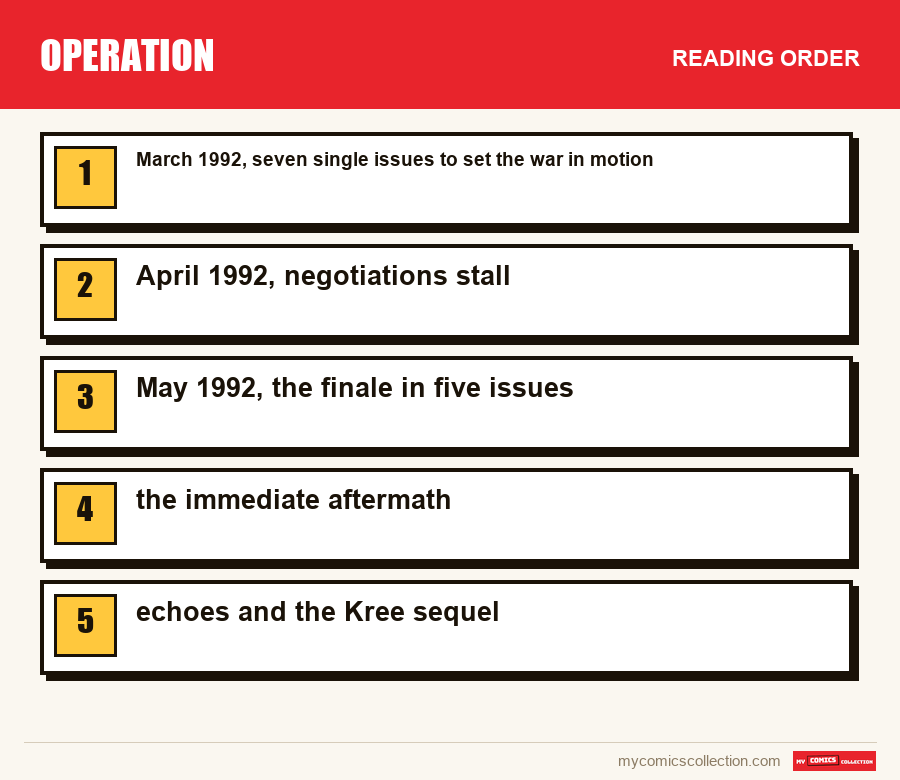
Phase 1: March 1992, seven single issues to set the war in motion
The opening month has seven parts, in this order: Captain America #398, Avengers West Coast #80, Quasar #32, Wonder Man #7, Avengers #345, Iron Man #278 and Thor #445. That order is the rotation of the titles, and it repeats in April and then in May, with one title fewer in the last month.
The opening braids three threads. Shi'ar agents kidnap Rick Jones to recover Kree artifacts meant for a fearsome weapon. Captain America discovers that a war has broken out between the Kree and the Shi'ar. Quasar, for his part, finds that the belligerents' use of a nearby stargate is destabilizing the Sun, which turns a distant conflict into a threat to Earth.
The pivot of this opening month is Avengers #345. The team splits into three groups there: an Earth team led by the Wasp that guards the planet, a team sent to the Shi'ar under Captain Marvel, and a team sent to the Kree under Captain America. Clint Barton gets Pym particles on this occasion to take up the Goliath identity again. Keep this breakdown in mind: it structures the whole crossover, since each title then follows one of these groups.
Practical tip: at the end of each month, pause. Reread the list of the month's seven single issues to check that you haven't swapped any title: a part of Thor read before a part of Avengers is enough to scramble the chronology.
Phase 2: April 1992, negotiations stall
The second month repeats the same rotation: Captain America #399, Avengers West Coast #81, Quasar #33, Wonder Man #8, Avengers #346, Iron Man #279 and Thor #446. This is the belly of the story, where Avengers diplomacy meets its limits.
The teams face various factions and, for the most part, fail to get anyone to accept negotiation. Captain America's team ends up a prisoner of the Kree several times. On the Shi'ar side, Kree artifacts are used to build a weapon called the Nega-Bomb. Deathbird eliminates Kree military leaders, while Skrull agents manipulate the Shi'ar court. Lilandra's peace efforts come too late.
As a reading experience, this is the phase where you are tempted to drop off: the action seems to scatter across titles. Resist. Each April issue adds a piece to the machinery that blows up in May. Stick to publication order rather than reading title by title: that is what preserves the suspense and the simultaneity of the fronts.
Phase 3: May 1992, the finale in five issues
The last month has only five parts: Captain America #400, Avengers West Coast #82, Quasar #34, Wonder Man #9 and Avengers #347. Iron Man and Thor already delivered their final chapters in April. Captain America #400 lands in this last month.
Spoiler alert: the Nega-Bomb goes off in Wonder Man #9 and devastates the Kree empire, at the cost of billions of lives. Avengers #347 then closes the main story on Hala: the Avengers learn there that the Supreme Intelligence orchestrated events to provoke a Kree evolution. Captain America calls a vote, in which the majority refuses to execute the Supreme Intelligence, but Iron Man and other dissenters override it and try to kill it. The Shi'ar then annex the Kree empire, with Deathbird as vice-queen.
It is a finale that divides the team more than it unites it, and in our view that is what makes it a moral turning point for the Avengers. Read Avengers #347 last, after Quasar #34 and Wonder Man #9, in publication order: it is the nineteenth part.
Phase 4: the immediate aftermath
Two titles extend the crossover starting the very next month. Captain America #401 (June 1992) explores Captain America's disappointment with teammates who disobeyed, and with the team as a whole. Quasar #35 and 36 (June and July 1992) deal with the cosmic fallout of the explosion and the collapse of the Kree empire.
These three issues are not among the 19 numbered parts, but they read like an epilogue. For a reader who wants to understand what the war cost, they are worth more than a mere extra: Captain America #401 gives the human side, Quasar #35 and 36 the galactic side. They read back to back, with no prerequisite beyond the 19 parts.
Do you collect this series?
Track what you own, what you are missing and what your collection is worth. 7-day trial.
Start my trial →
Phase 5: echoes and the Kree sequel
The follow-up spreads over several years, and this is where the most curious reader can linger. Silver Surfer volume 2 #79 (April 1993) brings back Doctor Minerva and Captain Atlas. X-Men Unlimited #5 (June 1994) shows the Shi'ar annexation ceremony. Avengers Forever presents, in its issue 8, a timeline where the Avengers become the paramilitary force of a repressive empire.
On the Kree revenge side, Avengers #364 to 366 and then Live Kree or Die! (1998) extend the theme. To place these sequels in the larger Avengers thread, our history of the Avengers in comics offers a chronological overview, and the Avengers reading guide shows where to go after the 1990s.
The tie-ins you can skip
In a crossover shaped like this one, the line between main series and tie-ins is blurry: all 19 parts are numbered and take part in the story. So there is no part to drop without losing a link, and restraint consists instead of choosing what you add around it.
- The late echoes (Silver Surfer #79, X-Men Unlimited #5, Avengers Forever #8): they extend the galactic backdrop without touching the 1992 plot. Save them for a second pass.
- The Kree revenge (Avengers #364 to 366, Live Kree or Die!): pleasant reading if you follow the Avengers of the period, unnecessary for understanding 1992.
- The two What If? issues (#55 and 56): they appear in the second collected edition, but the main story does without them.
If you want a short path, the story's milestones are Captain America #398 for the opening, Avengers #345 for the team split, Wonder Man #9 for the explosion and Avengers #347 for the final reveal. That is a summary, not a reading: you will miss the intermediate conflicts that give the ending its weight.
Single issues or trade paperbacks: how to read it
Two routes are open to you, depending on whether you love period single issues or continuous reading.
In trade paperback, reading is comfortable because the order of the volumes follows the order of the parts. Avengers: Galactic Storm volume 1 (March 2006, 280 pages) collects Captain America #398 and 399, Avengers West Coast #80 and 81, Quasar #32 and 33, Wonder Man #7 and 8, Avengers #345 and 346, Iron Man #278 and Thor #445. Volume 2 (December 2006, 288 pages) continues with Iron Man #279, Thor #446, Captain America #400 and 401, Avengers West Coast #82, Quasar #34 and 35, Wonder Man #9, Avengers #347 and What If? #55 and 56. An Avengers Epic Collection volume 22, titled Operation: Galactic Storm (July 2017, 488 pages), offers a third route.
Note that volume 2 does not include Quasar #36, which you will have to track down separately if you want the complete epilogue. With single issues, the pleasure is different: you get the original layout and the rotation effect. Lay the seven titles out on a table, sorted by month and then by rotation order, and read them in one sitting; the method avoids the filing errors that an alphabetical sort causes.
The key issues to know
The saga does not rest on a founding first appearance: its collectible value comes from its narrative turning points and round-number issues. Here are the landmarks, with the method to match.
- Captain America #398 (March 1992): the crossover's opener, and so the single issue you hunt for first in a complete lot.
- Avengers #345 (March 1992): the team's split into three groups and Clint Barton's return as Goliath.
- Captain America #400 (May 1992): a round-number issue of the series, slotted into the finale.
- Wonder Man #9 (May 1992): the chapter where the Nega-Bomb goes off.
- Avengers #347 (May 1992): the Supreme Intelligence reveal and the vote that divides the team.
To value a copy, always compare single issues of the same type: a standard cover with a standard cover, a reprint with a reprint. Examine the corners and the spine of the single issue, then check several completed sales of comparable copies. Our free estimate guides you through this comparison, without us putting forward a figure here.
Recap: the complete order
- Captain America #398 (March 1992)
- Avengers West Coast #80 (March 1992)
- Quasar #32 (March 1992)
- Wonder Man #7 (March 1992)
- Avengers #345 (March 1992)
- Iron Man #278 (March 1992)
- Thor #445 (March 1992)
- Captain America #399 (April 1992)
- Avengers West Coast #81 (April 1992)
- Quasar #33 (April 1992)
- Wonder Man #8 (April 1992)
- Avengers #346 (April 1992)
- Iron Man #279 (April 1992)
- Thor #446 (April 1992)
- Captain America #400 (May 1992)
- Avengers West Coast #82 (May 1992)
- Quasar #34 (May 1992)
- Wonder Man #9 (May 1992)
- Avengers #347 (May 1992)
- Epilogue: Captain America #401 (June 1992), Quasar #35 and 36 (June and July 1992)
Frequently asked questions
The crossover has 19 parts, published from March to May 1992 across seven titles: Captain America, Avengers West Coast, Quasar, Wonder Man, Avengers, Iron Man and Thor. Seven parts come out in March, seven in April and five in May. Captain America #401 and Quasar #35 and 36 then extend the story.
It isn't required, since the 1992 saga stands on its own. It does make a good companion, though: Avengers #89 to 97 presents the war between the Kree and the Skrulls whose protagonists return here. Read it first if you want to catch the echo, afterward if you prefer to discover the crossover with no reference points.
The three Avengers issues (#345 to 347) carry the team split and the final reveal, but they don't tell the whole war. You would lose the chapters of Captain America, Quasar or Wonder Man that build the stakes. Treat them as a summary, not a complete read.
Yes: two volumes of Avengers: Galactic Storm released in 2006 follow the reading order, and an Avengers Epic Collection volume 22 titled Operation: Galactic Storm came out in 2017. The second 2006 volume adds two What If? issues but stops at Quasar #35.
The immediate follow-up is in Captain America #401 and Quasar #35 and 36. The theme of Kree revenge then returns in Avengers #364 to 366 and in Live Kree or Die! (1998). More distant echoes appear in Silver Surfer volume 2 #79 and X-Men Unlimited #5.
Do you own single issues from the 1992 saga? Get them appraised before completing the series.
Appraise my comic