
A French supplement is not sold alone: it accompanied a specific issue of a magazine, and it is this issue that serves as its sole address. The statement of August 30, 2026 on the French market, in euros, gives a clear example: an ad titled « Comics Français MARVEL FRANCE Panini supplément à WOLVERINE 134 » asks for €1.99, and does not indicate any specific number. The booklet only exists, for the buyer and for the inventory, attached to its host. Detached from him, he becomes almost impossible to place, and his absence ceases to be visible.
This statement deserves caution when entering: it was taken on the French market, and all the amounts cited here are in euros, unlike the American statements in dollars which usually serve as a reference on this site. Do not mentally convert them, do not compare them to figures recorded across the Atlantic: these are two markets, two publishers' catalogs, two ways of numbering. An amount in euros on a Panini France magazine says nothing about the price of an American issue with a similar title, and the opposite is just as true.
Second precaution, of the same order: what I noted were the amounts réclamés by sellers on a single date, August 30, 2026, on a general auction site. No one paid these amounts. An announcement is a request, not a transaction; it can remain online for months without finding a buyer, being renewed, or copied. And since it is a single snapshot, it does not contain any trajectory: I cannot say that these amounts are rising, nor that they are falling, nor that they are being maintained. A photograph does not show movement. On the question of the supplement, this limit is even secondary, because the problem posed by these issues is not their price: it is their identity.
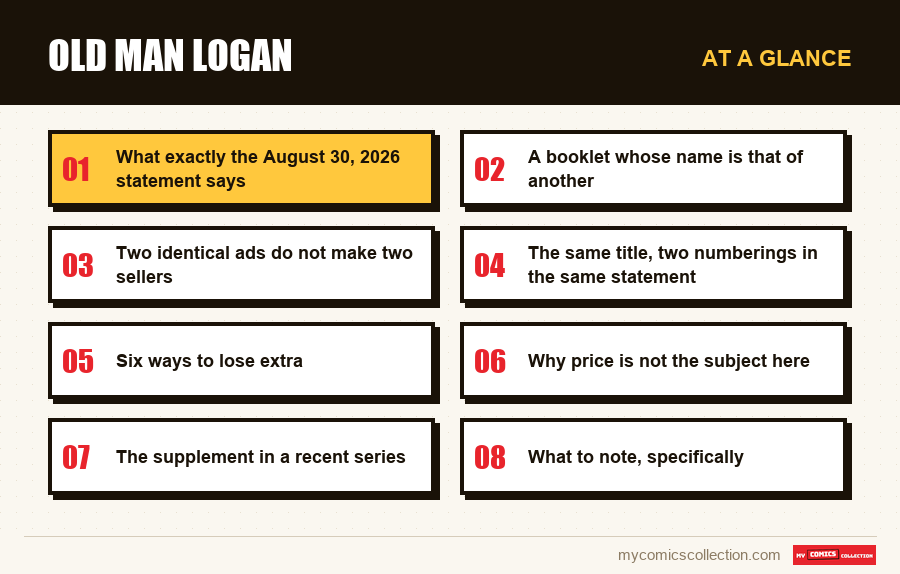
What exactly the August 30, 2026 statement says
The query used was “Wolverine Panini France”. It first produced a result that must be stated before all others: on the copies verified by an independent body, no announcement. Not a single one. The compartment is empty, and this emptiness is not insignificant (it means that no third party attests, in this statement, neither the condition of the copies offered, nor their authenticity, nor) in the case of the supplement: the very fact that it actually accompanied the number announced. Everything that follows is based on the sellers' declaration, and nothing else.
The announcements noted take up five lines. A « Wolverine (V2) n° 1 - Panini Marvel 2011 » at €1.95. A « Wolverine (V2) n° 6 - Panini Marvel 2011 » at €1.95. A « Comics Français MARVEL FRANCE Panini supplément à WOLVERINE 134 » for €1.99. The same ad, word for word and at the same amount, a second time at €1.99. Finally, a « WOLVERINE n°159, 04/2007, Marvel France » at €2.50. Five lines, two of which are one: four distinct objects, at most.
Four items is very few. Well below the ten announcements from which we can start talking about a price level. I will therefore not say that these booklets are “worth” two euros, nor that they are “cheap”, nor that a supplement can be negotiated “around €1.99”. A workforce of this size does not support any average, any range, any order of magnitude worthy of the name. It supports, on the other hand, an observation on the way in which these objects are nommés: and this is where this statement becomes instructive.
A booklet whose name is that of another
Aucun numéro propre
The wording of the supplement does not contain a number that belongs to it. The only number present, 134, designates the magazine it accompanied. Remove this number and only one category remains: « un supplément », as we would say « un encart ».
Une adresse empruntée
The booklet is therefore designated by an address which is not its own. It occupies the place of the host number in lists, searches and inventories, without ever having its own line.
Une information facultative
This address only exists if the seller takes the trouble to write it down. Nothing obliges him to do so, nothing is printed which makes it obvious to those who do not know the magazine. A seller in a hurry will write “Panini supplement”, and the item becomes anonymous.
Une preuve absente
Since the statement does not contain any third-party verified copies, the link between the supplement and issue 134 rests on the word of the seller. Neither the connection nor the existence of the object are independently attested.
These four observations go hand in hand. An object without an identifier of its own depends entirely on what someone wants to write about it; and no one controls this text. This is a very different situation from that of an ordinary issue, which has its rank printed on the cover and which is therefore found by this rank even when the description is botched. The supplement does not have this net. Its description est his identity. If you need an image: a magazine number is a house with a number on the door, the supplement is a room inside: you can only get there by going through the address of the house.
The practical consequence is immediate and applies to any inventory: a supplement must be noted as a propriété of the host number, not as a standalone line. An independent line entitled “Wolverine supplement” has no chance of being found in six months, nor of being compared to the issue to which it belongs.
And that's the other, more expensive half of the problem: as long as the extra isn't attached to the host number, its absence can't be seen. A shortage only becomes visible when there is an empty space to accommodate it. Without this location, we do not have the booklet and we do not know it.
Two identical ads do not make two sellers
The statement contains a perfect duplicate: two advertisements with strictly identical wording, for the same amount of €1.99. A coincidence of this precision (same wording, same price, same subject) cannot be explained by two people having spontaneously written the same sentence. The reasonable reading is that it is the same source publishing twice, either because it holds several copies or because an announcement was duplicated by the posting mechanism.
The lesson goes far beyond this case. Counting listings is not counting sellers, nor is it counting items. A classified catalog measures publishing activity, not a population of available copies. On five lines noted, a single duplication already reduces the real number by twenty percent. When the starting number is a few units, this difference is not a methodological detail: it changes the nature of what we are looking at.
This confusion always produces the same illusion, in both directions. An object appears more available than it is, because the same pile appears under several labels. Or it appears rarer than it is, because half of the copies in circulation are described in a way that the query does not find, and for a supplement lacking its own number, this second bias is particularly formidable.
There is a simple reflex to take when faced with any reading: before counting the lines, look for the pairs. Twin labels, identical amounts to the nearest unit, same expressions in the description. Each pair found removes one unit from the count, and the corrected number is the only one worth looking at.
The same title, two numberings in the same statement
The survey juxtaposes a “Wolverine (V2) No. 1” and a “WOLVERINE No. 159”. Two announcements, the same title, and two numbering systems which have nothing to do with each other: the first belongs to a second volume, where the counter starts from one; the second belongs to a long numbering which ran to over one hundred and fifty. These two figures are not comparable. “Number 1” designates one object, “number 159” designates another, and nothing in the number itself says which one.
The mechanism deserves to be seen for what it is. A review that starts from one resets a counter without erasing the old one: from this moment on, any issue cited without its volume is ambiguous. “I have number 6” means nothing until we say which of the two numbers 6. And if number 1 of the second volume is significantly later than number 159 of the first series, then the naive logic which associates small numbers and seniority completely turns around.
For those who keep an inventory, the resulting rule is without nuance: the volume is a part of the identifier, not a comment. A line that says "Wolverine 6" is a broken line; it doesn't show it today, because the one who wrote it remembers what he meant, but it will show it in two years, or the day someone else has to read it. The same requirement applies to an entire title with a long career, as recalled the editorial history of Wolverine in comics, where reminders and format changes follow one another without the numbering always keeping track of them.
The supplement combines two weaknesses: it does not have its own number, and the number it borrows belongs to a title whose numbering has been reset to zero at least once. “Supplement to Wolverine 134” therefore implicitly assumes a volume, and this assumption is not written anywhere in the announcement.
Six ways to lose extra
It does not appear in the search
A search by number does not return an object that does not have any number. The supplement can only be found by searching for the word "supplement" itself, or the number of its host: two queries that no one makes spontaneously.
The date is that of the host
A supplement does not have its own publication date: it left with the magazine. Classifying it chronologically therefore requires knowing the date of the number to which it was attached, information absent from its wording.
Wording depends on seller
Two sellers describing the same item can write two sentences without a common word, one citing the host number, the other not. No request brings them together.
He separates from his host
Stored elsewhere, loaned, resold separately, the booklet physically leaves the number which gave it its address. From then on, there was no telling what it belonged to.
Host number is ambiguous
The title having known at least two numberings, a reference to “Wolverine 134” only designates a specific object if the volume is known. Without it, the borrowed address is itself approximate.
His absence is not visible
A missing number leaves a hole in a sequence of numbers. A missing extra leaves nothing: it didn't occupy any rank, so its absence doesn't break any sequence.
These six mechanisms do not compensate for each other, they add up. An object that cannot be found by request, that cannot be dated, that changes name depending on the hand that writes it, that is physically separated from its reference and whose missing is silent: this is roughly the definition of an object that leaves a collection without anyone noticing. These are exactly the blind spots that a structured inventory is supposed to fill, and which the Old Man Logan collector's guide approached on the scale of an entire series.
Collecting this series?
Track what you own, what you are missing and what your collection is worth. 7 day trial.
Start my trial →Why price is not the subject here
We might be tempted to conclude from these amounts: €1.95, €1.99, €2.50: that these objects are worthless, and therefore that the question does not deserve attention. That would be two mistakes in one.
The first is methodological. Four distinct objects, on a single date, on a single site: this number says nothing about the price level of these booklets. Nor does it say what is practiced elsewhere, nor what is actually obtained for sale. And as the reading is a snapshot, it says nothing about an evolution: we cannot deduce a movement from a single point, and I therefore refrain from writing that these amounts would be stable, increasing or decreasing.
The second is more fundamental. The value of a supplement in an inventory is not primarily measured in euros, but in complétude. A number accompanied by its supplement and a number which has lost it are not the same object, even if the difference in the amount claimed is measured in cents. What is lost when the booklet disappears is not an amount, it is information, and information cannot be bought back for €1.99, because you must first know that it is missing.
There is also a useful asymmetry to keep in mind. Documenting a supplement costs a few seconds when you have it in front of you, with the magazine open in front of you. Reconstructing the same information ten years later, from an orphaned booklet found at the bottom of a box, may be simply impossible. The cost of the note and the cost of its absence have no relation to each other, and this is what makes the discipline profitable even on objects costing two euros.
The supplement in a recent series
What the statement illustrates on a Panini magazine is valid as a general mechanism, independently of the title. As soon as a publisher attaches an issue to a journal issue, he creates an object whose identity is derived. The rule is not specific to an era or a person: it depends on the way in which the object was put into circulation, and that alone.
For a modern series, the same logic applies with an additional difficulty: the ancillary objects are often more numerous, and nothing in their appearance indicates that they are ancillary. A reader who discovers the story of Old Man Logan in comics then begins to collect the series will find booklets which he will have to attach to their host so that they cease to be orphans. And, as with the French magazine, this connection will depend entirely on what the seller has written, or failed to write.
This is also why the question extends beyond a single series. The same character crosses several titles, several collections, several formats; what applies to an issue of a French magazine applies to any issue attached elsewhere, and the editorial history of the X-Men offers in this respect a particularly dense field of observation, with titles which intersect, relaunch and renumber each other.
Finally, a word about the purchasing gesture itself. When a listing does not have the host number, the only way is to ask for it before purchasing, while the item is still in the hands of someone who can look at it. This question, asked in time, costs a message; asked too late, it no longer has an answer. It is a reflex to integrate into the same routines as those described in Reasonable purchasing methods on Wolverine.
What to note, specifically
The host number to which the supplement was attached. This is the only address this booklet has, and it only exists if you write it down. Write it down exactly as the ad or review gives it, “supplement to Wolverine 134”, without rephrasing or simplifying it. This mention is the link between the object and the rest of your inventory; if it disappears, there is no way to reconstruct it from the booklet alone.
The exact nature of the supplement.“Supplement” is a category word, not a description. Write what you actually have in your hands: how many pages, what format in relation to the magazine, stapled or not, with or without a clean cover, printed in color or not. These characteristics are what will allow you, later, to recognize an identical object offered by someone who has described it with words other than yours.
The volume of the series concerned. The statement contains a second volume number 1 next to a number 159: proof, on five lines, that the number alone is not enough. Each time you write down a number of this title, write down the volume with it, in the same field if necessary. A line that says "Wolverine 6" without volume is a line that you will have to reopen one day, and that you may not know how to decide again.
The presence or absence of the supplement on the numbers you own. This is the point that turns an inventory into a tool. For each number likely to have been accompanied, explicitly indicate whether the issue is there, whether it is missing, or whether you do not know: the three states are different and the third is legitimate. Without this box, a missing supplement remains invisible forever, since it does not dig any holes in the sequence of numbers.
The price paid, shipping included. Note what the item actually cost you, including shipping, and not the amount shown in the ad. On issues of this order, shipping often weighs more than the item itself, and a claimed amount of €1.99 provides no information on the final cost. This paid value is the only data in your inventory that is a real transaction, as opposed to requests displayed elsewhere: it is your only verified anchor point.
By his host, and by him alone. The announcement noted on August 30, 2026 contains only one number, 134, and this number designates the magazine to which the issue was attached. In the absence of this mention, all that remains are physical characteristics (pagination, format, presence of a specific cover) which do not constitute an identifier but at least allow two objects to be compared with each other.
Because it concerns French publications sold on the French market. The journals concerned have no direct equivalent in the American catalog, and their amounts therefore only have meaning in their own market. Do not compare these euros to American statements: objects, print runs and purchasing habits differ.
Nothing guarantees it. The statement contains two advertisements with strictly identical wording and the same amount of €1.99, which points to a single source publishing twice. A listing count measures posting activity, not a number of sellers or a number of items available.
I cannot answer from this statement. Four distinct objects, on a single date, on a single site: the number is too small to base a price level, and a single snapshot does not by construction show any evolution. Amounts quoted are seller requests, not completed sales.
No, and the statement shows it: number 1 which appears there belongs to a second volume, therefore to a restarted numbering. Rank alone does not classify anything until the volume is known. This is why the volume must appear in the identifier itself, and not as a comment.
Reattach your supplements before you lose sight of them
A booklet without its own number is only found if it is recorded as a property of its host number, with its volume and its presence state. My Comics Collection lets you attach this information to the relevant issue, so that a missing supplement becomes a visible blank box instead of silence.