On current announcements around Wolverine #69, noted on August 30, 2026 on a general auction site in the American market, several labels promise a “never read, never opened” copy. This formula tells the supposed past of the object, it does not describe its current state: no one can verify it, not even the seller if he bought the lot second-hand. The amounts cited here are what sellers were asking for that day, not completed sales, and a single measurement says nothing about a price movement. In terms of copies verified by an independent organization, there are only five ads: $59.99 at the lowest, $82.70 in the middle, $499.99 at the very top: too small a number to draw a level from. On the unverified ad side, the floor drops to $2.00, and a set of six consecutive numbers costs $2.99.
A booklet announcement is contained in one line, and this line must hold together two things of a very different nature. On the one hand, what the seller notices: a fold, a color, a tear, a staple, possibly a numerical note issued by a verification body. On the other hand, what the seller thinks he knows, or hopes, or repeats because the formula inspires confidence. “Never read” belongs to the second category. This is not a fault of the seller, it is a property of language: we are describing an event which did not take place, and the absence of an event leaves no observable trace on paper.
The statement of August 30, 2026 around Wolverine #69 makes it very concrete, because it places this promise at the lowest price level on the market. The wording “Wolverine Vol. 3 #69 - #74 - New Unread Unopened: Combined Shipping” charges $2.99 for six consecutive issues. Six issues for less than three dollars, that's about fifty cents each: at this price, the promise of "never read" weighs nothing on the price, and that's precisely what makes it interesting to observe. It is not there to justify an amount, it is there out of editorial practice. Elsewhere, on other documents, the same formula will accompany much higher sums, and there will be no more verifiable content.
What exactly « jamais lu » describes: nothing observable
Take the statement seriously and ask yourself what it would take to demonstrate it. We would need to know the complete chain of hands through which the booklet has passed since it left the press, and to know that no one, at any time, has discarded the pages. No object carries this information. A very fresh booklet may have been carefully leafed through; a marked issue may never have been opened and may simply have traveled incorrectly. Both stories produce objects that are indistinguishable, meaning that the mention separates nothing.
The second problem is even simpler: the seller himself does not have the information. If he bought the lot second-hand, and this is the most common case at the lowest price levels, he repeats what he was told, or what he deduces from the appearance. He doesn't lie. He transmits a belief that came to him without a certificate. The ad reader receives the sentence as if it had been noted, whereas it has only been copied.
We must therefore remain neutral on the intention and firm on the informative value. The mention is not a deception, it is information without content. It occupies the space that a useful description should hold: what fold, where, on what depth, what color of edge, what hold of staples. A line dedicated to “unread unopened” is a line that did not serve to say what the photo does not show.
Conversely, the quantified status statements issued by verification organizations relate to what is observed. We can discuss the severity, the reproducibility, the cost, but they describe an object examined at a date, not a biography. It is this difference in nature, observation versus story, which structures the rest of this article.
The statement of August 30, 2026, and what it allows you to say
Five verified ads, and that's it
The request « Old Man Logan Wolverine 69 » restricted to copies passed by an independent organization only lists five current advertisements: $59.99 minimum, $82.70 central value, $499.99 maximum. Five is too little to talk about a price level. On such a thin field, a single optimistic seller moves the average, and removing an ad changes the conclusion. I therefore refrain from drawing a reference range for this segment.
A maximum is not a price
The high $499.99 is a request posted on August 30, 2026, not a trade. No one paid this amount at the time of the statement; the number measures a seller's hope and not being in a hurry. The ratio between this maximum and the floor at $59.99 mainly says that the sellers in this small group do not have the same reading of the market, not that the coin is worth the top of the scale.
The unverified floor at $2.00
Excluding verified copies, the cheapest ad: “Wolverine #69 (2008) | Old Man Logan | Mid Grade”: is asking $2.00. The wording assumes an intermediate quality instead of disguising it, which is more informative than many flattering formulas. The gap with the verified segment does not read like a good deal: the two groups do not offer the same service, and the second includes the cost of the examination.
One date, no movement
All of the above were observed on the same day. A photograph taken once shows no movement: I cannot say that these amounts are rising, falling or stabilizing, for lack of a second reading with which to compare them. Any sentence about a trend would be an invention added to the data, not a reading of the data.
These four observations hold together. The verified segment is too sparsely populated to provide a benchmark; the unverified segment is populated but heterogeneous, since there is as much a single copy at $2.00 as a set of six at $2.99 and an issue belonging to another series. A busy reader would add all of this up into a “$2-$500 range” that would not describe any actual item. On the contrary, correct reading consists of separating the groups before looking at the amounts.
The amounts cited in this article are those that sellers claimed on August 30, 2026 on a general auction site in the American market, for advertisements then in progress. None of them are the price of a completed sale, and copies verified by an independent organization are counted separately from others.
Five verified ads do not constitute a usable sample. I report them because they exist, and I refuse to infer what a verified copy of this issue is “worth”.
Six issues at fifty cents each: a reading price
The “#69 - #74” lot, which fetched $2.99, deserves more than a footnote. Six consecutive issues for three dollars, combined shipping costs announced in the label, it comes to about fifty cents per issue. In a recently published story, available in large numbers, this is the level where the object ceases to be a piece to watch and becomes again what it is first: something that can be read.
This is the best possible use of this price level, and it is a reading argument, not an investment argument. A series of consecutive numbers, purchased at once and from the same seller, offers exactly what reselling individually makes painful: continuity. No missing issues in the middle, no six weeks of waiting between chapters, no repeat shipping costs that end up exceeding the price of the issues themselves.
However, you have to make both ends meet. A lot at this price is rarely accompanied by a detailed description of each example, and it is arithmetic: describing six objects takes six times more time than describing one, for a derisory total amount. The phrase “new unread unopened” serves precisely to cover this silence with a reassuring phrase. It does not replace the absent description, it masks its absence.
The calculation to be made is therefore simple. If the lot is purchased to read the arc, fifty cents per booklet leaves a huge margin of error: even two copies that are significantly less beautiful than expected do not ruin the operation. If the lot is purchased in the hope of finding an apparently impeccable copy, the reasoning changes completely, because nothing in the advert promises this in a verifiable way, and the promise which appears to be so, in fact, commits nothing.
What damages a booklet without anyone opening it
The decisive argument against “never read” is not moral, it is physical. Reading is only one cause of deterioration of a booklet, and probably not the main one over a long period of time. A copy can come out of a box in poor condition without a hand having ever opened it.
Transportation, first. A booklet slipped into an envelope that is too flexible takes on a crease at the corner or a ripple on the edge, and this crease is permanent. Poorly placed cardboard allows the copies to move and rub against each other; the friction eats the colors on the edges. None of this requires reading.
Light, then. A back exposed to daylight will discolor, and this is all the more visible when the original color is strong. A pile stored sliced outwards near a window will, a few years later, have a band running all the way up. The object has not been touched; it was poorly placed.
The paper itself, finally. It yellows over time, and humidity and heat accelerate the movement. Storage in a cellar or under the roof makes a booklet age faster than a dozen careful readings. What the ad reader wants to know is not whether the copy was opened, but where and how it was stored, and no ready-made formula gives this information.
Collecting this series?
Track what you own, what you are missing and what your collection is worth. 7 day trial.
Start my trial →Two series, two numberings: the trap of the same name
A number that does not belong to the intended series
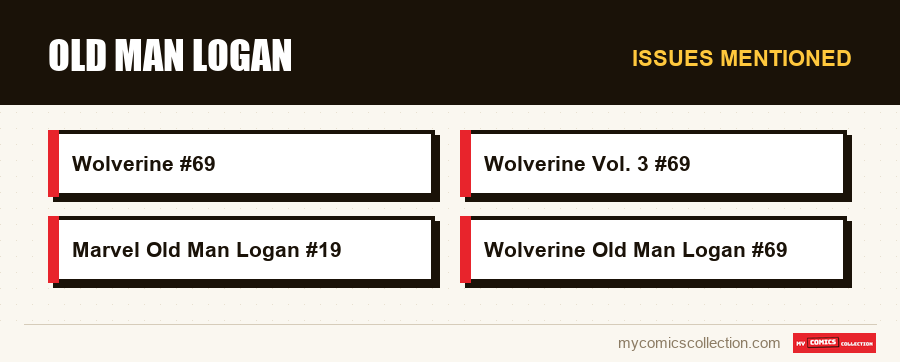
The ad “Marvel Old Man Logan #19 2017” for $3.50 does not concern the booklet sought. It is an issue of another series, later launched under the character's name and given its own numbering. It goes up because the words used overlap, not because the object matches.
The year as the first filter
Two labels on the statement bear different years for what should be the same issue: “(2008)” on the $2.00 ad, “2009” on the $3.99 ad. The year displayed is what the seller entered, and it is primarily used to identify discrepancies that merit a question before purchasing.
A storage code stuck to the title
The label "Wolverine Old Man Logan #69 NM [...] C30A" ends with an internal seller code. It designates a location in its stock, not a characteristic of the copy. A search by number also catches these suffixes, and brings up announcements unrelated to the request.
Lot or unit, it's not the same purchase
$2.99 for six numbers and $2.00 for a single number are similar in total amount and nothing like the unit. A ranking by increasing price mixes these two types of ad without signaling it; it is up to the reader to reestablish the distinction.
The number 69 appears everywhere
The same number can be a fascicle number, a reference fragment, a piece of year or a storage code element. Searching by number alone guarantees a mixture of all of these. Associating the number with the name of the series definitely reduces the noise.
Position in the arc
An isolated number and a number taken in the middle of a sequence do not read the same way. The statement batch covers six consecutive positions; a single ad only covers one, and the ad doesn't say which one in terms of the story.
This list has one thing in common: none of these traps are bad faith. These are mechanical effects of the way an ad search engine brings together strings of characters. The seller who sticks « C30A » at the end of his title manages his stock; anyone who sells number 19 of another series is selling a perfectly legitimate item. The sorting is up to the buyer, and it is done by reading the entire wording rather than stopping at the price displayed on the left.
This is also why a price comparison based on a single query is fragile. Of the five cheapest unverified listings in the survey, one is for another series and another is a set of six. There remain, in reality, three announcements that are truly comparable to each other. Three, in a segment where we thought we had five: the statistics melt away as soon as we read the labels.
What to note before purchasing, and save after receiving
The condition that you observe yourself upon receipt, never the seller's formula. Open the package, look at the four corners, the edge, the holding of the staples, the flatness, and write what you see in your words. If the card for your copy reads "never read, never opened", it will forever retain a sentence that you cannot verify and which does not describe the object in front of you. Your own observation will be accurate on the date you made it.
The exact series and its launch year. The statement contains a number belonging to a series launched later under the character's name, with its own numbering. A file which only bears “Old Man Logan” and a number becomes ambiguous as soon as a second issue from the same universe enters the collection. Note the title of the series as it appears on the cover and the year that series was launched, not just the year printed on the copy.
The position of the number in the arc. Knowing that an issue opens, continues or closes a sequel changes the way we complete the collection and how we lend the object to someone who is discovering the story. The survey lot covers six positions in a row; a single purchase covers one, and a form which forgets it requires reopening the question with each new purchase.
The provenance, lot or unit, and the actual unit price. Six issues at $2.99 do not register as six purchases at $2.99. Note the total amount of the lot, the number of booklets received, and the resulting unit price, around fifty cents here. Without this breakdown, a collection made up of lots displays a false total cost and makes any subsequent comparison unusable.
The possible presence of a fault which appeared without reading. Fold taken from cardboard, discolored strip on the spine, yellowed paper: these three are listed separately, because they do not tell the same storage story and they do not evolve at the same pace. A note dated today will tell you, in two years, if the yellowing has progressed in your home or if it was already there when you arrived.
There is nothing to say, and it is not the most likely hypothesis. The formula circulates from ad to ad because it reassures and it costs nothing to write. A seller who bought his lot second-hand often takes it back in good faith, without having any means of verifying it. The problem isn't the intention, it's that the sentence doesn't carry any actionable information.
Because the August 30, 2026 statement only contains five, all being sold. On such a small sample size, the central value of $82.70 depends entirely on what ads were online that day, and the maximum of $499.99 is enough to distort any average. These are requests, not transactions. Five points do not make a price level.
To read the arc, yes, without hesitation: approximately fifty cents the booklet leaves a considerable margin of error on the real condition of each copy. To hope to find a piece of impeccable appearance, the answer is different, because nothing in an ad at this price describes the six objects one by one. You must buy knowing which of the two objectives you are pursuing.
By reading the series title printed on the cover rather than the character's name. In the statement, an advertisement bears a number 19 dated 2017: it belongs to a series launched later under the name of the character, with its own numbering, and it has no positional relationship with number 69 of the original series. Two series can have numbers that do not compare.
This is a storage code specific to the seller, which tells him where the item is classified in his stock. It does not describe the state, nor a variant, nor a particularity of the object. Its presence above all reminds us that a search carried out by number alone also catches these suffixes and brings up advertisements unrelated to the request.
Keep your observation, not the seller's promise
My Comics Collection allows you to record the exact series, year launched, issue position in the arc, actual unit price of a bundle purchase, and the condition you yourself observed upon receipt. What you note remains true; what the ad promised disappears with it.