On the French market, a newsstand booklet frequently displays on its cover a notice of the type « 4/8 » which says exactly which chapter of a story the issue contains. The American edition does not carry this indication. The French statement of August 30, 2026 gives a direct example: an ad « WOLVERINE N° 186 Old Man Logan (4/8) Panini 2009 Comme Neuf » claimed €3.95. Out of thirty-two ads found that day for query « Old Man Logan Panini Wolverine », the lowest amount requested was €2.90, the median value was €4.75 and the highest amount was €35.00. None of these thirty-two announcements concerned a copy verified by an independent organization.
A precision of method is essential above all else, because it changes the reading of all the figures which follow. This reading does not come from the American market, contrary to almost all of the observations published on this site. It was carried out on the market français, on a general auction site, and all amounts are expressed in euros. A reader accustomed to seeing dollars and numerical grades here must therefore change his mental reference point: we are talking about newsstand booklets sold by French individuals, in a different currency and in a different market culture.
Second clarification, just as important: the sums cited are amounts réclamés by sellers on August 30, 2026, not completed transactions. Nobody paid €4.75, nobody paid €35.00. These numbers describe the state of a display at a given time, what sellers hope to get, not what a buyer has actually agreed to pay. A single photograph taken on a single day cannot say anything about a movement: there is no increase or decrease to comment on here, only a level observed once. Any dynamic reading of these figures would be an invention.
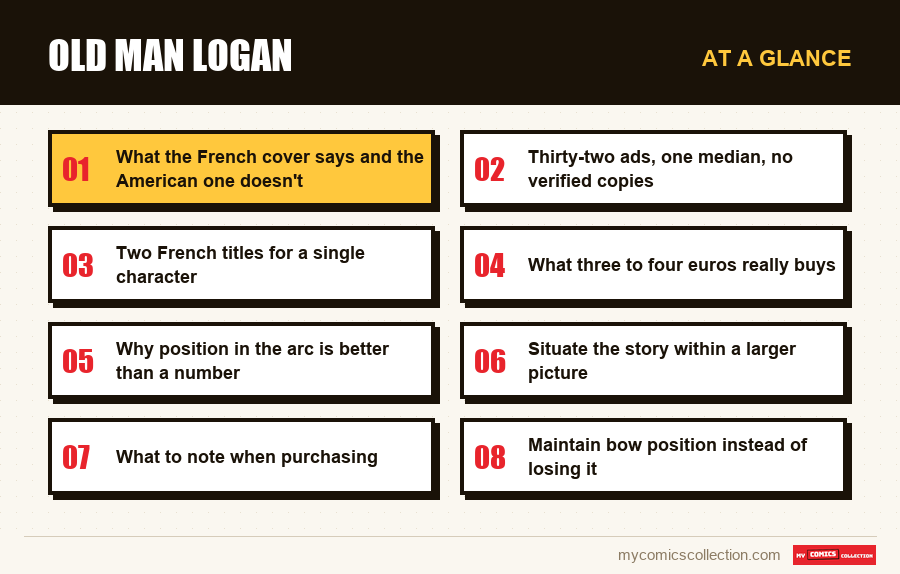
What the French cover says and the American one doesn't
The most informative advert in the survey is not the most expensive: it is that of number 186 of the French series, described as “Old Man Logan (4/8)” and offered at €3.95. This parenthesis, printed on the object itself, communicates narrative structure information. She says that the booklet contains the fourth segment of a story which has eight segments. A buyer who has never heard of this story, who does not know how many chapters it has and in what order they follow, learns all this by looking at an advertisement photograph.
The American edition does not provide this support. The original cover bears a serial number and nothing that places the booklet within a narrative arc. The American reader, or the French buyer who obtains the original edition, must therefore look elsewhere for information: in a database, in a guide, in a forum, or by buying blindly and reconstructing the order afterwards. The French mention does the work for him, free of charge, on the object.
This is a real advantage of French newsstand publishing, and it is rarely formulated as such. The usual conversation pits the original edition, considered more noble, against local versions, considered secondary. On this precise point, the relationship is reversed: the French edition carries data that the original edition does not carry. It's not a question of market value, it's a question of practical usefulness for someone who wants to read a story in the right order without prior work.
Thirty-two ads, one median, no verified copies
The median at €4.75
Of the thirty-two advertisements noted, the median value requested was €4.75. This is the amount that separates the display into two equal halves, and it holds up much better than average to isolated ads placed very high. It describes a market for ordinary booklets, purchasable without budgetary thought.
The floor at €2.90
The lowest amount on the statement, €2.90, corresponds to a “choice” offer covering numbers 44 to 209 of the same French series. This is not the price of an identified number but a call price valid for one hundred and sixty-five different positions, which does not have the same meaning.
The maximum at €35.00
A statement ad asks for €35.00, more than seven times the median. An isolated high point expresses a particular seller's expectation, not a market level. Nothing in a statement taken on a single day allows us to say that a buyer ever accepted this amount.
Zéro exemplaire vérifié
None of the thirty-two announcements concerns a copy passed through the hands of an independent verification body. At this price level and in this market, certification is simply not an option: the cost of the process would far exceed the amount claimed for the object.
Thirty-two listings isn't a small sample size, but it's not a deep market either. The number is enough to describe a price zone, something like three to five euros for an identified booklet, without authorizing a fine conclusion on this or that particular number. As soon as we divide these thirty-two advertisements by title, by number and by declared condition, we come back to subsets of a handful of copies each, and at this stage no price level is demonstrable. The right posture consists of reading the statement as an overall order of magnitude, not as a number-by-number rating grid.
The total absence of certified copies in the statement is not a statistical accident: it is a characteristic of the segment. Independent verification is a service whose cost is fixed and whose economic logic assumes an object whose value justifies the expense. A booklet asking for four euros does not cross this threshold, and it will not cross it because it is in good condition.
Concretely, this means that a French buyer in this segment buys based on description and photography. Its protection depends on the quality of the images, the precision of the seller, and its own ability to read a state. She doesn't care about a label. Hoping to one day resell these booklets based on certification would be a contradiction in terms of the very nature of this market.
Two French titles for a single character
The survey reveals a second difficulty, less visible but more costly in practice. The character is not published in France under a single title. A monthly French series welcomes it in its pages, this is where we find number 186 and its mention "(4/8)", and a distinct French mini-series is devoted to it under another title, of which numbers 1, 2 and 3 appear in the statement, asking for €3.50, €3.50 and €3.90 respectively.
These two publications do not overlap or replace each other. They carry independent numbering which each has its own account. A collector who only knows one of the two titles would pass by the other without even knowing that it exists, and would believe its set to be complete when he is missing an entire part of the material available in French.
This is a structural pitfall of newsstand publishing, not a peculiarity of this character. The same hero circulates from one medium to another according to the editorial choices of a local publisher, and the thread is reconstituted by cross-checking rather than by reading a continuous numbering. This mechanism also concerns well beyond this specific case, as shown the editorial history of the Wolverine character, published in France under successive brands and formats.
A search by title misses half
Looking for a single French title means ignoring the other publication. The two formulations must be queried separately, otherwise part of the available material remains invisible to the buyer.
Two dates, two contexts
The statement mentions a French publication from 2009 for the monthly series and publications from January 2016, 2016 and March 2016 for the mini-series. These are not the same editorial waves, nor the same offer on the second-hand market.
The price does not distinguish the two
Between €3.50 and €3.95, the two publications are in the same corridor of claimed prices. The amount requested therefore provides no information on the nature of the proposed booklet.
Lots drown out identification
An offer covering one hundred and sixty-five numbers does not say what each of them contains. It sells access to a series, not a specific chapter of a story.
The numbers do not compare
A number 3 of a mini-series and a number 186 of a monthly do not rank on the same scale. Confusing the two counters produces invisible holes in a collection tracker.
The arc position is not systematic
The words “(4/8)” appear on a statement announcement. There is nothing to confirm that it appears on all French issues, and it must therefore be verified on a case-by-case basis rather than assuming it is acquired.
Collecting this series?
Track what you own, what you are missing and what your collection is worth. 7 day trial.
Start my trial →What three to four euros really buys
At median height, access to the story in French costs a few euros. This is an amount that does not merit arbitration: it is below the price of a coffee in many cities. For a curious reader who wants to discover a story without commitment, the barrier to entry is essentially zero, and the position statement on the cover even makes the exercise feasible without prior documentation.
On the other hand, we must be careful not to make a hasty comparison with the American edition. The reading of August 30, 2026 relates only to the French market: there is no American measurement of the same numbers on the same day here. To say that French costs less, or more, than the original would be a conclusion without data. What is established is the French level; what is not is the gap with another market.
The modesty of the amount has a consequence on which we must be clear. An item asking for four euros does not constitute an investment. Shipping costs are often a substantial fraction of the total, sometimes more than the item itself, and no amount of reselling will recoup it. The purchase is justified by reading and by the pleasure of owning a complete booklet, not by an expectation of added value. This distinction also runs through the entire subject, as recalled in the guide devoted to purchasing Wolverine booklets at a low price.
Finally, the “choice” offer at €2.90 deserves separate treatment. It offers access to numbers 44 to 209 of the same French series, i.e. one hundred and sixty-five positions. It's a valuable tool for filling holes in a series you're already following, since you pay a single rate regardless of the number requested. On the other hand, it is an unsuitable tool for those looking for a specific chapter of a specific story: nothing in the ad says which content corresponds to which number, and it is up to the buyer to provide this information.
Why position in the arc is better than a number
A serial number places an issue in a publication chronology. He says nothing about the story. Two consecutive issues can belong to two unrelated stories, and two chapters of the same story can be separated by an insert. Serial numbering is an object counter, not a summary.
The position statement describes the structure of the story. “4/8” affirms two things simultaneously: that this booklet comes after three others, and that the story has eight segments in total. The second point is the most useful, because it gives the buyer the size of the target before they even start looking. He knows how many items he needs, which turns an indefinite quest into a finite, verifiable goal.
This information also has defensive value. A buyer who knows the denominator immediately detects an ad that claims to sell a complete story in too few installments. It also identifies incomplete batches presented as whole. Without the denominator, there is no simple way to do this verification, and it depends on the good faith of the description.
The counterpart is that this mention belongs to the French edition and follows the division chosen by the French publisher. It describes the way in which a story was distributed in local fascicles, which does not necessarily cover the original division. It is therefore excellent for navigating within the French edition, and without authority for reasoning about the original edition. It must be read for what it is: a map of French territory, not American territory.
Situate the story within a larger picture
An isolated story takes on its meaning in an editorial context. The character on which this report relates is part of a long continuity, with points of origin, revivals, crossovers with other series. Understanding this architecture avoids two symmetrical errors: believing that one booklet is enough to understand everything, and believing that you need to have everything to read anything.
A reader who wants to reconstruct the character's trajectory benefits from going through the editorial history of the story itself, which explains where it came from and how it was extended. The broader framework, that of the mutant series in which these publications fit, is described in the editorial history of the X-Men. These two readings cost nothing and avoid redundant purchases.
There is a very concrete reason for this. In a market where booklets cost a few euros, the unnecessary expense does not come from the unit price but from the multiplication of duplicates and off-topic purchases. Thirty poorly chosen booklets at four euros represent a real sum, entirely avoidable by half an hour of tracking. The dominant cost in this segment is the cost of the identification error, not that of the object.
This is also why the position statement deserves to be treated as data to be retained, and not just as a cover detail. It is precisely what distinguishes a documented purchase from a random purchase, and it disappears from memory as soon as the booklet joins a pile.
What to note when purchasing
The position in the arc, when printed. If the cover bears a notice such as “4/8”, copy it as is. It gives both the rank of the booklet and the total number of segments, which will tell you later how many you are missing. If the mention is absent, note it also: the absence is information, it will save you from needlessly looking for it a second time.
The exact French title and its number. Don't just write down "Old Man Logan": two separate French publications carry this character. Write the title of the publication as it appears on the cover, followed by the number that belongs to it. This is the only couple that identifies a booklet unambiguously on this market.
The nature of the publication: monthly or mini-series. The survey shows a French monthly series and a French mini-series which coexist. Specify which one you hold, because both numberings start from their own account and a number 3 is not comparable to any number 3 in the other publication. Without this mention, your list becomes unreadable as soon as it grows.
The French publication date. The statement associates 2009 with the monthly series and January, March and the current of 2016 with the mini-series. This date is the most reliable benchmark for distinguishing two issues whose covers are similar, and it will allow you to reconstruct the order of French publication if a title changes along the way.
The price paid, shipping included. In a segment where the item is worth three to four euros, shipping is not a detail: it can represent a major part of the expense. Record the total actually charged, not the amount shown in the ad. This is the only way to know later what your set really cost you.
She indicates that the booklet contains the fourth segment of a story which has eight in total. This is narrative structure information added by the French edition. The statement of August 30, 2026 gives an example: an ad describing “WOLVERINE N° 186 Old Man Logan (4/8) Panini 2009 Like New”, asking €3.95.
No. The original cover does not display the position of the booklet within a narrative arc. A buyer working on the American edition must obtain this information by another means, whereas the French edition provides it on the object itself.
The French statement of August 30, 2026 gives a median of €4.75 requested over thirty-two advertisements, with a floor at €2.90 and an isolated high point at €35.00. These are amounts claimed by sellers, in euros, and not sales concluded. A measurement taken on a single day says nothing about developments over time.
Because independent verification does not apply to this segment. Of the thirty-two advertisements noted, none concerned a copy passed by a verification body. The cost of such an approach is unrelated to a sum of a few euros, which explains its complete absence.
It is used to fill gaps in a series that we are already following, since a single price of €2.90 applies regardless of the number requested among positions 44 to 209. It is not used to find a specific chapter of a story: the ad does not say which content corresponds to which number, and it is up to the buyer to provide this correspondence.
Maintain bow position instead of losing it
The mention “4/8” disappears from your memory as soon as the booklet joins a pile. My Comics Collection allows you to record the exact French title, the number, the nature of the publication, the publication date and the price paid including shipping, for each copy, and to immediately see the chapters that you still have to find.