There are no Silver Age Venom key issues. The Silver Age runs from 1956 to 1970, but Venom doesn't appear until 1988 , in Amazing Spider-Man #300 (Todd McFarlane cover). If you're hunting for a "Silver Age Venom," you're chasing a comic that was never published. Here's the real timeline and the issues you should actually target: with their June 2026 eBay values.
"Venom Silver Age key issues" is a common search, but it rests on a mix-up of eras. The Silver Age of comics spans 1956 to 1970 (source: Wikipedia): the golden era of modern superheroes, from the Flash in Showcase #4 to Steve Ditko's earliest Spider-Man. Venom is a far later character.
Rather than invent issues that don't exist, this guide sets the facts straight: where Venom actually comes from, which era his foundational issues belong to, and which ones deserve your collecting budget.
Why there's no Silver Age Venom
The answer is simple and chronological. The Silver Age ends around 1970, followed by the Bronze Age (early 1970s to mid-1980s) and then the Copper Age (mid-1980s to early 1990s) (source: Wikipedia). Venom lives in those last two eras, never the Silver Age:
- 1984: The black suit (the future symbiote) appears: Bronze Age.
- 1988: Venom finally appears as a full character: Copper Age.
In other words, nearly two decades separate the end of the Silver Age from Venom's birth. Any seller or listing advertising a "Silver Age Venom" has the era wrong: be wary.
The real lineage: from black suit to Venom
The symbiote grew out of a fan-submitted idea by Randy Schueller, bought by editor-in-chief Jim Shooter for $220 in 1982 (source: Wikipedia). Here's the real chain, in order:
- Amazing Spider-Man #252 (May 1984): Spider-Man wears the black costume for the first time in the main universe (Earth-616).
- Marvel Super Heroes Secret Wars #8 (Dec. 1984): the black suit's origin is told: Spider-Man brings it back from Battleworld. It's the first building block of the future symbiote (not indexed by our eBay estimator).
- Amazing Spider-Man #300 (May 1988): the symbiote, rejected by Peter Parker, bonds with Eddie Brock: this is the first full appearance of Venom, on an iconic Todd McFarlane cover.
These three issues are Venom's only real "ancestors." None belong to the Silver Age.
The real key issues and their values (June 2026)
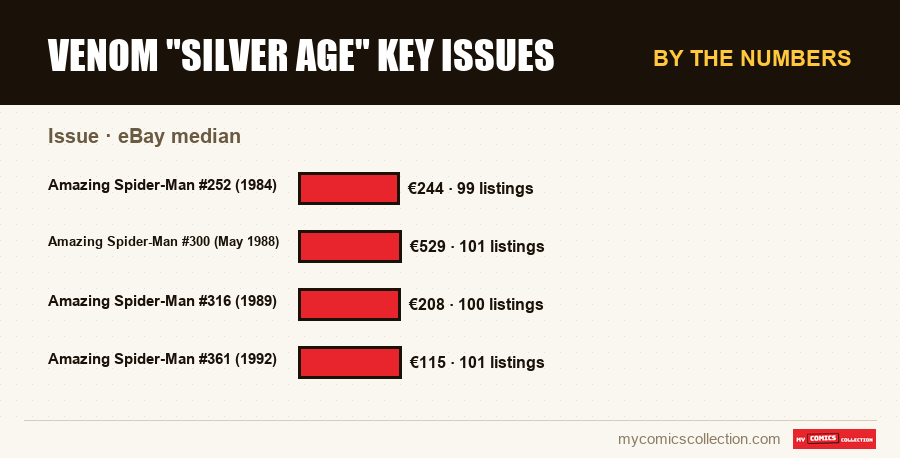
Values = median of active eBay listings, all editions and grades combined (our estimator, eBay.fr + eBay.com):
| Issue | Era | Significance | eBay median |
|---|---|---|---|
| Amazing Spider-Man #252 (1984) | Bronze Age | First black suit (Earth-616) | €244 · 99 listings |
| Amazing Spider-Man #300 (May 1988) | Copper Age | First full Venom appearance, McFarlane cover | €529 · 101 listings |
| Amazing Spider-Man #316 (1989) | Copper Age | First full Venom cover | €208 · 100 listings |
| Amazing Spider-Man #361 (1992) | Copper Age | First Carnage appearance | €115 · 101 listings |
The grail remains ASM #300: a documented record sale of $13,500 in high grade (sources: QualityComix, GoCollect). The "all grades combined" eBay median is pulled down by raw copies and lots; a high-grade CGC copy sits well above it.
Beyond the Amazing Spider-Man issues, Venom's first solo series is Venom: Lethal Protector #1 (1993): also Copper Age, not indexed by our estimator. Again, nothing from the Silver Age.
What to do if you were hunting a "Silver Age Venom"
- Redirect to ASM #300. It's the true foundational issue: maximum liquidity (~100 active listings at all times) and durable demand.
- On a tight budget, target #361 (Carnage). At a ~€115 median, it's the most affordable way into the symbiote family.
- Beware "Silver Age Venom" listings. Either the seller has the era wrong, or they're overselling a Copper Age issue: always check the year and the value before buying.
Era landmarks so you don't get the age wrong
The confusion comes from "Silver Age" having become, for many, a synonym for "old". Yet comic book ages are precise date ranges, and knowing them saves you from hunting an issue that never existed. Here are the useful landmarks for this file.
- The Golden Age precedes everything else, with starts such as Action Comics #1 (1938).
- The Silver Age runs from 1956 to 1970: from the Flash of Showcase #4 to Steve Ditko's first Spider-Man.
- The Bronze Age extends from the early 1970s to the mid-1980s.
- The Copper Age runs from the mid-1980s to the early 1990s.
Applied to Venom, the grid gives a clear result. The black costume arrives in 1984, squarely in the Bronze Age. The character proper is born in 1988, squarely in the Copper Age. Nearly two decades separate the end of the Silver Age from that birth, and no issue can fill the gap.
An origin anecdote helps fix the chronology. The symbiote stems from an idea sent in by a fan, Randy Schueller, which editor Jim Shooter bought in 1982. The costume then appears in Amazing Spider-Man #252 (May 1984), its origin is told in Marvel Super Heroes Secret Wars #8 (December 1984), and then the symbiote, rejected by Peter Parker, bonds with Eddie Brock in Amazing Spider-Man #300 (May 1988).
Three reflexes when a listing talks about a "Silver Age Venom":
- Read the year printed in the cover's legal line: if it is later than 1970, the issue is not Silver Age, whatever the listing title says.
- Match the issue against the chain above: #252, Secret Wars #8, #300, #316, #361. If it is not one of them, ask what it actually contains.
- Compare with the value of the real issue: a listing that oversells a Copper Age issue under an older era label is the most frequent case.
This grid applies beyond Venom. A character cannot have a key issue older than its creation, and the character's birth date fixes the age of all its founding issues. Knowing where you stand in the timeline remains the best filter against labeling errors.
Frequently asked questions
No. The Silver Age runs from 1956 to 1970, while Venom only appears in 1988 in Amazing Spider-Man #300, on a Todd McFarlane cover. Looking for a "Silver Age Venom" means looking for a comic that was never published.
It first arrives in the 616 universe in Amazing Spider-Man #252 (May 1984). Its origin is told in Marvel Super Heroes Secret Wars #8 (December 1984), where Spider-Man brings it back from Battleworld.
Amazing Spider-Man #300 (May 1988). The symbiote, rejected by Peter Parker, bonds with Eddie Brock there, on a cult Todd McFarlane cover.
An idea sent in by a fan, Randy Schueller, and bought by editor Jim Shooter in 1982. It led to the 1984 black costume, then to Venom.
Either the seller has the era wrong, or is overselling a Copper Age issue. Always check the year and the value before buying.
Own a Venom comic? Get a free valuation with our tool based on real eBay sales to find its low, median and high value.