For investing in Venom, one issue ticks both the durability and liquidity boxes: Amazing Spider-Man #300 (first full appearance, May 1988), with a €529 eBay median and 101 active listings (June 2026), plus a documented record sale of $13,500 in high grade. The rest of the symbiote family is cheaper but riskier. Here are the real values, the actual liquidity, and the pitfalls: with no invented return figures.
Venom debuted in 1988: there's no Silver Age here, it's a Copper/Modern Age character. Its values were lifted by Sony's trilogy ($1.84B worldwide box office, source Box Office Mojo), which widened the buyer base. But "popular character" doesn't mean "good investment": the gap between issues is enormous.
This guide uses verifiable data only: live eBay values (our estimator) and documented records. No past return figure is invented: when a data point can't be verified, we state it qualitatively. This is not financial advice.
Venom issues and their real value (June 2026)
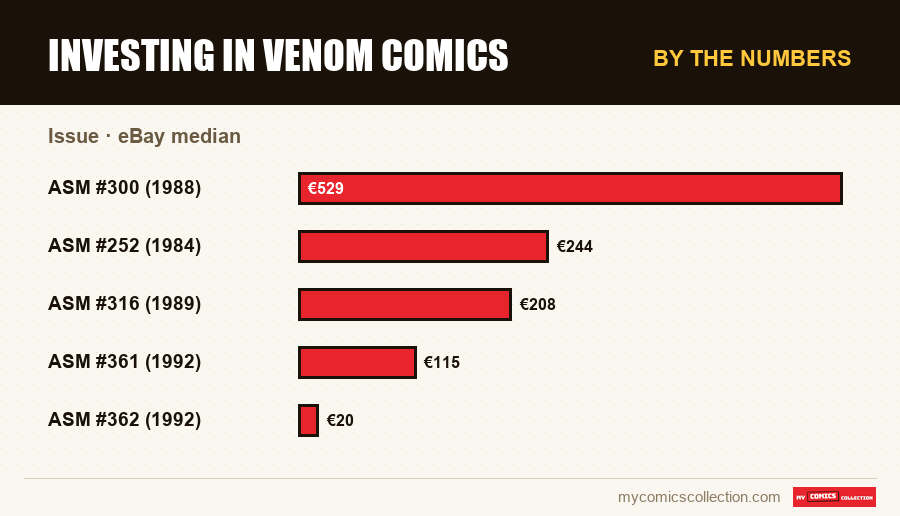
Values = median of active eBay listings, all editions and grades combined (our estimator, eBay.fr + eBay.com). The listing count is the key metric: it's liquidity: how easily you can resell.
| Issue | Significance | eBay median | Liquidity |
|---|---|---|---|
| ASM #300 (1988) | First full Venom appearance | €529 | 101 listings |
| ASM #252 (1984) | First black suit (Earth-616) | €244 | 99 listings |
| ASM #316 (1989) | First full Venom cover | €208 | 100 listings |
| ASM #361 (1992) | First Carnage appearance | €115 | 101 listings |
| ASM #362 (1992) | Second Carnage, direct follow-up | €20 | 101 listings |
Liquidity: the most underrated criterion
A comic only has "value" if you can resell it. Every issue above shows ~100 active listings at any given time: a deep, liquid market, rare for 1988-1992 issues. In practice, you'll always find a buyer, and a reference price, without locking up your capital for months.
Careful, though: high liquidity also means high supply. Nobody holds absolute scarcity on these raw issues. The value lever is condition, not the issue number alone.
Why condition makes all the difference
The "all grades combined" median for ASM #300 (€529) is pulled down by raw copies and lots. The documented record for this issue in high grade is $13,500 (sources: GoCollect, QualityComix). The gap between a creased copy and a CGC 9.8 runs into thousands of euros. Investing in Venom means, above all, investing in the grade. An average raw copy isn't an investment: it's a collectible.
The concrete risks
- 1990s oversupply. Venom is a modern character: print runs were huge. Venom: Lethal Protector #1 (1993, first solo series) has ~24,000 copies already CGC-certified, of which ~10,000 in grade 9.8 (source: GoCollect). The 9.8 is almost a baseline there, not a rarity: hence a modest value (NM- ~$55 Overstreet). This issue isn't indexed by our eBay estimator (limited to Amazing Spider-Man): check it case by case.
- Dependence on the film calendar. Mainstream demand tracks the movies. Sony's trilogy ended (2024): without a new project, the momentum can fade.
- Fakes and restoration. On a €500+ issue, CGC/CBCS certification isn't optional.
A grounded approach (based on real data)
- #300 in high grade = the safe haven. Maximum liquidity, durable demand, undisputed cornerstone status.
- #361 (Carnage) at ~€115 = the entry point. The first appearance of a major character, still affordable.
- Be wary of €20 issues (e.g. #362): fun to collect, but resale margin is near zero after fees.
- Check the value at the time you buy. The medians above are from June 2026; prices move.
Building a symbiote collection step by step
The values table gives five reference points, but the order in which you acquire them matters as much as the issues themselves. Here is a progression that follows the character's history, from 1984 to 1993, and what to check at each step.
- Step 1, the costume: Amazing Spider-Man #252 (1984) shows Spider-Man's first black costume in the 616 universe. It is not yet Venom, but it is the origin of the symbiote.
- Step 2, the character: Amazing Spider-Man #300 (May 1988) is Venom's first full appearance, and #316 (1989) his first full cover.
- Step 3, the offspring: Amazing Spider-Man #361 (1992) introduces Carnage, and #362 gives the direct sequel.
- Step 4, the solo series: Venom: Lethal Protector #1 (1993), the character's first solo series.
This progression explains the asymmetry of the file. The first three steps are firsts: the costume, the character and its offspring. The fourth is a series opener published in an era of huge print runs, which changes the nature of scarcity: here you are not hunting the issue, you are hunting the grade.
Three checks before every purchase:
- The exact issue and title. Amazing Spider-Man has many neighboring issues with different roles, and a single wrong digit is enough to change character.
- The real condition. The all-conditions median hides the gap between an ordinary raw copy and a very high-grade copy, and that gap carries the value.
- Certification, as soon as an issue is expensive: fakes and restorations exist, and a certified copy is the only serious guarantee.
A note on method: our estimator only indexes Amazing Spider-Man. For Lethal Protector #1 and any Venom-titled series, no median is given, and you must check the value case by case before buying.
Finally, if the goal is reading rather than investing, the same sequence makes an excellent path: you watch a costume become a character, then a family of symbiotes. Reading in this order makes each issue clearer than if you acquire them at random from listings.
Frequently asked questions
Amazing Spider-Man #300 (May 1988), Venom's first full appearance. It is the issue that combines solidity and liquidity, with many active listings at all times.
Because value is pulled up by high grade: the gap between a creased copy and a certified 9.8 is considerable. An average raw copy is a collectible, not an investment.
An oversupply from the 1990s, with issues like Venom: Lethal Protector #1 already certified by the tens of thousands, a dependence on the film calendar (the Sony trilogy ended in 2024), and the presence of fakes and restorations.
Amazing Spider-Man #361 (1992), the first appearance of Carnage, remains an entry point to a major character. Amazing Spider-Man #252 (1984), the first black costume, and #316 (1989), Venom's first full cover, are other reference points.
No. It relies only on verifiable values and records and invents no past returns. Always check the value at the time of purchase, because prices move.
Own a Venom comic? Get a free valuation with our tool based on real eBay sales to find its low, median and high value before you buy or sell.