normalman is a 1984 superhero parody whose premise is reversed: the character has no power in a world where everyone has power. Published by the self-publishing house of another independent author: the same one which then published an animal series which had become a monument -, today it asks itself to 7,99 $ de médiane on 90 raw announcements, with entries at 1,39 $. Only one certified ad exists. It's cheap reading, and it's its author's best personal work.
This series is the blind spot of bibliographies: cited nowhere, available everywhere, and clearly more interesting than its reputation.
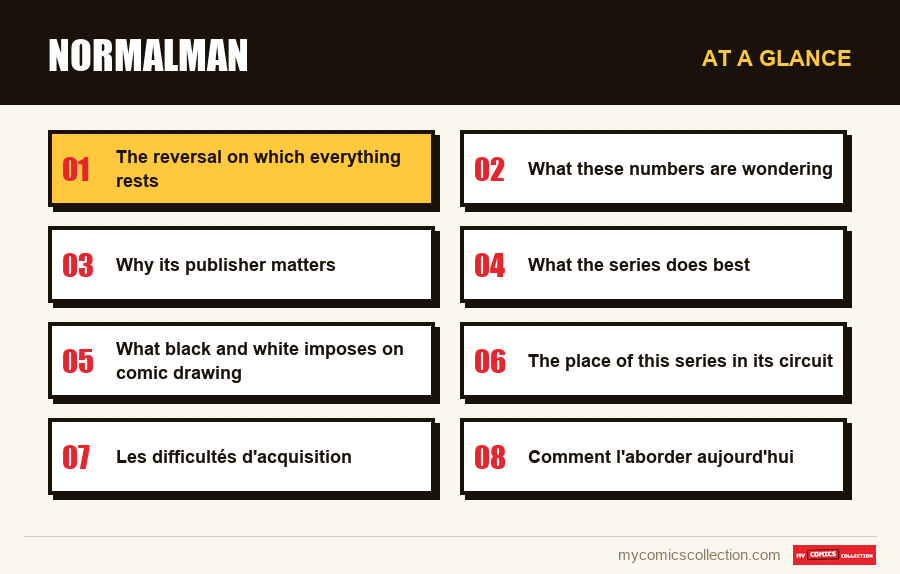
This article explains the reversal on which it is based, what the statement says about it, why its publisher matters as much as its author, and how to approach it today.
The reversal on which everything rests
The principle is contained in one sentence and it is more fruitful than it seems.
In an ordinary parody, you take an extraordinary character and make him ridiculous. Here, we take an entirely ordinary character and place him in a world where the norm is to be extraordinary.
Moving changes everything. It's no longer the superhero who is mocked, it's the world around him: and this world, seen by someone who has no place in it, reveals absurdities that its inhabitants no longer perceive.
This system has a lasting consequence: it does not depend on any particular production. It does not mock a particular series or a particular author, but the conventions of the genre as such, which explains why it remains readable forty years later without prior erudition.
What these numbers are wondering
The values below come from a fixed price announcement survey carried out on August 29, 2026: prices asked, distinguished according to whether the copy is raw or certified. They reflect the hope of a seller, never an amount actually collected.
The raw market
90 ads, of $1.39 to $49.99 requested, median $7.99. Abundant supply for a 1984 self-publishing series.
The maximum remains modest, without any extreme value to distort the reading.
The certified market
Only one ad, has $33.79 requested. An isolated figure, which describes a seller and not a market.
This is degree zero of certification: no one judges the operation profitable here.
Lowest entries
Multiple numbers to $1.39 to $1.92 requested, with conditions described in precise and correct terms, not damaged copies.
An instructive comparison
The Image series by the same author displays $7.55 of requested median. A gap of 44 cents separates a 1984 self-publishing from a large-circulation publication from the 1990s.
Why its publisher matters
This is the most interesting element of the context, and it appears directly in the ad titles.
The series was published by a small house that existed solely to allow an author to publish their own work without going through an established structure. This same publisher carried a long-term animal series at the same time, which has since become a benchmark for self-publishing.
Welcoming the work of another author was therefore not a publisher's activity, it was a colleague's gesture. The company had no sales department, no catalog to supply, no growth strategy.
This detail illuminates everything that follows. The author of this parody would become ten years later co-founder of a structure based on exactly the same principle, authors who own what they create, on an incommensurable scale.
In other words, these $1.39 numbers document the circuit where the idea came from. They are not only anterior: they are the matrix.
A useful warning on tone. It's a parody from 1984, written in the humorous codes of its time, with heavy puns and a gag rhythm that doesn't resemble contemporary humor.
The background system remains excellent; the dressing has aged. A reader expecting a modern satire will be taken aback the first ten pages, then get used to it, or not, and he will have found out for $1.39.
What the series does best
Three things a regular parody doesn't get.
It makes visible the arbitrariness of gender. Seen by someone who does not participate, the convention according to which people in costumes settle public affairs with fists becomes astonishing. No one needs to comment on it: you just have to look at it from the outside.
It produces real sympathy for its protagonist. He is not the simpleton on duty: he is reasonable in a world that is not, and his position quickly becomes more enviable than ridiculous.
It lasts over time. The short format and the constant invention of new conventions to return to avoid the exhaustion that threatens single-concept series.
These successes explain why this work remains recommendable regardless of any historical curiosity. You can read it without knowing anything about its author or its publisher., and find what you're looking for.
What black and white imposes on comic drawing
A technical constraint is worth noting, because it explains part of the appearance of these pages.
Self-publishing in this period printed in black and white for cost reasons, without exception. A humor artist loses a tool that his colleagues in the major editions used widely: garish color, which alone indicates that a scene is comical.
We must therefore obtain the effect differently, and the solutions are visible. The expressions are pushed far, the postures exaggerated, the settings simplified until only what serves the gag is kept. It is a drawing that makes noise with mute means.
This economy has aged well. A page of colorful gags from the 1980s today seems dated by its palette even before we read; a black and white page does not bear this mark and can be read without period effect.
This is an involuntary advantage, obtained by budgetary constraints, and it is worth pointing out to anyone who hesitates in the face of the absence of color.
The place of this series in its circuit
A final reference helps to understand what we are holding in our hands.
The mid-1980s saw a large number of independent black and white series flourish, driven by the hope of reproducing some resounding successes. Most last a few issues and disappear without a trace.
This differs on two points. It was brought to fruition rather than abandoned, and it had a purpose rather than a niche:a starting idea solid enough to last several dozen issues without repeating itself.
This explains why it is still circulating in 90 advertisements forty years later, when dozens of contemporary titles have completely disappeared from the second-hand market.
For a curious reader of this period, it therefore constitutes an excellent sample: it shows what the circuit produced when it produced well, without requiring the investment that the animal series published by the same publisher would require.
Collecting this series?
Track what you own, what you are missing and what your collection is worth. 7 day trial.
Start my trial →Les difficultés d'acquisition
A title that is poorly sought after
The title is written without capital letters and in a single word, which ads rarely respect. Searches yield incomplete results.
Un papier fragile
Self-publishing in this period employed economical papers that yellowed and broke at folds.
Des rééditions dispersées
The content was subsequently reproduced in various formats, without a reference set being required.
The port that doubles the price
At $1.39 each, shipping individually costs more than the item. Batch is the only sensible approach.
Finally, a word on the research itself, which is more delicate here than the purchase. The title is written in a single word and without capital letters, the advertisements transcribe it in four or five different ways, and no single query brings up the entire offer. You have to try several successive spellings, or go through the name of the publisher, which remains stable, correctly spelled by the sellers and rare enough in this catalog to serve as a perfectly effective filter.
Comment l'aborder aujourd'hui
The method follows directly from the prices recorded and the nature of the series.
Buy a lot, not numbers. With 90 listings in circulation and a median of $7.99, there are many sellers offering multiple issues together, and this is the only way to avoid shipping dominating the spend.
Do not search for the first number as a priority. Nothing in the statement distinguishes it, and the device can be appreciated from anywhere: each number replays the starting reversal on new ground.
Read three before you judge. The first is to get used to the tone, the second to understand the mechanism, the third to know if it amuses you in the long term.
This approach costs less than a current new number. This is probably the best report of this entire campaign, and it concerns a series that almost no one recommends.
Ce qu'il faut enregistrer
In this series, the determining field concerns the condition of the paper, something that most inventories treat too roughly.
The degree of yellowing and the condition of the folds, noted separately from the general condition. Economy self-publishing papers from the 1980s degrade in two independent ways: they brown with light, and they break at the center fold under handling. A copy can be impeccable on one level and lost on the other.
No current state scale distinguishes these two degradations, and yet one is reversible in its practical effects, a yellowed copy can be read very well, while the other is not.
The composition of the original batch, since these numbers are almost always bought in packs: knowing what came together avoids buying by mistake a number already present at the bottom of a cover.
These two fields serve conservation rather than value, which is exactly the issue on a set costing a few dollars that we want to be able to read again in twenty years.
Questions fréquentes
Of an entirely ordinary character placed in a world where the norm is to be extraordinary. The reversal reverses the usual parody: it is no longer the superhero who is mocked but the world around him, revealed in its absurdities by someone who has no place in it.
The background remains excellent, the dressing has aged. The puns are strong and the gag rhythm does not resemble contemporary humor. Allow ten pages of acclimatization, and if that doesn't take, you'll have it for $1.39.
Nothing justifies it: the reading does not distinguish it from the others, and each number replays the initial reversal on new ground. Instead, buy a bundle, which the 90 listings in circulation make easy: at $1.39 each, shipping individually would cost more than books.
Because no one judges the operation profitable on a series whose gross median requested is $7.99. This is level zero certification, and the single ad noted at $33.79 describes a seller, not a market.
Not at all, the series can be read without knowing anything about its context. This context, however, adds a layer: the house that published it existed only to allow an author to publish his own work, and the person who signed this parody will co-found ten years later a structure built on the same principle, on a completely different scale.
Yellowed, or broken at the fold?
Two independent degradations that no current status scale distinguishes.