Mysterio (Quentin Beck) is Spider-Man's master of illusion, and his comics history starts with The Amazing Spider-Man #13, cover-dated June 1964, written by Stan Lee and drawn by Steve Ditko. A former special effects technician with no powers, he fakes reality with holograms, smoke and staged sets under a famous fishbowl helmet. He joined the Sinister Six, passed the Mysterio name through several identities, and was the architect of the Guardian Devil storyline against Daredevil in 1998.
Among Spider-Man's rogues, Mysterio is a rival of a special kind: he does not hit the hero, he rewrites what the public thinks it sees. That idea, set down in 1964, has run through sixty years of comics, from the caricature of the fake crime-fighter to the mastermind able to push another hero to the edge of madness.
Here we follow Quentin Beck across five eras, from the newsstands of 1964 to recent events, naming the writers and artists behind each turning point. The subject is Quentin Beck: when a storyline belongs mostly to Spider-Man or Daredevil, we say what role Mysterio plays in it.
As always in this guide, only verified facts (creators, issues, dates) are stated as fact; the analysis is our own, with no reproduction of protected artwork or dialogue.
His First Appearance
The fishbowl helmet debuts in issue #13 of the series, in the story titled "The Menace of... Mysterio!", June 1964. Stan Lee writes, Steve Ditko pencils and inks. The series is only a few months old, and the duo is still looking to refresh its villains: after the Vulture, Doctor Octopus or the Sandman, they need an enemy whose threat does not come from muscle.
The principle of the issue rests on a reversal. Witnesses see Spider-Man committing robberies at night, the press goes wild, and a costumed crime-fighter, Mysterio, offers to stop him. The public cheers him. Spider-Man follows his trail, discovers a special effects expert imitating his abilities to frame him, and sends him to prison. The adversary is not a monster from elsewhere, he is a showman who went over to the wrong side.
The look matters as much as the idea. The glass fishbowl helmet, the cape and the boots are Steve Ditko's graphic invention, and it is that design, more than any line of dialogue, that secured the character's longevity. One collector's note: a much later revelation made Beck one of the fake aliens of Amazing Spider-Man #2, but that retroactive detail changes nothing about the status of #13. Our page on Mysterio's first appearance goes into this point.
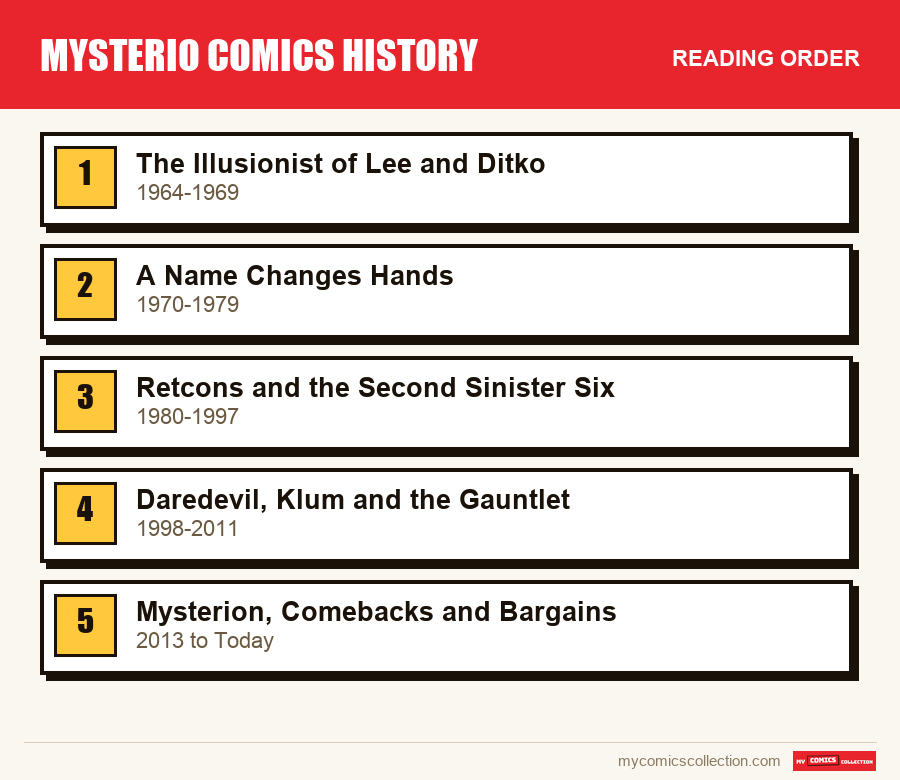
Era 1: The Illusionist of Lee and Ditko (1964-1969)
After his defeat in #13, Quentin Beck does not disappear. He returns in The Amazing Spider-Man Annual #1, dated 1964, where Doctor Octopus gathers several Spider-Man enemies to form the Sinister Six. Mysterio holds his place there alongside Sandman, the Vulture, Electro, Kraven and the team's leader. The story sets up a lasting pattern: Beck serves as the illusion specialist inside a coalition, which gives the character a function his physical rivals lack. Our guide to the best Sinister Six comics places this Annual within the team's history.
The regular series continues the thread. Mysterio is unmasked in Amazing Spider-Man #24, teams up with the Wizard in Amazing Spider-Man Annual #4, then returns in issues #66 and #67. That two-parter comes after Steve Ditko left the series: the character survives a change of art team, which shows his appeal does not depend on a single pencil line.
What changes for Beck in this period looks modest. He keeps his costume, his methods and his status as a serious but beatable enemy. Still, his appearances establish the grammar of all his future clashes: an elaborate plan, a visual spectacle, a hero who doubts his senses, then a flaw Spider-Man exploits. For the collector, this decade is the one of first appearances and annuals, issues from the original run that are shelved with the Silver Age period of Amazing Spider-Man.
Era 2: A Name Changes Hands (1970-1979)
The next decade is the strangest for the character, because it separates his name from his person. In The Amazing Spider-Man #141 and #142, the first of which is dated February 1975, Gerry Conway and Ross Andru introduce a second Mysterio, Daniel Berkhart, while Beck is in prison. The costume changes wearer, but the role remains: the illusionist has become a function any specialist can take on. Fans of the Bronze Age will find Gerry Conway on our page about the writer.
The end of the decade brings Beck himself back. Amazing Spider-Man #198 and #199 show him engaged in a scheme aimed at Aunt May's fortune, a con in which illusion is used to get money rather than to humiliate the hero. The character gains a seedier dimension here, that of a calculating criminal, far from the flamboyant fake crime-fighter of the early days.
Era 3: Retcons and the Second Sinister Six (1980-1997)
The 1980s introduce retroactive continuity. Peter Parker, the Spectacular Spider-Man #50 and #51 pit Mysterio against Spider-Man in a story about silverfish, and issue #51, "Aliens and Illusions!", published in 1981, is credited to Roger Stern on script, Marie Severin on pencils and Jim Mooney on inks. We learn there that Beck had been hired by the Tinkerer, the adversary of #2 from 1963: the retcon makes Mysterio and his men the fake aliens of that issue, which ties the character to the very beginnings of the series.
The rest of the decade sees Mysterio move through shorter stories. He appears in Amazing Spider-Man #311, and in Power Pack #55, where he is beaten by a team of kids, a humorous register that shows how much the character can change tone depending on the series that hosts him. The same costume lends itself both to family farce and to criminal scheming, which partly explains his staying power.
The following decade offers him a group comeback: Amazing Spider-Man #335 to #339 bring together a second Sinister Six around Doctor Octopus, where Mysterio resumes his place as the team's illusionist. He is then regularly called up for Spider-Man enemy line-ups, to the point of becoming a reflex member of these coalitions.
Do you collect this series?
Track what you own, what you are missing and what your collection is worth. 7-day trial.
Start my trial →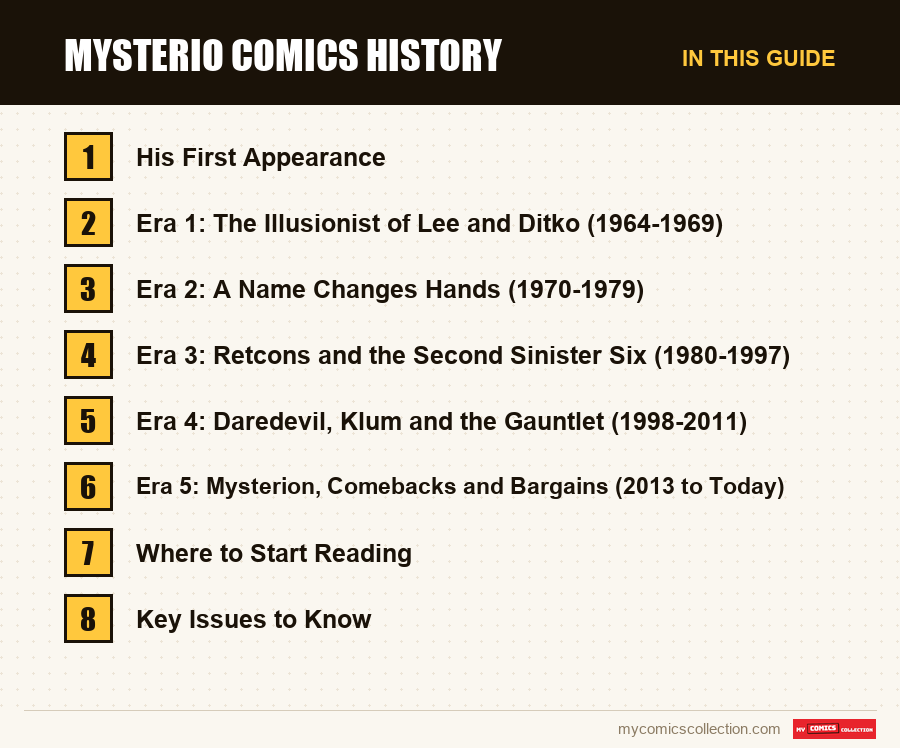
Era 4: Daredevil, Klum and the Gauntlet (1998-2011)
The turning point of the late 1990s happens outside Spider-Man's series. In Daredevil vol. 2 #1 to #8, published from November 1998 to June 1999, Kevin Smith writes the Guardian Devil storyline, drawn by Joe Quesada and Jimmy Palmiotti. Mysterio is the central villain, and this is where Beck's role changes in nature: he no longer tries to fool a crowd, he orchestrates a setup meant to make Daredevil doubt his faith, his friends and his own sanity.
Mysterio's role in the storyline is that of a stage director. He appears under a false identity, "Nicholas Macabes", and manipulates events to push Daredevil to the breaking point. Doomed by an inoperable brain tumor, he expects Daredevil to kill him on discovering the plot. Spoiler alert: Daredevil throws his lack of originality back at him, and Beck shoots himself at the end of the storyline. Doctor Strange steps in to purge the drug the cross handed to Daredevil was laced with, which explains this storyline's place in the history of Daredevil in comics, where Mysterio is not the subject but the instrument of a crisis.
The name outlives the character. The fishbowl changes heads again in 2002: Francis Klum, the third man to wear it, comes from the imagination of Kevin Smith and Terry Dodson, the duo behind the Black Cat miniseries that year. Beck, for his part, returns in Friendly Neighborhood Spider-Man #11 to #13, in a dark red version of his costume: sent to hell after his suicide, he claims his "superiors" in the afterlife sent him back to Earth to maintain a cosmic balance. Todd Nauck draws #12, where Beck unmasks.
Later, the Gauntlet cycle, in Amazing Spider-Man #618 to #620, brings back a Beck who claims to have faked his death and now works for the Maggia. The character has thus gone through a death, a supernatural return and a rational explanation, three states that show Mysterio is above all a character whose identity is negotiable, always shifting. Our Spider-Man hub gathers the issues from these cycles.
Era 5: Mysterion, Comebacks and Bargains (2013 to Today)
The 2010s diversify the Mysterio family further. Avenging Spider-Man #22, dated June 2013, introduces Mysterion, created by Christopher Yost and David Lopez. The character belongs to the same line of illusionists, but he is a reminder that the Mysterio title works like a brand several characters can carry, and that the publisher knows how to extend it. The Ultimate line also offers its own version, which turns out to be a series of robotic avatars piloted by the main-continuity Mysterio.
The recent period puts Beck back in the big villain teams. He appears in the new The Amazing Spider-Man series launched in 2018 under Nick Spencer's pen. Spoiler alert: tortured in hell, Beck gets out thanks to a bargain made by Harry Osborn, then Kindred kills him again so he will not reveal his identity too soon; he stays in Kindred's service when Doctor Octopus's Sinister Six re-forms as a prelude to Sinister War. Anyone approaching Beck through these recent stories will benefit from knowing #13 and the 1998 Daredevil storyline first.
Where to Start Reading
The best way in depends on the type of reader. Here are four doors, from the most classic to the most recent.
- The classics reader should start with Amazing Spider-Man #13, then the 1964 Annual #1. There they will find the concept in its purest form, in Steve Ditko's artwork.
- The reader curious about hidden stories should read Peter Parker, the Spectacular Spider-Man #50 and #51 (Roger Stern, Marie Severin, Jim Mooney), which tie Beck to the fake aliens of 1963.
- The adult reader who likes dark storylines should pick Daredevil vol. 2 #1 to #8 by Kevin Smith, Joe Quesada and Jimmy Palmiotti, where Mysterio drives a psychological thriller.
- The modern-series reader can pick up the Gauntlet storyline, Amazing Spider-Man #618 to #620, before moving on to the Nick Spencer era.
Whichever you choose, read in cover-date order rather than by collection number: the Stern-era retcons change the meaning of #2, and it is better to know the original before its reread.
Key Issues to Know
For Mysterio, the collecting checklist includes his 1964 birth, his costume handoffs and his most striking set pieces, identified by cover date and not by reputation.
- Amazing Spider-Man #13 (June 1964): the first appearance, by Stan Lee and Steve Ditko, to be placed just before the Green Goblin first appearance issue in a run of the series.
- Amazing Spider-Man Annual #1 (1964): the Sinister Six, an annual to be shelved with the other issues of the period.
- Amazing Spider-Man #141 (February 1975): the introduction of Daniel Berkhart, by Gerry Conway and Ross Andru.
- Peter Parker, the Spectacular Spider-Man #51 (1981): the fake-aliens retcon, by Roger Stern, Marie Severin and Jim Mooney.
- Daredevil vol. 2 #1 (November 1998): the opening of Guardian Devil.
- The 2002 Spider-Man/Black Cat miniseries: Francis Klum, with Kevin Smith and Terry Dodson.
- Avenging Spider-Man #22 (June 2013): Mysterion, by Christopher Yost and David Lopez.
Buying method: sort your copies by era first, spot the gaps, then judge each issue by its condition and the quality of the copy rather than the reputation of the title. Before paying for a #13 or a 1964 annual, check the corners, the spine and the cleanliness of the cover, then compare the listing against a free estimate. Post-2000 issues are easy to find; 1960s issues call for patience and a careful check of cover and corner condition.
Frequently Asked Questions
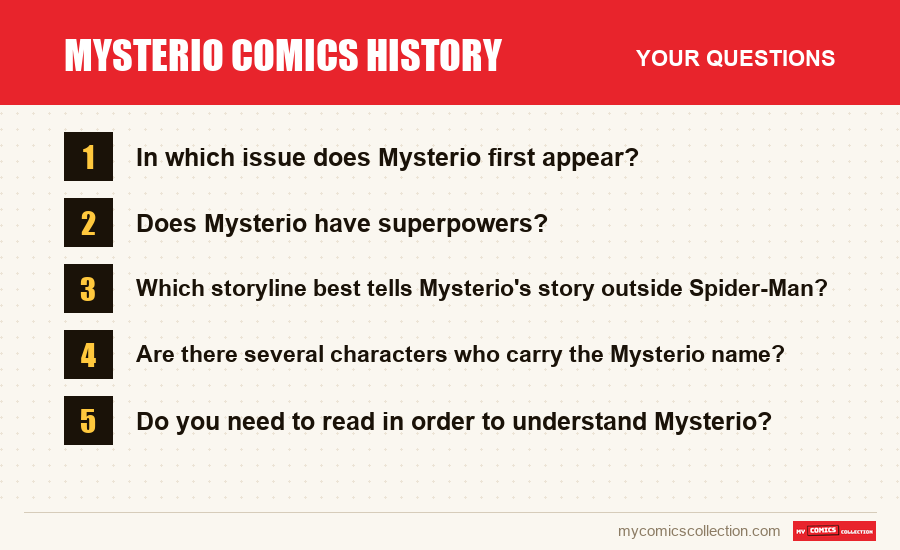
Beck debuts in Amazing Spider-Man #13, a June 1964 issue created by Stan Lee and Steve Ditko. Beck first plays the crime-fighter, then Spider-Man unmasks the special effects technician who wanted to pin robberies on him. A later revelation ties him to the fake aliens of #2, but #13 remains the reference.
No. Quentin Beck is a former special effects technician: his weapons are holograms, smoke, drugs and rigged sets. This lack of powers is the very definition of the character, since his whole threat rests on preparation and staging, not on strength.
The Guardian Devil storyline, in Daredevil vol. 2 #1 to #8 (November 1998 to June 1999), written by Kevin Smith and drawn by Joe Quesada and Jimmy Palmiotti. Under the name Nicholas Macabes, Mysterio maneuvers against Daredevil. The story belongs first to Daredevil, but Beck plays the architect.
Yes. Quentin Beck is the original Mysterio, Daniel Berkhart takes over the costume in Amazing Spider-Man #141 and #142 (Gerry Conway and Ross Andru), and Francis Klum arrives in 2002 with Kevin Smith and Terry Dodson. Mysterion, created in 2013, belongs to the same line.
Not strictly. Each storyline reads on its own, but cover-date order keeps you from reading a retcon before the original. Start with #13 and the 1964 Annual #1, move on to Daredevil vol. 2 #1 to #8, then to the recent comebacks, to see why the character leaves such a mark.
Found Mysterio in your longboxes? Get your copy of Amazing Spider-Man appraised before you put it away.
Estimate my comic