
In short
Ms. Marvel #1 is cover dated January 1977. Gerry Conway wrote it and John Buscema drew it, and the pair are credited with creating the Ms. Marvel identity. It is the issue in which Carol Danvers takes the name Ms. Marvel and gets her own series, yet it is not her debut, which belongs to Marvel Super-Heroes #13 from March 1968. Value follows from that distinction, plus condition and restoration.
Collectors searching for the value of this issue are usually asking one question under another: is this the book where Carol Danvers begins, or the book where something else begins? The honest answer is the second. Ms. Marvel #1 opens a series and a superhero identity, and it sits several years after the character first walked onto a page. Knowing which of those two events a copy represents is the first step in pricing it, so this guide is organized around the issue itself and around what to check before buying a copy.
The credits, the January 1977 cover date and the plot points below were verified before writing; the reading of them for a buyer is our own. No amount appears here, because a figure from one sale says little about the next copy, and a method travels further than a number.
The identity of the issue
Ms. Marvel #1 carries a January 1977 cover date. Gerry Conway wrote it and John Buscema drew it. Conway scripted only the first two issues of the series, while Buscema stayed on as artist through issue #3, so the opening issue belongs to a short Conway and Buscema stretch at the very start of the run.
When you describe a copy to a buyer, or to a grading company, that pairing is the credit to use: Conway wrote it and Buscema drew it. A listing that prints a longer list of inkers, colorists or cover artists is offering something to check against the book in hand, not a selling point of the copy.
The issue is the first of a series that runs 23 issues, from January 1977 to June 1979. A run of 23 numbers is a short, finite target for a collector, and that shapes how you plan a set.
What happens in the issue
In the series, Carol Danvers is the editor of a women's magazine spun off from the Daily Bugle, a features writer turned editor who gets little warmth from J. Jonah Jameson. As Ms. Marvel she fights the Scorpion, and the opening stories make a point of her amnesia: the heroine does not know where her powers come from. We stay at the level of plot summary on purpose, because there is no need to reproduce dialogue or pages to understand why the issue matters.
What matters for a collector is the shift in setting. Carol had been introduced as security chief of a restricted military base, and the first issue places her in a magazine office with a superhero identity of her own. That change is one of the clearest signs that the book was designed as a fresh start and not as a continuation of the Mar-Vell stories.
Why it is not her first appearance
The book a buyer should set beside this one is Marvel Super-Heroes #13, where Roy Thomas and Gene Colan brought Carol in with a March 1968 cover date. There she is the security chief of a restricted military base. She does not wear a costume and she has no name beyond her own. Mar-Vell himself debuts a number earlier, in Marvel Super-Heroes #12, which has its own page in our guide to the Mar-Vell debut.
The distinction is not academic when you are buying. A listing that calls Ms. Marvel #1 her first appearance without a qualifier is pointing at the wrong book, because the debut of the character is the 1968 issue. Marvel Super-Heroes #13 and Ms. Marvel #1 are priced as different collectibles because they answer different demands, one for a debut and one for the start of a heroine's identity. A buyer who confuses them can pay the wrong price for either one.
The bridge between the two books is a third one. In Captain Marvel #18 (November 1969), an explosion merges Carol's DNA with Mar-Vell's, and the 1977 series builds on it: the energy released by a device called the Psyche-Magnetron made her a human and Kree hybrid. A Carol Danvers shelf therefore has three early stops, the 1968 debut, the 1969 explosion and the 1977 identity.
Who made it and in what context
Gerry Conway wrote the opening issues, and Conway's other work is a useful companion for anyone who likes the period. The series' letters page, titled "Ms. Prints", carried letters debating whether or not the character was feminist, which tells you how readers of the time received the launch.
Conway wrote issues #1 and 2, and with issue #3 Chris Claremont took over as writer for the rest of the run, through #23. The art changed hands during the series as well, and Dave Cockrum drew issues #20 and 21. Claremont's name on the series is a significant part of its later reputation, since Claremont also brings Mystique into its pages.
Why #1 is a key issue
The case for the issue is built from several facts that can be checked. It is the first number of Carol Danvers's own series. It is the issue in which she is named Ms. Marvel. It launches a run that includes the debut of Mystique in Ms. Marvel #16, from 1978, covered by our Mystique debut guide. And it starts a character line that continues through the Avengers, the X-Men and, from 2012, the Captain Marvel title.
Compare it with the usual reasons a #1 earns its place: a character debut, an origin, a death, or a creative milestone. Here the reason is an identity. The name Ms. Marvel is what the issue gives Carol Danvers, nine years after her first appearance, and the series it opens is the one Claremont went on to write for twenty-one issues.
Do you collect this series?
Track what you own, what you are missing and what your collection is worth. 7-day trial.
Start my trial →
What drives the value of a copy
Four factors matter, and the order is a useful way to approach any listing. First, which issue is it: a copy of #1 of the 1977 series, as opposed to the 2014 launch that shares the title. Second, the physical grade. Third, whether the copy has been restored. Fourth, whether the grade and any restoration note are certified on a label.
Grade on a mass-market comic from the 1970s is judged on spine stress, corner wear, cover gloss and color breaks, staple condition, page color and centering. On a cover printed with strong, saturated color, a white crease or a chipped corner shows readily. Ask for photographs under raking light and look at the spine from the side as well as the front.
Restoration is the factor that most often separates a copy that looks right from one that is right. Pressing, cleaning, color touch and tear repair all affect how a copy is described. A label that records restoration tells you openly, and a raw copy that looks unusually clean for its age deserves a direct question. You can afford to wait for a copy with a clear history.
Certification is the fourth factor. A label does two things for this particular book: it confirms the edition and the grade, and it makes the copy comparable to others. Compare sold results for certified copies of the same grade and the same restoration status, not asking prices, and compare them to this issue alone and not to the 1968 debut or to the 2014 relaunch.
Numbers that get confused with it
Three books share part of this issue's name or subject. Marvel Super-Heroes #13 (1968) is the debut of Carol Danvers. Ms. Marvel #1 from 2014, with Kamala Khan, is a different character and a different book, and it has its own page in our Kamala Khan collector guide. The Captain Marvel series written by Kelly Sue DeConnick, launched in July 2012, gives Carol the Captain Marvel name.
All three are legitimate collectibles, and none of them is the 1977 issue. When a listing says only "Ms. Marvel #1", check the year on the cover, the credits and the character before you read the price. The volume number, the publisher's indicia and the creators are the three details that settle the question in a few seconds.
Before you buy: a short checklist
Check the cover and indicia first: the year, the volume, the issue number and the cover date. Then examine the spine, corners and edges for the wear that a 1970s newsstand book typically shows. Confirm that the editorial page is present and that the interior pages are the same issue as the cover.
Ask the seller whether the copy is certified, whether it has been pressed or restored, and for full-resolution photographs of the front, back and spine. If the copy is raw, decide in advance what you will do if a grading company comes back with a lower grade or a restoration note than the listing implied. A return policy that covers that case is a reasonable condition for a purchase.
If you collect Carol Danvers by character, the efficient sequence is to buy the debut in Marvel Super-Heroes #13 and this issue as a pair, and to look at the other books of the period only after that decision. If you collect by series, decide how far into the run you want to go before you start. A run to #23 is a small, finite target.
The appearances that follow
Four numbers are the ones to know after the first issue. Ms. Marvel #16 (1978) brings the first appearance of Mystique, created by Claremont and Cockrum, whose true appearance is revealed in Ms. Marvel #18 (1978). The Avengers #200 is the issue in which Ms. Marvel is kidnapped by a character named Marcus. The Avengers Annual #10 (1981), written by Claremont, is the follow-up to that story and the issue in which Rogue permanently absorbs Carol's abilities and memories. The Uncanny X-Men #164 (December 1982) turns her into Binary, after the alien Brood experiment on her.
That sequence is a good outline for a Carol Danvers shelf: the debut, the series, the Marcus story and its answer, and the cosmic turn. The full story of the character is told in our Carol Danvers history, and the reading selection is in the where to start guide; this page stays with one number.
Frequently asked questions
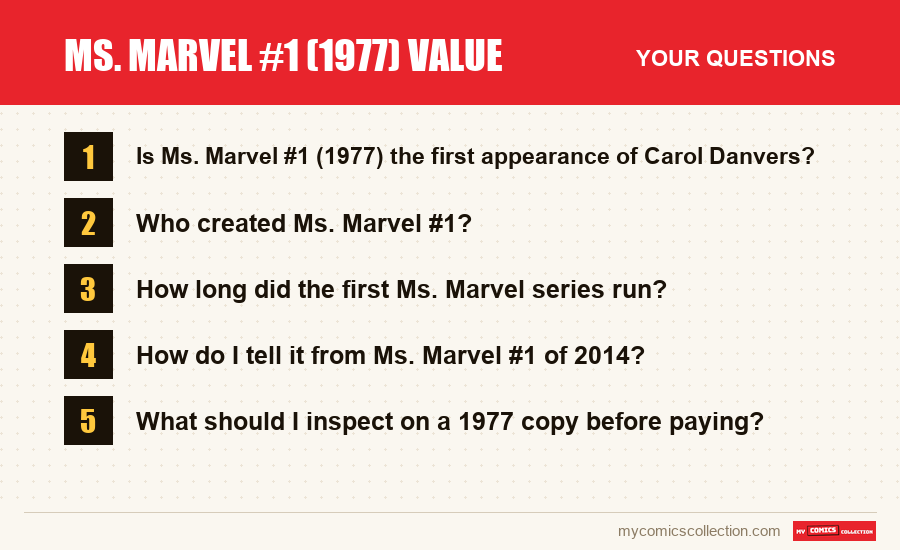
No. The character first shows up in Marvel Super-Heroes #13, an issue that Thomas scripted and Colan drew for March 1968. Ms. Marvel #1 from January 1977 opens her own series and is the issue in which she takes the name Ms. Marvel.
The 1977 book is a Gerry Conway script with John Buscema art, and that pair created the heroine called Ms. Marvel. Conway wrote only issues #1 and 2 before Chris Claremont took over, while Buscema drew the first three issues. Carol Danvers herself was created earlier by Roy Thomas and Gene Colan.
The series that began in January 1977 runs 23 issues and ends in June 1979. Chris Claremont writes it from issue #3 to the end, Dave Cockrum draws issues #20 and 21, and issue #16 brings the first appearance of Mystique, so the short run holds more than one collectible number.
Check the year, the character and the credits. The 1977 issue stars Carol Danvers and is credited to Gerry Conway and John Buscema. The 2014 issue stars Kamala Khan and is a separate series, covered in its own collector guide, so the two should never share a price comparison.
Confirm the year and cover date, then inspect the spine, corners and staples, and ask whether the copy has been pressed or restored. A certified label that records grade and restoration is the strongest proof, and sold results for the same grade are a better guide than asking prices.
If you own a copy of Ms. Marvel #1 from 1977, get a free estimate once you have confirmed the year and the cover date.
Estimate my comic