
A move, even a well-organized one, is an ordeal for a comic collection. The pressure on boxes, summer truck heat, the humidity of a temporary basement, or simply a mistimed movement at loading: each step represents a real risk.
A move, even a well-organized one, is an ordeal for a comic collection. The pressure on boxes, summer truck heat, the humidity of a temporary basement, or simply a mistimed movement at loading: each step represents a real risk. For an ordinary collection, a crumpled comic is an annoyance. For a collector with CGC 9.8s, Silver Age key issues, or slabs carefully preserved for years, it's a serious financial and emotional loss.
This guide walks you step by step through organizing your collection's move without damage: from supplies prep to reorganizing at your new home.
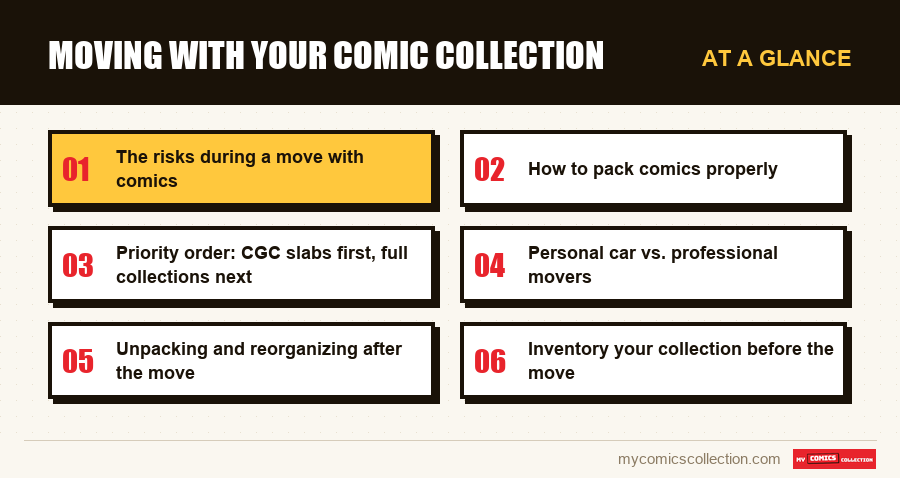
The risks during a move with comics
Double-wall reinforced moving boxes
Comic longboxes themselves must go inside reinforced (double-wall) moving boxes. A standard box gives way under pressure and weight. Prefer "book size" boxes: they're sized for heavy, dense loads.
Thick bubble wrap and polyethylene foam
For CGC slabs and out-of-slab valuable comics, thick bubble wrap (10mm bubbles minimum) and polyethylene foam sheets are essential. Avoid newspaper: printing ink can migrate onto light covers.
Silica gel packets and a hygrometer
Slip moisture-absorbing packets into each box during transport, especially if you're crossing a humid period or your stuff is in temporary storage. A small digital hygrometer (under $11) lets you check destination storage conditions.
Labels and permanent markers
Label each box with its contents (e.g., "Amazing Spider-Man #1-100," "CGC slabs, FRAGILE"), required vertical position ("THIS SIDE UP"), and unload priority. This detail saves hours searching for a specific comic after the move.
How to pack comics properly
Good packing follows simple logic: each comic in its bag with its board, upright in a longbox, and the longbox properly braced so it doesn't tip during transport.
Common comics
For comics in standard bag & board, verify the board is in good shape (not bent, not humid) before packing. Fill longboxes with no empty space: comics that "tilt" to one side corner themselves. If a longbox isn't full, add acid-free cardboard dividers to fill the gap.
Valuable raw (ungraded) comics
For comics you keep raw but in very good condition, add extra protection: a bubble wrap envelope around the mylar sleeve, then store in a dedicated shortbox. Label the box: "Open first, fragile comics."
CGC slabs
Each slab must be individually wrapped in thick bubble wrap, held upright in a box with foam separators between each copy. Never lay slabs flat: the weight of a slab on another can cause micro-fractures on the case or mark the cover through the plastic wall. A slab box should never exceed 8-10 copies to stay manageable and secure.
Priority order: CGC slabs first, full collections next
During a move, clearly establish a handling hierarchy by value and fragility:
- Priority 1: CGC slabs: transported in your personal vehicle, never in the truck. Dedicated box on the passenger seat or in the trunk, braced so it doesn't move.
- Priority 2: High-value raw key issues: in their own shortbox, labeled, transported with you or in the truck's first load. These boxes should never end up under other boxes.
- Priority 3: Complete collections and runs: in standard longboxes, well-labeled, loaded last in the truck to be unloaded first.
- Priority 4: Common and reading comics: they can tolerate more handling. Store in well-filled longboxes and load without special priority.
If you've insured your collection, photographically document each box's state before loading. These photos are valuable in case of a dispute with a professional mover.
Collecting this series?
Track what you own, what you are missing and what your collection is worth. 7 day trial.
Start my trial →Personal car vs. professional movers
The transport mode question deserves thought based on your collection's value:
Personal car
The safest solution for valuable pieces. You control temperature (A/C), absence of violent shocks, and box orientation. Ideal for CGC slabs, rare key issues, and high-value mylar-kept comics. Limit: capacity: a car can comfortably transport only 3-4 longboxes.
Professional movers
For the main collection volume, often unavoidable. Some precautions:
- Explicitly inform the mover that certain boxes contain valuable collectibles, request they be marked "FRAGILE" and loaded last (unloaded first)
- Avoid intermediate storage in summer if possible
- If the truck must park overnight, ask about conditions: covered parking or sun-exposed?
- Never accept your comic boxes being placed under appliances, heavy furniture, or other bulky items
Unpacking and reorganizing after the move
Unpacking is an often-neglected but equally important step. Resist the temptation to pull everything out fast: take time to check each lot's condition.
Start with priority boxes. Open each longbox and review the comics, particularly the first and last in the box (those taking the most pressure). For CGC slabs, check case integrity, absence of condensation inside, and label in place.
It's also the ideal moment to update your inventory in your collection management app. Take advantage of all your comics passing through your hands to fix conditions, add forgotten issues, and flag any damage. If a comic was damaged in transport, photograph it immediately for your insurance.
Finally, before permanently storing your longboxes in their new location, check room conditions: humidity, direct light exposure, proximity to heat sources. A simple hygrometer gives you measurements in minutes. Aim for 45-55% relative humidity and below 68°F (20°C) for optimal preservation.
FAQ: Moving with a comic collection
Inventory your collection before the move
My Comics Collection lets you catalog, value, and document each comic in your collection: an essential base before, during, and after a move.
Start the 7-day free trialNo commitment · Cancel anytime · Instant access