What has been transmitted from this work is not primarily a graphic style: it is the demonstration that an editorial model could hold up. A horror series in dominant noir, based on obscure folklore, owned by its author and published outside the big houses: no one knew that such an object could last thirty years. The feature has been copied extensively and often poorly; the model has been taken up by authors whose books do not resemble it at all.
Distinguishing these two legacies helps us understand why so many graphic imitations failed while real influence flourished elsewhere.
The sections that follow separate what has been passed down from what has only been copied, examine how to recognize real lineage, and discuss what this means for building a shelf around that vein.
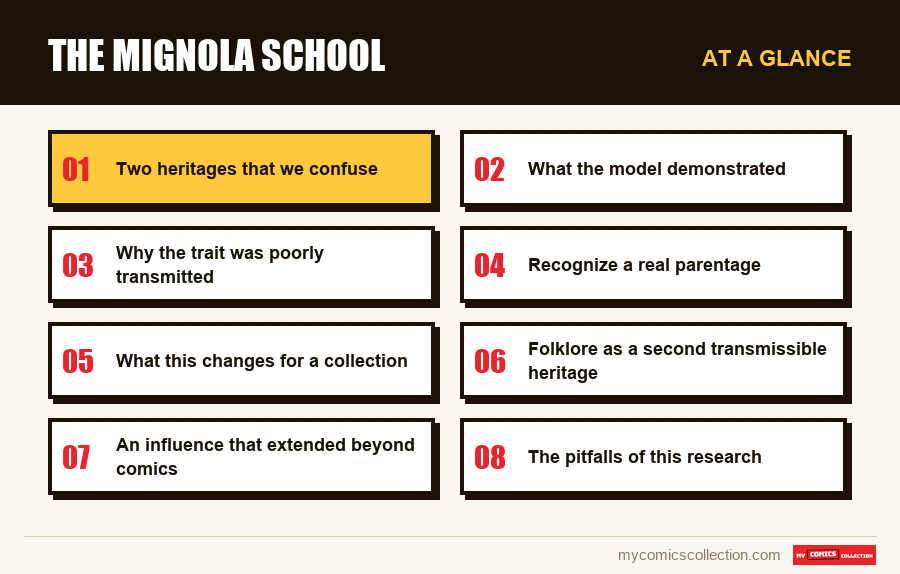
Two heritages that we confuse
Making the distinction settles most of the discussions on this subject.
The visible legacy is graphic: flat black areas, angular silhouettes, half-hidden faces. It can be found on a plate, copied effortlessly, and abounds in the production of the last twenty-five years.
The invisible legacy is economical and editorial: an author can own a genre series, publish it outside the big houses, turn it into a sustainable universe, and make a living from this activity for decades.
The second is the most consistent and leaves no stylistic trace. A book entirely different in appearance may fall under this lineage., and a board that looks exactly like it may not belong to any of them.
Most comments only talk about the first one, because it's obvious. It's also the least interesting.
What the model demonstrated
That a minor genre could last
Fantasy horror was considered a narrow niche, good for short series. Thirty years of continuous publication have shown otherwise.
This is the most useful demonstration for subsequent authors.
That an author could keep everything
Design, ownership, direction of the universe and choice of collaborators remaining in the hands of the creator, over time and without interruption.
That a universe could expand without being diluted
The branching into numerous titles has not produced the usual fading, because the orientation has remained centralized.
Qu'on pouvait conclure
The series ended, which showed that an ending was compatible with continued exploitation of the universe.
Why the trait was poorly transmitted
The question has already been addressed from a technical angle: what is copied is the appearance, not the composition. There is a second reason, this one economic.
A drawing in large flat areas is quick to execute. For an editor trying to keep a schedule, this is an argument, and for a busy designer, a solution.
The style was therefore adopted by people who did not want the result but the speed. This produces exactly what we observe: dark pages, quickly made, without the composition that would justify the blacks.
The original was slow despite its apparent economy: deciding where to place a mass takes time that filling it doesn't. Copying an economic method without copying the decision work amounts to keeping only what costs little, and the result is reflected.
This is why the period has produced many pages that look the same and few that work.
A necessary nuance so as not to be unfair. Several authors have worked with dominant blacks before this work, in engravings, posters, or the comic strip itself.
Talking about school therefore does not mean that this device is a personal invention. It means that a work has made it visible and desirable to a generation, which is a different and perfectly real contribution.
Recognize a real parentage
Three signs make it possible to distinguish a worked heritage from a surface borrowing, and they are applicable to any board.
The relationship between black and white. A real filiation retains as much clear white as clear black. A surface borrowing accumulates blacks and grays until they saturate the page.
Le traitement du hors-champ. The original method shows little and suggests much. A loan shows as much as an ordinary production, just darker.
Le rapport au matériau. A sophisticated lineage draws on real sources and refuses to explain them; a loan invents its creatures and presents them to the reader.
These three criteria converge towards the same question: did the author take up a constraint, or only an appearance? A constraint is seen in what it prohibits; an appearance to what it adds.
What this changes for a collection
A collector who appreciates this vein and wants to expand it comes up against a concrete problem.
Searching by appearance doesn't work. The recommendations available are almost all based on graphic resemblance, which leads straight to surface borrowings: numerous and generally disappointing.
Searching by publisher works best. The houses which have published this vein with conviction have welcomed other authors working in the same spirit, without necessarily the same trait.
Searching by collaborators works best. The designers, colorists and co-authors who have passed through this universe have carried out projects elsewhere, where we find the method rather than the appearance.
This last avenue is by far the most productive, and it's the one that no one follows. She asks to keep the list of speakers rather than that of titles, which no current catalog encourages.
Folklore as a second transmissible heritage
An element is transmitted better than the trait and less well than the economic model, and it deserves to be isolated.
Employing real folk traditions rather than invented mythology is a method, not a style. It is learned, it is worked, and it gives very different results depending on the hand: which is the sign of a successful transmission rather than a copy.
Several authors have adopted this approach without taking anything from the drawing, drawing on entirely different regional corpora. The result looks nothing like the original and yet comes from the same decision.
This is probably the most fruitful filiation, because it gives access to inexhaustible material without imposing any aspect. An author who uses the method remains free in his line; an author who repeats the line has gained nothing in terms of material.
It is also the most difficult to spot from the outside, which explains why we talk about it so little. Nothing on a cover indicates that a story is based on documented sources rather than an invention.
Collecting this series?
Track what you own, what you are missing and what your collection is worth. 7 day trial.
Start my trial →An influence that extended beyond comics
A final observation, which goes beyond the scope of the medium and sheds light on the extent of the phenomenon.
The combination found here (investigation into supernatural affairs, dedicated organization, folklore used without explanation, dry tone) has become a recognizable formula in several story formats produced since.
Attributing this diffusion to a single work would be excessive: the formula has several sources and ancient antecedents. But it is difficult not to note that it spread after a particularly visible demonstration of its effectiveness.
For a reader, the interest of this observation is practical: the vein is not limited to comics, and related stories are also found in other formats, where they are often better referenced.
It is an additional avenue to broaden a reading, and it has the advantage of not depending on comic book catalogs, which do not group these works together.
The pitfalls of this research
The dark confused with filiation
Many black series have nothing to do with this method. Graphic obscurity is not a criterion.
Les comparaisons commerciales
“For lovers of” is a sales pitch, not an indication of actual kinship.
Imitation by speed
Quickly made pages take on the appearance without the composition. It is the most abundant production of this vein.
Series without a market
These titles sell poorly and are difficult to find, due to not being listed as a set.
Finally, let us note a practical consequence of this absence of grouping. These related books do not form an identified collection, do not bear any common mention and do not appear in any keyword search. They therefore circulate at the price of ordinary securities, without membership premium, which is excellent news for those who know how to spot them and a real difficulty for everyone else.
What influence cost the original
A feedback effect deserves to be noted, because it affects the perception of the work itself.
When a device is massively copied, it ends up appearing banal: including to the person who made it visible. A reader who discovers the original after twenty years of imitations may find it suitable, while looking at the source.
This is the usual fate of influential works, and it's particularly sharp here because the copied element is immediately visible. An influence on structure or rhythm would wear out less quickly.
The solution, for a reader today, consists of looking at what the imitations have not picked up: the restraint of the off-camera, the balance with the white, the refusal to explain. These are the expensive elements, therefore the least copied, therefore the most revealing.
They are enough to reestablish the gap between the source and what it produced.
What to record
To expand a collection along this vein, the record should follow people rather than titles.
The contributors to each book (designer, colorist, co-author) made into a searchable list. This is the only avenue that goes back to truly related works, since collaborators who have passed through this universe lead projects elsewhere where the method is found without the appearance. No catalog organizes information in this sense.
A collector who keeps this list discovers books that no recommendation would have suggested, and avoids those that all recommend.
Your appreciation of parentage, noted in one word for each acquisition: method repeated, or appearance only. This distinction is subjective and it will only exist if you formulate it, yet it is the only one that makes the vein navigable.
These two fields organize research that the market does not structure, for lack of a name under which to group these books.
Frequently asked questions
Not the style, but the demonstration that an author could own a genre series, publish it outside the big houses, turn it into a lasting universe and make a living from this activity for decades. This heritage leaves no graphic trace: a book with an entirely different appearance may reveal it.
Because a drawing in large flat areas is quick to execute, and it was therefore adopted by people who wanted the speed and not the result. The original was slow despite its apparent economy: deciding where to place a mass takes time that filling does not.
By three signs: as much pure white as pure black, a truly exploited off-camera, and material drawn from real sources left unexplained. They all come back to a single question: has the author adopted a constraint or an appearance? A constraint is seen in what it prohibits.
By the collaborators, not by the appearance. The designers, colorists and co-authors who have passed through this universe carry out projects elsewhere where the method is found. Searching through graphic resemblance leads, on the contrary, straight to surface borrowings, numerous and disappointing.
This is the risk, and it is the usual fate of massively copied works: all the more clear here as the copied element is immediately visible. The parade consists of looking at what the imitations have not taken up: the restraint of the off-camera, the balance with the white, the refusal to explain.
Who worked on this book?
It is the trail that leads back to truly related works, and no catalog organizes it.