
In short
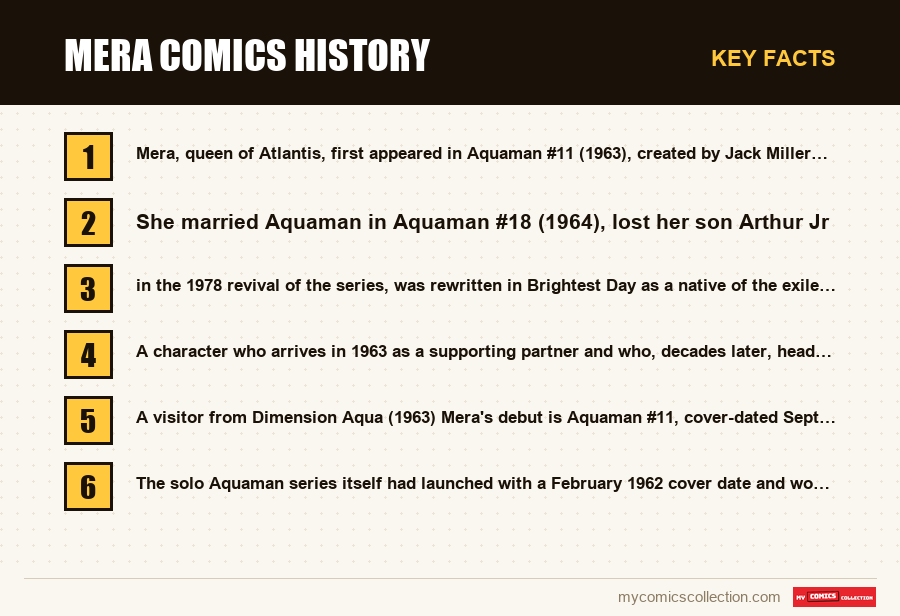
Mera, queen of Atlantis, first appeared in Aquaman #11 (1963), created by Jack Miller and Nick Cardy, as a woman from a water-based realm called Dimension Aqua. She married Aquaman in Aquaman #18 (1964), lost her son Arthur Jr. in the 1978 revival of the series, was rewritten in Brightest Day as a native of the exile colony Xebel, and gained her own miniseries, Mera: Queen of Atlantis, in 2018.
For most of her history Mera has been introduced as someone's wife, and that is exactly why her trajectory is worth following in order. A character who arrives in 1963 as a supporting partner and who, decades later, headlines a miniseries and appears on screen has moved a long way, and the route is not straight. She has been a queen, a grieving mother, a woman institutionalized after a breakdown, a Red Lantern deputy, an ambassador and a mother again.
Mera's Jack Miller and Nick Cardy debut, her wedding issue and every later credit and cover date here were confirmed, while any name we could not confirm stays out. The reading of what each change means for her is our own analysis, and no dialogue or pages are reproduced.
A visitor from Dimension Aqua (1963)
Mera's debut is Aquaman #11, cover-dated September 1963, created by Jack Miller and Nick Cardy. The solo Aquaman series itself had launched with a February 1962 cover date and would run fifty-six issues until 1971, so Mera arrives early in that run, when the book was still deciding what its world looked like. Her homeland is Dimension Aqua, a place defined at the time more by its distance from Earth than by detail. Her backstory there involves Leron, who usurps her kingdom; Aquaman later frees her from his captivity, a piece of history that Action Comics #539 (January 1983) revisits two decades on.
That vagueness is a feature, not an accident. It lets Miller and Cardy introduce an equal for Aquaman, a person with her own power and her own home, rather than a human rescue subject. Her ability is hydrokinesis, and the solid hard water constructs she shapes became her visual signature. The collecting consequence is worth stating: the debut issue is a character first appearance, not a story that tells you much about her, and the reading pleasure of her early years lies in the issues that follow it. For a detailed look at the era, the Aquaman Silver Age key issues guide covers the series around her debut.
Marriage and family in the Silver Age (1964 to 1971)
The relationship moves quickly. In Aquaman #18, cover-dated December 1964, Aquaman and Mera marry, in what is counted as the first superhero wedding shown on camera in comic book history. It tied Mera to the throne of Atlantis for good, since her husband was the king, and from then on her story could not be separated from his without a deliberate decision to separate them.
The series then expands her circle. Aquaman #22 (July/August 1965) brings in her twin sister Hila, who turns to villainy as Siren, which gives Mera a mirror and a family conflict that does not involve Atlantis. These two issues set the template the character follows for decades: a wife and queen with her own origin in another realm and her own relatives outside Aquaman's circle. The couple soon have a son, Arthur Jr., nicknamed Aquababy. The first run ended in 1971 after fifty-six issues, but the pattern it set did not.
Aquababy and the breakdown (the late 1970s)
The Silver Age wife becomes a tragic figure when the series returns in the late 1970s, a revival that ends after just seven issues with #63 in 1978. In Aquaman #60 (February/March 1978), Black Manta kidnaps the infant and seals him in a suffocating tank. Across Aquaman #57 to #62 (1978), Mera searches for a healing device, Leron returns, and she arrives too late to save her son. Grief makes her unstable, and Vulko later has her institutionalized. Here the character's emotional interior drives the story, and the loss shapes how later writers use her: the 1980s stories that follow are built on it.
That change matters for how collectors read the character. The wedding issue (#18) and the loss storyline (#57 to #62) bracket Mera's early life, and the books around the loss are the easiest way to see how far her role had moved from a supporting hero's partner.
Madness, a wound and a return to Dimension Aqua (1986 to 1991)
The 1980s reorganized Aquaman himself, with a four-issue Aquaman (volume 2) miniseries written by Neal Pozner, running from February to May 1986, that put him in a largely deep-sea blue camouflage costume, and a 1989 Aquaman Special written by Robert Loren Fleming, with plots and breakdowns by Keith Giffen and full pencils by Curt Swan. The five-issue Aquaman (volume 3) miniseries of 1989 is where Mera's grief takes its most extreme form: she is driven insane by the death of Arthur Jr. In the finale, Aquaman (volume 3) #5 (October 1989), she attacks Aquaman, he impales her, and she survives and returns to Dimension Aqua to resume her duties there.
That exit takes the character off the Aquaman stage for a while, and a new ongoing Aquaman (volume 4) that began in 1991 was cancelled after thirteen issues. For a reader who wants to see how a supporting wife becomes a person with her own agency, the late 1980s are the hardest years, but also the ones that give the later reconciliations their weight.
The queen returns in the 1990s (1993 to 2001)
The 1990s bring a stronger Aquaman and a recovered Mera. Aquaman: Time and Tide, a four-issue miniseries of 1993 and 1994, is written by Peter David, and further explains Aquaman's origins. David then wrote the ongoing Aquaman (volume 5), launched with #1 (August 1994), for nearly four years, leaving after #46 (July 1998), with Erik Larsen taking over from #50 (December 1998) and Dan Jurgens from #63 (January 2000). The series ended with #75 in January 2001. During this run Mera is found in the Netherworld, brainwashed by Thanatos and with a son called AJ, and she comes back once again sane from the dimension where she had been trapped, restored as a character who can act on her own account.
The arrangement matters because the 1990s are the decade when Aquaman's own mythology was rebuilt. The best summary of that restructuring is in the guides to the era, including our ranking of the best Aquaman runs, and Peter David has his own page at Peter David comics. In this period Mera is no longer defined by loss alone; she becomes someone who has recovered from it.
Do you collect this series?
Track what you own, what you are missing and what your collection is worth. 7-day trial.
Start my trial →
Blackest Night, Brightest Day and the Xebel rewrite (2009 to 2011)
Mera's biggest retcon comes in the event years. In Blackest Night #6 (December 2009) she is named a deputy officer of the Red Lantern Corps, the rage-driven corps of that event, a choice that draws directly on her years of grief. In Brightest Day #6 (July 2010), the origin is rewritten: Dimension Aqua is revealed to be Xebel, a sealed penal colony reached through a portal in the Bermuda Triangle, and Brightest Day #16 (December 2010) continues the thread through the Kaldur'ahm storyline.
That rewrite does two things. It gives her a political relationship to Atlantis instead of a mystical one, so that her marriage to the king becomes something with a history, and it supplies the conflict of belonging that later writers use. For a collector, it also means that two versions of her origin sit in the same character: the 1963 realm and the revised Xebel. When you read across eras, treat Dimension Aqua as the Silver Age name and Xebel as the later explanation.
Flashpoint and the New 52 (2011 to 2016)
In Flashpoint: Emperor Aquaman #1 (June 2011) and #2 (July 2011), with Flashpoint: Wonder Woman and the Furies #2 (July 2011), an alternate Mera is killed by Wonder Woman, which leads that timeline's Aquaman to declare war on Themyscira. The main continuity restarts in September 2011 with Aquaman (volume 7) #1, started by Geoff Johns, Ivan Reis and Joe Prado. The series ran until #52 in 2016, and Mera is a regular in it: in Aquaman (volume 7) #2 (October 2011) she is mistakenly taken for a mermaid, and by #8 (February 2012) Black Manta is hunting Atlantean artifacts around the couple.
The run is also the point where Mera is most visibly a partner rather than a spouse: she is a fighter and a hero in her own right. The comparison of the 2018 film with its comics inspirations shows how closely the screen version draws on this period.
Rebirth and her own series (2016 to today)
In the Rebirth era Mera becomes Aquaman's fiancée rather than his wife. The Aquaman series (volume 8) opens with the one-shot Aquaman: Rebirth #1 (August 2016), keeps Dan Abnett as writer and ends with #66; after the Thule crisis, Arthur names Mera the ambassador of Atlantis to the surface. Mera: Queen of Atlantis, written by Dan Abnett, then runs from February to July 2018 as her own limited series, which gives her an unusual publishing status for a character who debuted in a supporting role.
Later stories have Mera give birth to a daughter, Andy, shortly after a coma caused by using her power, and the couple finally marry at what was originally planned as a welcome back party for her. The latest Aquaman series began in January 2025 as part of DC All In, so the story remains active. On screen, Amber Heard played Mera in Justice League (2017), with a cameo in Zack Snyder's Justice League, in Aquaman (2018) and in Aquaman and the Lost Kingdom (2023).
The key issues across her history
- Aquaman #11 (1963): the debut of Mera, by Jack Miller and Nick Cardy.
- Aquaman #18 (1964): the marriage of Aquaman and Mera.
- Aquaman #22 (1965): the introduction of her twin sister Hila, later Siren.
- Aquaman #60 (1978): Black Manta kidnaps Aquababy, inside the #57 to #62 storyline that ends with his death.
- Aquaman (volume 3) #5 (1989): impaled by Aquaman, she survives and returns to Dimension Aqua.
- Blackest Night #6 (2009): she is named a deputy officer of the Red Lantern Corps.
- Brightest Day #6 (2010): Dimension Aqua is revealed to be Xebel.
- Mera: Queen of Atlantis (2018): her own miniseries, written by Dan Abnett.
The list is a map of status changes: guest, wife, mother in grief, patient, Red Lantern, exile from Xebel, headliner. A collector who owns only the debut has the origin but not the arc.
How to collect Mera
Start with the Silver Age pair, Aquaman #11 and #18, then add the Peter David run for the restored character and the New 52 volume for the modern one. Because Mera appears across a long list of Aquaman books and crossovers, the practical method is to keep a numbered list by series and year, so that an issue where she is only a cameo does not get confused with one that changes her story.
Watch the volume numbers: the Aquaman title has restarted many times, and a cover that says #1 can belong to 1962, 1986, 1989, 1991, 1994, 2011 or 2025. Check the cover year before you buy, and keep her miniseries as a separate shelf. The Aquaman reading order helps with the sequence.
Frequently asked questions
Mera debuts in Aquaman #11, cover-dated 1963, created by writer Jack Miller and artist Nick Cardy. She is introduced as a woman from Dimension Aqua, and the issue is the character's first appearance, ahead of her marriage to Aquaman in issue #18.
They marry in Aquaman #18, cover-dated December 1964, counted as the first superhero wedding shown on camera in comic book history, and it ties Mera to the throne of Atlantis. Their son Arthur Jr. arrives soon after and dies in the series' 1978 revival, kidnapped by Black Manta.
She debuted as a native of Dimension Aqua. Brightest Day #6 in July 2010 revealed that Dimension Aqua is Xebel, a sealed penal colony reached through a portal in the Bermuda Triangle. Collectors usually treat the 1963 name and the later explanation as the same place.
Yes. Mera: Queen of Atlantis, written by Dan Abnett, ran from February to July 2018 as a miniseries. Before that she was a regular in the Aquaman titles, including the 2011 New 52 series started by Geoff Johns, Ivan Reis and Joe Prado, and the Rebirth series that followed.
Three films cast Amber Heard as Mera: Justice League in 2017, Aquaman in 2018 and Aquaman and the Lost Kingdom in 2023. Each one condenses what the comics spread over decades. The comics version has decades of marriage, loss, exile and rulership that no single film adapts in full.
If you own a Silver Age Aquaman issue with Mera on its pages, estimate its condition-based value before deciding which later chapters to add.
Estimate my comic