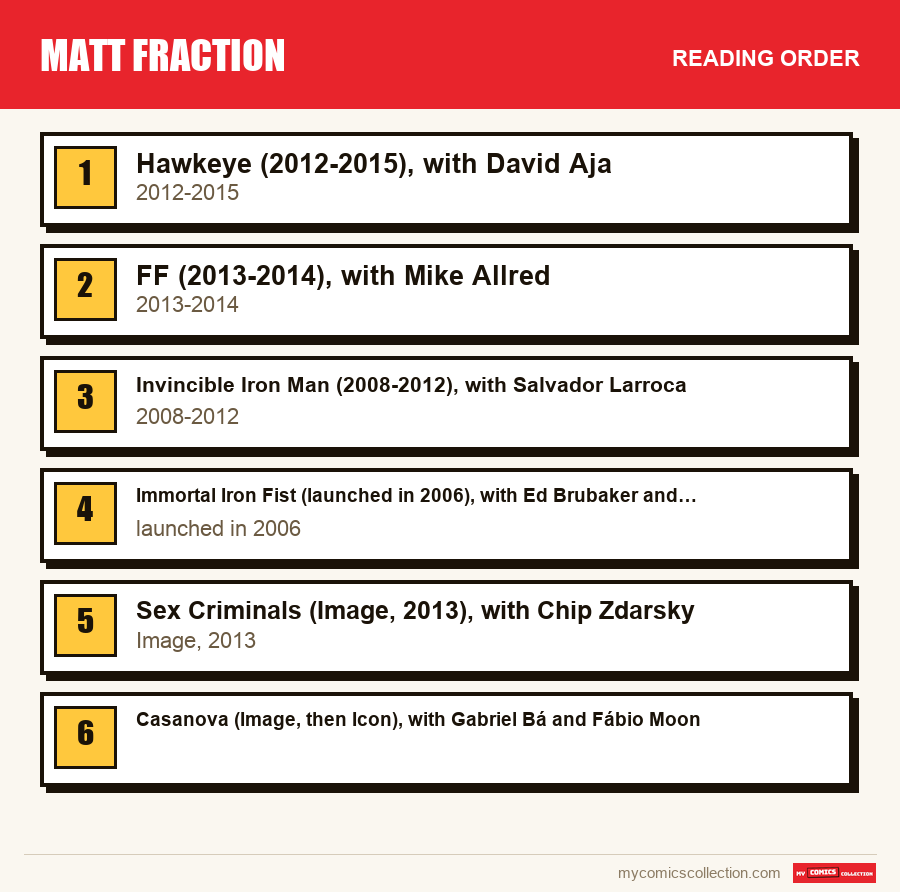
To read Matt Fraction, open Hawkeye (Marvel, 2012 to 2015, with David Aja), twenty-two issues that stand on their own. Follow it with FF (2013-2014, with Mike Allred), then Invincible Iron Man (2008 to 2012, with Salvador Larroca). Next come Immortal Iron Fist (launched in 2006 with Ed Brubaker and Aja) and Sex Criminals (Image, with Chip Zdarsky). Save Casanova, the densest of the lot, for last.
Matt Fraction writes books whose look changes with the artist alongside: David Aja's nervous panel grid, Mike Allred's pop flats, Salvador Larroca's glossy line, Chip Zdarsky's comic verve. Knowing where to start therefore means choosing a collaboration rather than a character, and this path arranges them from the most open door to the most demanding.
As always on this guide, only verified facts (creators, issues, dates) are stated as fact; the analysis is our own, with no reproduction of protected art or dialogue.
What sets this path apart from a plain bibliography
Since the mid-2000s Fraction has written series at Marvel and at Image, and the whole body of work refuses to be sorted by universe. A reader who came in through Hawkeye will not find the same pleasure in Casanova, and someone who loves Sex Criminals may find Invincible Iron Man too tame. So we ordered the steps by a practical test: what you need to have read before opening the first issue. Hawkeye and FF ask for nothing. Iron Man and Iron Fist call for a little context, which we supply. Casanova demands patience.
No biographical page on Fraction has been written on this guide. For a first look, our ranking of the best Hawkeye runs gives the 2012 series as a reference point. This text sets career chronology aside and sticks to a reading order, justified one step at a time.
Step 1: Hawkeye (2012-2015), with David Aja
Hawkeye (volume 4) opens in 2012 on Clint Barton filmed in his everyday apartment-building life, with no cosmic mission and no flying headquarters. Fraction writes a run of nearly self-contained episodes that pile up debts, neighbors and injuries until they form an overarching plot. Kate Bishop, who first appeared in Young Avengers in 2005, earns full partner status here.
Aja's art, colored by Matt Hollingsworth in a palette dominated by purple, imposes a geometric panel layout that few other Marvel series have attempted. Issue 11 takes the point of view of Clint's dog, and issue 19 rests on sign language: two formal exercises that show a writer thinking about the page as much as the story. The series runs twenty-two issues, which makes it easy to own in full.
Why begin here? Because nothing blocks the way in. The Avengers stay in the background, and the tone slides from comedy to melancholy without warning. If the taste takes hold, the key issues dossier for Hawkeye maps out the collecting milestones around the character.
Step 2: FF (2013-2014), with Mike Allred
When the Fantastic Four leave for an unknown length of time, Scott Lang, the second Ant-Man, takes over the school housed in their building. Fraction and Allred, the latter coming from independent comics and pop art, deliver a story where the humor of the prodigy children masks a bereavement. The title FF borrows the name of a team, but the subject is a father rebuilding himself.
This step reveals a second register: ensemble writing. In Hawkeye, two characters fill almost the whole space; here, a troupe of children and several adults fight for the pages without the thread ever getting lost. Readers benefit from knowing about the death of Cassie Lang, told in The Children's Crusade, but the story gives enough that you can do without it. Our ranking of the best Ant-Man runs puts this one in first position.
FF also succeeds on a point that is easy to miss: legibility. Allred draws simple faces and bold colors, so each character is recognizable at first glance, even when flipping through. For someone discovering Fraction, it is the natural companion to Hawkeye, with an extra dose of tenderness.
Step 3: Invincible Iron Man (2008-2012), with Salvador Larroca
Fraction inherits the title in 2008, just as the film starring Robert Downey Jr. makes Tony Stark visible beyond comic shops. The first arc, "The Five Nightmares", pits Stark against enemies who go after his company and his technology. The series continues with "World's Most Wanted", in which Stark ends up hunted after Norman Osborn's stint at the head of American security, then with "Stark Resilient", which shows an inventor rebuilding his empire from nothing.
It reads at a different pace from Hawkeye: the writing is denser, the cycles longer, and the register borrows from the tech thriller. Larroca delivers a very smooth line that divides readers. The numbering also deserves attention: the series went back to Iron Man's historical numbering along the way, which explains the three-digit issue numbers up to the end of Fraction's cycle, around issue 527.
Who is it for? The reader who likes long-running series and is willing to accept Marvel continuity without having read all of it. If you want to place this cycle within the character's whole bibliography, the Iron Man reading guide offers a general path, and the Iron Man hub gathers the other articles.
Step 4: Immortal Iron Fist (launched in 2006), with Ed Brubaker and David Aja
Immortal Iron Fist brings together Fraction, Ed Brubaker and David Aja to relaunch Danny Rand, a martial arts hero created in the 1970s. The central idea of the launch is that Danny is only one holder in a lineage: others carried the iron fist before him, Orson Randall among them, and each belongs to a mystical city. That principle turns a kung-fu series into a historical serial, with flashbacks spanning several eras.
This title takes a little effort: the series assumes you know who Danny Rand is and why he wields this power. Our piece on Iron Fist and his key issues gives that foundation in a few minutes. Brubaker's readers will feel at home too: the series reads like a pulp counterpart to Brubaker's crime stories, and the article Ed Brubaker: where to start places this title within that whole body of work.
The collaboration with Aja foreshadows Hawkeye, with an already highly composed page and action sequences cut like choreography. Reading Iron Fist after Hawkeye lets you recognize the graphic signature and gauge what Fraction adds once the universe turns mythological.
Do you collect this series?
Track what you own, what you're missing and what your collection is worth. 7-day trial.
Start my trial →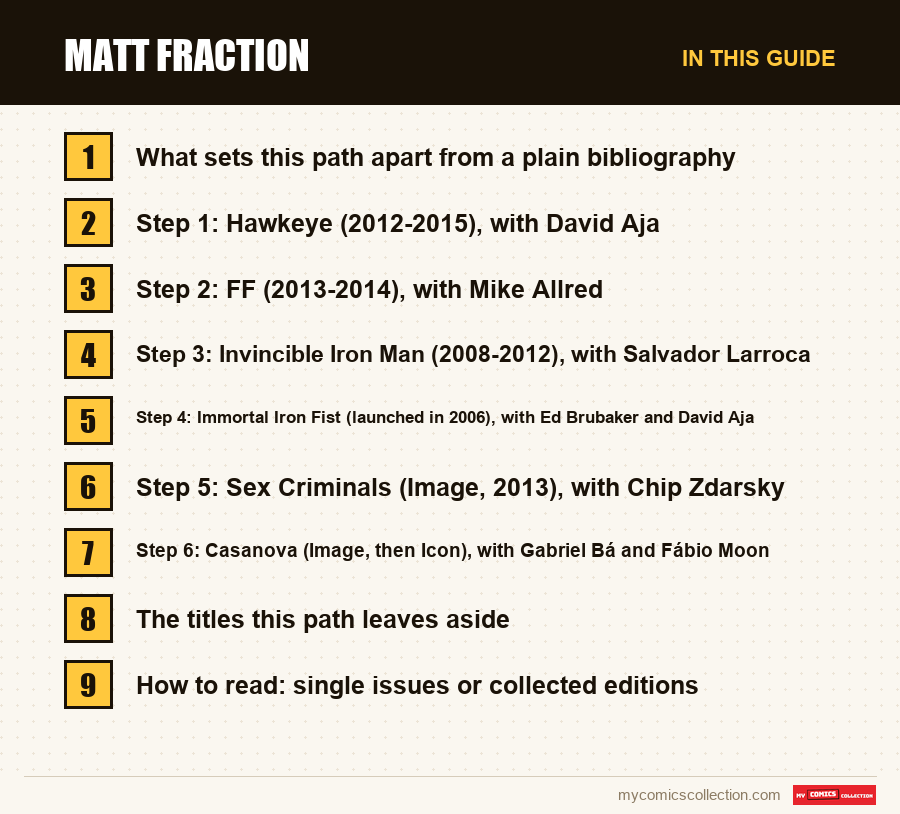
Step 5: Sex Criminals (Image, 2013), with Chip Zdarsky
Sex Criminals came out at Image in 2013 and breaks with the superhero: a couple discovers that each of them can stop time at the moment of climax, and decides to use that power to rob a bank. Fraction writes the series in the first person, with monologues about intimacy and mental health, and Zdarsky draws the whole thing with a comic verve that defuses the subject without betraying it.
It is a read for adults, as the content makes clear fairly quickly: the series deals with sexuality head-on. It lands at this spot in the path because it shows Fraction free of any publisher's brief, with a frank tone and a humor that work differently from the Marvel series. Publication has had its pauses, which complicates collecting single issues a little; the collected editions, for their part, follow one another without a hitch.
If you are discovering the Image catalog through this book, the Image collecting guide explains how to place this title among the publisher's other creator-driven series.
Step 6: Casanova (Image, then Icon), with Gabriel Bá and Fábio Moon
Casanova starts in 2006 and we put it last because it is the densest. The brothers Gabriel Bá and Fábio Moon share the art on a spy whose missions cross parallel realities, in a world where the order of events keeps shifting. The series was first published at Image, then picked up at Marvel in its Icon imprint, with new cycles.
Reading it takes concentration: Fraction experiments here with fragmented storytelling techniques that are rare elsewhere. The episodes are short, the story jumps from one reality to another, and some pages reward a second read. Readers who enjoyed the formal precision of Hawkeye will find a proving ground here.
One piece of advice on method to close out this series: check the edition before you buy, because the cycles have been republished in several formats and by several publishers, and the collected editions do not always follow the release order of the single issues.
The titles this path leaves aside
Fraction has written plenty more: the Fear Itself event (2011), drawn by Stuart Immonen, as well as Image series like Satellite Sam (with Howard Chaykin) or ODY-C (with Christian Ward). We do not put them at the center of the path. Fear Itself is a crossover whose full reading requires other series; Satellite Sam and ODY-C are more niche projects, best tackled once the six steps are done. None is a bad choice, but none replaces the chain of Hawkeye, FF and Iron Man.
How to read: single issues or collected editions
The format depends on the series. Hawkeye suits both. Gathering the twenty-two single issues is no problem; on the collected side, make sure the issues drawn by Annie Wu and Javier Pulido are in the volume, since some editions shelve them separately. FF and Invincible Iron Man are better read in collected editions, because the numbering changes along the way and the titles overlap.
For Immortal Iron Fist, take the main series volumes before the Immortal Weapons miniseries. For Sex Criminals, collected editions avoid the gaps caused by publication pauses. For Casanova, check that the chosen edition gathers the cycles in order. In every case, separate reading from collecting: a single issue in good condition makes sense for a number 1, but the pleasure of rereading often runs through the collected edition.
Recent series, like Sex Criminals, have no established market value. Three factors will move it: how many issues the series reaches, the number of reprints of the first issue, and an adaptation, to be mentioned only if confirmed. So rely on completed sales rather than isolated announcements, and compare the condition of each copy.
Recap: the recommended order
- Step 1: Hawkeye (2012-2015), with David Aja, the way in.
- Step 2: FF (2013-2014), with Mike Allred, the ensemble register.
- Step 3: Invincible Iron Man (2008-2012), with Salvador Larroca, the long-running series.
- Step 4: Immortal Iron Fist (from 2006), with Ed Brubaker and David Aja, mythological pulp.
- Step 5: Sex Criminals (Image, 2013), with Chip Zdarsky, the adult read.
- Step 6: Casanova, with Gabriel Bá and Fábio Moon, the most demanding.
If you only have time for three series, take Hawkeye, FF and Sex Criminals: three registers that barely overlap. To explore the rest, the blog page lets you branch out to the characters that interest you.
Frequently asked questions
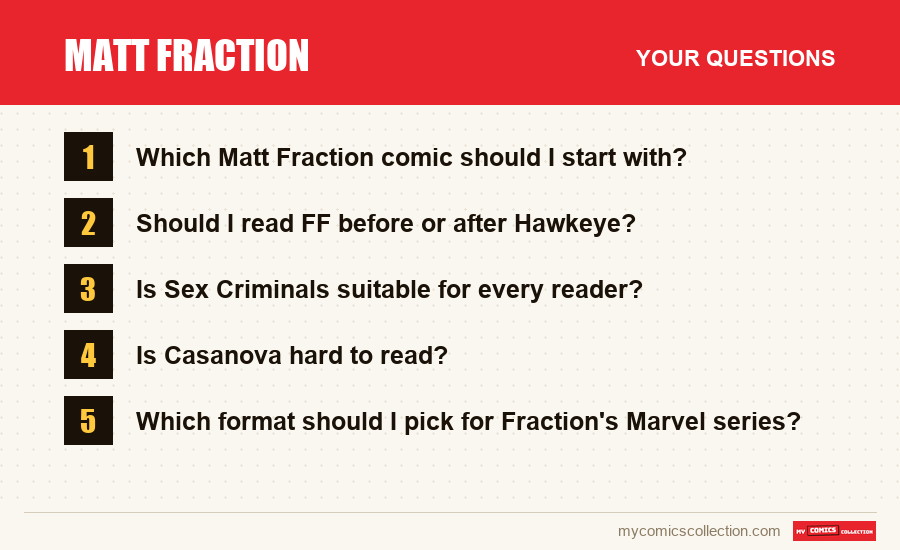
Start with Hawkeye (2012-2015), drawn by David Aja. The series runs twenty-two issues, needs no prior reading of the Avengers, and already shows what sets Fraction apart: self-contained episodes, carefully worked form and a tone that moves from comedy to melancholy.
After. Hawkeye offers the freest way in, while FF assumes a little background on Scott Lang and the disappearance of the Fantastic Four. Knowing about the death of Cassie Lang in The Children's Crusade helps, though it is not essential to follow the story.
No, it is a series for adults. It treats sexuality explicitly, with a humor that takes nothing away from the frankness of the subject. If you are looking for reads for a younger audience, stay with Hawkeye or FF, which do not have this issue.
Yes, it is the densest title in the path. The story hops from one reality to another and forces you to reread some pages. It is best approached after Hawkeye, whose formal daring it extends, rather than as a first Fraction read.
Collected editions for Invincible Iron Man and FF, since the numbering changes along the way. For Hawkeye, single issues are easy to assemble, but check that a collected edition includes the issues by Annie Wu and Javier Pulido before buying it.
A Hawkeye (2012) number 1 or a Fraction series in your boxes? Get the copy appraised before deciding what to keep.
Estimate my comic