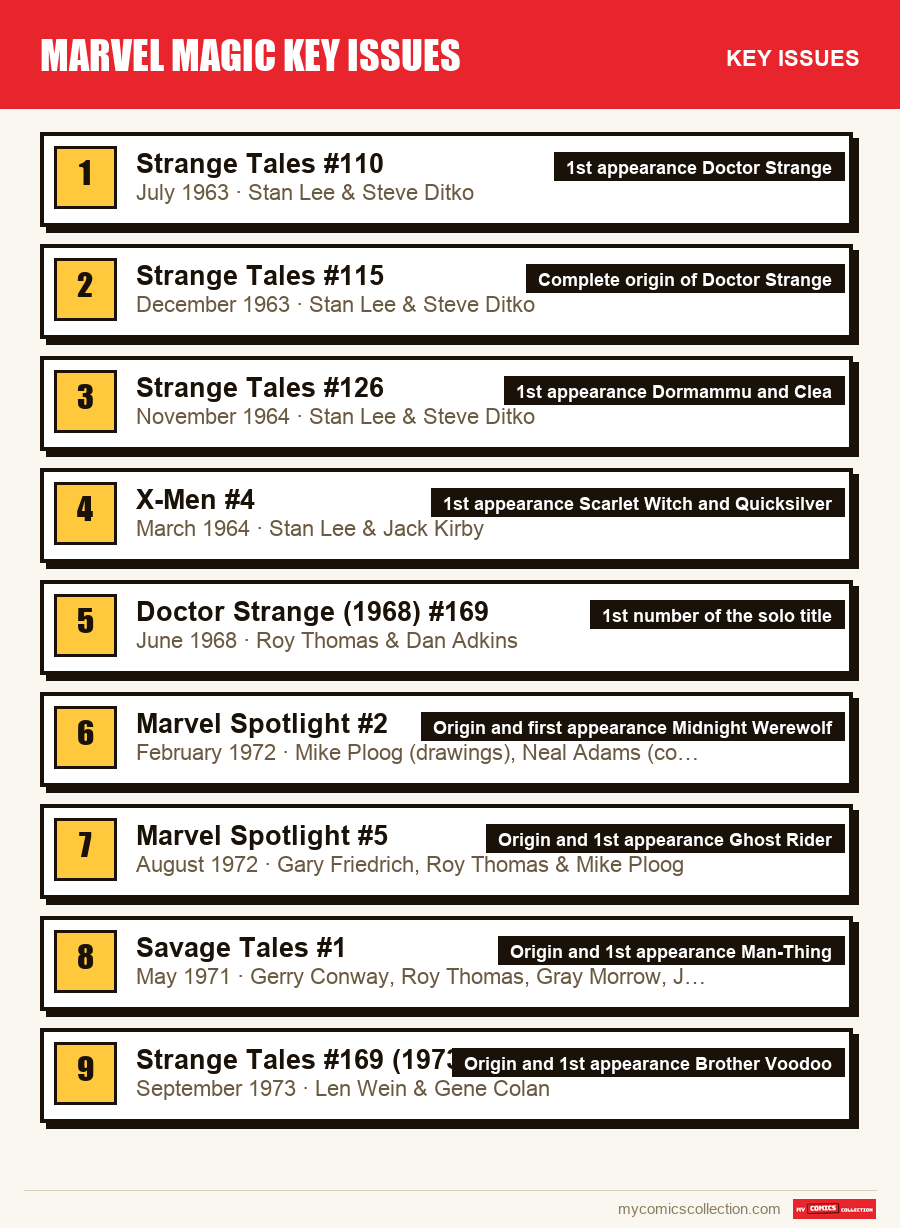
The key issues of Marvel magic revolve around a few indisputable pillars: Strange Tales #110 (July 1963, first appearance of Doctor Strange), X-Men #4 (March 1964, first appearances of the Scarlet Witch and Quicksilver), Marvel Spotlight #5 (August 1972, birth of Ghost Rider) and Marvel Spotlight #2 (February 1972, first Midnight Werewolf). Added to this are full-fledged origins like Strange Tales #115 (the origin of the Sorcerer Supreme), Strange Tales #126 (first appearance of Dormammu and Clea) and Savage Tales #1 (birth of Man-Thing). It is these original shows, often printed in small numbers and published in inexpensive anthologies from the 1960s and 1970s, which today concentrate most of the collector's value linked to the occult side of the Marvel universe.
Magic holds a special place in Marvel's publishing history. Unlike classic superheroes born from radiation or genetic mutations, characters linked to the occult, witchcraft and the supernatural appeared in successive waves, often in second-tier anthology titles before conquering their own series. Doctor Strange arrived in 1963 as a simple supplementary story in Strange Tales, alongside the Human Torch. Ten years later, Ghost Rider and the Midnight Werewolf was born in the Marvel Spotlight trial format, designed precisely to test new concepts before offering them a monthly series.
This modest, almost accidental birth is precisely what makes these issues so sought after today: limited editions, secondary title status at the time of publication, relative indifference of collectors of the time towards characters considered too strange for the general public. As a result, decades later, the high-grade rarity of these original shows far exceeds that of many of the more famous early appearances of superheroes published during the same period.
This guide reviews the issues that truly structure the “Marvel magic” segment of the vintage comic book market: their conditions of publication, their creative teams, their documented rarity and, when they exist, their actual sales values observed at auction or on the secondary market.
The origins of the supernatural at Marvel: from Ditko to the Bronze Age
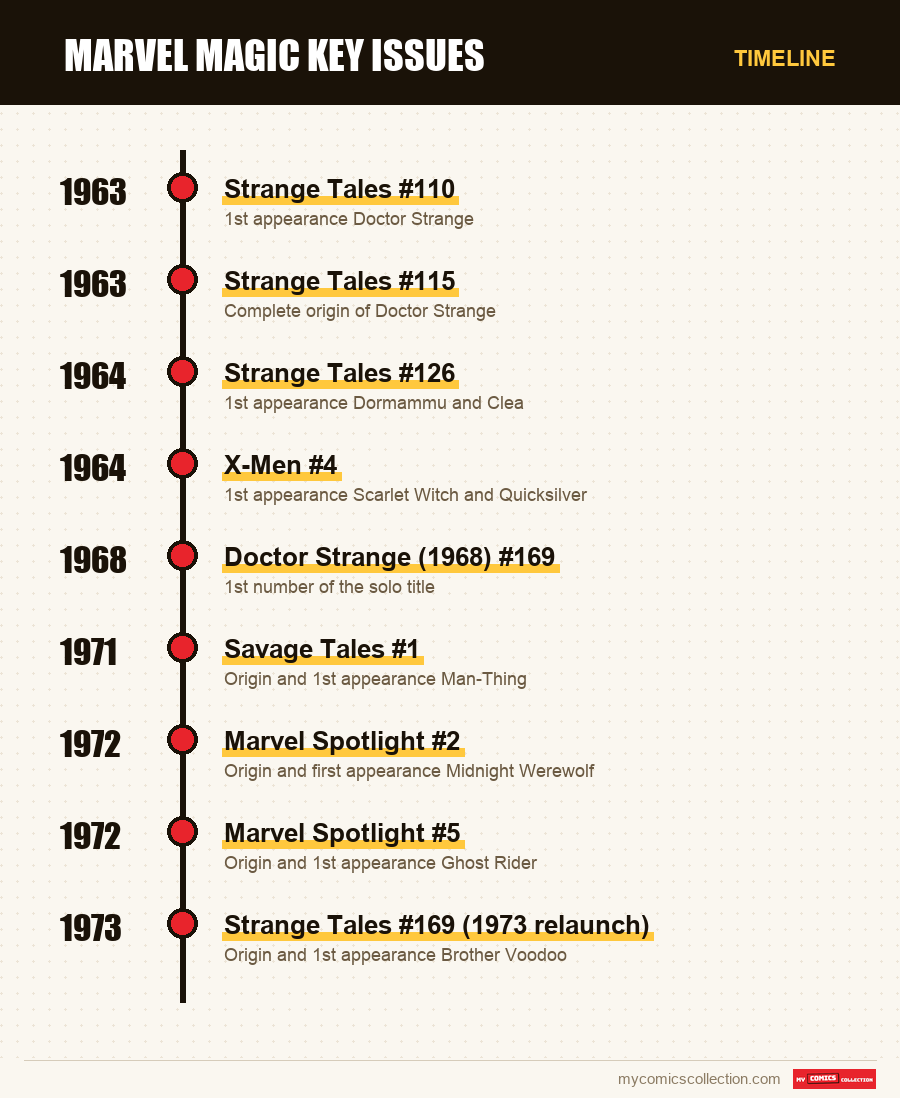
It all began in July 1963 with Strange Tales #110, an anthology issue where Doctor Strange does not even appear on the cover, eclipsed by the Human Torch. The story, just five pages long, titled “Doctor Strange Knows All!” Enter: Wong”, is written by Stan Lee and drawn by Steve Ditko, who immediately imposes his hallucinatory style and impossible architecture as the visual signature of the character. The issue will be followed, a few months later, by Strange Tales #115 (dated December 1963), which provides for the first time the complete origin of the fallen surgeon who became Sorcerer Supreme: the car accident, the loss of dexterity, the initiatory journey to the Ancient One, and the first mention, not yet incarnated, of Dormammu and Agamotto. It is also in this issue that Baron Mordo appears, who will become one of the character's recurring adversaries.
It was not until Strange Tales #126 (dated November 1964) that we saw Dormammu truly flesh out on the page, alongside a young woman from the Dark Dimension who became his niece and, later, one of Doctor Strange's lasting loves: Clea. This issue closes the first major mythological cycle of the character and lays the foundations for everything that will follow in the following decades, up to the MCU films.
The Strange Tales series itself ends at number #168 in 1968. Marvel then decides to make Doctor Strange the hero of his own title, continuing directly with the numbering: Doctor Strange (1968) #169 comes out in June of the same year, with a script by Roy Thomas and drawings by Dan Adkins which once again retrace the origin of the character for new readers. This is the first time that the Sorcerer Supreme gives his name to an entire series, a fundamental editorial milestone even if the series only lasted fifteen issues before being canceled in 1969.
The next turning point came at the beginning of the 1970s, when the publisher sought to renew its horrific and supernatural offering to ride on the public's enthusiasm for monsters and the occult. The trial title Marvel Spotlight serves as a laboratory: issue #2 (February 1972) introduces Jack Russell, aka the Midnight Werewolf, with a cover by Neal Adams and interior designs by Mike Ploog. Six months later, Marvel Spotlight #5 (August 1972) presented Johnny Blaze and the birth of Ghost Rider, from a screenplay by Gary Friedrich and Roy Thomas, with Mike Ploog once again on visual controls. The same creative verve gave birth, in May 1971, to Man-Thing in the magazine Savage Tales #1, alongside the first comic book adaptation of Conan the Barbarian.
Finally, in September 1973, Marvel relaunched the title Strange Tales: which had remained dormant since 1968 - to introduce Brother Voodoo (Jericho Drumm), with a screenplay by Len Wein and drawings by Gene Colan, with a cover by John Romita Sr. This issue bears, by a curiosity of numbering specific to Marvel at that time, the same number #169 as the first solo publication of Doctor Strange five years earlier, two very distinct comics that he Do not be confused when making a purchase.
Strange Tales #110
The very first issue featuring the Sorcerer Supreme, published as a simple five-page supplement story in an anthology dominated by the Human Torch. Doctor Strange does not appear on the cover, which has long limited the interest of contemporary collectors in the release: a factor which partly explains the current rarity of high-grade copies. The period print run, never documented with precision, is considered particularly low for a comic of this historical caliber.
Strange Tales #115
This issue tells for the first time the accident that destroyed the hands of surgeon Stephen Strange and his initiation with the Ancient One. There we also find the very first mentions, still purely textual, of Dormammu and Agamotto, as well as the appearance of Baron Mordo. An original issue is structurally more desirable than just a secondary first appearance, making it one of the pillars of any collection dedicated to the character.
Strange Tales #126
The first appearance in the flesh of Dormammu, lord of the Dark Dimension, and his niece Clea, who would become one of the most important female characters in the Doctor Strange mythology over nearly six decades of publication. It is also the number that lays the visual foundations of the demon's design, repeated almost identically until the 2016 film Doctor Strange.
X-Men #4
A pivotal issue from the Silver Age that introduces Quicksilver, Scarlet Witch, Toad, Mastermind and the Brotherhood of Evil Mutants all at once, while also offering the second appearance of Magneto. Wanda Maximoff is still presented as an antagonistic mutant before becoming, a few years later, one of the most powerful magical figures in the entire Marvel universe. Demand for this number has seen a dramatic increase since WandaVision aired in 2021.
Doctor Strange (1968) #169
After the end of Strange Tales at issue #168, Marvel continues the numbering to launch the very first series entirely dedicated to Doctor Strange, with a new condensed version of his origin. The series only had fifteen issues before its cancellation in 1969, which mechanically limits the number of copies available today, particularly in very high conservation.
Marvel Spotlight #2
Marvel Spotlight serves as a trial title to test new characters before offering them a regular series: this second issue introduces Jack Russell, the Midnight Werewolf, in a complete story that tells his origin from its first publication. The character experienced a new wave of interest in 2022 thanks to the Disney+ special Werewolf by Night, directed by Michael Giacchino with Gael García Bernal in the title role.
Marvel Spotlight #5
The complete origin of Johnny Blaze and his transformation into Ghost Rider, including the first appearance of Roxanne Simpson. Considered one of the most difficult Bronze Age issues to find in very high grade, it set a resounding record when a CGC 9.8 copy was sold, the highest sum ever paid at the time for a comic from this period: the CGC census lists only four copies at this grade, none above.
Savage Tales #1
Published in magazine format rather than a classic comic, this issue marks the birth of Man-Thing, a swamp creature linked to the magic of the Nexus of All Realities, in the same issue that delivers the very first adaptation of Conan the Barbarian in comics, "The Frost-Giant's Daughter". A hybrid issue between horror, fantasy and witchcraft which remains an important milestone for collectors of the occult side of Marvel.
Strange Tales #169 (1973 relaunch)
The first issue of Strange Tales since the title was discontinued in 1968, this relaunch introduces Jericho Drumm, the voodoo priest who became Brother Voodoo, with a cover by John Romita Sr. The character, still relatively confidential in the magical Marvel universe, remains one of the most affordable entry points on this list for collectors starting a thematic collection devoted to the occult.
Collecting this series?
Track what you own, what you are missing and what your collection is worth. 7 day trial.
Start my trial →The impact of adaptations on the rating
The magical side of Marvel has experienced very uneven screen exposure depending on the characters, and this is directly reflected in the behavior of the secondary market. Doctor Strange (2016), worn by Benedict Cumberbatch and directed by Scott Derrickson, exceeded $676 million in worldwide revenue and remained for several years the biggest introduction of a solo character in the MCU. This release, then the sequel Doctor Strange in the Multiverse of Madness in 2022, has maintained a constant demand for Strange Tales #110, #115 and #126, whose high-grade ratings have increased almost continuously since the mid-2010s.
The most spectacular and best documented effect remains that of the series WandaVision, broadcast on Disney+ from January 2021. It triggered an immediate and measurable increase in demand for several titles linked to Scarlet Witch and Vision: Samhain and reached a sales record at $399. The tension on supply was such that Marvel had to reprint several of these titles, which had then become unobtainable on the traditional market.
Ghost Rider underwent two cinematographic adaptations with Nicolas Cage: Ghost Rider in February 2007, then Ghost Rider: Spirit of Vengeance in February 2012. These films, received relatively freshly by critics, did not cause a lasting speculative bubble comparable to that of WandaVision, but they largely contributed to popularizing the character outside the circle of comic book readers, maintaining a stable demand base on Marvel Spotlight #5 for almost two decades.
The Midnight Werewolf, for its part, benefited in October 2022 from a black and white Disney+ special directed by Michael Giacchino with Gael García Bernal, presented as the first “special presentation” of the MCU. The impact on comic book sales remained modest compared to previous releases linked to Disney+: the volume of copies exchanged increased slightly without reaching the peaks observed during more anticipated releases, which clearly illustrates that not all adaptations have the same mechanical effect on the rating of a comic. As for Brother Voodoo and Man-Thing, they have to date not seen any live-action adaptation within the MCU, which partly explains why their founding issues remain among the most affordable in this selection.
To place a sale in its grade context, it is useful to understand the real difference between two similar ratings: our comparison CGC grade 9 vs 9.8 details the gap in value that this half point represents on this type of Silver and Bronze Age comics.
Buying guide
- Distinguish clearly between the two “Strange Tales #169”. A copy dated June 1968 is the first solo Doctor Strange; a copy dated September 1973 is the first appearance of Brother Voodoo. Two completely different comics bearing the same serial number, a frequent source of confusion and sometimes error in description among lax sellers.
- Systematically check the presence of the original interior pages on anthology issues. Strange Tales, Marvel Spotlight, and Savage Tales contained multiple stories per issue; some copies circulated incomplete or with detached pages, which directly affects the final grade.
- Favor CGC or CBCS encapsulated copies for numbers with a high financial stake like Strange Tales #110, X-Men #4 or Marvel Spotlight #5, where the price difference between one grade and the next can be counted in the thousands of dollars.
- Don't neglect the original numbers in favor of just the first appearances. Strange Tales #115 (origin of Doctor Strange) or Marvel Spotlight #2 and #5 (origins of Werewolf by Night and Ghost Rider in the same issue as their first appearance) offer narrative and collectible value equivalent, sometimes greater, to a simple cameo.
- Watch for upcoming adaptation windows. Any announcement related to Doctor Strange, Scarlet Witch or Ghost Rider in the MCU has historically preceded an increase in demand for the corresponding seminal issues; yet unadapted characters like Brother Voodoo or Man-Thing remain more affordable entry points as long as no announcement is made.
- Compare several recent sales before buying, particularly on issues like Strange Tales #126 or Savage Tales #1 where public sales data remains sparse: a single old comparable does not necessarily reflect the current rating.
- Catalog your collection as you acquire it. To track the total value of a themed collection dedicated to Marvel magic, the comic collection management application allows you to centralize numbers, grades and estimates without manual re-entry.
- Beware of reprints and facsimiles, in particular on Marvel Spotlight #5 and