In short
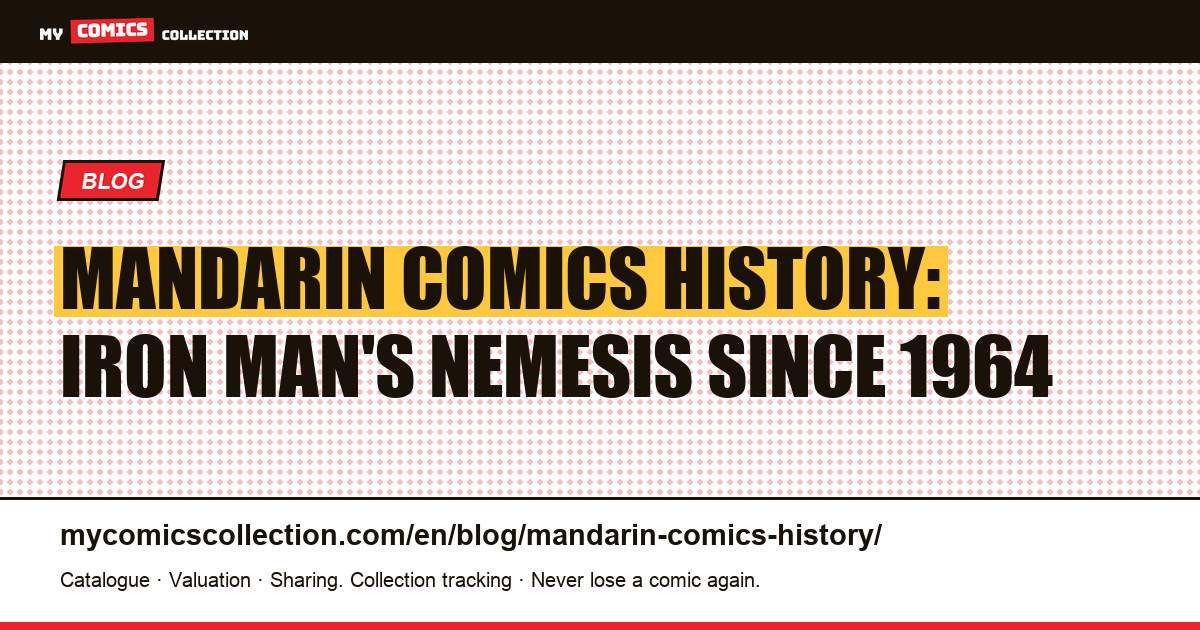
Iron Man's conqueror with ten rings arrives in Tales of Suspense #50 (1964), scripted by Stan Lee, penciled by Don Heck, with a Jack Kirby cover. His origin in Tales of Suspense #62 ties the rings to a wrecked Makluan starship. His early stories are retold in Joe Casey and Eric Canete's Iron Man: Enter the Mandarin (2007), reinterpreted by Matt Fraction, and finally killed in The Punisher volume 12 #1 (2018).
Iron Man's greatest enemy is not a rival industrialist or a mirror image in armor. He is a conqueror in a robe, armed with ten rings, who has been returning to the pages of Marvel for sixty years. Because the character has been reimagined so many times, from a Cold War menace to a mastermind of financial schemes and then to a puzzle of identity, the fastest way to understand him is to follow his publishing history in order.
Each issue number, credit and year in this guide was verified against published records before it was written, and the only cover month given is the one for the debut. What each era does for the character, and how the eras connect, is our own reading, offered to help you organize a collection. The films that use the name are a separate matter and are not covered here, since they differ from the comics character.
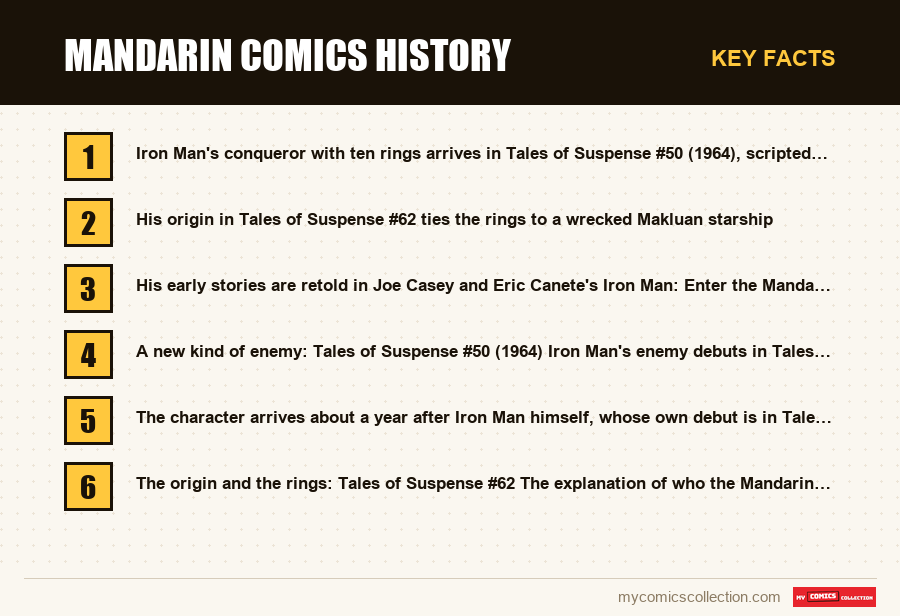
A new kind of enemy: Tales of Suspense #50 (1964)
Iron Man's enemy debuts in Tales of Suspense #50, with a February 1964 cover date. Stan Lee writes it, Don Heck draws the interior pages and Jack Kirby draws the cover. The character arrives about a year after Iron Man himself, whose own debut is in Tales of Suspense #39, and the timing matters: the hero is still new, and the series needs an opponent who cannot be beaten by force alone.
That is what the Mandarin supplies. He is a conqueror with a mind for strategy and a set of weapons whose effects vary from ring to ring, which makes each meeting with Iron Man a puzzle rather than a slugfest. For a collector, the issue is worth holding as the first page of a very long rivalry, and as an early example of how Marvel built an enemy specifically for one hero rather than borrowing a general-purpose villain.
The origin and the rings: Tales of Suspense #62
The explanation of who the Mandarin is arrives a few issues later, in Tales of Suspense #62. He is born in pre-revolutionary China to a wealthy father said to descend from Genghis Khan and an English noblewoman. His parents die soon after his birth, and his aunt raises him. The family fortune goes into his education in science and combat, and the government later seizes the estate when he cannot pay his taxes.
He then explores the Valley of Spirits, a place that is forbidden, and finds the wreck of a Makluan starship and the skeleton of an alien, Axonn-Karr. The ten rings are the ship's propulsion source. The Mandarin learns to command them with his mind, and each ring has its own power and is worn on a specific finger. The origin works because it gives the rings a cause outside the character: the weapons are alien technology, not mystical jewelry, and he is a man who has read the manual better than anyone else.
Keep this origin in mind, because every later writer either respects it or breaks it on purpose. The Makluan wreck, the Valley of Spirits and the mixed parentage are the fixed points against which the reinventions of 2007 and after make sense.
Ultimo and a defeat: Tales of Suspense #76 to #86
The Silver Age schemes follow a clear pattern. In Tales of Suspense #76 to #78, the Mandarin uses the android Ultimo against Iron Man, a story that shows him preferring weapons that he has found or built to fighting in person. He sabotages and steals missiles and spy planes built by Stark, tries to turn the weapons of various nations against them, and captures Iron Man or Tony Stark in his early encounters.
In Tales of Suspense #84 to #86, Happy Hogan, wearing the Iron Man armor, is teleported to China, and Iron Man rescues him and beats the Mandarin in personal combat for the first time. It is a revealing turn: the villain's mind is sharp, but his plan collapses once the fight becomes physical. The same period includes The Avengers Annual #1, where he sends former Avengers enemies against the team and turns hate-rays on the world until the Wasp's attack on him shuts them off. That annual is useful to a collector because it shows the Mandarin outside the Iron Man books, as a threat large enough to need a team.
By the end of the 1960s the shape of the character is set: an ambitious conqueror, a lover of elaborate plans, and an enemy who always seems to leave the story alive. That last trait is what makes his many returns possible.
Acts of Vengeance and the Hand
For several decades the Mandarin keeps appearing in the Iron Man books, in stories that are a pleasure to read in order but rarely define him. The next landmark is outside Iron Man's own series. During the Acts of Vengeance crossover, he helps switch the mind of Psylocke into the body of Kwannon and conditions her to believe she is Lady Mandarin, his assassin. Wolverine and Jubilee rescue her, which ends his ties with the Hand. The issues involved are The Uncanny X-Men #256 to #258, with Chris Claremont writing #256, and he also confronts the Avengers in The Avengers #313.
The importance of this episode is that it shows the Mandarin as a manipulator who works across the shared universe, not only a foe in an armored hero's book. For anyone who collects the X-Men, these issues are the reason the Mandarin appears on a checklist of Psylocke's history.
Hands of the Mandarin and Heroes Reborn (1995 to 1998)
In 1995, the story called "Hands of the Mandarin" runs through Iron Man #312 and War Machine #10. Len Kaminski writes it and Tom Morgan pencils it. The Mandarin turns China feudal, and Iron Man and War Machine defeat him.
The late 1990s are also a time of experiments. In the Heroes Reborn alternate continuity, the Mandarin is a robot minion of Doctor Doom, in Iron Man volume 2 #5 (1997). Then, in 1998, the relaunched Iron Man volume 3 #1 to #10 builds a long story around him. He constructs the flying fortress Dragon of Heaven in order to conquer Russia, but the real goal is to test Iron Man. The fortress explodes and the Mandarin appears to die, though Iron Man doubts it.
Taken together, these years show the writers asking what a conqueror can be in a world after the Cold War. The answer in 1998 is a villain whose real campaign is against one man, which is the template for almost everything that follows.
Iron Man: Enter the Mandarin (2007)
The next step is a retelling. Iron Man: Enter the Mandarin, written by Joe Casey and drawn by Eric Canete, appeared in 2007 as an expanded and modified retelling of the early Tales of Suspense appearances, going back to the rivalry that issue #50 had opened in 1964. Rather than adding a new chapter at the end of the chronology, it revisits the beginning and fills the gaps that the short Silver Age stories left between encounters.
For collectors, the series is the clearest bridge between the classic version and the modern ones. It shows that the character can be updated without discarding the 1964 premise, and it is a good place to start for readers who want one complete story rather than a long chronology.
Do you collect this series?
Track what you own, what you are missing and what your collection is worth. 7-day trial.
Start my trial →
Matt Fraction and the story of his life (2009 to 2012)
Matt Fraction's work on The Invincible Iron Man volume 4 questions the origin itself. In Annual #1, the Mandarin tells a kidnapped film director a version of his past that is full of contradictions, and the version offered in the story has him as the son of an opium-den prostitute, which contradicts the English noblewoman of Tales of Suspense #62. The point is not to replace the old origin but to make it unreliable.
The larger arc follows in the 2011 and 2012 issues. The Invincible Iron Man #500 (2011) is titled "The New Iron Age," with Fraction writing and a group of artists that includes Salvador Larroca. Through #513, #520, #522 and #526 (2012), Stark's mind is under the Mandarin's influence and the Mandarin plans to use ten giant Titanomechs as hosts for the souls of ten alien beings, until Ezekiel Stane apparently kills him in #526. The character who began as a conqueror of nations ends the run as something stranger: a villain whose plan is cosmic and whose past cannot be trusted.
Rings of the Mandarin: Kieron Gillen (2014)
When Marvel NOW! relaunches Iron Man, Kieron Gillen writes Iron Man volume 5, and the rings themselves become the subject. In issues #18 to #28 (2014), the rings escape a S.H.I.E.L.D. vault and bond with new hosts, who become Mandarin-One through Mandarin-Ten. Malekith and the Mole Man appear in the hunt, Arno Stark is drawn into it, and the sentience of the rings is traced to the corpse of Recorder 451.
This phase answers a question that earlier eras left open: if the power lies in the rings, who is the Mandarin? The answer in 2014 is that the title can pass from one person to another, and that the real constant is the set of ten weapons. It is a strong ending for the arc that began with a starship wreck in Tales of Suspense #62.
The Punisher and the end of the line (2018)
The last major comics appearance in this trajectory is The Punisher volume 12 #1 (2018), in which the Mandarin, acting as the public face of the Hydra-occupied nation of Bagalia, gives a speech at the United Nations and the Punisher kills him with a bullet that bypasses his ring-generated force field. It is a quiet ending compared with the fortresses and satellites of his earlier plans, and it closes a history in which the character kept returning from apparent death.
The key issues across his history
- Tales of Suspense #50 (1964): the first appearance, by Stan Lee and Don Heck, with a Jack Kirby cover.
- Tales of Suspense #62: the origin, with the Makluan wreck and the skeleton of Axonn-Karr.
- Tales of Suspense #76: the start of the Ultimo story, which runs through #78.
- Tales of Suspense #84: the start of the arc in which Iron Man beats the Mandarin in personal combat, through #86.
- The Avengers Annual #1: the hate-ray plot against the team.
- Iron Man #312 (1995): "Hands of the Mandarin," scripted by Len Kaminski.
- Iron Man: Enter the Mandarin #1 (2007): the retelling by Joe Casey and Eric Canete.
- The Invincible Iron Man #526 (2012): the story in which the Mandarin is apparently killed by Ezekiel Stane.
How to follow the Mandarin in a collection
Start with Tales of Suspense #50 and #62, and keep #76 to #78 and #84 to #86 next to them as the core of the Silver Age run. Then move to Iron Man: Enter the Mandarin as a complete modern story, and to the Fraction and Gillen issues if you want the later reinventions. The Psylocke storyline belongs on an X-Men shelf as much as an Iron Man one.
The numbering is the main trap. Iron Man has restarted several times, so write the volume next to every number: Iron Man #312 from 1995, Iron Man volume 3 #1 from 1998 and Iron Man volume 5 #18 from 2014 are three different books. The Invincible Iron Man has volumes of its own, with the Fraction issues carrying #500 and above. Finally, keep the comics character apart from the film versions: the stories above have a different Mandarin from the one on screen, as our guide to Shang-Chi and the ten rings explains. For the hero he fights, the Iron Man history and the Iron Man hub give the surrounding series.
Frequently asked questions
Look for Tales of Suspense #50, dated February 1964 on the cover. Stan Lee wrote it, Don Heck drew the interior pages and Jack Kirby drew the cover. His origin follows in Tales of Suspense #62, so collectors often look for the two together.
In the comics, the rings are the propulsion source of a wrecked Makluan starship that the Mandarin finds in the Valley of Spirits, next to the skeleton of the alien Axonn-Karr. He learns to command them mentally, and each ring has its own power. This origin appears in Tales of Suspense #62.
Iron Man: Enter the Mandarin, written by Joe Casey and drawn by Eric Canete, appeared in 2007. It is an expanded and modified retelling of the early Tales of Suspense appearances that began with issue #50 in 1964, and it works as a self-contained modern entry point.
He appears to die several times, in the Dragon of Heaven explosion of Iron Man volume 3 (1998) and again in The Invincible Iron Man #526 (2012). The most decisive end comes in The Punisher volume 12 #1 (2018), where the Punisher kills him during a speech at the United Nations.
No. Trevor Slattery in Iron Man 3 and Xu Wenwu in Shang-Chi belong to the films, while the printed Mandarin remains the Makluan-ring conqueror of 1964. The comics Mandarin is the conqueror created in Tales of Suspense #50, with the Makluan rings of Tales of Suspense #62.
Holding a Tales of Suspense #50 or #62? Get an estimate of its condition and value in a few minutes.
Estimate my comic