
In short
Malibu began in 1986 as Malibu Graphics, launched by Dave Olbrich and Tom Mason with private financing from Scott Mitchell Rosenberg. It handled the first Image Comics books in 1992, then built the Ultraverse, a tightly linked superhero line that launched in 1993 with Prime, Hardcase and The Strangers. Marvel bought Malibu in November 1994, ran the Ultraverse through the 1995 Black September crossover, and ended the original line in late 1996.
Malibu is the publisher collectors remember for a single universe, yet its story starts years earlier with a small Southern California house and a long list of imprints. The path from Ex-Mutants in 1986 to Ultraverse: Future Shock in 1997 runs through licensed comics, a deal with a young Image Comics, a creator-owned imprint and a Marvel takeover.
Founders, imprint names, launch-title creators, cover years and the structure of Black September were checked against published histories before writing. The reasons the Ultraverse stayed closed, and what the Marvel years meant on the shelf, are our own reading, and no artwork or lettering is reproduced.
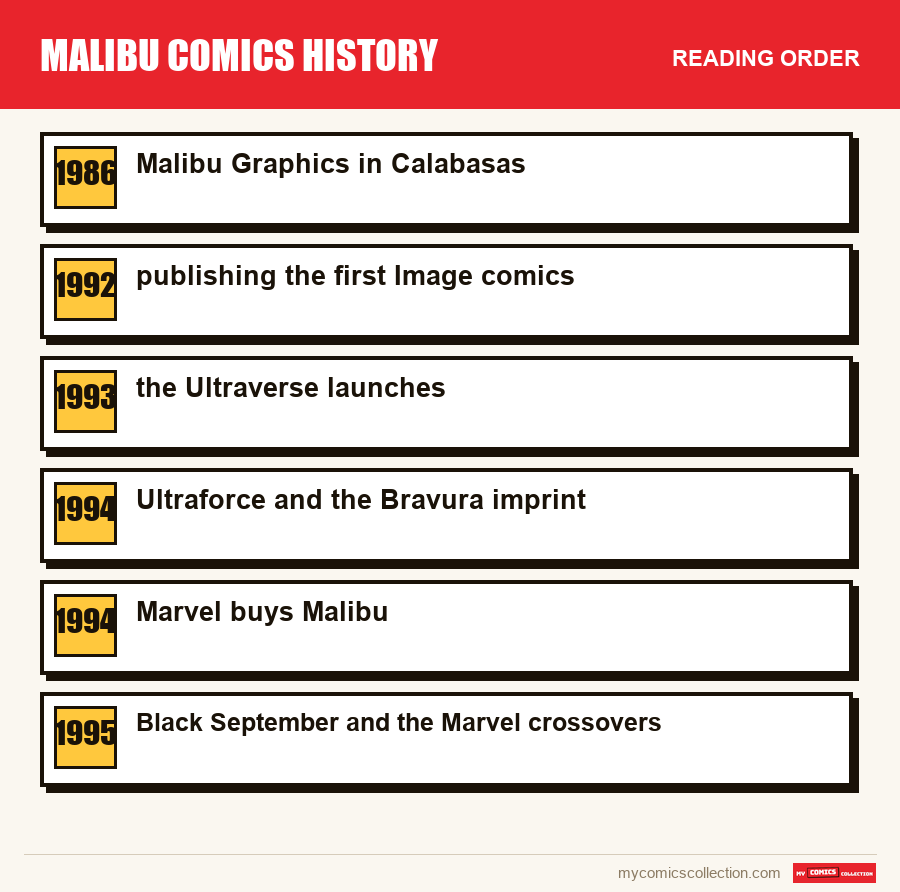
1986: Malibu Graphics in Calabasas
Malibu Graphics was launched in 1986 by Dave Olbrich and Tom Mason, with private financing from Scott Mitchell Rosenberg, who ran the distributor Sunrise Distribution. The company's headquarters was in Calabasas, California. Rosenberg also backed other small publishers, including Eternity Comics, Amazing Comics, Wonder Color Comics and Imperial Comics. In 1987, after his behind-the-scenes role came to light, he discontinued most of them and merged some into Malibu, keeping Eternity as a Malibu brand. Chris Ulm joined as editor-in-chief in 1987.
The first title was Ex-Mutants, by David Lawrence and Ron Lim. Other early books included Dark Wolf, Libby Ellis, The Liberator and The Trouble with Girls. Malibu also created a shared universe called Shattered Earth, which held Ex-Mutants alongside The New Humans. In 1988 Malibu also acquired the character Shuriken from creator Reggie Byers.
1988 and 1989: Aircel, Adventure and Eternity
Malibu grew by absorbing smaller labels. It took over Aircel in 1988 from a Canadian publisher and used it for Barry Blair's comics and an adult line. In 1989 it added Adventure, which carried licensed titles such as Planet of the Apes and Alien Nation. Eternity, kept from the earlier Rosenberg group, handled magazines and anime-inspired material, including Robotech and Ben Dunn's Ninja High School, and Dinosaurs for Hire also appeared under that banner.
That imprint structure explains why a collector will see several logos on Malibu-era comics from the late 1980s. A book with an Aircel, Adventure or Eternity mark is still part of the same company, and the logo tells you what kind of title it is more than who made it.
1992: publishing the first Image comics
In early 1992 Malibu served as publisher for the first comics from Image Comics, whose members formed part of the Malibu Graphics Publishing Group. The arrangement gave the new creator-owned company access to distribution channels at a moment when Image needed a way into the direct market. Image left Malibu in early 1993, once its finances were secure enough to publish on its own, so the shared period lasts about a year, and the story of the founders who built Image is told in the Image Comics history guide.
In the same stretch Malibu built its short-lived Genesis line, which combined Centaur Publications heroes, revived in 1992 in the form of the Protectors, with characters from Adventure and Eternity. Dead Clown and Widowmaker were placed in the same universe. Malibu also worked with Adobe Photoshop on a standard for computer coloring and became the first company to use digital coloring for all its titles. In late 1992 Malibu merged with the video game developer Acme Interactive to form Malibu Comics Entertainment, Inc., with Malibu Interactive as a subsidiary.
1993: the Ultraverse launches
The Ultraverse launched in June 1993 after development that began in 1992 under the working name "Megaverse," a name the company had to drop. The launch titles were Prime, Hardcase and The Strangers. The line stressed tight continuity and frequent crossovers, came to dominate Malibu's catalog, and its writers included Mike W. Barr, Steve Englehart, Steve Gerber, James D. Hudnall, Gerard Jones, James Robinson, Len Strazewski and Larry Niven.
Each launch book had its own pitch. Prime #1, dated June 1993, came from Gerard Jones, Len Strazewski and Norm Breyfogle, and follows Kevin Green, a teenager who changes into an adult-bodied hero while his young mind stays the same. The first volume of Prime ran 26 issues. Hardcase #1, also dated June 1993, was written by James D. Hudnall and stars Tom Hawke, a Hollywood actor with powers. The book ran 26 issues, from June 1993 to August 1995.
The Strangers was created and written by Steve Englehart and gathers a group of cable car passengers who gain powers at the same moment. Mantra #1 followed with a July 1993 date, written by Mike W. Barr. Its lead, Lukasz, is an immortal warrior placed into the body of Eden Blake. The first volume ran 24 issues, from July 1993 to August 1995.
More books followed through 1993 and 1994: Exiles, The Night Man, Freex, Firearm, Prototype, Solitaire, Sludge, Solution, Wrath and Warstrike, plus Rune from January 1994 to April 1995. Ultraverse Origins #1 appeared in January 1994 as a one-shot gathering origin pieces first released as back-up material in various comics. Two crossover miniseries tied the line together: Break-Thru (December 1993 to January 1994), the first Ultraverse crossover, which follows the chief heroes to the moon, and Godwheel (January to February 1995).
1994: Ultraforce and the Bravura imprint
The Ultraverse's flagship team book was Ultraforce, which began in August 1994. Gerard Jones wrote the first seven issues and George Pérez drew them. The pre-Black September team included Contrary, Ghoul, Hardcase, Pixx, Prime, Prototype, Topaz, Black Knight and Siren. Volume 1 ran 11 issues numbered #0 through #10. An animated series with 13 episodes, produced by DIC Entertainment and Bohbot Entertainment, aired on USA Network from October 15 to December 31, 1995, with Scott Mitchell Rosenberg as a producer. The Pérez connection is worth a note for readers of George Pérez's career.
In January 1994 Malibu also launched Bravura, a creator-owned imprint. Its founding members included Dan Brereton, Howard Chaykin, Dan Jurgens, Walt Simonson, Jim Starlin, Gil Kane and Steven D. Grant. Titles included Breed, Power and Glory, Edge, Dreadstar and Star Slammers. Walt Simonson's participation links Bravura to the author guide at Walt Simonson: where to start, and a rock-music imprint, Rock-It Comix, launched in early 1994.
November 1994: Marvel buys Malibu
Marvel Comics purchased Malibu on November 3, 1994. DC had been negotiating to buy the company, and Marvel decided to purchase Malibu itself to prevent that from happening, while Malibu publicly said Marvel wanted its digital coloring system. The video game division was sold to GameTek and renamed Padded Cell Studios, and Tom Mason and Chris Ulm left Malibu in 1995. In the Marvel multiverse the Ultraverse was designated Earth-93060, and the Genesis line Earth-1136.
For the Ultraverse, the purchase closed the independent phase of the line, since every title launched in 1993 and 1994 now belonged to a company whose own superheroes lived in a different universe, and the crossovers of 1995 followed directly from that ownership.
Do you collect this series?
Track what you own, what you are missing and what your collection is worth. 7-day trial.
Start my trial →
1995: Black September and the Marvel crossovers
The Ultraverse's turning point was Black September, which ran from May to October 1995 as a crossover between Ultraforce and Marvel's Avengers. It spanned Ultraforce #8 to #10, Ultraforce/Avengers: Prelude, Avengers/Ultraforce #1 from Marvel, Ultraforce/Avengers #1 and a Black September one-shot numbered "#∞". Dane Whitman, the Black Knight, first appeared with the team in Ultraforce #8, and the event ended with him trapped in the Ultraverse.
Seven series were then rebooted with "#∞" issues followed by volume 2, among them Prime, Rune and Ultraforce. These books featured Marvel characters to attract Marvel's regular readers, and Ultraforce volume 2 had a new roster with Black Knight as team leader. The volume 2 relaunches were cancelled shortly afterward, and with that Marvel cancelled the entire Ultraverse line.
1996 and 1997: the end of the original line
This version of the Ultraverse ran until the end of 1996. Prime volume 2 ran from ∞ through 15 across 1995 and 1996, and Ultraforce volume 2 ran 16 issues from September 1995 to December 1996, also numbered from ∞ through 15. A one-shot, Ultraverse: Future Shock #1, followed in February 1997 to resolve unfinished plotlines. Very little Malibu content was published after 1996.
The live-action Night Man series, which aired in syndication from September 1997 to May 1999, is the last major sign of the line, and it appeared after the comics had stopped. That gap between the end of publication and the TV run is part of why the Ultraverse feels like a finished chapter instead of an ongoing property.
What became of the characters
The Ultraverse has not returned as a line. Steve Englehart was commissioned by Marvel to relaunch the Ultraverse with its most recognizable characters, but Marvel's editorial side decided not to revive the imprint, and in 2005 Marvel editor-in-chief Joe Quesada told Newsarama that a revival was "next to impossible" under the structure of the original deal. In 2012 Englehart suggested in a podcast that a share of profits owed to surviving Malibu creators was the obstacle, which Tom Brevoort denied, citing a non-disclosure agreement. The characters have surfaced only as references, such as a past Rune storyline mentioned in Who Is Adam Warlock on Marvel Unlimited in 2023.
For collectors, that status makes the original run a closed set. There is no modern relaunch to compete with the 1993 to 1996 issues, and the Marvel connection is limited to the 1995 crossovers and the volume 2 books.
The key issues across the line
- Ex-Mutants #1 (1986): Malibu's first title, by David Lawrence and Ron Lim.
- Prime #1 (1993): Kevin Green debuts in a Jones, Strazewski and Breyfogle launch book.
- Hardcase #1 (1993): Tom Hawke's debut, written by James D. Hudnall.
- Mantra #1 (July 1993): Lukasz and Eden Blake, written by Mike W. Barr.
- The Strangers #1 (1993): Steve Englehart's cable car group.
- Ultraforce #1 (1994): the flagship team book, with Gerard Jones writing and George Pérez drawing.
- Avengers/Ultraforce #1 (1995): the Marvel half of the Black September crossover.
- Ultraverse: Future Shock #1 (1997): the one-shot that closes the line.
How to collect Malibu and the Ultraverse
Pick a lane before you buy. The Ultraverse is the most coherent target, and the launch books (Prime, Hardcase, The Strangers, Mantra) are the usual starting point. Crossover miniseries like Break-Thru and Godwheel make sense once you own the monthly books they connect.
Watch the numbering. The 1995 "#∞" issues and the volume 2 restarts are easy to confuse with the original runs, so record volume, number and cover year for every book. Check which side of Black September a title falls on, since Prime volume 1 (26 issues) and volume 2 (16 issues) are different runs. Separate the pre-1993 Malibu material, such as Ex-Mutants and the licensed Adventure books, from the Ultraverse, so your shelf order stays clear.
Frequently asked questions
Malibu Graphics was launched in 1986 by Dave Olbrich and Tom Mason, with private financing from Scott Mitchell Rosenberg of the distributor Sunrise Distribution. Chris Ulm joined as editor-in-chief in 1987. The company later became Malibu Comics Entertainment, Inc.
The Ultraverse was Malibu's shared superhero universe, launched in June 1993 with Prime, Hardcase and The Strangers. It emphasized tight continuity and frequent crossovers, and later grew to include Mantra, Rune, The Night Man and Ultraforce.
Marvel Comics bought Malibu on November 3, 1994. The Ultraverse was then given the designation Earth-93060 in the Marvel multiverse. The Black September crossover with the Avengers followed in 1995 and ended with the cancellation and relaunch of the Ultraverse titles.
Yes. In early 1992 Malibu served as publisher for the first Image Comics titles, giving the new company access to distribution channels. Image left in early 1993, once its finances allowed it to publish independently.
There is no announced return. Marvel commissioned Steve Englehart to plan a relaunch but chose not to revive the imprint, and Joe Quesada said in 2005 that republishing the books was "next to impossible." The original line ended in late 1996, with a final one-shot in February 1997.
Do you own a 1993 Ultraverse first issue or a Black September crossover? Get an estimate in a few clicks.
Estimate my comic