The August 30, 2026 statement on the query “Magneto Uncanny The five cheapest listings show one thing: Several sellers explicitly describe the character's role reversal (an antagonist taking on a role of authority, a mentor stepping down) and asking between $2.16 and $4.48 for it. The market therefore names this motive, recognizes it, but does not pay for it. Please note: these are amounts claimed on a single date, not concluded transactions, and nothing here says in which direction the prices are moving.
The vocabulary of comic book announcements revolves around a few events that are always the same. A first appearance, a death, a return, a change of costume. Each has its fixed formula, its abbreviation, its place in the title of the ad. By observing the reading carried out on August 30, 2026 on a specific issue, we see an additional reason appear, less common in catalogs and yet described in full by the sellers: the reversal of status. A character occupies one function, he takes on another, often opposite. The bad guy becomes responsible. The professor steps aside. The ad says it, word for word, in its title.
What this survey allows us to establish is a small amount, and it must be put down immediately so as not to overwhelm. These are asking prices, posted by sellers at a given time on an American market, not amounts exchanged. A measurement taken only once does not describe any trajectory: it is impossible to deduce that this fascicle rises, falls or stagnates, since there is no second point of comparison. And the maximum recorded, $424.95, says nothing about the market: it says what a particular seller hopes to get, which is not the same thing as an amount that someone has agreed to pay.
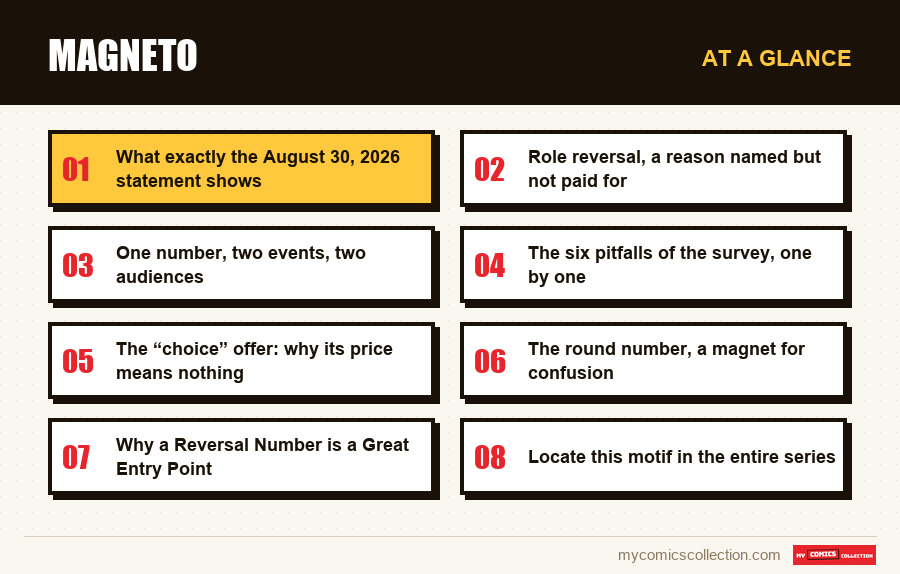
What exactly the August 30, 2026 statement shows
The query “Magneto Uncanny X-Men 200” returns 177 unverified ads. The lowest amount claimed is $2.16, the highest is $424.95, and the median value is $15.00. This difference of more than two hundred times between the extremes is not abnormal on a broad query: it mixes states, print runs, lots and, as we will see, issues which are not even the one we are looking for. The median at $15.00 is the most honest indicator in this set, because it ignores both tails of the distribution.
The verified copies are counted separately, and their number is the most important fact of the statement: eleven advertisements. Eleven. Their minimum is $35.00, their central value is $89.00, their maximum is $189.99. Eleven observations do not constitute a sufficient sample to say anything about the price level of this segment. A single optimistic seller, a single misinformed lot, and the central value shifts by tens of dollars. We can note that the verified amounts begin where the unverified mass has already largely passed, but we must stop there and refuse to draw a rule from this.
The contrast between the two sets is instructive without being conclusive. On one side, 177 ads that start at just over two dollars. On the other, eleven ads which start at thirty-five. This is not proof that verification multiplies the value by sixteen: it is the mechanical consequence of the fact that no one verifies a booklet that he intends to sell for three dollars, the cost of the operation far exceeding the proceeds of the sale. Verified copies are therefore, by construction, the best preserved, and what distinguishes them is the condition, not the stamp.
Role reversal, a reason named but not paid for
$2.16: the reversal spelled out
The ad “Uncanny X-Men #200 (1985) VG Professor This is the lowest amount of the entire statement.
$2.99 : same issue sold for trial
“Uncanny
$3.00: same orientation, without markings
“The Uncanny X-Men #200 [...] Trial of Magneto” takes up the legal angle, without specifying either the channel or the edition. Three cents more than the previous one for a less detailed description.
$4.48: another title, same number
« X-Men #200 - Wolverine & Cable [...] FN 6.0" is not the booklet you are looking for: it is another series also bearing the number 200, brought up by the request because the numbers coincide.
Four of the five announcements noted are held between $2.16 and $4.48. Two call the role reversal, two call the trial. In other words, the same physical object is put up for sale for two different events, both of which it contains, and each seller chooses which one to place first. Neither of these two choices produces a premium: the amounts requested remain in the same pocket square, give or take a few dozen cents. The reason is identified, formulated, put forward, and it does not change the displayed price.
The reversal of status thus joins the family of reasons that the market knows how to describe but does not value. An ad that takes the trouble to detail “this character abandons his position, another replaces him” does a better than average job of description, and does not benefit from it in any price.
For a reader, it's exactly the opposite: this category of booklets is particularly accessible, since a few dollars are enough to get their hands on a pivotal episode that the market has not bid for.
One number, two events, two audiences
The situation described by this survey deserves attention, because it is structurally tricky. One booklet contains two moments that the sellers deem worthy of mention. Some only talk about the first, others only the second. A buyer who is looking for role reversal will formulate his request with the words of the role reversal, and will not see the advertisements written around the trial, even though they are exactly the same booklets, often less expensive or better described.
This mechanism is not specific to this number. As soon as an episode advances several threads at the same time, its description fragments into as many vocabularies. The collector who questions the market with only one of these vocabularies sees a portion of the offer, believes that it is the entire offer, and forms a false idea of the price level. The solution is simple to state and tedious to apply: list the events contained in the booklet before searching, then search once per event. The subject deserves a complete examination, as in the study of two requests which point to one and the same booklet.
It should be added that these two events are not of the same nature. One is a trial, a dramatic episode which we can simply say places the character in a position to be judged. The other is a change of function, which permanently modifies the character's place in the story. The second has consequences for dozens of subsequent issues, the first remains a limited event. Nothing in the statement says that the market makes this distinction: the amounts requested are the same on both sides.
The six pitfalls of the survey, one by one
Broad match picks up everything
177 announcements for a single issue, this means that the query catches lots, states very far from each other and objects that are not the issue. The dispersion from $2.16 to $424.95 is primarily a symptom of this inaccuracy, not a characteristic of the number.
One date, no trend
All of these amounts were observed on August 30, 2026. There are no prior records to compare them to. Any sentence like “this number goes up” or “this number falls” would be a pure invention: an isolated point does not trace a curve.
Claimed is not cashed
These are prices posted by sellers who hope to obtain them. An ad can stay online for months without finding a buyer. The maximum at $424.95 measures an individual ambition, not a transaction, and has no index value.
The “choice” offer distorts the ranking
The ad « Uncanny X-Men U PICK comic 200-380 [...] 1st Gambit » at $3.96 occupies fourth place in the statement. It covers one hundred and eighty different numbers: its amount is a call price displayed for the entire choice, not the price of the number you are looking for.
Round numbers attract homonyms
« X-Men #200 - Wolverine & Cable [...] FN 6.0” at $4.48 belongs to another title. In a family of series that are renumbered and relaunched, round numbers are the most exposed to this type of collision.
Eleven verified is too few
The verified segment has eleven listings, from $35.00 to $189.99, central value $89.00. This size prevents us from concluding anything about a price level: each ad weighs nearly ten percent of the sample.
The “choice” offer: why its price means nothing
An ad deserves separate treatment, because it occupies the fourth position in the list in order of price when it should not appear in a price ranking at all. It offers a choice from numbers 200 to 380, or one hundred and eighty issues, for $3.96. The mechanism is known: the seller displays a single amount valid for all of his stock, and the reader then chooses the number he wants to receive.
The problem for anyone reading a price statement is that this amount competes with advertisements relating to an identified issue. On a table sorted by ascending price, the choice offer slips between two unit advertisements and gives the impression that the number sought is around four dollars. It's not false, it's not true either: it's information of a different nature. The price of a choice among one hundred and eighty references reflects what the seller accepts for his most ordinary number, not for the one you are looking for.
There is a second reason to be wary. An offer covering such a wide range often highlights, in its title, the most selling argument of the entire range: here a first appearance which has nothing to do with number 200. The title of the ad therefore does not describe the booklet you will receive, it describes the best number in the lot. Confusing the two is like believing that you are buying for four dollars a booklet that is not even in the selection you were aiming for.
This does not disqualify this type of offer. To complete a long series at low cost, it is even one of the most effective tools, and the subject is covered more widely in methods to buy X-Men without breaking the bank. But it must be put in the right category: it is a source of supply, not a price observation.
Collecting this series?
Track what you own, what you are missing and what your collection is worth. 7 day trial.
Start my trial →The round number, a magnet for confusion
The fifth statement shows an ad titled “X-Men #200: Wolverine & Cable [...] FN 6.0", at $4.48. It corresponds to a different title from the one sought, but it has the same number, and the query therefore returned it. This is not a fault of the search engine: it is the direct consequence of an editorial practice where several series coexist under similar names and where each sooner or later reaches its round numbers.
Round numbers are particularly exposed because they are deliberately manufactured as events. A publisher approaching the two hundredth issue of a series plans a longer episode, a careful cover, a turning point for its characters. Several series of the same family make the same calculation, and the same figure ends up designating several remarkable objects. A query that associates a character name and a number cannot separate them on its own.
The practical consequence is that you must read the exact name of the series in the title of the ad, and not rely on the number. Here, one word makes all the difference between the two titles. This is not much, and it is enough to designate two unrelated booklets, published at different times and telling different stories. The statement of August 30, 2026 provides the demonstration in five lines: of the five advertisements observed, only one in five relates to an object other than the one sought, which is already considerable.
Why a Reversal Number is a Great Entry Point
There is a fundamental reason, independent of prices, why this type of book merits the attention of a reader who is discovering a character. A status reversal episode is obligated to explain the situation it changes. For a change of function to have meaning, the story must recall the previous function, say why it ends and show who takes over. This exhibition is not a didactic aside: it is the very driving force of the episode.
A first appearance booklet, conversely, presupposes nothing but establishes nothing either: the character is new, without history, often secondary. An episode taken in the middle of an arc, on the contrary, assumes a whole context that the reader does not have. The reversal occupies a comfortable intermediate position: it arrives late enough for the issues to exist, and it is structurally forced to summarize them.
This argument takes on particular relevance when the character concerned is an antagonist who accesses a position of authority. Such an episode only works if the reader understands why this choice is questionable, and therefore only if the story recalls what the character was. This is the kind of reading that makes an adversary intelligible rather than decorative, and which naturally extends the thinking carried out in the analysis of an adversary whose arguments hold up.
The fact remains that this reading interest does not translate into any purchase bonus. The market, as we have seen, demands between two and four dollars for these booklets. For a reader who wants to understand a character without investing in a collection, this is an entry at almost no cost, and it is perhaps the most useful lesson of this survey.
Locate this motif in the entire series
A status reversal never exists in isolation. It arises from previous events and produces consequences in subsequent issues, making it a convenient reference point for dividing a long series into periods. Before the overthrow, a configuration; afterward, another. The reader who seeks to find his way through several hundred fascicles benefits from identifying these hinges rather than trying to follow everything chronologically, and the overall history of the X-Men in comics provides the framework in which these shifts take on their meaning.
This hinged reading has a practical effect on how to build a collection. Rather than aiming for the completeness of a series, we can aim for coverage of moments when the configuration changes. It is less costly, since these moments are rarely those that the market bids higher, and it is more readable, since each booklet acquired provides structural information on the overall story.
Finally, we must admit a limitation of this approach: there is no guarantee that sellers will report reversals. The survey shows that two out of five advertisements do so for this precise number, which is already remarkable, but this motif does not have a dedicated abbreviation like the first appearances have. Identifying these booklets therefore requires knowing a minimum of the story, or relying on resources that list them. Keyword research alone will not be enough.
What to note when saving this booklet
The exact reason, and which of the two events motivated the purchase. This issue contains both a role reversal and a trial. Note the one for which you purchased it, because it is this information that will allow you later to find the booklet in your own collection, and to understand why it is there. If you bought for the change of function, write it down: in six months, the mere mention of the number will not remind you of anything.
The exact title of the series, in full. The statement contains an announcement with the same number and a similar title, for a completely different issue. Saving “number 200” without the full name of the series means preparing to confuse two unrelated objects the day you take stock of your duplicates. Copy the title as it appears on the cover, not as you think you remember it.
The distribution channel, when the ad indicates it. One of the announcements noted explicitly mentions a print run intended for newsstands as well as a first print run. These indications did not change the amount requested here, but they distinguish physically different copies. If the seller specified it, report it; if you haven't checked it yourself, note that the information comes from the seller.
The actual unit price when the purchase comes from a choice offer. If your copy comes from an ad covering a range of numbers, the amount displayed is not the price of this issue: it is the price of a selection. Note what you actually paid for this part, including shipping if it was shared, otherwise your purchase history will assign a value to this number that never existed.
The condition you observed yourself upon receipt. The announcements announce states, sometimes with a numerical notation, sometimes with an abbreviation. These mentions bind the seller, not the reality of the object in your hands. Open the envelope, look at the back, the corners, the edge, and record what you see. This is the only line in your file of which you will be the sole author, and it is the one that will count if you one day resell.
The August 30, 2026 reading shows nothing of the sort. The two ads that explicitly describe role reversal ask for $2.16 and, for the second wording, an amount of the same order as the ads that don't mention it. The reason is named by the sellers, therefore recognized, but it is not accompanied by any increase visible in this data.
Because broad query mixes very different objects: varied states, lots, offers covering several numbers and even an issue from another series bearing the same number. The median at $15.00 describes the whole better than its extremes. The maximum reflects the hope of an isolated seller, not an amount that someone would have agreed to pay.
They range from $35.00 to $189.99, with a central value of $89.00. Eleven observations are too few to draw a conclusion about the price level of this segment: each ad weighs nearly a tenth of the total, and a single atypical seller would significantly change the result. These figures are to be read as an indication of order of magnitude, nothing more.
By reading the full name of the series in the title of the ad rather than the number. The statement contains an advertisement whose title differs by a single word from that sought and which nevertheless designates an unrelated issue. Round numbers are the most exposed, because several series of the same family reach them and treat them as events.
It is a good source of supply to fill holes in a long series, but its amount does not provide any information on the price of the issue you are looking for. The listed offer covers one hundred and eighty issues: its price reflects the most common issue in the selection, and its title often highlights the strongest argument in the entire range, which may concern a completely different issue.
Keep track of what sets each of your copies apart
Reason for purchase, exact title of the series, distribution channel, actual unit price, condition observed with your own eyes: these five pieces of information don't fit in anyone's head and disappear within a few months. My Comics Collection saves them per copy, and returns them to you the day you need them.