
In 1981, an episode takes an adversary hitherto written as an obstacle and gives him a motive that the reader can follow step by step, and sometimes approve of. This gesture is the most profitable in serial writing, because an antagonist whose reason for acting is understood never exhausts himself: each confrontation replays a real disagreement. It is also the most risky, because from the moment the opponent is fundamentally right, the hero must be wrong somewhere, and the entire series must accept this imbalance.
There are two ways to write a recurring enemy. The first consists of keeping him in a functional state: he wants something harmful, he fails, he comes back, and the reader accepts this mechanism as he accepts a door opening and closing. The second is to give it a reasoning: not an excuse, not a decorative trauma placed in a footnote, but a chain of causes that stands up and which could be defended in its place. The transition from the first form to the second almost never happens smoothly, because it requires rereading everything that has been published before.
This is exactly what is happening in the 1981 issue discussed here. The episode doesn't just add a psychological layer to an existing character: it changes the nature of the conflict. Before, we faced a threat. Afterwards, we face a position. And a position, unlike a threat, cannot be defeated by force without the victory feeling like an admission. This shift explains both the longevity of the character since then, his back and forth between camps, and the lasting impossibility for subsequent authors to reuse him as a simple problem to be resolved.
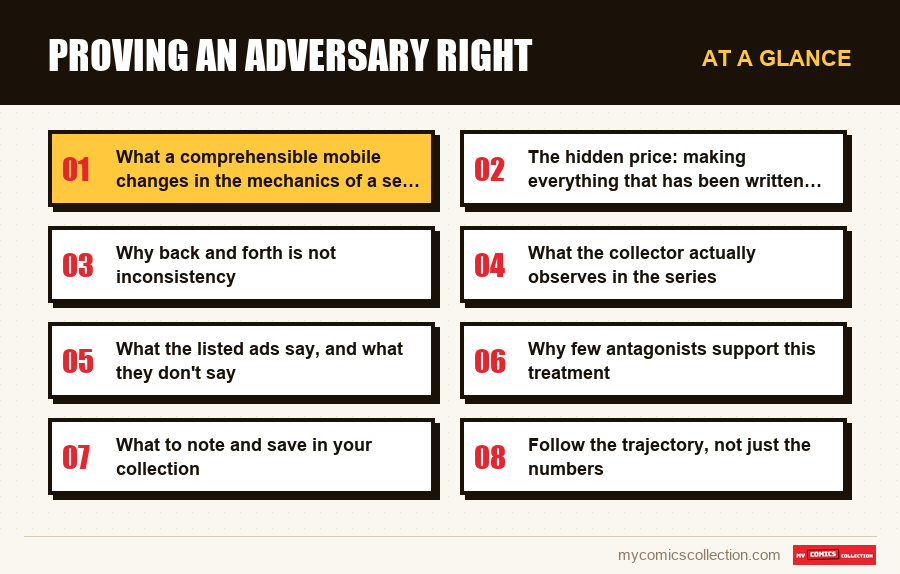
What a comprehensible mobile changes in the mechanics of a series
An antagonist without a legible motive imposes a discreet but heavy constraint: each of his returns must be justified by the plot. We must explain why he is free, why he is starting again, why no one has resolved the problem in the meantime. These justifications pile up and end up taking up the space of the story itself. Conversely, an adversary whose reasoning is understood does not need to be justified: he acts because he still thinks he is right, and this persistence is in itself the only necessary explanation. The narrative cost of his return drops to almost zero.
This gain is paid for elsewhere. As long as the enemy is a function, the hero never has to defend his own position: the opposition is enough to legitimize him. As soon as the enemy argues, the hero in turn becomes liable. The reader begins to wonder what prudence is worth in the face of emergency, what patience is worth when it always benefits the same people. The series can no longer be content with making the good side win; it must show why the hero's method is better than that of the adversary, which is infinitely more difficult than showing that he hits harder.
There is a third, less obvious consequence: victory becomes suspect. When we neutralize a threat, the case is closed. When we neutralize someone who was partially right, we have not resolved anything: we have only postponed the discussion. The following authors therefore inherit a situation where each defeat of the antagonist is provisional by construction, not by editorial convenience. It is this difference that readers perceive without always naming it, and which separates a character that we expect from a character that we endure.
The hidden price: making everything that has been written before coherent
A forced rereading of the past
Dozens of previous appearances have been written without this depth, with sketchy motivations assumed as such. The new episode cannot erase them: it must make them compatible. Each old gesture retrospectively becomes the clumsy expression of a reasoning that we did not yet know.
Le seuil du crédible
Retroactive consistency works as long as it explains past actions without excusing them. If the writing veers into excuses, the reader stops believing in the character: he sees the author's maneuver. The balance point is narrow, and it is reached or missed in the same episode.
Loss of simple register
Once the mobile is installed, it becomes impossible to reuse the character as an elemental threat. Any appearance must reopen the debate, even briefly. A hurried author who uses it as a pure force of opposition immediately produces a false note perceived by the regular readership.
A charge passed on to the next
The gesture engages well beyond its author. Each heir creative team must position itself on the basis of the disagreement, including when the story it wants to tell has nothing to do with it. The added depth is irreversible: it cannot be removed without contradicting it.
This requirement for retroactive consistency explains why so few comparable attempts succeed. Rewriting a secondary character's motivation is easy: they have little past to absorb. Rewriting that of an established adversary, present for years in dozens of episodes, amounts to resuming an already inhabited construction. The new foundations must support the existing walls, without apparent demolition. When the operation fails, the reader doesn't say "that's inconsistent": they say that the character has changed, which is a polite way of noting that the seam is visible.
The gesture is not only psychological enrichment: it is a contractual commitment to the readership. By agreeing with the opponent on a point, the series implicitly promises to never again treat this point as settled.
This is why the oscillations that follow (shifts to the side of the heroes, ruptures, returns to hostility) are not accidents of writing. They are the only honest way to keep the initial promise over a long period of time.
Why back and forth is not inconsistency
The criticism comes up in each cycle: the character changes sides too often, we no longer know where he is, the editor exploits the ambiguity for comfort. The objection is understandable, but it misses the logic of the situation. An antagonist whose motive is judged to be partially legitimate cannot remain stable. If he remains a permanent enemy, the series suggests that his reasoning ultimately had no value, and the founding episode loses its meaning. If he becomes a permanent ally, the disagreement disappears and the character ceases to be interesting. The only tenable position is oscillation.
This oscillation also has a fairly regular grammar. Rupture occurs when an external threat renders disagreement secondary: both sides agree on urgency without agreeing on principle. The rupture occurs when this threat disappears and the principle becomes central again. None of this is arbitrary: it is the mechanical consequence of a fundamental disagreement between two positions, neither of which is absurd. A series which refuses oscillation should settle the debate, and settling the debate would amount to canceling the contribution of 1981.
It should be added that oscillation is also what protects the character from wear and tear. A permanent enemy ends up tiring, because the reader anticipates the outcome. A permanent ally dissolves into the group. The alternation maintains an uncertainty which is not based on an artifice of a scenario but on an open question. The reader does not wonder “what will he do?” » as one wonders the outcome of a magic trick; he asks himself “who is right this time?” ”, which is a question in which he participates.
What the collector actually observes in the series
A recognizable before and after
Previous apparitions can be recognized by the brevity of the motivations presented. After the switch, the confrontation scenes almost always contain an argumentative speech, even if short.
A breakup date to note
Recording the year 1981 as a benchmark in your series sheet helps you understand why two episodes a few years apart can treat the same character in a seemingly incompatible way.
Alternate roles to label
Marking each appearance by the role played (opponent, circumstantial ally, third party) restores a legible trajectory where a simple chronological list gives the impression of disorder.
Scattered pivotal episodes
Not all flips occur in the same series. They are divided between main titles, derivative series and one-off stories, which makes monitoring impossible without an up-to-date record.
Reissues to distinguish
An episode identified as a turning point is re-edited, collected, republished. A statement which does not distinguish the original print from subsequent copies mixes very different objects under the same title.
A non-chronological reading order
The episodes which respond to each other on the basis of the disagreement do not always follow each other. Reconstructing this thematic order requires work of relating that numbering alone never provides.
Collecting this series?
Track what you own, what you are missing and what your collection is worth. 7 day trial.
Start my trial →What the listed ads say, and what they don't say
A one-time observation of the market, carried out on August 29, 2026, gives a useful picture provided you read it for what it is. These are amounts claimed by sellers on this specific date, i.e. requests posted, and not completed transactions. For the copies offered without passing through a verification body, there were one hundred and seventy-five proposals, ranging from 4.02 to 149.99 dollars, the midpoint of the distribution being located at 14.95 dollars. The verified copies, counted separately because they do not describe the same object, were twenty-three in number, between 24.99 and 249.99 dollars, with a midpoint of distribution at 119.50 dollars.
The exploitable fact is contained in one sentence: one hundred and seventy-five proposals around fifteen dollars in mid-distribution, for an episode that critics and readers consider to be a major narrative turning point. The recognized importance of a story therefore does not make it rare. These are two independent dimensions: the first relates to what the text has changed in the series, the second to the quantity of copies still in circulation and the number of sellers ready to part with them at the same time.
Two precautions are necessary. First, a measurement taken on a single date shows absolutely no movement: it does not allow us to say that the amounts requested have increased, nor that they have decreased, since there is no second point of comparison in this statement. Then, the isolated high value of a distribution, here almost a hundred and fifty dollars on the unverified side, reflects the hope of a particular seller, not an observed level. It is the middle point, backed by a large workforce, which describes what the market really offers, and only it.
The verified subset calls for an additional reserve. Twenty-three announcements are few compared to the hundred and seventy-five others, but the number remains sufficient to be described; On the other hand, it would be imprudent to draw detailed conclusions, for example on differences between state levels, each subcategory then falling to a few units. A reasonable reading stops at the observation that these two populations of advertisements do not compare directly: one offers a booklet, the other offers a booklet accompanied by an external evaluation and packaging, which constitutes a different product.
Why few antagonists support this treatment
Proving an adversary right requires that his objective can be formulated in a sentence that a reader could utter seriously. This condition immediately eliminates the majority of recurring enemies. Those whose motive is wealth, domination for its own sake or personal vengeance cannot cross the threshold: we can explain their behavior, we cannot adhere to it even partially. Explanation produces psychological understanding, not legitimacy, and it is legitimacy, not understanding, that makes the character inexhaustible.
A second condition is necessary, more rarely met: that the disagreement concerns a point where the hero himself is not absolutely solid. If the protagonist's position is impeccable, the opposing argument becomes a fallacy and the debate collapses. The gesture therefore only works if the series agrees to expose a weakness in its own camp: a slowness, a naivety, a privilege. Many titles refuse this cost, sometimes for good commercial reasons, and settle for complex but never founded antagonists.
The third condition is duration. A legitimate motive posed in an isolated episode, then forgotten, produces nothing: subsequent authors must refer to it, contest it, change it. This continuity cannot be decreed; it depends on the collective memory of an editorial team over several decades. Where it remained, the character became structuring. Where it was lost, the added depth dissolved within a few years and the character returned to functional status, often without anyone noticing.
We thus measure the exact nature of the risk. The gesture is not likely to fail at the moment it is made: a good episode remains a good episode. He risks failing later, through abandonment. It is a narrative investment whose return depends entirely on those who come after, and who have not signed anything.
What to note and save in your collection
The tipping point must be a given, not a memory. Including the year 1981 as a motivational turning point in your series sheet, with a sentence explaining what is changing, avoids having to reread ten episodes to find out why the tone differs between two periods. This note is the only one that allows you to explain to another reader, or to yourself three years later, the logic of the whole thing.
The role played in each appearance deserves a field distinct from the simple “present”. Noting whether the character acts as an opponent, as a casual ally or as an external third party transforms a flat list into a trajectory. It is precisely this information that makes the oscillations readable instead of making them seem like editorial clutter, and no numbering provides it.
Episodes which explicitly reopen the debate must be reported separately. Not all appearances are equal: some simply use the character, others take up the argument at its core and move it. Marking the seconds constitutes, in practice, the real reading route: the one we recommend when we want to understand the interest of the character without imposing several hundred booklets.
The distinction between original print and reprint must be made upon entry into the collection. A story recognized as a turning point is republished in multiple forms, and a statement that confuses them makes any subsequent comparison impossible, including with the announcements observed. It's a distinction that costs thirty seconds at the time of addition and hours if reconstituted afterwards.
A market observation must be dated in the form, never copied as a value. Recording « relevé du 29 août 2026, cent soixante-quinze annonces non vérifiées, milieu de distribution 14,95 dollars » keeps the information in its status as a one-off observation. Writing a bare number, without date or number, amounts to creating a certainty which never existed and which we will later believe to have verified.
Because it replaces functional motivation with sustained reasoning, which the reader can reconstruct and discuss. Before, the character was opposed; afterwards, he defends a position. This shift modifies the very nature of subsequent confrontations, which cease to be obstacles to become disagreements.
No, they arise directly from the initial choice. A character whose motive is judged to be partially founded cannot remain either a permanent enemy, which would invalidate his argument, nor a definitive ally, which would eliminate the disagreement. Alternation is the only configuration which preserves the voltage originally placed.
The two things are independent. The statement of August 29, 2026 listed one hundred and seventy-five unverified proposals for this episode, with a distribution average of around fifteen dollars: an abundance which coexists without contradiction with a recognized narrative importance.
None. The statement relates to a single date and contains only one measurement point; there is therefore nothing to compare. These amounts are also requests from sellers, not concluded transactions, which prohibits them from being treated as recorded prices.
Because they do not describe the same object: a verified copy is accompanied by an external evaluation and packaging which are part of what is sold. Mixing them would produce an artificial distribution, mixing two populations of ads with distinct logics.
Follow the trajectory, not just the numbers
Record each appearance with the role played, the tipping point and the date of your market observations. Your collection stops being a list and becomes a reading again.