Magneto: a list of one hundred advertisements which do not contain the booklet sought
On August 30, 2026, a query for "Magneto Counted separately, verified copies form 75 listings, from $34.95 to $79,999.99, median $7,999.99. The ratio between the two medians exceeds two hundred. No certification bonus explains such a difference: going down to the bottom of the ranking, we see that the cheapest advertisements do not relate to the booklet sought. The ordinary segment is not a cheaper segment, it is a segment that contains almost no object. All these amounts are claimed by sellers on this date, not collected during a transaction, and a single measurement says nothing about an evolution.
A difference of one to two hundred between two medians taken on the same day, on the same query, a few seconds apart, is not a market fact. This is a red flag on the measurement itself. Collectible markets produce significant differences between a damaged copy and an impeccable copy, between a current edition and a rare variant, but these differences scale: we go from a ratio of two to a ratio of ten, sometimes fifty on extreme pieces. A ratio of two hundred between the central points of two sets constructed by the same query falls into another category of phenomenon. When a figure becomes absurd, the first hypothesis to examine is never economic: it is methodological.
The statement of August 30, 2026 documents precisely this case. The query « Magneto X-Men 1 1963 » targets a unique and perfectly identifiable object: the first issue of the series launched in 1963. It produces two sets. On one side, 101 ads without mention of verification, the minimum of which falls to $1.50 and the median stands at $37.99. On the other, 75 listings for verified copies, with a minimum of $34.95 and a median of $7,999.99. Reading this as « la certification multiplie la valeur par deux cents » would be the most natural conclusion, and that would be a complete mistake. The rest of this article shows why, and what this changes for anyone who has a collection and would like to place a value on it.
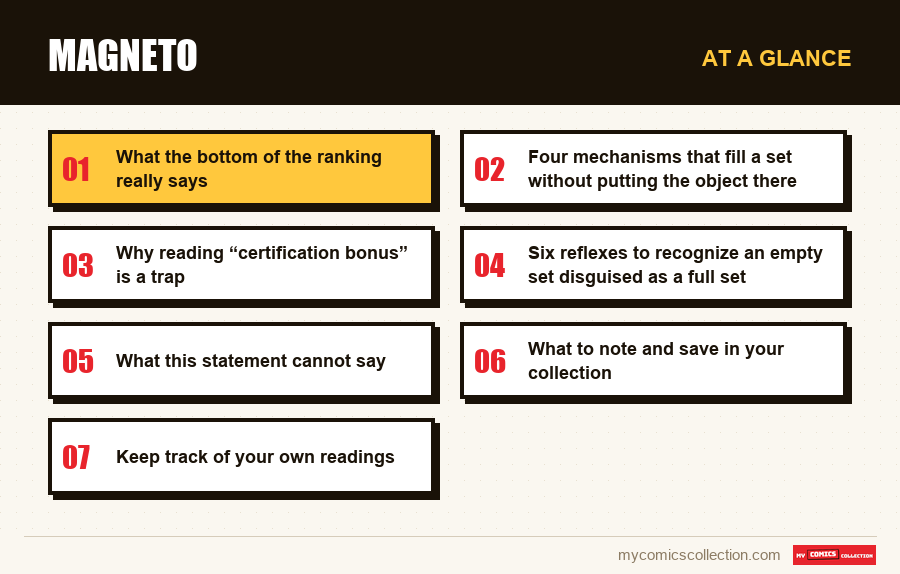
What the bottom of the ranking really says
The median of a set cannot be judged alone. It is judged by opening the advertisements that produce it. Of the five cheapest offers in the ordinary segment, none corresponds to the specification in question. The first, at $1.50, is entitled « Uncanny X-Men (1963-2011) #1 »: it is a catalog wording which adds to the number the range of years covering the entire series. The second, at $1.79, is called « X-Men (1963 - present) books at Arkham City Mall Comics & Collectibles » and is not a copy at all, but a generic store entry. The third, at $2.59, concerns « Uncanny X-Men #315 (1963 1st Series) [...] NM »: another number, whose title contains 1963 because it identifies the original series. The fourth, at $2.99, is announced as « Uncanny X-Men You Pick The Issue Newsstands Keys 1st Apps »: an offer of your choice, where the buyer then designates the number he wants. The fifth, at $3.00, is a « UNCANNY X-MEN #309 (Marvel, 1963) VG-F »: yet another number.
Five ads, five different ways to not be the desired object. And yet each contains the words of the request. This is the heart of the problem: the search engine does exactly what it is asked to do. It assembles labels containing "X-Men", "1" and "1963". He does not know that "1963" sometimes designates a year of publication, sometimes the starting point of a range, sometimes a series identifier attached to a number that has nothing to do with it. He also doesn't know that a store entry is not a copy.
Four mechanisms that fill a set without putting the object there
The year-series that restricts nothing
A date attached to a title does not always designate the printing date of the copy sold. In "1963-2011" or "1963 - present", the year is used to distinguish one series from another with the same name. It therefore applies to hundreds of numbers at a time. Adding this year to a query gives the illusion of narrowing the search even though it broadens it to the entire collection.
The shop entrance
Some advertisements do not offer any specific item: they serve as a showcase for a seller and list a range. Their displayed price is a call price, based on the cheapest item in stock. Such a line weighs in a survey exactly like a copy, and it mechanically lowers the observed floor.
The offer to choose from
The “pick your number” format works the same way. A single displayed amount covers an entire catalog whose actual prices differ after selection. The visible figure does not correspond to any identifiable object, but it is well counted in the distribution.
The isolated number in a title
A “1” in a query is found in “#315”, in “1st Series”, in “1st Apps”. The number sought is not an identifier: it is a typographic pattern present everywhere. On a long and abundantly listed series, this porosity is enough to populate the entire bottom of a ranking with other numbers.
None of these four mechanisms is an anomaly of the platform or a seller's maneuver. These are perfectly legitimate wording conventions, which are useful in their original context and which become toxic as soon as a tool aggregates them to derive a statistic. Their common point is decisive: they all produce very low prices. A store entry is displayed at the lowest, an offer of your choice too, a current issue of a series of several hundred episodes is worth a few dollars. The noise is therefore not distributed randomly: it is concentrated at the bottom of the distribution, exactly where the floor is formed, and it pulls the median towards it.
One last clue definitively settles the question. The regular segment maximum reaches $33,000.00, an order of magnitude comparable to the verified segment. The booklet sought therefore appears in this set: sellers are offering the object, without mention of verification, at high prices.
But it only appears at the top. A median calculated on a set where the targeted object only occupies the upper end describes neither the object nor the rest. It describes the central point of the noise. It's not a low price: it's a figure that has no reference.
Why reading “certification bonus” is a trap
The conclusion we spontaneously arrive at when faced with two such distant medians is that of a premium: having a copy verified would multiply its value. This reading is attractive because it is based on a real fact, verified copies actually sell for more than equivalent non-verified copies, and because it offers a ready-made explanation. This is precisely what makes it dangerous: it dresses up a measurement defect as an economic phenomenon, and it does so with a plausible story.
The test is simple and consists of one question: do the two sets compared contain the same thing? Here, no. The check functions as an unintended relevance filter. A verification body examines a physical, precise, identified copy; a store entry or an offer of your choice cannot go through this. The verified segment is therefore, by construction, almost entirely composed of the searched object. The ordinary segment has not undergone any filter of this type. Comparing their medians is like comparing a set of exemplars with a set of search results.
In other words, the difference measured is not the effect of certification on a price: it is the effect of certification on the composition of the sample. The true verification premium, if one wanted to estimate it, would require comparing copies of the same issue, in comparable condition, verified and unverified. This statement does not allow us to do so, and this must be said rather than filling the void with an intuition. On this point as on others, reading a character benefits from separating what we observe from what we project onto it.
Collecting this series?
Track what you own, what you are missing and what your collection is worth. 7 day trial.
Start my trial →Six reflexes to recognize an empty set disguised as a full set
Open the five cheapest
An aberrant floor can be diagnosed in just a few clicks. If none of the five lowest advertisements relate to the desired object, the median is already doomed: the noise is not marginal, it is structuring.
Beware of the added year
Adding a year to a query always seems prudent. On a long series, it is often the opposite: the year of launch appears in the title of all the issues. Check what the year means in the labels before using it as a filter.
Discard showcases and offers to choose from
An advertisement which does not commit a specific item is not a price observation. Identifying them is done by the wording: a range, a store name, an invitation to then select.
Look up as well as down
The maximum of the ordinary segment, comparable to that of the verified segment, was the decisive index. A coherent vertex with its own set while the center is not indicates that the object is present but in the minority.
Count before concluding
A small number of people, only a few announcements, does not support any conclusion on a price level. Here the numbers are comfortable, and that is precisely what is misleading: a hundred advertisements give an impression of solidity that an examination of the content destroys.
Distinguer réclamé et conclu
All of these values are requested by sellers on a given date. No one paid $33,000.00 nor $79,999.99 in this statement: these are stated hopes. A current ad measures intent, not a transaction.
What this statement cannot say
We must be as clear about the limits as we are about the conclusions. This statement was taken on a single date, August 30, 2026. A single photograph shows no movement: it does not allow us to say that the amounts requested are rising, nor that they are falling, nor that they are stagnating. Any sentence on a trend would require at least two comparable statements, separated in time, constructed with the same method. This is not the case here, and the absence of this information is better than a comfortable assertion.
The survey also says nothing about the state of conservation. A booklet of this age trades very differently depending on whether it is tired or close to new, and nothing in the aggregate figures allows us to disentangle this dimension. A difference of several thousand dollars even within the verified segment may reflect a condition, a singularity of copy, or simply the optimism of a seller. Distinguishing it would require an ad-by-ad examination which these statistics do not replace.
Finally, this report concerns a single site, a single national market, and announcements in progress at a given time. It does not represent all possible transactions for this issue. Its value is not to establish a price: it is to show, on a clear case, how a perfectly calculated statistic can relate to a whole which does not contain what we believe. The lesson can be transposed to any desired title, including when we looking to complete a low budget series and that a floor that is too beautiful attracts the eye.
What to note and save in your collection
Enter the value that you constructed yourself, not that which a tool calculated. On a booklet of this level of research, no automatic estimate holds, for the exact reason demonstrated here: the set on which it calculates is not populated with the object. The only defensible value is that which is obtained by opening the advertisements, putting aside the windows and other numbers, and looking at what remains. It is manual labor, and it has no substitute.
Systematically timestamp any value entered. A value without a date is unusable six months later, because we will no longer know whether it reflects an old state of the market or a recent observation. Noting “August 30, 2026” next to the amount costs a few seconds and transforms perishable data into a usable benchmark. It's the difference between a sheet that ages well and one that becomes a trap.
Record the exact query that was used for the statement. This case shows that a query is not neutral: “Magneto X-Men 1 1963” produced a largely irrelevant set. Keeping the formulation used allows, upon rereading, to reconstruct what was measured, to identify that a spurious year had slipped in, and to repeat the observation under the same conditions.
Separate in your file what is verified from what is not. Since the verification here acts as a filter on the very composition of the sample, mixing the two registers in a single value destroys the information. A verified copy and an ordinary copy of the same issue belong to two markets which are better followed separately, even if it means carrying two distinct markers.
Explicitly mark issues for which no reliable estimate exists. It is more honest, and more useful, to write “no usable estimate as of August 30, 2026” than to copy a median that we know is false. An assumed empty field signals to the future reader, who will often be oneself, that the work remains to be done, whereas an erroneous figure gives the illusion that it has been done.
By opening the few cheapest ads in the set. If they do not relate to the object sought (another number, a store window, an offer of choice) the median is contaminated. This check takes less than a minute and avoids recording a value without a referent, like here where the five lowest bids, between $1.50 and $3.00, were all off-topic.
Not systematically, but you need to know what this year designates in the wording of the title concerned. When it is used to identify an entire series, it is found in forms such as "1963-2011" or "1963 - present" on hundreds of different issues. In this case it does not restrict anything and imports noise. Check this point before relying on the filter.
No. Above all, it measures a difference in composition between two sets. The verified segment contains almost only the requested issue, because a verified copy is necessarily an identified object. The ordinary segment contains labels of all kinds. Estimating a true verification premium would require comparing copies of the same issue in comparable condition, which this statement does not allow.
That the booklet is indeed present, but only at the top of the distribution. This amount remains a price asked by a seller on August 30, 2026, not an observed transaction. An isolated peak reflects a selling intention: it indicates where the item is located in the whole, it does not prove that a buyer has accepted this level.
Absolutely not. All these values come from a single day of observation. A single measurement does not contain any movement information: at least two measurements spaced over time, constructed in the same way and on sets cleaned in the same way, would be required to indicate an increase or a decrease.
Keep track of your own readings
A hand-constructed value is only valuable if it is preserved along with its date and the manner in which it was obtained. My Comics Collection lets you record, for each issue, the estimate you think is defensible and when you made it, rather than displaying a figure calculated on a set that no one has verified.