The August 30, 2026 report on the current advertisements of an American general auction site shows that the elongated fascicle of Uncanny X-Men No. 150, dated 1981, claims to be at the same level as the ordinary issues of its series: $4.99 for a copy presented in elongated format in declared 8.0 condition, compared to $4.02 for a copy declared in 4.0. From 176 unverified listings, the central value is $14.97 and the five cheapest listings fall within a range of less than a dollar. The thickness of the booklet cannot be paid for. Please note: these are amounts requested by sellers on a single date, no sales concluded, and a single statement says nothing about any developments.
There is a stubborn idea among the beginning collector: the thicker the issue, the more it should be worth. The intuition seems reasonable: more paper, more plates, a higher cover price at the time of publication. The survey carried out on August 30, 2026 on the current advertisements of a large general auction site, American market, says exactly the opposite. The extended issue dedicated to Magneto in Uncanny X-Men, dated 1981, is no longer distinguishable from anything. It claims to be at the level of the most banal issues of the same series, and sometimes below copies in significantly inferior condition.
This page examines what this statement really allows us to say, and especially what it does not allow. The figures cited correspond to amounts requested by sellers on a single date, never to completed transactions. A photograph taken only once shows no movement: neither rise, nor fall, nor stagnation. It describes a state of supply, at a given moment, and nothing more. We will draw five practical consequences for maintaining a collection, all verifiable in the data presented.
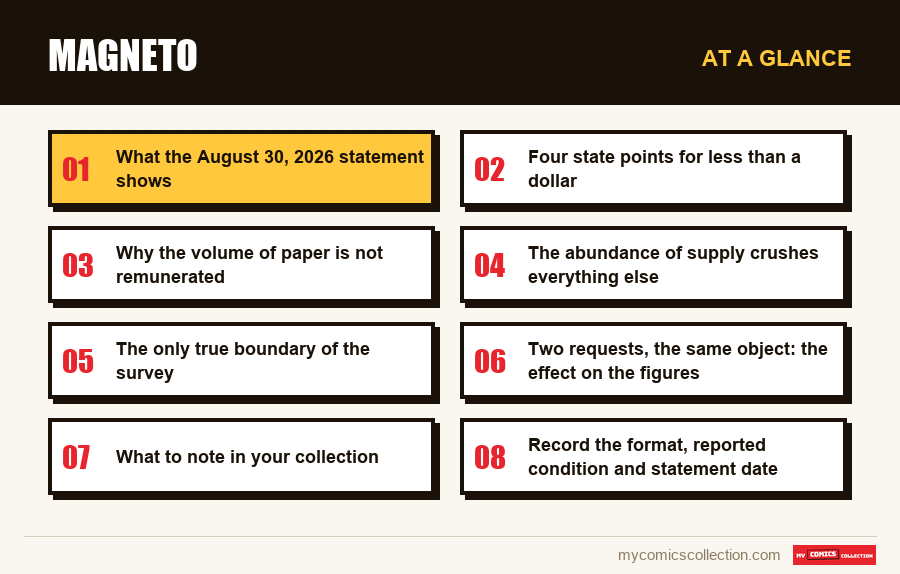
What the August 30, 2026 statement shows
The query was for « Magneto Uncanny X-Men 150 ». She reported 176 unverified advertisements, that is to say copies offered without passing through a verification body. The lowest amount requested was $4.02, the middle value was $14.97, the highest was $149.99. Alongside this set, 23 listings were for verified copies: $24.99 low, $119.50 mid, $249.99 high.
The maximum of $149.99 in the unverified segment has no indicative value. A single number at the top of a distribution reflects the ambition of a particular seller, not a market level. All it takes is one person to set a high price and wait for that number to exist. There is no indication that he ever found a buyer, and the statement contains no information on the sales actually concluded. The same reasoning applies to the $249.99 verified segment.
What matters more is the low tail of the distribution. The five cheapest advertisements all, without exception, relate to the issue actually sought, dated 1981. None is a lot, a reissue or a derivative object that has polluted the query. This homogeneity is what makes the comparison possible: we compare the same object five times, described in five different states, by five different sellers.
Four state points for less than a dollar
4,02 $: état déclaré 4.0
A copy from 1981 advertised in modest condition, accompanied by a mention of combined shipping costs. This is the lower limit of the entire unverified reading. A readable, unpretentious copy, at an amount that represents almost nothing compared to the cost of shipping.
$4.88 and $4.95: without declared condition
Two advertisements from the same issue from 1981, without numerical condition indication. They are placed between the two extremes of this small group, a few tens of cents from the lower limit. Their mere presence densifies the interval and makes any price distinction illusory.
4,99 $: format allongé, état déclaré 8.0
The decisive announcement. It explicitly presents the issue as a number in elongated format and declares a status of 8.0. It costs 97 cents more than the copy announced in 4.0. Neither the thickness nor the four points of difference in condition produce the slightest noticeable extra.
5,00 $: édition kiosque
The same issue from 1981, presented as an edition intended for newsstand points of sale. It closes the group of five, 98 cents from the lower limit. A distribution characteristic often highlighted by sellers does not create any price separation here either.
The result deserves to be stated bluntly: five announcements, declared states ranging from 4.0 to 8.0, one mention of elongated format, one mention of newsstand edition, and a total interval of less than a dollar. At this price level, none of the characteristics that the collector is accustomed to considering as decisive produce any measurable effect. Neither the state, nor the pagination, nor the distribution circuit.
Immediate and risk-free consequence: when the difference between the worst and the best available copy is counted in cents, taking the best costs nothing. There is no reason to buy a copy advertised as 4.0 when a copy advertised as 8.0 costs a dollar more.
This conclusion applies to this statement, on this date, on these advertisements. It says nothing about what these copies were worth a year ago or what they will be worth tomorrow, and it is not based on any recorded sales. The reasoning, on the other hand, is transposed: wherever the low tail is also compressed, the same rule applies.
Why the volume of paper is not remunerated
The extended issue was, at the time of its publication, sold for more than the ordinary issues of the series. This is the very logic of the format: more pages printed, more manufacturing costs, a higher displayed price. No coverage amount appears in the statement and it would be inappropriate to advance one. The observation is limited to this: whatever this difference was at the time, it has completely disappeared from the price structure observed today.
What the market for old booklets pays for is not the weight of the object. This is what the issue contains that is irreplaceable and the real difficulty in obtaining a copy. An issue without a notable episode and available in the hundreds is not more valuable because it has more pages. Conversely, a thin but rare booklet that conveys a moment that readers are looking for stands out without its pagination having anything to do with it.
The consequence for those who read is excellent, and it must be said as it is. The extended format automatically offers more material to read for the same amount as an ordinary issue. On this precise statement, the ratio between the content obtained and the amount claimed is better for the thick number than for any standard number of the same series. The collector-reader gains exactly where the collector-speculator finds nothing.
This dissociation between reading value and exchange value runs through the entire creation of a collection. It explains why two people can look at the same booklet and draw opposing judgments from it without either person being wrong. The question to ask yourself before any purchase is simply to know which of the two values you are looking for, because they are not housed in the same objects. To explore this point further on the entire series, the historical overview of the X-Men in comics places each period in its editorial logic.
The abundance of supply crushes everything else
One hundred and seventy-six advertisements for a single issue: this is the main explanation of what we observe. It is not the state which becomes indifferent by a mysterious property of the market, it is the offer which is too broad for a difference in quality to be monetized. When dozens of sellers offer the same item at the same time, none can ask for more without seeing the buyer move on to the next ad.
A 1981 booklet printed at an industrial level, kept by a large number of readers for several decades, mechanically finds itself in this situation. The compression of gaps is not an accident: it is the arithmetic translation of an abundance. On an item that is truly difficult to find, with only a few listings, the same difference of four condition points would produce incommensurate amounts, because the buyer would have no immediate alternative.
This reading invites us to reverse the order of the questions. Before wondering in what condition to buy, you need to ask yourself how many copies are available. The number of announcements is the information that governs all others. It indicates whether we are in a regime where the state pays itself or in a regime where it does not pay itself, and this distinction completely changes the purchasing strategy.
It also changes the way we understand the central value of $14.97. This amount is the one around which the 176 unverified advertisements are distributed, well above the low queue. The difference between $4.02 and $14.97 does not mean that the more expensive copies are better: it means that sellers position their ads in very different ways, with very different expectations, on the same abundant item.
The only true boundary of the survey
Vérifié ou non vérifié
The verified segment starts at $24.99, about five times the lower limit of the regular segment. This is the only clear separation in the statement. It does not depend on the format, nor on the declared state, nor on the edition: it depends on the passage through a verification body.
A date, not a trend
All these values come from a single observation, August 30, 2026. No comparison with an earlier date is possible here. Asserting an increase or decrease based on this reading alone would be a methodological error, not excessive caution.
Demandé, pas encaissé
These are amounts that sellers are asking for in current listings. None of them attest to a transaction. A displayed price is an offer; only a concluded sale constitutes data on what the market actually agrees to pay.
Vingt-trois annonces, effectif modeste
The verified segment is based on only 23 ads. It's not much. We can note that its lower limit is well above that of the ordinary segment, but it would be imprudent to deduce from this a stable price level for the verified examples.
A maximum is not a price
The regular segment's $149.99 and the verified segment's $249.99 are isolated highs. They describe the hope of a single seller. Using them as a reference would lead to massively overvaluing a booklet that others offer at four dollars.
Un marché géographique donné
The statement relates to the American market of a general auction site, in dollars. Shipping conditions, fees and availability differ elsewhere. The amounts cannot be transposed as they are to another market without precaution.
Collecting this series?
Track what you own, what you are missing and what your collection is worth. 7 day trial.
Start my trial →Where does the price cut go, and why is it elsewhere than we think?
The collector who discovers these figures naturally seeks the dividing line. It is neither between 4.0 and 8.0, nor between an ordinary issue and an extended issue, nor between one newsstand edition and another. It is located between the verified copies and the others: on one side a lower limit at $4.02, on the other a lower limit at $24.99. Nothing else in this statement produces a discrepancy of this order of magnitude.
This is not to say that verification creates value. The statement does not allow us to resolve this question, and two very different mechanisms could produce the same result: either the verification increases the amount claimed, or the sellers only submit for verification the copies that they already judge to be superior. The available data do not distinguish between these two explanations, and we should be careful not to choose one.
What is certain, however, is the order of magnitude of the march. A buyer who hesitates between two unverified copies is deciding on pennies; a buyer who moves from the ordinary segment to the verified segment changes spending category. This is the only decision in this statement that really involves a budget, and it is therefore the only one on which it is worth thinking at length.
For a collector who builds a set around a character, this hierarchy has practical significance. She suggests concentrating the financial effort on a very small number of parts and completing everything else in the ordinary segment, where the difference in quality cannot be paid for. Low-cost acquisition strategies are detailed in our dedicated guide for buy X-Men without breaking the bank.
Two requests, the same object: the effect on the figures
A precision of method is necessary. The 176 advertisements do not describe 176 different objects: they describe the same booklet offered 176 times. This evidence has a direct consequence on interpretation. Each additional announcement adds an opportunity for comparison for the buyer, therefore additional downward pressure on the amounts claimed. The number of ads is not a sign of rewarding popularity; it is a sign of availability.
The way the query is formulated also affects the results. A search associating the name of a character with a series and a number does not return exactly the same population as a search relating only to the reference of the booklet. This point is developed in our analysis devoted to two ways to query the market for the same booklet, and it explains part of the differences that we observe from one reading to another.
None of this invalidates the central observation. Whether the request is broad or narrow, the lower queue remains occupied by copies of the correct issue, in very different states, at almost identical amounts. It is this regularity, and not the exact number of announcements, which bears the demonstration.
There remains a lesson on reading the ads themselves. A seller who takes the trouble to mention the elongated format indicates that he considers this characteristic as an argument. The amount he asks for shows that it is not one in this market segment. The gap between what a description highlights and what the pricing structure reflects is always instructive.
What to note in your collection
The elongated format is recorded as a material constraint, never as added value. A thicker issue does not fit in the same soft protections as ordinary issues, does not fit in the same boxes and deforms differently under the weight of a stack. Noting “elongated format” in your file is used to prepare suitable storage, not to justify a higher valuation: this statement shows precisely that it is no longer distinguishable.
The stated condition must be recorded as a seller's statement, not as a fact. In the five cheapest ads, one copy is advertised in 4.0, another in 8.0, two have no number. These mentions come from different people applying their own criteria, without external control. Record the value, specifying that it is declared, and clearly distinguish it from a condition noted by a third party.
The newsstand edition note deserves its own line, regardless of its effect on price. Here, a copy presented in this way costs $5.00, among the others. This characteristic is part of the distribution circuit and is part of the identity of the issue, just like its year. It documents what you own; it adds nothing to what this fascicle represents by going up on this statement.
Any market observation is noted with its date and status. An amount without a date is unusable six months later. Write "requested August 30, 2026", specify that this is a current listing and not a sale, and indicate whether the item was in the verified segment or the regular segment: since that's where the spread from $4.02 to $24.99 occurs. Without these three pieces of information, an archived figure says nothing.
The number of available ads is data to keep in the same way as the price. One hundred and seventy-six simultaneous propositions explain the crushing of differences far better than any consideration of the state. By recording this number next to the amount, you keep the key to interpretation. A future statement showing a very different workforce will then be read in context, instead of comparing to a bare number.
Not in this statement. The copy presented as an extended format issue sold for $4.99 on August 30, 2026, compared to $4.02 for a copy advertised in 4.0 condition. Less than a dollar separates the five least expensive ads, all for the same 1981 issue. However, the format was sold more expensively at the time of publication. This observation concerns amounts requested on a single date, not sales concluded.
The survey shows that the question almost does not arise in the lower queue: four status points separate two announcements 97 centimes apart. You might as well take the best copy available, since the extra cost is negligible. The situation would be different on a rare issue, where the buyer does not have dozens of immediate alternatives.
This amount is the highest among the 176 unverified listings. It reflects the expectation of an isolated seller and does not attest to any transaction. Taking a distribution peak as a reference would lead to greatly overvaluing a booklet that others are offering at four dollars on the same day. The central value, at $14.97, better describes the average ad position.
Few things. Twenty-three advertisements constitute a modest number, insufficient to establish a reliable price level. We can only note that the lower limit of this segment, $24.99, is approximately five times higher than that of the ordinary segment. The statement does not make it possible to say whether the verification increases the amount claimed or whether only the copies already deemed superior are subject to it.
No, and that's an important point. A measurement taken only once, on August 30, 2026, describes a state of supply at that time. It would take at least two comparable surveys, separated in time and constructed according to the same request, to speak of a movement. Nothing in these data justifies announcing progression or decline.
Record the format, reported condition and statement date
An elongated issue cannot be stored like the others and an amount without a date is worthless. My Comics Collection allows you to record for each copy its format, its condition as declared to you, its edition and your time-stamped market observations, so that your purchasing decisions are based on your own statements rather than on an impression.