Madame Web: the French binding album, a third numbering on top of the other two
To look for Madame Web in the French edition is to come up against three stacked numbering systems: the original American booklet, the French monthly magazine that translates it, and the hardback album that binds several of these magazines into a single volume. None of the three can be deduced from the other two. The survey carried out on August 30, 2026 on the French market (therefore in euros, and not in the usual American currency of our surveys) returns 181 advertisements for the Nova magazine published by Lug, with a minimum claimed of €2.99, a median of €9.90 and a displayed maximum of €300.00. These amounts are prices asked by sellers at a given time, not completed transactions. Among these 181 announcements, none concerns a copy verified by an external organization.
A reader who wants to get their hands on a specific apparition spontaneously searches for a number. This is the reflex that the American edition has installed: a series, continuous numbering, a number which designates one object and one only. The French edition of the 1970s and 1980s does not work like this. It regroups, it translates, it renames, it recomposes. An American issue becomes one chapter among others in a French monthly review which has its own numbering, unrelated to that of the original series. And this French review is in turn capable of being bound, in batches, in an album which also bears a number: a third, still different from the first two.
The statement of August 30, 2026 makes this mechanism visible in a few lines of announcement titles. There we find side by side an ad « NOVA ** N° 84 ** JANVIER 1985 LUG EDITIONS » at €2.99, an ad « NOVA 134 TBE mars 1989 LUG / Marvel / Semic Spiderman » at €3.00, and an ad « BD- Marvel ALBUM N°20 NOVA, septembre 1979 - Lug, Spider-man » also at €3.00. Three objects, three numbers, and the third, 20, is an order of magnitude below the other two while it designates a thicker volume, containing several magazines. Nothing in the figure itself indicates this difference in nature. It is the word « album » in the wording, and it alone, which indicates this.
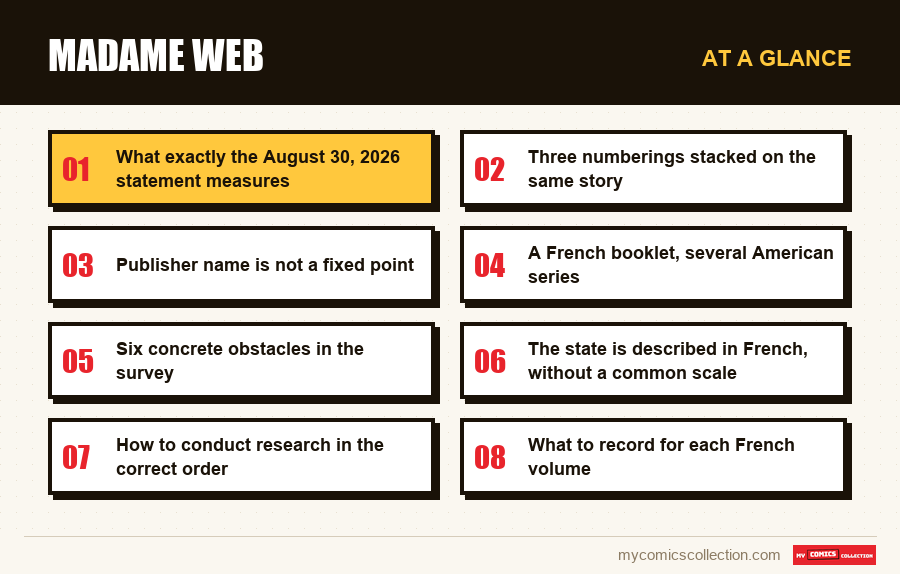
What exactly the August 30, 2026 statement measures
First clarification, and it changes everything: this reading was not taken on the American market. The amounts are denominated in euros and come from advertisements written in French, relating to objects printed in France. Our usual readings are based on the American market and its currency; this one no. Directly comparing the two series of figures would make no sense, neither in terms of the level of the amounts, nor in terms of the uses of description that accompany them.
Second clarification: the 181 advertisements identified are current offers, that is to say sums that a seller hoped to obtain on August 30, 2026. None of them attests that a buyer has accepted this amount. A price asked and a price paid are two distinct quantities, and only the second really provides information on the exchange value. We therefore present these figures for what they are: a snapshot of the offer on a date, nothing more.
Third precision, which follows mechanically from the first two: a single measurement does not describe any movement. We only have one point in time here. To assert that these amounts are rising, falling or stagnating would require at least a second statement on another date, and we do not have that. Any sentence like “it’s climbing” would, on this basis, be a pure fabrication. We prohibit ourselves from writing it.
There remains the shape of the distribution, and it speaks for itself. Between the minimum of €2.99 and the maximum of €300.00, the ratio is one to one hundred. The median is €9.90: in other words, half of the ads are under ten euros. The maximum is therefore an isolated point very far from the heart of the offer. It reflects the hope of a seller, possibly backed by a particular object that the wording does not detail, but it says nothing about the price at which the magazine usually circulates. It is the median, not the extreme high, that describes the current market.
Three numberings stacked on the same story
The American number
This is what the databases and reading guides document: an issue in a series, on an American publication date. It's also the only one of the three that most readers are familiar with, because it's the one that structures all the online literature on the subject.
The issue of the French review
The monthly magazine which hosts the translation has its own, independent series of issues. The survey shows numbers 62, 84, 99 and 134 for the same journal, spread from March 1983 to March 1989. This figure does not refer to any American series in particular, since the journal hosts several.
Le numéro de l'album
The album combines several issues of the magazine into a single volume and is given a separate issue. The announcement noted concerns an album no. 20 dated September 1979. This number counts the albums produced, not the magazines they contain: it therefore progresses much more slowly.
Aucune conversion automatique
Going from one numbering to another requires a hand-established correspondence table, object by object. No one publishes this table in a complete and accessible way. The collector therefore reconstructs it by cross-checking, from the summaries printed in the volumes he already owns.
This superposition is not a publishing accident: it is the economic model of the newsstand magazine. The monthly booklet is sold by the number and disappears from display shelves; the album brings together several months at once and is intended for long-term sale, often in bookstores. The two objects coexist, contain the same content and are arranged differently. The same story can therefore exist in duplicate in a French collection without anything on the covers indicating this.
The most costly trap is the simplest: mistaking an album number for a magazine issue. Seeing “album no. 20” and then looking for magazine no. 20 amounts to looking for an object that has no connection with the one we were aiming for, or even an object that does not exist in this form.
The reverse is just as misleading. A seller who owns an album but advertises the issue of one of the magazines it contains correctly describes the contents and incorrectly describes the item. Without a photo of the back or the summary, the confusion does not resolve until receipt of the package.
Publisher name is not a fixed point
A second source of error appears in the labels noted. Two publisher names circulate for one and the same journal depending on the period. An ad is titled “1986 Comics Français Lug Semic NOVA N° 99 MARVEL COMICS” and advertised at €3.00; another, “NOVA 134 TBE March 1989 LUG / Marvel / Semic Spiderman”, for the same amount. In both cases, the seller mentions the two names side by side, as if hesitating or as if he wants to cover both possible searches.
For the buyer, the consequence is immediate and purely practical: a search carried out under a single publisher name only yields part of the deposit. Advertisements that only mention the other name remain invisible, and there is no warning that they exist. We must therefore systematically question the two designations, and accept that the results partially overlap.
This detail also explains part of the price dispersion observed on August 30, 2026. When the same object is described under several labels, the offers are not visible to each other. A seller who does not appear in the same results as his competitors does not align with them, and displays an amount that has never been compared to the rest of the offer. The fragmentation of labels mechanically produces the gap, independently of the actual rarity.
Finally, this instability of the publisher's name confuses the dating benchmarks. Collectors often use the name on the cover to roughly locate a period. Here, the overlap of the two names in the wording prohibits this shortcut: it is the printed date, when it is reproduced in the advertisement, which remains the only usable reference point: January 1985 for number 84, March 1989 for number 134.
A French booklet, several American series
The French monthly review is not the translation of a series. It's an anthology. The ad “NOVA n° 62 ED LUG MARCH 1983 SPIDER-MAN 4 FANTASTIQUES SPIDER-WOMAN TBE”, offered at €3.00, lists three distinct American series brought together in a single issue. The seller lists them because he knows that his potential buyers are not looking for the magazine: they are looking for one of the series it contains.
This structure has a direct consequence on the way you classify your collection. Such a booklet does not fall under any of the series it hosts, since it hosts them all. Classifying it under one of them makes the others impossible to find; classifying it under its own journal title leaves it on the shelves organized by character. There is no right answer, only a decision to make and keep.
It also has a consequence on waiting. When you acquire a booklet for a given character, you are not buying an entire volume devoted to this character: you are buying a fraction of a volume. The rest of the pages belong to other stories, which may be of interest, but which were not part of the initial research. At three euros per issue, the difference is anecdotal; it ceases to be so on more expensive volumes, or when you buy in series to complete a plot.
For a secondary character, this dilution is even more marked. A brief appearance in a translated chapter is not noted anywhere on the cover, and the announcement labels only cite the headliners: those who sell. Finding a one-off appearance therefore requires knowing in advance the American issue concerned, then going back to the journal that translated it: the reverse order, starting from the journal to discover what it contains, does not work on a large scale. THE reading guide dedicated to the character serves precisely to establish this first stage, that of the American reference.
Six concrete obstacles in the survey
The wording acts as a catalog
Everything we know about an advert is in its title: number, date, publisher, series cited. What is not there does not exist for the search engine, and therefore not for the buyer.
The date is the only stable anchor
January 1985, March 1989, September 1979, March 1983: the months and years recorded situate the objects in relation to each other much more surely than the numbers, which belong to different systems.
Two publisher labels
The same journal appears under two names depending on the year, sometimes both in the same wording. A search carried out under a single name misses part of the available offer.
Album or booklet, same number
An album No. 20 and a magazine No. 20 would be two unrelated objects. Only the presence of the word “album” in the title of the ad allows us to decide.
No verified copies
Of the 181 advertisements noted, none concerns a copy passed by a verification body. The condition is therefore judged by eye, on photos, without a common scale.
The summary is not given
An album does not systematically say which numbers it links. The real content is discovered upon opening, or by cross-checking with copies already owned.
Collecting this series?
Track what you own, what you are missing and what your collection is worth. 7 day trial.
Start my trial →The state is described in French, without a common scale
The most structuring figure in the survey is perhaps the most discreet: zero copies verified out of one hundred and eighty-one advertisements. On the American market, a significant part of the offer goes through organizations which assign a standardized rating and seal the object; this note then becomes a common language between seller and buyer, and a good part of the price is explained by it. Here, this language does not exist.
Instead, the labels use quality French abbreviations: "TBE" appears in two of the advertisements noted, that of number 134 and that of number 62. It is an assessment of the seller, expressed in a common vocabulary, without a published reference or third party to arbitrate it. Two sellers using the same abbreviation can describe significantly different items, and neither is acting in bad faith.
This shifts all the weight of evaluation onto photographs and free description. For stapled newsstand magazines, the points of wear are known: the spine, the corners, the central folding, the yellowing of the paper. A buyer who only has a front cover photo sees precisely none of these points. Asking for a view of the back before purchasing is not distrust, it is the only information available.
This also puts the price gap into perspective. When half of the ads are below €9.90, a difference of a few euros between two offers does not measure a documented difference in condition: it measures the appreciation of two different people, on two objects that no third party has examined. The maximum of €300.00 recorded on August 30, 2026 can be read in the same context: it is not validated by any external verification, and nothing in the statement explains what would justify it.
How to conduct research in the correct order
The method that works goes back the circuit of intuition. We start from the American booklet, because it is the only reference documented from start to finish. We then identify the French journal likely to have translated it, based on the dates: the gap between the American publication and the French publication is regular for a given publisher, and the dates printed on the journals provide a verifiable benchmark. We only deal with the album last, as a possible container and not as an autonomous track.
At each stage, we note what we have verified ourselves and what we assume. A correspondence established by reading the summary of a volume one owns is a fact. A correspondence deduced from an approaching date is a hypothesis, which may be false and which must be reported as such in its notes. Mixing the two amounts to creating a correspondence table from which we will no longer be able to say, six months later, which lines are based on which.
This discipline costs a few minutes per object and avoids two recurring errors: buying a story that you already have in another container, and searching for weeks for a magazine whose number never existed because it actually came from an album. Both occur more easily as the amounts involved are low: at three euros, we check less.
Finally, it serves to clearly separate two registers which quickly become confused in a collection: what is published fiction and what is adaptations, whose chronology and characters do not obey the same rules. On this point, the clarification proposed in the comparison between the 2024 film and the comics avoid searching in the paper editions for elements that are not there.
What to record for each French volume
The object type before its number. Write “album” or “journal” in front of the number, systematically, including when the answer seems obvious to you at the time of entry. This is the only information that prevents us from confusing album no. 20 of September 1979 with a magazine bearing the same number. A bare number, without a qualifier, becomes ambiguous again as soon as you reread it out of context, and it will be even more so for anyone who consults your notes after you.
The list of magazine issues bound in the album. As soon as you open an album, note the numbers of the issues it contains and record them in the volume card. This list is precisely what the announcements do not provide, and what no one publishes in a consolidated manner. It will save you from separately repurchasing magazines already present in an album on your shelf, and it constitutes, cumulatively over several volumes, the embryonic correspondence table that you are missing.
American series actually contained. Write them all down, not just the one that prompted the purchase. The March 1983 issue found in our sample announces three in its wording alone. Without this list, a volume purchased for a character becomes invisible the day you look for another character that it also contains, and you will buy the same item a second time under another entry.
The French publisher and the year shown on the copy. Copy the name as it appears on the object, without standardizing it, and add the month and year when they are printed. Since two publisher names coexist for the same journal depending on the period, the exact mention that your copy bears is data in itself, useful for finding comparable announcements and for situating the volume in the chronology of publication.
The price paid, shipping included. Record the total amount charged, including shipping costs, and the date. On objects where half of the offer is under ten euros, the shipping costs a considerable fraction of the real cost, and an object price noted alone gives a false image of what the collection cost. It is also the only series of figures that you can be sure corresponds to successful transactions, unlike the amounts displayed in the advertisements.
By the word itself. In the statement of August 30, 2026, only one advertisement bears the mention "ALBUM" in its title, with the number 20 and the date September 1979. The others cite a bare number, between 62 and 134. In the absence of the word, a photo of the edge or the thickness of the volume generally settles the question, an album connecting several issues being significantly thicker than a stapled magazine.
Because the two counters do not count the same thing. The journal number increases with each monthly publication; the album number increments with each bound volume, which absorbs several months of review. The second therefore progresses much more slowly than the first. A No. 20 album can thus contain issues whose numbers have two or three digits, without there being the slightest inconsistency.
No, and we must be careful not to read it that way. This is a price asked by a seller on August 30, 2026, in a distribution whose median is €9.90. No buyer was recorded at this amount, and no verification body intervened on the object concerned, since the statement does not include any out of the 181 advertisements. An isolated extreme point measures a seller's expectation, not a market level.
No. This survey concerns the French market, in its currency, on objects printed in France and described in French. Our other statements relate to the American market and its currency. Beyond exchange, these are two markets with different uses: the state description practices, the use of verification organizations and the structure of the offer are not the same. Reconciling the amounts without saying so would produce a misleading comparison.
Consider it incomplete rather than false. The sellers highlight the most sought-after titles, and an ad that only cites one can perfectly relate to a booklet that contains three, like the one from March 1983 noted here. If the exact content determines the purchase, ask for a photo of the summary before ordering: it is the only document that lists what the volume actually contains.
A collection that accepts three numberings at once
Following French editions means keeping, for the same story, an American reference, a magazine number and sometimes an album number. My Comics Collection lets you save each volume with its type, publisher, date and series it contains, then instantly find what you already own before ordering the same content again under another cover.