Some of the ads that come up on a search for “Lex Luthor Action Comics 23” do not put an identified copy on sale: they offer an entire stock from which the buyer will choose their number after payment. The amount displayed then corresponds to the cheapest booklet in the lot. On the August 30, 2026 statement, the cheapest of the 139 unverified advertisements, at $1.95, was for fifty-one issues to choose from, and none of the five cheapest advertisements concerned the issue sought.
The instinct of most buyers is to sort a list of ads from lowest to highest price, look at the first line and conclude something about the value of the number they are looking for. This gesture seems reasonable; However, it is one of the most misleading on the market for old booklets. The first line is almost never the price of the booklet in question. It is the call price of an ad designed to occupy this place, and a “choice” ad, which covers several dozen numbers sold at the same price, is mechanically designed to be installed there.
The survey carried out on August 30, 2026 on a general auction site in the American market makes this phenomenon measurable. Of the 139 unverified ads responding to the query, the lower bound falls to $1.95 while the central amount of the same set is at $11.67, or about six times higher. This gap is not the sign of a hidden good deal: it is the trace of a different object. Let's make this clear from the outset, because everything else depends on it: these amounts are those that sellers are claiming on a given date, these are not completed transactions, and nothing in this statement allows us to say that only one of these announcements found a buyer.
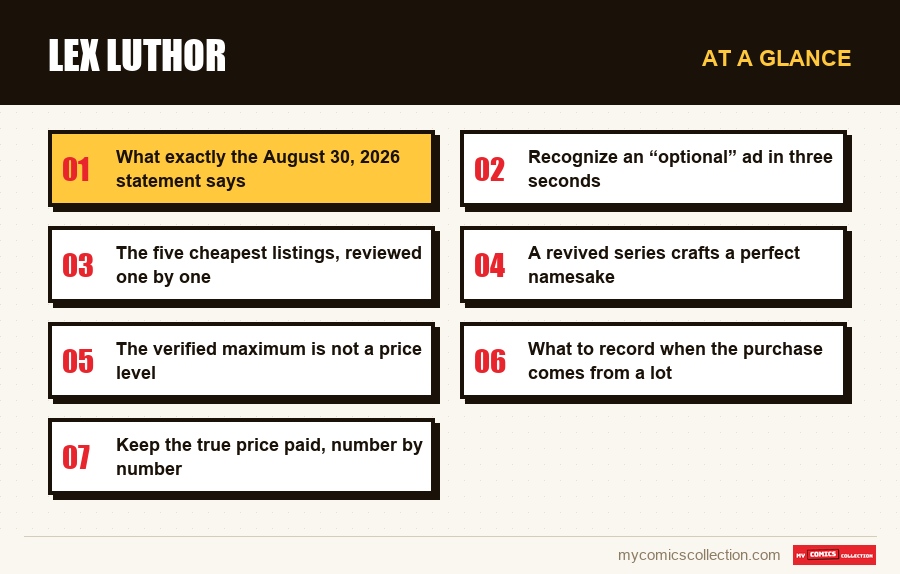
What exactly the August 30, 2026 statement says
The raw figures fit into two blocks, and we must resist the temptation to merge them into one. On one side, 139 unverified advertisements, that is to say copies described by their seller without passing through an independent verification body: the lower limit is set at $1.95, the central amount at $11.67, the upper limit at $499.99. On the other, the verified copies, counted separately: 20 advertisements only, with a lower limit at $24.99, a central value at $72.50 and an upper limit at $93,500.00.
The first lesson relates to the distance between the two blocks. A lower limit at $1.95 on one side, $24.99 on the other: the ratio exceeds twelve. A reader in a hurry will see the cost of certification there. This is partly true, but the main cause lies elsewhere: the unverified block contains objects which are not the issue sought, and the verified block contains much less, simply because we do not verify a batch of fifty-one numbers of choice.
The second lesson concerns the workforce. Twenty verified ads, that’s not a market: it’s a handful of sellers. A set of this size does not support any generalization. We can say that these twenty sellers asked for these amounts that day, nothing more. Claiming a “market value” based on twenty lines is equivalent to describing a city based on its first twenty crossed inhabitants. This caution is not a vanity method: it prevents you from building a purchasing budget on sand.
The third lesson is the one that we systematically forget: this reading was taken only once, on a single date. It therefore shows no movement, neither rise, nor fall, nor stability. A single photograph does not tell a trajectory. Any sentence that begins with “this number is going up” or “this number is going down” would be, with this data alone, a pure invention. At least two spaced and comparable surveys, constructed using the same filtering method, would be required to begin a comparison.
Recognize an “optional” ad in three seconds
A range of numbers in the title
The title does not name a number but an interval. On the statement, the cheapest ad in the entire set showed a range covering fifty-one issues for $1.95. As soon as a hyphen separates two numbers, the price ceases to designate a specific object.
A selection mention
Phrases indicating that the buyer chooses after the purchase are explicit, often placed in brackets or in capital letters in the title. They say that the seller has stock and not a copy, and that the photograph best shows one of the items available.
A round and very low price
The call amount of a stock announcement is calibrated for the least requested issue in the range, not for the most sought after. It therefore lives permanently at the bottom of the ranking, where the buyer's eye falls first.
A lack of individual state description
A single copy advertisement describes this copy. A stock announcement describes a general policy: it cannot detail the status of each issue, since it does not yet know which one will go.
These four signals can be read without opening the ad, directly from the results list. This is what makes them valuable: sorting by ascending price places these ads in front of you, and three seconds of attention is enough to identify them before they pollute your representation of the price. Of the five least expensive listings in the survey, the very first fell into this category, and the following four fell into a related problem which we detail further below. In other words, the entire bottom of the ranking was unusable for anyone really looking for the old booklet.
A “choice” ad is not a scam and should not be presented as such. The seller hides nothing: he announces a range, a unit price and a selection method. For the buyer who fills the gaps in a long series, this format is even the most economical available, since it avoids paying postage per issue and allows you to order around ten current issues at once.
The problem only appears when we transform these announcements into measurements. A price list that includes them no longer measures the specification sought: it measures the commercial floor of a stock. The right attitude is therefore not to condemn them, but to exclude them from the calculation while keeping them on your shopping list.
The five cheapest listings, reviewed one by one
$1.95: fifty-one numbers to choose from
An ad covering issues 1 to 51 of a series launched in 2011, with selection after purchase. The amount displayed corresponds to the least requested issue in this range. He never named the number targeted by the request.
$1.98: an unrelated number
A booklet from the old series, but bearing a number completely different from the one sought. It goes up because the name of the series and that of the character appear in its title, not because it responds to demand.
$2.85: recent namesake
Number 23 does exist here, but it belongs to the series relaunched in 2011 and dated 2013. Same series title, same number, different editorial object, and therefore different market.
$3.20: same namesake, different seller
Second occurrence of number 23 of the relaunch, a few dozen cents apart. Two announcements close in price give a misleading impression of convergence: they converge on the homonym, not on the old issue.
$3.38, yet another number
A second issue from the old series, again from a number unrelated to the request. Its presence confirms that the search engine matches words, not bibliographic identities.
The overall observation
Five ads, five items that are not the one we are looking for. The lower limit of $1.95 therefore describes nothing of the targeted fascicle, and the central amount of $11.67 is itself dragged down by this parasitic population.
Collecting this series?
Track what you own, what you are missing and what your collection is worth. 7 day trial.
Start my trial →A revived series crafts a perfect namesake
The second mechanism at work is more insidious than the first, because it does not rely on any salesman's shortcuts. When a publisher relaunches a series under the same title starting from number 1, it mechanically recreates, a few years later, all the issues already published decades before. Number 23 of the old series and number 23 of the relaunched series then bear a strictly identical designation. Neither seller cheats: they honestly describe what they have.
On the statement, two of the five cheapest listings fall into this category, at $2.85 and $3.20. They are faithfully described, the date of 2013 and the mention of the relaunch appear in their title, and yet they occupy, in a list sorted by price, the place that a reader in a hurry will attribute to the old booklet. The reader then leaves with the idea that he can acquire the coveted object for three dollars, which is false, and he will judge any honest advertisement in the old booklet to be overvalued.
The methodological consequence is clear: a report based on a textual query always contains at least three families of objects. The old booklet actually targeted, its namesake from the relaunch, and a mass of unrelated numbers that the engine goes up because the name of the character or that of the series appears somewhere. These three families have neither the same rarity, nor the same demand, nor the same price. Adding them together into a single statistic produces a number that describes none of the three.
The sorting is done on two clues that the announcements almost always provide: the year of the series in parentheses, and the year of publication of the booklet itself. As soon as these two dates are recent, we are in front of the homonym. If you are wondering which editorial group this or that issue belongs to, the order of reading the periods is precisely what is detailed in our reading guide dedicated to the character, and it makes this distinction immediate.
The verified maximum is not a price level
The statement contains a spectacular value: $93,500.00, the upper limit of the verified segment. It must be treated with total coldness. This amount belongs to a set of twenty ads whose central value is $72.50. The gap between the two is counted hundreds of times. No consistent price population has such a range: this figure does not describe the segment, it describes a particular item offered for sale by a particular seller, on a particular date.
It should be added that this amount is a request, not a transaction. No one paid it in this statement, and there is no indication that anyone will pay it. An isolated high marker measures the hope of the person who displays it; it belongs to the register of commercial intention, not to that of observation. The reasoning also applies, on another scale, to the upper limit of the unverified segment at $499.99: an ad can remain online indefinitely at any amount.
The practical conclusion lies in a simple rule: when an extreme moves away from the center of its own population to the point of ridiculing it, it leaves the calculation and becomes a separate observation, to be commented on as such. It is not a question of hiding it (it exists, it is real, it deserves to be pointed out) but of refusing to allow it to serve as a benchmark for anyone evaluating a current purchase. The same principle applies to the lower limit drawn by a stock announcement: the two ends of the reading are the two zones where we most often measure something other than what we believe.
What to record when the purchase comes from a lot
Note the price actually paid for this number, never the displayed price of the ad. This is the most important point of all of the above. If you buy three issues in an ad of choice at $1.95 each, each costs $1.95 in your register, not the total amount of the order nor the price that that issue would have been sold individually. The line is wrong from day one if you enter anything else, and this error is never corrected after that because no one remembers where the purchase came from.
Record the series of ownership, not just the number. A register that contains "Action Comics 23" without further clarification is forever ambiguous, since two distinct objects meet this designation. Add the year of launch of the series, or failing that the year of publication of the booklet. This two-character information is what separates a searchable collection from an inventory from which nothing can be learned after three years.
Separate shipping from unit price. The benefit of a choice ad is largely due to the sharing of shipping across several numbers. If you incorporate this shipping into the cost of each issue, you get a unit price that is artificially inflated for small orders and artificially squashed for large ones, making any subsequent comparison between your own purchases impossible.
Mark the nature of the original announcement. A copy purchased in a batch of your choice, a copy purchased individually and a copy verified by an independent organization are not comparable. Three words in a comment field are enough. The day you reconstruct the history of your acquisitions, this mention will prevent you from putting amounts side by side that do not measure the same thing.
Date the statement you relied on. If you note an estimate next to a booklet, write the date you noticed it and specify that these were requested amounts. An estimate without a date quickly becomes a timeless statement, and this is how figures recorded on a single day end up circulating as permanent truths.
Four clues can be read from the list of results: a range of numbers separated by a hyphen in the title, an explicit mention of selection after purchase, a very low price compared to the rest of the list, and the absence of any condition details specific to a copy. Just one of these signals is enough to put the ad aside before calculating anything.
No, and it would even be counterproductive. To complete a long series of current issues, it is often the cheapest format, particularly because shipping is shared. The only action to be avoided is to let these advertisements enter into a price calculation: they are used to buy, not to measure.
Because the series was relaunched in 2011 starting from number 1. Its number 23, published in 2013, bears exactly the same designation as number 23 of the old series. The sellers are not cheating: they honestly describe two distinct objects that the textual query cannot separate.
It is only worth what twenty advertisements taken on the same day are worth, that is to say very little. Such a small number does not allow a price level to be established: it describes the demands of a few sellers at a given time. It can be cited as an observation, never as a valuation reference.
He doesn't show anything like that. A measurement taken on a single date is a snapshot, not a trajectory: it contains no information about the past or the direction of the market. It would take at least two spaced statements, constructed with the same filtering, to sketch a comparison, and it would always be about amounts requested, not sales concluded.
Keep the true price paid, number by number
A purchase made in a batch of your choice is only worth it if you know, two years later, what this specific number really cost you and to which series it belongs. My Comics Collection records the unit price, the original series and the nature of the advertisement for each issue, so that your own figures remain usable even when those of the market are not.