The same French publisher published the same universe in two parallel formats, a large format and a pocket format, and each had its own numbering, starting from one. Number 17 in the large format and number 18 in the pocket format are therefore not neighbors: they are two objects with no content link. Of the 197 advertisements noted on August 30, 2026 for “Superman Sagedition”, on the French market and in euros, the minimum claimed was €1.00, the median at €8.00 and the maximum at €1,150.00. These are amounts requested that day, not completed transactions. None of these announcements relate to a copy verified by an independent organization.
When we follow Lex Luthor in French, we don't follow a series: we follow a publisher. The French editions of the 1970s and 1980s did not use the original numbering of the American publications, they built their own collections, with their own counters. And the same publisher could run two collections at the same time, in two different formats, each with its own independent numbering. The result is a collision of numbers that comes from no competitor, no late reissue, no international namesake: it is internal to a single catalog, produced voluntarily, and it almost always goes unnoticed.
The survey which serves as the basis for this article changes ground compared to our usual measurements. It does not relate to the American market or dollars, but to the French market, and all the amounts cited here are expressed in euros. They were observed on August 30, 2026 on a general auction site, that is to say a place where French comics rub shoulders with vinyl and tableware, and where sellers set their prices alone. What we read are therefore requests displayed at a specific moment. No one tells us how many of these ads found takers, or for what amount.
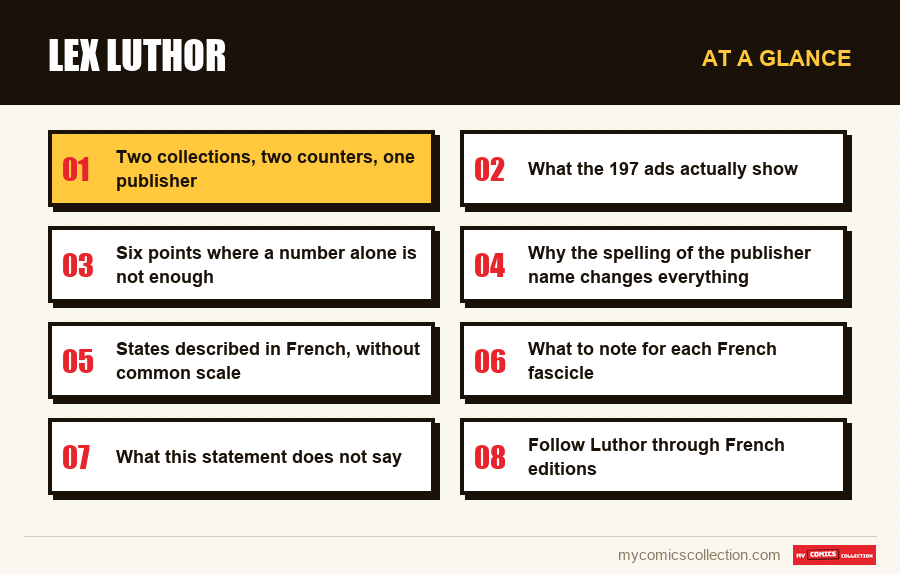
Two collections, two counters, one publisher
The advertisements noted show two distinct families of booklets published by the same French publisher. On one side, a large format: « Superman Géant 16 - Sagédition: Comics DC 1982 » claimed €1.00, « Superman géant n° 17 - SAGEDITION: Comics DC » claimed €2.00, « Superman Géant 20 - Sagédition 1983 » claimed €3.00. On the other, a pocket format: « SUPERMAN POCHE n°18 - Sagédition 1979 - DC Comics VF: Assez bon état » at €3.00, and « Superman Poche n°43 Sagedition VF 1981 Etat correct couverture griffée » at €2.90.
Placed side by side, these five titles tell it all. The large format bears a number 17. The pocket format bears a number 18. The two counters advance in parallel, each from its own starting point, and nothing in the number alone allows us to know which object we are talking about. A collector's notebook that notes "Superman 17" recorded nothing: it recorded an ambiguity. The same line can designate two issues of different sizes, different pagination, different content, published in different years.
This situation is quite different from the number collisions that we usually encounter. The classic case is two publishers who each publish their number 1 with the same character, or a relaunched series which starts again after a first version. Here, there is neither competition nor relaunch: the publisher has deliberately brought several ranges to life at the same time, each aimed at a different use, and there has never been any reason to number them together. The collision is not a market accident, it is a normal consequence of an editorial policy.
What the 197 ads actually show
197 announcements, only one date
The report counts 197 offers online on August 30, 2026 for the query “Superman Sagedition”. This is a comfortable number, sufficient to describe the way in which sellers position themselves. But all these observations were taken on the same day: they describe a photograph, not a trajectory. No conclusion about an increase or a decrease can come from a single measurement, and we do not draw any from it.
A median of €8.00
The median value of requests is €8.00. In other words, half of the sellers ask for less than that. This is the most robust benchmark in the survey, because it does not move when an extreme ad enters or exits the pack. He indicates that we are here in a market for current booklets, where the sums at stake are measured in coins rather than notes.
A floor at €1.00
The lowest amount recorded is €1.00, and one of the large format ads is at precisely this level. This floor tells less about the value of the object than the cost of putting it on sale: at this price, the seller is mainly looking to make space. It is also the best entry point for anyone who wants to start exploring these formats without commitment.
A maximum of €1,150.00
The peak of the reading reached €1,150.00. Faced with a median of €8.00, this difference does not describe a price level: it describes an isolated ad in a very heterogeneous whole, where entire lots, exceptional conditions or simple seller hopes can coexist under the same request. This figure should not be used as a reference for anyone, neither for purchase nor for estimation.
The distance between €1.00 and €1,150.00 is worth paying attention to, because it is instructive on the very nature of the statement. A broad query on a general site does not return a homogeneous set of comparable articles: it returns everything that contains the searched words. Isolated issues, complete collections, lots of several dozen pieces, unrelated objects whose description mentions the publisher. Treating this set as a series of comparable prices would amount to mixing things that the market does not mix.
A precision which requires the reading of all of the above: the 197 figures used here are amounts demandés by sellers, displayed on screen on August 30, 2026. These are not completed sales. A booklet priced at €3.00 can stay online for months, or leave the next day for less; nothing in the statement allows us to decide.
Second clarification, of the same order: none of the 197 announcements concerns a copy passed through the hands of an independent verification body. The count is zero, and it is therefore impossible to reason here as one would in a market where certification structures prices.
Six points where a number alone is not enough
The format before the number
Large format and pocket format coexist with the same publisher, with two numberings that have nothing in common. As long as the format is not written, the number does not designate anything specific. This is the information to enter first, even before the number.
The French year, not the American
The announcements date the issues to 1979, 1981, 1982 and 1983. These years are those of the French publication, which does not coincide with the original date of the published material. Recording the year listed on the advertisement avoids wrongly comparing a French issue to an older American publication.
The publisher's name is written in two ways
The statement shows “Sagedition” with accent and “Sagedition” without accent, sometimes in capital letters. A search carried out on a single spelling automatically leaves out part of the offer. It is necessary to interrogate both forms and, if the tool allows it, a form insensitive to accents.
States said in full
“Good condition, branded cover”, “fairly good condition”: the sellers describe freely, without a common scale. These formulations do not translate into a rating, and two sellers do not put the same requirement behind the same words.
Two counters moving forward together
The large format is 17 when the pocket shows 18, then 43 in another ad. The two series progress in parallel and regularly intersect in the same number ranges. The confusion is not occasional: it is structural.
Aucune certification à l'horizon
Zero copies checked out of 197 ads. In this segment, certification is not rare: it is absent. The question of whether to buy certified or not simply does not arise due to lack of supply.
Why the spelling of the publisher name changes everything
The detail seems anecdotal and it is not. On the advertisements noted, the same publisher appears sometimes “Sagédition”, sometimes “Sagedition”, in one case entirely in capitals. These variations do not come from a disagreement between sellers over the correct name: they come from keyboards, typing habits, and common usage which consists of quickly typing an ad title without worrying about diacritics.
The consequence is direct. A search engine internal to a marketplace does not always treat accent as a negligible variant. Depending on the tool, searching for the accented form can return a strict subset of what the unstressed form returns, or the opposite, or two partially disjoint sets. The buyer who only questions a single graph unknowingly constructs a partial view of the market, and forms an idea of prices based on an amputated sample.
The same reasoning applies to the way we name the format. “Giant” with accent, “giant” without, “Pocket” in uppercase or lowercase: each variant is a filter. Serious monitoring of this type of edition therefore consists of multiplying the formulations rather than relying on a single request deemed canonical. It's mechanical work, but it makes the difference between seeing five ads and seeing fifty.
This observation also has an impact on keeping a personal inventory. If we enter the publisher sometimes in one way, sometimes in another, we end up with two distinct entries for a single publishing house, and the groupings become false. Choosing a reference spelling once and for all, and sticking to it, costs a few seconds at the time of entry and avoids tidying up again later.
States described in French, without common scale
The two formulations noted in the advertisements deserve to be compared line by line, because they do not belong to the same register. “Correct condition with scratched cover” names a defect: the cover has scratches. “Fairly good condition” does not name anything: it is an overall assessment, an opinion, the value of which depends entirely on the severity of the seller.
The first formulation is by far the most useful to the buyer, even though it admits a problem. It describes a verifiable photo fact, on which the buyer can form their own opinion. The second cannot be verified: it says neither what is going well nor what is going wrong. Between two ads at the same price, the one that declares a specific defect says more than the one that promises satisfactory condition.
What is valid when purchased is valid when registered. Copying the seller's assessment into your inventory amounts to archiving the opinion of a stranger about an object that you now have in your hands. Good practice is the opposite: open the booklet upon receipt, observe it yourself, and note the observation in concrete terms. A scratched cover, a rubbed spine, a dog-eared page are observations; “good condition” is not one of them.
In this particular market, the complete absence of verified copies gives this personal discipline additional weight. Nowhere can the collector rely on an external rating, carried out according to a known and enforceable protocol. The only available source of qualification is himself, in his own words, applied in the same way from one booklet to another.
Collecting this series?
Track what you own, what you are missing and what your collection is worth. 7 day trial.
Start my trial →What to note for each French fascicle
Format first, number second. Write “Géant 17” or “Poche 18”, never “17” or “18” alone. Since two collections from the same publisher progress in parallel with independent counters, the format is not a comfort precision: it is part of the identity of the copy, in the same way as the number. Without it, the inventory line makes it impossible to find the object, or to know if it is missing from the collection, or to identify a duplicate.
The French publisher and its reference spelling. Note the French publishing house that published the booklet, and set a unique spelling in your inventory even if the announcements alternate between the accented form and the unaccented form. Optionally add the variant as a comment, to remember to also look for it when you are awake. It is this entry that will one day allow you to group all your French editions together.
L'année de parution française. The advertisements bear 1979, 1981, 1982 or 1983: these are the vintages of the French edition, not those of the original material. Record the one that appears on the booklet you are holding. It is he who places the object in the chronology of the French collection and who will make any chronological classification of your inventory coherent.
The defect noted by you, in concrete terms. Replace the seller's assessment with your own observation, stated as fact: scratched cover, bent corner, rusty staples, yellowed paper. A named defect is re-verified in ten years; an overall rating like “fairly good condition” is never rechecked, because no one knows what it referred to. In a market without certification, this is the only authentic description.
The price paid, shipping included. Record the total amount you paid out of pocket, including shipping, not just the amount shown in the ad. In a segment where the median requested is €8.00, shipping often weighs as much as the issue itself: ignoring postage distorts any subsequent reading of what your collection actually cost you.
What this statement does not say
We must be as clear about the limits as we are about the findings. The August 30, 2026 reading was taken only once. It cannot therefore describe any movement, either upwards or downwards: to speak of evolution, we would need at least two measurements spaced over time, carried out in the same way. Any statement that claims that a format values or depreciates would, at this point, be pure speculation.
The statement also doesn't say what buyers agree to pay. It records what sellers ask for, which is not the same thing. On a general market, some of the advertisements remain online for a long time without finding a buyer, and others leave on the first day. The median of €8.00 describes seller behavior, not market equilibrium.
Finally, the statement does not detail what each batch contains. An ad at €1,150.00 can cover a large set or a singular piece; we know nothing about it, and we are careful not to interpret it. On this type of discrepancy, prudence consists of dismissing the extreme point of reasoning rather than inventing an explanation for it.
Follow Luthor through French editions
A collector who builds an axis around Lex Luthor in French quickly comes up against this reality: French publications are not organized around the character, they are organized around a title and a format. Following the adversary therefore involves following the publisher's collections, format by format, rather than hoping for a series dedicated to it.
This changes the method. Instead of hunting down a list of numbers known in advance, we keep a table of French collections and their number ranges, we note what we have, and we identify the gaps. The format serving as the main key, this table has as many numbering columns as there are ranges from the publisher. It's more cumbersome than a single series, but it's the only faithful representation of what was actually published.
This approach by publisher and format combines well with a thematic reading of the character. To locate the periods, the character's journey in comics donne le cadre, et a reasoned reading order helps you decide which eras are worth looking for in the French edition. If your axis is comparative, the confrontation between the two great strategists of the genre shows how two seemingly close characters call for very different collections.
On the acquisition side, the logic of this French market with a small median has nothing to do with that of the pieces sought. The historically most coveted booklets obey rarity and certification mechanisms that are not found here. Conversely, low budget shopping strategies apply directly to these editions, where most of the offer is under ten euros. And to organize all this without getting lost, the collection guide dedicated to the character proposes possible axes.
The method, in practice
Concretely, the first step is to decide which formats you collect. Large format only, pocket only, or both: the choice is made at the start, because it determines the structure of your entire inventory. There is no obligation to take everything, and an axis restricted to one format is completed much more quickly than an axis which embraces all the ranges of an editor.
The second step is the day before. It is based on several queries carried out in parallel, with and without accent, with the format word and without it. A broad query on the name of the publisher alone gives the scale of the offer, 197 ads at the time of the survey, but mixes everything up; Narrower queries, format by format, yield usable lists. The two approaches complement each other.
The third step is sorting upon receipt. You open, you see, you note: format, number, publisher in your reference spelling, French year, defects observed, total price including shipping. Five minutes per issue when it arrives is better than a catch-up session on fifty items whose purchasing conditions you have forgotten.
The fourth step, finally, is the periodic rereading of your table. This is where duplicates appear, where numbering holes are obvious, and where we spot cases where we bought the same number twice because we forgot to specify the format. On this specific corpus, this is the most frequent error, and the only effective protection remains the rigor of the initial entry.
No. The two collections are numbered independently of each other, each having started on its own. The same number in two different ranges designates two fascicles with no relation in content. This is why the format must appear in your inventory before the number.
Both. The report shows the two spellings in the ad titles, sometimes in capitals. Depending on how the search engine processes accents, a single query may miss part of the offer. Systematically query both forms.
It corresponds to the median amount claimed by sellers on August 30, 2026, not a price at which an issue changed hands. The survey only observes online ads. It shows where requests are located, not where transactions are located.
It does not serve as a benchmark. Compared to a median of €8.00, this single amount describes an isolated ad in a very disparate group, where entire lots and isolated pieces are found under the same request. The price asked by a single seller does not constitute a market value.
Not in this statement: of the 197 advertisements observed, none concerns a copy passed by an independent verification body. The count is exactly zero. The question of the certified therefore does not arise here, and your own description of the state serves as the only qualification.
An inventory that distinguishes formats
When two collections from the same publisher advance with parallel numberings, a simple list of numbers is no longer enough. My Comics Collection allows you to record the format, the publisher, the year of French publication, the condition noted by you and the price paid including shipping, then to spot at a glance the holes and duplicates of each range.