Jeff Lemire et Andrea Sorrentino ont signé ensemble six œuvres majeures: Green Arrow et Old Man Logan with major publishers, then A.D. After Death, Gideon Falls, Primordial et le Bone Orchard Mythos en creator-owned. Their common signature is the destruction of the grid of boxes: with them, the layout tells as much as the text. Start with Gideon Falls.
Six major works, two registers, the same formal obsession. The Lemire-Sorrentino duo is one of the most identifiable collaborations in recent American comics.
What distinguishes them is not a genre or a theme, but a method: seeking what comics can tell that neither cinema nor novels can. This article traces their common journey, explains what makes their mark, and indicates where to start depending on what you are looking for.
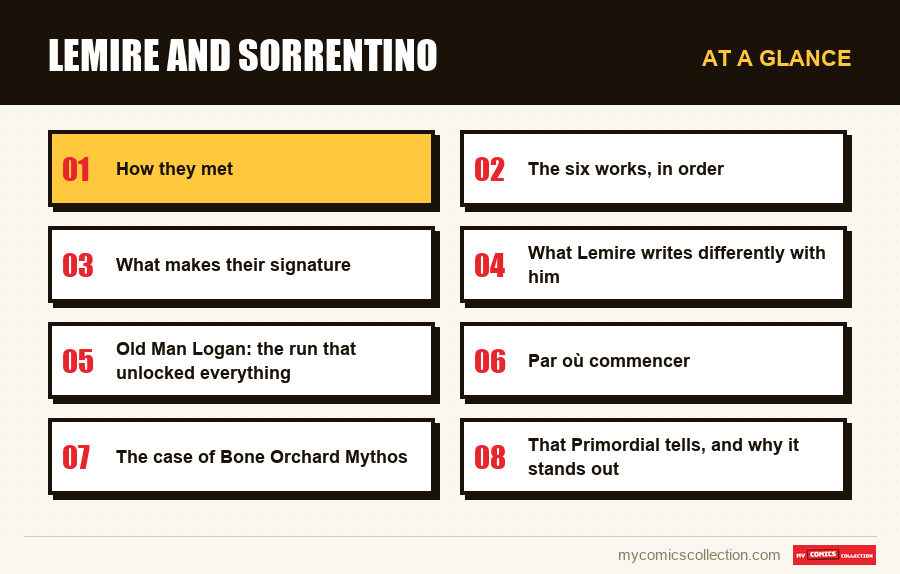
How they met
The meeting takes place at DC, on Green Arrow. Lemire took over the archer in the early 2010s and Sorrentino, a still little-known Italian designer, arrived on the series after the first issues.
The run is today cited as one of the character's best, but its main interest lies elsewhere: this is where Sorrentino begins to deconstruct the page in a general public setting. Squares which fragment during archery scenes, arrow trajectories which cross several squares, sequences exploded into mosaics. On a monthly superhero series, this was unusual.
They then found themselves at Marvel on Old Man Logan, then leave the big publishers to publish together as creator-owned. It is from there that their work becomes truly unique.
The six works, in order
Green Arrow: le laboratoire
At DC. The run where the method is put in place, within the constraints of a monthly series from a major publisher. Read to understand where the rest comes from, not for the rest.
Old Man Logan: la confirmation
At Marvel. An aged Wolverine in a devastated future. The duo applies their vocabulary to a very coded character, and proves that it works outside of the intimate register.
A.D. After Death: the breakup
Their first creator-owned, and most experimental. A man in a world where death has been defeated. The work combines classic plates, illustrated prose and sketchbooks in the same volume.
Gideon Falls: le sommet
27 issues of cosmic horror set around a barn that doesn't exist in the same place for two people. This is the work where experimentation remains entirely at the service of the plot.
Primordial: l'histoire
The animals sent into space at the start of the space conquest did not die. A short story, more formally contained, and the most melancholic of their joint production.
Bone Orchard Mythos: the universe
At Dark Horse. A collection of linked horror stories, published as stand-alone volumes rather than a continuous series. The most recent, and least explored.
What makes their signature
Four processes recur from one work to another, to the point that we recognize a page of the duo without seeing the cover.
The grid that disintegrates
The layout remains wise as long as the story is wise. As soon as reality wavers, the boxes multiply, lose their borders, overlap. The reader feels the rupture before understanding it.
Color as a signal
Reduced palettes, often monochrome, where a single color emerges occasionally. On gray pages, a saturated red works as a tone rather than a hue.
The page as object
Compositions in crosses, in circles, double pages readable in two directions. The shape of the board carries part of the meaning, which makes these books resistant to digital reading.
The explanation refused
Their stories maintain opaque areas. This is not an easy thing: it is a convention of cosmic horror, where what is fully explained ceases to worry.
What Lemire writes differently with him
The comparison with his other collaborations is instructive. With Dustin Nguyen on Descender, Lemire writes soft science fiction, carried by watercolor. With Dean Ormston on Black Hammer, he writes a melancholy rereading of the superheroic. When he draws himself, he writes rural drama.
With Sorrentino, he writes horror, and above all, he writes with the page in mind. The scenarios he entrusts to him contain sequences which would have no meaning elsewhere: a memory which contaminates a neighboring box, two eras which occupy the same board, an architecturally impossible space which nevertheless must be shown.
This is what distinguishes this collaboration from a simple writer-cartoonist association. Lemire doesn't write a script that Sorrentino illustrates; he writes for what Sorrentino knows how to do, and the result would not be transposable to any other designer.
Old Man Logan: the run that unlocked everything
It deserves a paragraph on its own, because it is the commercial pivot of their joint career and it explains why Image and Dark Horse then gave them a free hand.
The character (an elderly Wolverine, the last survivor of a future where the villains won) came from a very popular earlier story. Resuming such a figure is usually a constrained exercise: we inherit precise expectations and specifications.
Lemire and Sorrentino nevertheless included most of their vocabulary. Memory sequences contaminate the boxes of the present, the grid disintegrates during fits of rage, and the character's dreams occupy boards constructed like labyrinths. On a high-circulation monthly Marvel series, it was a gamble.
The success of this run gave them what matters most to a duo of authors: proof, in figures, that their approach could sell. A.D. After Death appears right after, and nothing is retained.
Collecting this series?
Track what you own, what you are missing and what your collection is worth. 7 day trial.
Start my trial →Par où commencer
Commencez par Gideon Fallsin the majority of cases. It is the most complete, the most readable work, and the one where experimentation never takes precedence over the story. Twenty-seven issues, a real ending, no sequel to buy.
Prenez Primordialif you want to test the duo in a short format. It is the most formally contained, which makes it a good gateway for a reader who is put off by exploded pages.
Gardez A.D. After Death pour la fin. It is their most demanding book, mixing three graphic registers in the same volume. Excellent, but confusing if this is your first contact with them.
Runs from major publishers: Green Arrow et Old Man Logan: are to be read afterwards, like archives: we see the method forming under constraint, with the compromises imposed by a monthly series with a large circulation. They also have the advantage of being widely available second-hand, where their personal titles are becoming rarer.
A practical consequence of their work on the page: these books are difficult to read digitally. E-readers offer a box-by-box display which rebuilds a grid where the authors destroyed it: that is to say which cancels out precisely what makes them interesting.
This is one of the rare cases where the medium changes the content. If you are cataloging your collection, note the format for these titles: “I have it in digital” and “I have it in paper” do not mean the same reading.
The case of Bone Orchard Mythos
Their most recent project deserves a separate mention, because its editorial structure is unusual and confusing to buyers.
It is not a continuous series but a set of linked stories, published in different forms: some in stand-alone volumes, others in short series. They share a universe and motifs, without any presuming the reading of the others.
For the reader, it's comfortable: you can enter through any one. For the collector, it is a puzzle: nothing indicates on the cover that a volume belongs to the set, and there is no common numbering. This is the kind of case where a catalog by title completely fails, and where only explicit grouping allows you to know what you have.
That Primordial tells, and why it stands out
It is their sweetest book, and the only one based on historical facts. It is worth noting because it contradicts the idea that they would only do horror.
The starting point is real: at the start of the conquest of space, several animals were sent into orbit without a return plan. Dogs, monkeys, mice. They died up there, and the programs continued. Primordial poses a counterfactual hypothesis: what if they weren't dead?
The story alternates between an earthly investigation, a scientist seeks to understand why the two superpowers suddenly stopped their programs, and what is really happening beyond. The spatial part is almost silent: animals, without dialogue, in a space that Sorrentino draws in circular compositions.
It is their most moving work, and by far their most accessible. If Gideon Falls seems too hard or too long, that's how you have to get into their work.
Follow a duo rather than a series
Collecting by pair of authors poses a problem that neither collecting by character nor that by series poses: the works are scattered between four publishers (DC, Marvel, Image, Dark Horse) over a dozen years, without any editorial link between them.
No store puts them together, no publisher's catalog lists them as a set. The only way to know what is missing from a Lemire-Sorrentino collection is to keep the list yourself, work by work and format by format.
Questions fréquentes
No, no narrative continuity connects them. Gideon Falls, Primordial and the Bone Orchard Mythos are three separate universes, without common characters or places. What they share is a formal approach, the grid of boxes treated as a narrative tool, and a taste for cosmic horror, where the threat comes from a structure of reality rather than from an antagonist. You can therefore read them in any order, or read only one without missing anything from the others. Gideon Falls, Primordial and the Bone Orchard Mythos are separate universes that share only a formal approach and a taste for cosmic horror. You can read them in any order, or read just one.
Pas en priorité. Green Arrow et Old Man Logan are good runs, but their main interest in this course is documentary: we see the method being formed under the constraints of a monthly series. Their personal work is more accomplished.
Because the box-by-box display of e-readers reconstructs a reading grid where the authors deliberately destroyed it. A cross-shaped double page or a plate readable in two directions loses all its effect once cut. This is one of the rare cases where the support actually cuts out the content.
No, each story is autonomous and can serve as a gateway. This is precisely what makes the set difficult to collect: nothing on the cover indicates belonging to the universe, and there is no common numbering allowing you to know what is missing.
By keeping the list yourself, because no publisher provides it: their works are divided between four different houses with no editorial link. Saving each title with its format and year is the only method that allows you to know, in the store, if the volume you are holding is already at home.
Four publishers, one collection
Follow the works of a duo of authors scattered between several houses, and always know what is missing.