Jeff Lemire's intimate books have virtually no certification market. Asking prices observed on August 28, 2026 on the American market: Essex County wonders around $24, The Underwater Welder 16 $, Trillium #1 9 $, Royal City #1 $7, and none of these four titles display a single certified ad. His genre series number dozens. The gap tells the story of how this market really works.
Four titles, zero graded copies for sale. It's not a hole in the data: it's the result.
Certification consists of having a comic graded and sealed by a third-party service, which makes its state opposable and facilitates resale. On Lemire's genre series, this market exists and it is active. On his personal books, he is absent. This article explains why, and what this actually involves when buying or reselling.
Le relevé
Essex County
Brut : median $23.95 across 29 listings, from $6 to $1,699.95.
Grade : aucune annonce.
The highest median of the survey, and the narrowest offering: only 29 copies. The $1,700 maximum refers to a specific item, not the current book.
The Underwater Welder
Brut : median $15.99 across 24 listings, from $5.50 to $99.99.
Gradé : aucune annonce.
The most restricted offer in the statement. A unique volume published directly as a book, never cut into booklets.
Trillium #1
Brut : median $9 across 62 listings, from $0.99 to $79.99.
Gradé : aucune annonce.
Published in installments by a major publisher label, therefore with a wider circulation. The supply doubles compared to the single volumes.
Royal City #1
Brut : median $6.99 across 59 listings, $1 to $70.
Gradé : aucune annonce.
The least expensive of the survey, while the series is by far the least known, and the most difficult to collect complete because of its change of title.
Why these books are not certified
Three reasons combine, and none is a judgment on their quality.
These are books, not pamphlets.
Essex County et The Underwater Welder were published directly in volume. Certification is a practice born from the stapled booklet, and it does not apply well to a bound book that is stored in a library.
The readership is not the same
These titles circulate in general bookstores, among people who read a book rather than collect a series. No one seals what they intend to reread.
Arithmetic does not follow
Getting it certified costs more than a $7 or $16 copy is worth. The operation only makes economic sense beyond a certain threshold, never reached here.
No mythical “first number”
The certification focuses on objects with status: first appearance, first issue of a cult series. A one-volume graphic novel doesn't fit into any of these boxes.
The comparison that enlightens
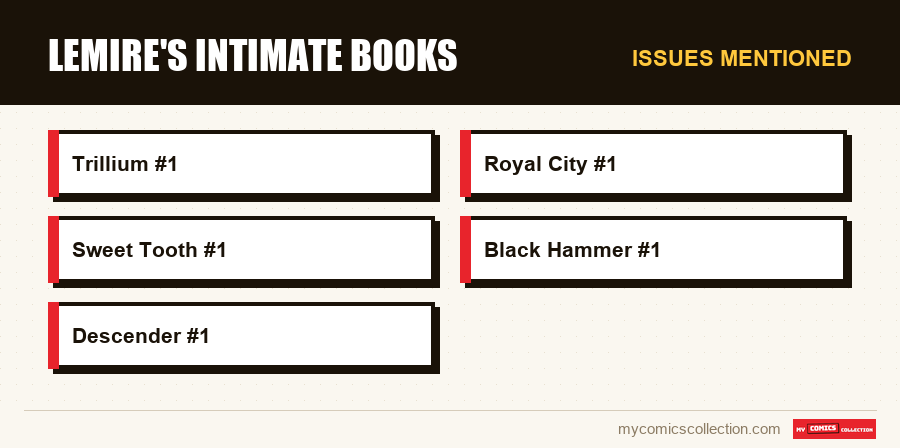
The same survey, applied on the same day to Lemire's genre series, gives a completely different landscape. Sweet Tooth #1 has 28 certified listings and a graded median of $105. Black Hammer #1 en compte 17. Descender #1, seize.
However, they are the same years, the same author, sometimes the same publisher. The only variable that changes is the type d'objet: a numbered booklet belonging to a series, or an independent book.
This is a useful lesson far beyond Lemire. The certification market does not measure literary value, or even rarity: it measures belonging to a culture of serial collecting. An excellent and rare book may have no graded market, while an ordinary issue of a popular series will have one.
The maximum at 1,700 dollars
La fourchette d'Essex County rises to $1,699.95 for a median of $23.95: a ratio of seventy. On genre series, such a gap would designate a cover variant. Here the market structure is different.
A book published as a single volume does not have variant covers. What creates the gap are other factors: the first printings of the three original separate volumes, the signed copies, and the limited or out-of-print editions. They are distinct objects, not different states of the same object.
The practical consequence is important: on this type of title, we cannot deduce the value of a copy from the general range. You have to identify precisely what you have (what print, what edition, signed or not) because these categories do not overlap at all.
What it means if you sell. On a serial sheet, certification is a recognized means of obtaining a better price: it transforms a seller's opinion into an enforceable note. On a book like Essex County, it is of no use: the buyer is looking for a book to read, not a sealed object.
So describe the condition honestly and in detail, photograph the edges and corners, and indicate the print. That's what makes the difference in this market, not a label.
The narrow offer, the other information from the statement
The number of ads deserves as much attention as the price. The Underwater Welder has 24 copies available, Essex County 29: against 62 for Trillium #1 and 59 for Royal City #1.
The difference is in the format. A booklet is printed in tens of thousands of copies and many appear on the second-hand market; a bound book is printed more modestly, and above all its buyers keep it. A book in the library does not come back for sale; a booklet in a box, yes.
This explains the apparent paradox of the survey: the most expensive titles are also the least numerous, even though they have no organized collector's market. The scarcity here comes from conservation, not speculation.
Collecting this series?
Track what you own, what you are missing and what your collection is worth. 7 day trial.
Start my trial →What this changes for a catalog
On genre series, three pieces of information locate a copy: the variant, the edition and the note. On intimate books, the note disappears, it does not exist, and two others appear.
L'édition. Original separate volumes, complete, later reissued. These are objects with no price relationship between them, and nothing on the edge clearly says so.
The signature. On an author who regularly participates in festivals, the signed copy is frequent and completely changes the value. This is information that is immediately lost if we do not note it at the time of purchase.
A catalog which records “Essex County» said nothing. The same recording “Essex County, complete, first print, unsigned, spine lightly marked” places the object in a specific segment of a range that goes from $6 to $1,700.
The price gap between the four titles
A final reading of the statement deserves attention: these four books are not equal to each other, and the order is surprising.
Essex County wonders three times more expensive than Royal City #1, and one and a half times more than The Underwater Welder. However, all three are by the same author, in the same intimate register, and published on close dates. What separates them is neither quality nor seniority.
It’s the format and institutional recognition. Essex County is a trilogy that has become a unique book, selected in national reading programs in Canada, and regularly cited in lists of reference graphic novels. This recognition creates demand outside the circle of collectors: booksellers, teachers, readers who don't buy any other comics.
Royal City #1, conversely, is an independent series issue among thousands of others. Its price of $6.99 is that of a regular first issue, and it will remain so until nothing external comes along to displace it.
The lesson is useful for situating any graphic novel: what makes a book rise is demand from outside the comic book market. An adaptation, a school selection, a literary prize have more effect on these titles than any printing rarity.
Should we draw a purchasing strategy from this?
For a reader, yes, and it is simple: these books are accessible, and there is no incentive to wait. None of the mechanisms that make a book rise (scarcity of printing, speculation, announcement effect) are at work here. A median of $7-24 for acclaimed, full-length works is value for money that genre series from the same author don't offer.
For a collector, the conclusion is different. The absence of a graded market means an absence of liquidity: reselling a raw copy requires finding an interested reader, where a certified booklet finds a buyer on an organized market. These are books to buy to have, not to trade.
There remains one nuance to be made. “No liquidity” does not mean “unsaleable”: it means that the sale requires time and a specific buyer, where a certified booklet is placed in a few days on a structured market.
Concretely, a seller in a hurry will sell off a graphic novel, for lack of a reference price to hold on to. A patient seller will get the median, or even more if the copy is a signed first print. It's a difference in timing, not in value, but it explains the lower part of all the ranges noted, where we find decent copies sold at a third of the median simply because their owner wanted to get rid of them quickly.
Questions fréquentes
No, it's the result itself. The same method applied on the same day to Lemire's genre series goes back 16 to 28 certified advertisements depending on the titles. The absence is therefore real and specific to these books, not an artifact of the research.
This would have no practical use. There is no reference market to compare a certified copy of this title, the typical buyer is looking for a book to read, and the cost of doing so exceeds the observed median. A detailed condition description and photographs serve resale much better.
By the fact that it is not the same object. On a book published in volume, it is not cover variants that create the difference but distinct editions: first printings of the original separate volumes, signed copies, limited out-of-print editions. These categories are not comparable to each other.
Because a bound book purchased to be read remains in a library, while a serial issue often ends up resold in batches. The rarity observed here comes from reader conservation, not from a deliberately limited print run or speculation.
The exact edition: separate volumes, complete or reissue:, the edition, and whether the copy is signed or not. This last information completely changes the value of an author present at a festival, and it is immediately lost if it is not recorded at the time of acquisition. Also note the condition of the edges and corners: on a bound book, these are the two points of wear that any buyer examines, and describing them in advance avoids most disputes upon resale.
On a book, the edition replaces the note
Print run, edition and signature are the three pieces of information that identify a graphic novel: none of which appears on the spine.