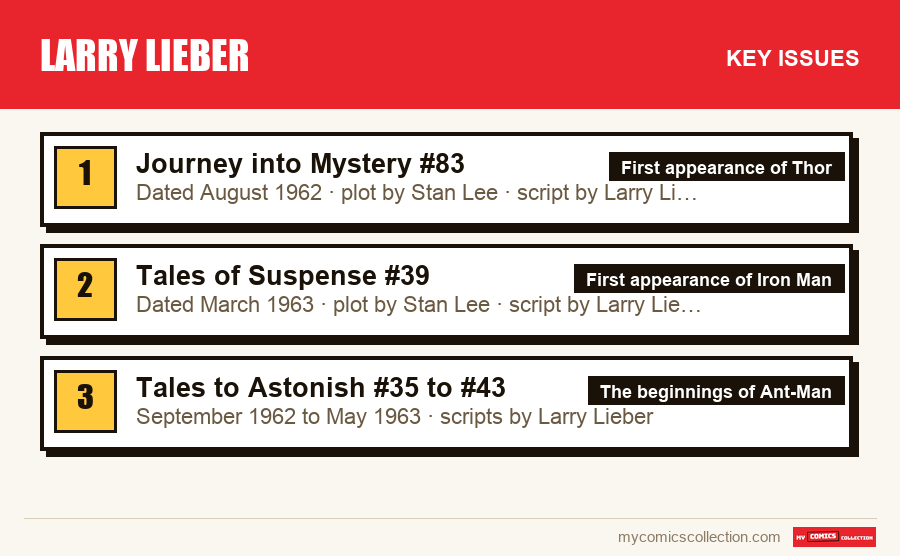
Larry Lieber, born on October 26, 1931 in New York, is the younger brother of Stan Lee. On his brother's plots, he scripted the first Thor stories (Journey into Mystery #83, dated August 1962), the first Iron Man stories (Tales of Suspense #39, March 1963) and the first nine costumed adventures of Ant-Man, inventing along the way the names Donald Blake, Tony Stark and Hank Pym, as well as the metal uru. He then wrote and drew the western Rawhide Kid from 1964 to 1973, ran a magazine line at a rival publisher in 1974-1975, then drew the daily Spider-Man comic strip from 1986 to 2018. In September 2026, at almost 95, he signs a Spider-Man western story, "Of Webs and Six-Guns," in Amazing Spider-Man #1000, drawn by Giuseppe Camuncoli.
The story of the Silver Age at Marvel is almost always told with three names: Stan Lee, Jack Kirby, Steve Ditko. That is right, but incomplete. Behind several of the publisher's first heroes, there is a fourth man, whose name appears small in the credits and who is readily forgotten: Stan's brother, Larry Lieber.
His path is singular. He was never the star of the house, never tried to be, and spent most of his career in discreet positions: scripter on other people's plots, complete creator of a western, newspaper strip artist for more than thirty years. Yet names he invented at the typewriter are now spoken in films seen by hundreds of millions of viewers.
This article retraces that path, from the monsters of the late 1950s to Spider-Man's #1000, sticking to verifiable credits. The portrait of his brother is another subject, which we do not repeat here.
A younger brother in the shadow of Timely
Lawrence D. Lieber was born in Manhattan, the second child of a Jewish immigrant family of Romanian origin. His older brother, Stanley Martin Lieber, is nearly nine years older than him. Larry took an interest in drawing early. His mother died when he was sixteen; he lived for a time with his brother, then left to work very young, as a messenger for a big New York daily and in the studio of a Times Square letterer.
He then joined the publisher run by Martin Goodman, the future Marvel, as an assistant on the magazine side, while taking evening classes at an art school. His first known comics credit dates from May 1951: a four-page crime story he drew and inked in All True Crime #44. The same year, he enlisted in the air force and served four years, two of them in Okinawa during the Korean War.
On his return, he studied at the Art Students League, drew a few science fiction and romance stories for his brother, and wrote some of them himself, by his own recollection. The practice of the time did not credit writers, which makes his 1950s bibliography incomplete.
1958: a writer almost in spite of himself
In 1958, the publisher goes through a crisis and lays off almost all of its comics employees. Stan Lee finds himself alone writing, and asks his brother to help. Larry protests that he is not a writer; Stan answers that he has read his letters. It is the start of a very particular collaboration: Stan imagines the plot, Larry writes the complete script, panel by panel, and an artist, very often Jack Kirby, puts it all into pictures.
Lieber has said he first broke the stories down into pictures, as the artist he was, before typing the text. These stories fill the monster and science fiction anthologies of the late 1950s and early 1960s: Journey into Mystery, Strange Tales, Tales of Suspense, Tales to Astonish. His first confirmed script is "I Led the Strange Search for Manoo," thirteen pages drawn by Kirby in Amazing Adventures #2, dated July 1961.
These anthologies are precisely the ones in which, a few months later, the publisher will launch its new heroes. Lieber is therefore in the right place at the right time.
Thor, Iron Man, Ant-Man: the three debuts
Journey into Mystery #83
Lieber's first superhero work. He invents there the name Donald Blake, the god's human identity, and the metal uru from which the hammer is made. He said he drew his names from the biographical section of his dictionary, assembling pieces of foreign names. His eight Thor stories also introduce Loki, Odin, Balder, Asgard and the Bifrost bridge.
Tales of Suspense #39
Lieber writes the origin story and christens Tony Stark. It will nonetheless be his only episode: from the next issue, Stan Lee hands the series to another writer, before taking it back himself. This brevity explains why his name is so little associated with the character, even though the identity he invented has become one of the best known in popular culture.
Tales to Astonish #35 to #43
Lieber is credited as Ant-Man's co-creator with Kirby, and it is he who named Hank Pym. The character had been presented without a costume a few months earlier, in Tales to Astonish #27 of January 1962. Lieber then writes his first nine superhero adventures, before other writers take over.
Why did Lieber not continue on these series? He himself explained it plainly: his brother was a demanding editor, who corrected his dialogue, and who ended up calling back former professionals. Lieber reports a sentence from Stan, half reproach, half compliment, according to which he was not good, but better than the others. He took a certain amused pride from it. He also said that, at the time, Thor was for him just one story among others.
Rawhide Kid: ten years of western as a complete creator
Starting with issue 41 of Rawhide Kid, dated August 1964, Lieber writes and draws the series, and does so until 1973, after which the title publishes only reprints. It is the period of his career he claimed most as his own. He was looking, he said, for more freedom and the desire to draw again. He also wanted a serious tone, the opposite of the humor that was spreading through the superhero series: he hoped his readers would cry as in a great cinema western.
For a collector, this period is an endearing curiosity. The publisher's westerns were long neglected by the market, in favor of superheroes, and Lieber's issues have remained relatively accessible. This is not a buying recommendation, simply an observation: you can still read and own an entire decade of an early creator's work without aiming at the star issues of the Silver Age.
During these years, Lieber also draws Amazing Spider-Man Annual #4 and #5, in 1967 and 1968. The second evokes for the first time, in flashback, Peter Parker's departed parents. In 1969, he co-writes and co-draws Doctor Doom's first solo story, in Marvel Super-Heroes #20. These are his first direct ties to Spider-Man, fifty-eight years before #1000.
The 1970s: editor at a rival
The end of Rawhide Kid leaves him without a big project. He writes a few westerns and war stories, tales for the black-and-white magazines, and covers for reprints in Kirby's style. He also said he could not go work at DC like other writers: Stan Lee's brother would have been suspected of being a spy.
In 1974, he nonetheless joins a competitor: the new house launched by Martin Goodman, Marvel's former owner, who wants to rival his former colleagues. Lieber runs the black-and-white magazine line there, then the whole production when the head of the color comics leaves. The adventure falls short at the end of 1975. Lieber remembers it as a difficult period, in which it fell to him to announce rate cuts to the writers.
Back at Marvel, he runs the branch that produced from New York reprints for the British market, as well as new Captain Britain stories. In 1977, he co-writes the character's adventures in the weekly Captain Britain, issues 24 to 37, then in Super Spider-Man. It is a little-known link between him and a hero created the year before, who turns fifty in October 2026. To understand this parallel market, read our article on the first appearances in Marvel's British comics.
Thirty-two years of Spider-Man in the press
In 1978, Lieber draws the daily Hulk comic strip, written by his brother, and ends up writing it himself until its end in 1982. He also takes part in the Spider-Man strip in 1980 and 1981. Then, in 1986, he succeeds the regular artist on the daily Spider-Man strip, and also draws the Sunday page for several years in the 1990s.
The routine is well oiled: Stan sends a complete script, Larry draws, reduces his pencils and faxes them each week to his brother, who corrects the text and sometimes the art. Lieber retires from the strip in July 2018; his last strip appears on September 8, 2018, two months before Stan Lee's death. During these thirty-two years, he is one of the most widely read Spider-Man artists in the world, every day in the press, without being identified as such by the comics audience.
He also signed, writing and drawing, two stories of Web of Spider-Man, in issues 21 and 25, in 1986 and 1987.
2026: Amazing Spider-Man #1000
It is this long companionship that gives all its meaning to his presence in #1000, out on September 30, 2026. His story, "Of Webs and Six-Guns," visibly mixes Spider-Man and the world of the western, his favorite genre. The art is entrusted to Giuseppe Camuncoli. We do not detail the plot, which is not publicly documented beyond its title at the time of writing.
What matters is the symbol. Lieber is one of the last living creators to have worked on the beginnings of the Marvel universe in 1962. Having him write in the thousandth issue of the flagship series, alongside authors who could be his grandchildren, ties the celebration to its source.
On the recognition side, Lieber received an Inkpot Award in 2003, the Bill Finger Award in 2008, which each year honors one living and one deceased writer, and in 2025 an honorary prize recognizing seven decades of career.
What a collector can retain
Read the credits
On Journey into Mystery #83 and Tales of Suspense #39, Lieber's name appears in the credits. A reading copy, or a reprint, is enough to see it.
Follow the western
Rawhide Kid from issue 41 is the best entry point to Lieber as a complete creator, art and script.
Link the two ends
The 1967-1968 Spider-Man annuals, then the 2026 #1000: nearly sixty years separate his two contributions to the title.