
The Kitty Pryde comics history starts with Claremont and Byrne creating her in X-Men #129, cover-dated January 1980. A teenager from Illinois with the power of intangibility, she enters Charles Xavier's school, becomes Sprite and then Shadowcat, and moves through four decades of teams: X-Men, Excalibur, Astonishing X-Men, Marauders. She starts as the reader's point of view in Claremont's stories, then becomes a lead in her own right.
Kitty Pryde entered comics as a student trailing a class of adults, and she ended up leading a crew of Marauders. In between, her path traces a rare editorial line: a supporting character designed to walk beside the reader who became one of the pillars of the mutant catalog.
As always in this guide, only verified facts (creators, issues, dates) are stated; the analysis is our own, with no reproduction of protected pages or dialogue.
Her first appearance
This January 1980 issue pairs Claremont on script with Byrne on art. It lands in the middle of the Dark Phoenix Saga and introduces two new faces: Emma Frost among the villains, and a middle schooler from Illinois who will join Xavier's family. For anyone interested in publishing history, this issue is a textbook case, which we cover in our entry on X-Men #129.
Claremont's choice makes sense in hindsight. In a team of battle-worn adults, many of them from other countries, there was no way in for the reader: a young girl who discovers alongside us what a mutant is, what training costs, and what it means to belong to a chosen family. Kitty fills that role for years, and that position as witness largely explains the goodwill readers feel toward her.
Her powers are right away the ones that will become her signature: she phases through solid matter. The storytelling device is simple and effective, since it makes her an infiltrator, a saboteur of electronic systems and, later, a fighter able to neutralize an opponent far more powerful than she is. Her status as a minor on the team remains a plot engine: every mission pits her against adults who think she is too young.
She first goes by Sprite. In X-Men #139, she is brought in as a full member of the team under that name, which marks a turning point: she is no longer a student looking on, but an X-Man. The Shadowcat nickname only arrives later, with the Kitty Pryde and Wolverine miniseries (1984 and 1985).
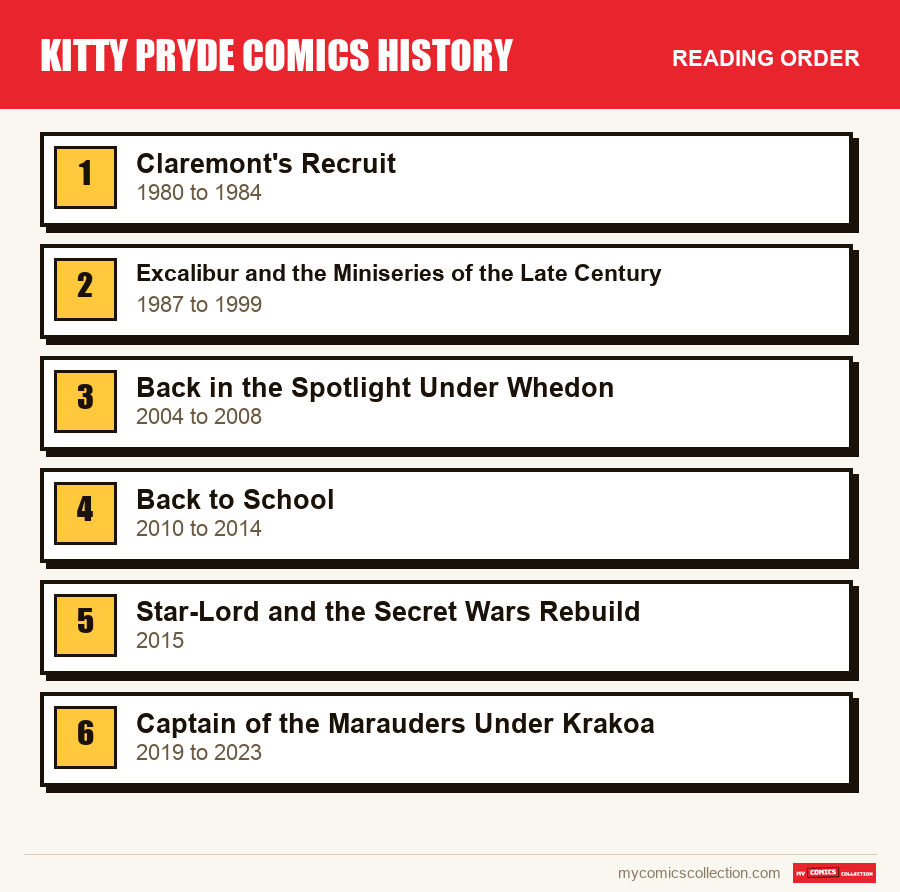
Era 1: Claremont's Recruit (1980 to 1984)
Kitty's first period cannot be separated from the work of Chris Claremont, who writes the series and turns it into the laboratory for his female characters. Her bond with Wolverine becomes the most remarkable thread: the most brutal man on the team ends up as the protective big brother of a teenager, which softens, without betraying, a character until then seen as a loner.
Warning, spoiler: the most discussed storyline of these years rests on a time jump with her at the center. In X-Men #141 and #142, Days of Future Past (Claremont and Byrne, inks by Terry Austin) shows an adult Kate Pryde, from a future where the Sentinels have enslaved mutants, projecting her consciousness into the body of the teenager she once was, in order to stop the killings that give rise to that world. Both issues are covered on our dedicated page.
This structural choice has a lasting editorial consequence. By making Kitty the key to a dark future, Claremont ties her to a cycle of stories that other teams will revisit for decades, and he sets her apart from the other young recruits, who have no role as a time-travel linchpin. You will find the broader context for this period in the guide Chris Claremont: where to start.
The Kitty Pryde and Wolverine miniseries, published in six issues across 1984 and 1985 and written by Claremont, is the second milestone. It extends the relationship between the two characters in a more intimate setting than the regular series, and it is in these pages that Kitty takes the name Shadowcat, the one most readers know her by today. For a collector, it is a short, complete series that sits naturally next to the issues of the parent series.
Era 2: Excalibur and the Miniseries of the Late Century (1987 to 1999)
Claremont and Alan Davis launch Excalibur with the one-shot Excalibur Special Edition #1, on sale in December 1987, ahead of the regular series in 1988. Kitty is part of the opening lineup, alongside Captain Britain, Meggan, Nightcrawler and Rachel Summers. For the character, this move to Britain is a change of scenery and tone: humor, parallel-world fantasy and team adventure replace the apocalyptic crises of the parent series.
The regular series runs from 1988 to 1998 and ends with issue 125. Claremont leaves with issue 34, in 1991; Alan Davis returns later with issue 42, as writer and artist. To understand what Kitty gains here, remember that she is no longer the youngest on the team: she becomes a pillar, the one who knows the rules of life as an X-Man and passes them on. An overview appears in our selection of the great Excalibur runs.
Outside Excalibur, the late 1990s give her three smaller projects. Pryde and Wisdom arrives in 1996. A year later, a three-issue miniseries in her name moves Xavier's former recruit into the service of Nick Fury's agency, and then X-Men: True Friends follows in 1999. These titles are short and have a smaller print run than the regular series: they mostly speak to readers who follow the character more than a team. From a collector's standpoint, they are completist pieces, rarely key issues, but they document the idea that Kitty can carry a story without a big name beside her.
Era 3: Back in the Spotlight Under Whedon (2004 to 2008)
In 2004, Joss Whedon and John Cassaday launch a new volume of Astonishing X-Men. Their run covers issues 1 to 24 and a Giant-Size Astonishing X-Men #1, through 2008. Kitty is a member of the team, and the series puts her back at the center of the action after several years spent tied to other settings.
The first arc, Gifted, opens on a supposed cure for the mutation, which will become the blueprint for the plot of the film X-Men: The Last Stand. It is also in these issues that Colossus returns, four years after his death in the comics. The emotional bond between Kitty and Colossus, one of the classic engines of the group, gets a second wind here, and the series rebuilds a front-line position around her.
Warning, spoiler: the moment that stays in memory is the conclusion of the arc that pits the team against the people of the Breakworld. Kitty slips into the projectile meant to destroy the Earth and makes it intangible so that it passes through the planet without touching it. She cannot get out and vanishes into space with it. Her return becomes a later narrative thread, and it turns this sequence into a showpiece that cements the image of the character: a heroine whose power is the means of saving the planet.
Era 4: Back to School (2010 to 2014)
February 2010 brings her back in Uncanny X-Men #521; she then turns up with Jason Aaron (Wolverine and the X-Men) and with Brian Michael Bendis (All-New X-Men). This is the period when the character takes on the role of teacher, the one who guides young mutants: the circle closes, since the recruit of 1980 becomes a mentor herself.
This era is less structured than Whedon's: it is spread across several series and several writers, and does not boil down to a single run. For a collection, it is better to follow the character's thread than to aim for one specific issue.
Do you collect this series?
Track what you own, what you are missing and what your collection is worth. 7-day trial.
Start my trial →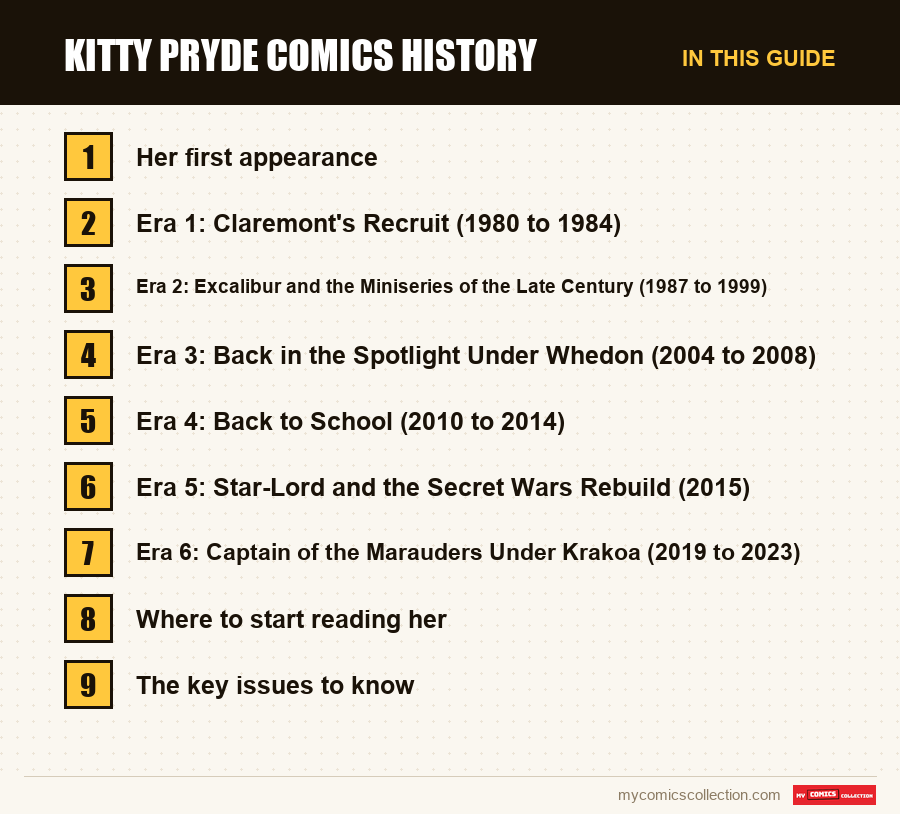
Era 5: Star-Lord and the Secret Wars Rebuild (2015)
In 2015, after Secret Wars, Kitty joins the Guardians of the Galaxy early in the year, then takes on the alias Star-Lord, at first mistaken for Star-Lady. She is the lead of Star-Lord and Kitty Pryde, launched the same year, written by Sam Humphries and drawn by Alti Firmansyah. It is a cosmic parenthesis in a career that had until then been earthbound and mutant.
This stretch shows that the character holds up when moved outside the X-Men frame. This part of her story shelves as a small, complete set, the kind collectors skip when they only follow the flagship series.
Era 6: Captain of the Marauders Under Krakoa (2019 to 2023)
In 2019, House of X and Powers of X, by Jonathan Hickman, overhaul the status of mutants by giving them a homeland, Krakoa. Kitty, under the name Kate Pryde, is the figure who gathers the Marauders to carry mutants to the island, and the Marauders series makes her a captain and the Red Queen of the Hellfire Trading Company. Readers will find an overview of the stakes of this period on the page devoted to Hickman's return.
What stands out, looking at the character's history, is the distance covered. The young student who walked through walls becomes a commanding figure, tied to a trading company, to a trade in mutant medicines and to the logic of a nation. She is revealed to be bisexual in 2020.
Warning, spoiler: starting with Fall of X, in 2023, Kitty returns to the ranks of the X-Men, and she teaches young mutants in Exceptional X-Men, launched in 2025. The loop is closed: recruit in 1980, teacher in 2025, under the new name Shadowkat, adopted at the time of Fall of X.
Where to start reading her
No single series carried Kitty throughout her career, so you enter her story through a specific angle. Here are four entry points depending on your reader profile.
- The classics reader: X-Men #129, then #139 and #141 to #142, to see how Claremont and Byrne establish the character and then use her as the linchpin of Days of Future Past.
- The team adventure reader: the 1987 Excalibur special, then the 1988 series, written by Claremont and drawn by Alan Davis.
- The modern reader: the first arc of Astonishing X-Men, Gifted (issues 1 to 6), short and accessible.
- The current-events reader: Marauders, best approached once you have read House of X and Powers of X.
For a curated reading path, see our selection of her best comics instead; here, we follow her trajectory.
The key issues to know
For a collector, the logic here is that of a supporting character who became a major one: first appearances weigh heavily, turning points less so, and you need to rank them without rushing. Here are the markers, with no prices, and a method.
- X-Men #129 (January 1980): Kitty Pryde debuts here, and so does Emma Frost. The absolute reference of the list, to be documented with care (grade, possible restoration, print run).
- X-Men #139: her integration as a full member under the name Sprite.
- X-Men #141 and #142: Days of Future Past, which puts her at the center of an alternate-future story. The two issues are best hunted together.
- Kitty Pryde and Wolverine #1 to #6 (1984 and 1985): the miniseries that sees the birth of the Shadowcat name. A short series to acquire complete.
- Excalibur Special Edition #1 (1987) and Excalibur #1 (1988): the debut of the British team.
- Astonishing X-Men #1 (2004) and the Giant-Size #1: the modern return to the spotlight.
- Star-Lord and Kitty Pryde #1 (2015): a completist piece.
As for method, compare copies of the same grade and the same printing before making a call, and reserve any rarity premium for remarkable condition. A 1980 copy should be examined under raking light, spine and edge included: quiet restoration lurks there. Issues from the 2000s and 2010s lend themselves better to a run-building approach, where you complete the series first before upgrading individual copies.
Frequently asked questions
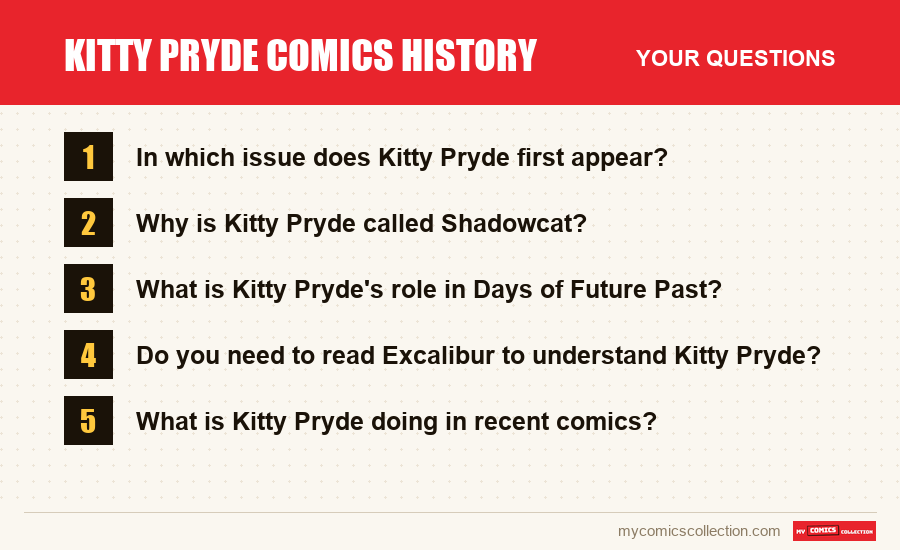
In X-Men #129 (January 1980), with Claremont on script and Byrne on art. Emma Frost debuts there too, which is why the issue draws double interest. In an inventory, list the series under its title at the time, X-Men.
She first went by Sprite, when she joined the team. The Shadowcat name arrives at the end of the Kitty Pryde and Wolverine miniseries, published in six issues in 1984 and 1985 and written by Chris Claremont. Since then, it has remained her best-known hero name, even though other aliases have existed.
In X-Men #141 and #142, an adult version of Kate Pryde, from a future dominated by the Sentinels, sends her mind into her teenage body to prevent assassinations that lead to catastrophe. Both issues are written by Claremont and Byrne, with Terry Austin on inks.
It is not essential, but the 1988 series shows an adult Kitty, settled in the United Kingdom with Captain Britain, Meggan, Nightcrawler and Rachel Summers. It reads as a standalone adventure, written first by Chris Claremont with Alan Davis on art, before the tone shifts after Claremont leaves at issue 34.
On Krakoa, she is called Kate Pryde, commands the Marauders and holds the title of Red Queen within the Hellfire Trading Company. She then returns to the X-Men starting with Fall of X and teaches in Exceptional X-Men, launched in 2025.
Do you own an X-Men #129 or an issue from the Claremont and Byrne era? Get its condition appraised before you sell it or insure it.
Appraise my comic