At Jim Valentino, the question is not “which number to stop at” but “which of the four registers are worth your time”. His bibliography does not form a progression: it is a set of blocks without continuity, written in opposing tones, between which one must choose rather than progress. For most readers, two blocks are enough: and there is no reason to read them in chronological order.
This configuration is rare. It makes entry easy and exit impossible to determine without a method.
This article describes the four blocks and their respective yields, indicates where to stop depending on what you are looking for, and points out the points where interest really picks up.
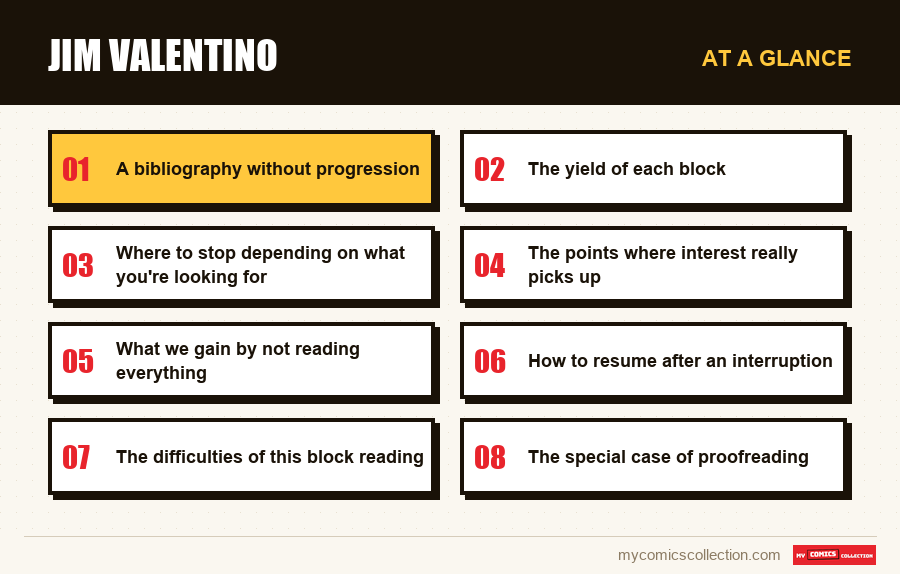
A bibliography without progression
We must first discard the expectation that we spontaneously place on an author's work.
We generally imagine a career as a curve: promising beginnings, maturity, eventually decline. This reading assumes a continuity of project that we find in many authors.
Nothing like that here. A superhero parody, a space adventure series, an urban vigilante cycle, an autobiography: four projects with no narrative link, no obvious technical progression, and addressed to different readers.
The consequence is liberating. No block is a prerequisite of another, and dropping one doesn't prohibit anything. You never “miss” anything by stopping.
The yield of each block
Parody: highest yield
Own identifiable voice, solid system which does not depend on any particular production, short format without commitment. A few numbers are enough to judge.
This is the only block to read in full if the tone suits you.
The space series: diminishing returns
Regular and professional work, appreciable unity of hand, but genre production without formal ambition. Interest is constant rather than growing.
Around fifteen numbers give the exact measurement of the whole.
The Vigilante Cycle: Concentrated Yield
All the interest is in the original series, conceived as a whole and concluded. The three revivals dilute the premise without adding anything.
The autobiography: uneven performance
Sequences of rare accuracy alternating with passages which run empty, for lack of narrative stake. The entire block can be read in one evening.
Where to stop depending on what you're looking for
Three drive profiles, three different breakpoints.
If you want to judge the author: the parody plus the autobiography. These two blocks contain all his personnel. They are short, they are quick to read, and they are enough to form an informed opinion.
If you are interested in his profession: add the original series of the vigilante cycle. It shows what he does when he seriously practices the genre he had mocked, which is the most instructive passage of his career.
If you are documenting a period: add around fifteen numbers from the space series. They show an author in a monthly production regime, a situation which explains many of his subsequent graphic choices.
Beyond these three thresholds, you are in completeness and more in reading. It's a legitimate project, but you might as well know it.
The most profitable stopping point is earlier than you might think. Two short blocks, the parody and the autobiography, represent a few hours of reading and give a fair image of this author.
Everything that follows adds context and nuance, not a revelation. A reader in a hurry can stop there without having missed the essential point, which is true of only a few authors.
The points where interest really picks up
They must be named precisely, because they are not where we would expect them.
Moving on to the revivals of the vigilante cycle. This is the clearest disconnect: the premise that supported the original series loosens, and the stories become interchangeable urban variants.
In the long middles of the space series. Not through a drop in quality but through repetition: the monthly format produces connecting episodes that add nothing to what the previous ones have established.
Nowhere in the parody. The short format and the constant renewal of targets avoid the exhaustion that threatens single-concept series.
Intermittently in the autobiography. The dips are local and not progressive, which makes abandonment hardly justified: the next passage can be excellent.
This distribution has a practical consequence: only the cycle of justice justifies a clean stop. The other blocks can be read to the end or pecked away, but do not abandon themselves along the way.
What we gain by not reading everything
The question deserves to be asked head-on, because completeness is the collector's default reflex.
On a bibliography where each block is independent, reading the whole produces no benefit in understanding. There is no thread to piece together, no character return, no evolution to follow from one block to another.
What we gain from stopping is to keep a good impression. A reader who reads the two best blocks retains the memory of an interesting author. The same reader who continues until late reminders ends up wondering why he started.
This risk is real and specific to this bibliography, where the best and the weakest are accessible at the same price and in the same lots. Nothing materially prevents you from going to the end, which makes the decision entirely personal.
This is also what makes this article useful. On a work where the market establishes no hierarchy, someone must propose one, even if you choose otherwise.
Why does a career take this form?
The fragmentation of this bibliography is not an individual oddity: it results from conditions that can be named.
An author who stays with the same publisher, on the same series, develops a continuous work, and the critics know how to tell it. An author who changes house, format and register every five years produces blocks, and no one knows how to talk about it.
These changes are not always an aesthetic choice. A series ends due to lack of sales, a publisher closes, an opportunity presents itself elsewhere, an editorial workload absorbs creation time. The form of a bibliography records as many constraints as intentions.
This is particularly true here, where the transition to editorial management mechanically made personal production rarer after the 1990s.
Knowing this avoids frequent misunderstandings. The breakup is not dispersion or indecision: it is the trace of a career led in an unstable sector, by someone who grasped what was happening.
Collecting this series?
Track what you own, what you are missing and what your collection is worth. 7 day trial.
Start my trial →How to resume after an interruption
A practical situation inevitably arises in this type of bibliography, and it deserves a method.
You read a block, you stop, six months pass. When we start again, the question is not “where was I” but “did I like this block”.
On a continuous series, the answer comes from the story: we remember an ongoing plot. Here, each issue being largely autonomous, no thread reminds us why we read:and we start again without knowing if we are continuing a good experience or a chore.
The easiest method is to reread the last issue you read rather than moving on to the next one. It costs a few minutes, it restores the tone, and it settles the question immediately.
It's a trivial piece of advice that is especially valuable for its economy: on a bibliography without continuity, five minutes of rereading replaces half an hour of hesitation.
The difficulties of this block reading
No imposed order
The lack of continuity deprives us of the usual reference point. You have to decide for yourself where to start and where to end.
Lots that mix everything
Buying in packs brings blocks that you hadn't chosen, which pushes you to read beyond the useful point.
A price that does not arbitrate
The best and the weakest wonder in the same range. The budget provides no safeguards.
Few recommendations available
This author is rarely commented on as a designer. Opinions to rely on are rare.
A final benchmark to situate the effort required: the four blocks combined represent significantly fewer pages than a single long-term series by a contemporary author. The question of the stopping point therefore arises in hours and not in years, which makes any deliberation excessive: one can make the wrong block without consequence, go back, and start again elsewhere for the price of an evening.
The special case of proofreading
A point often neglected, and which modifies the arbitration for those attached to this author.
The blocks do not reread equally. The parody gains on rereading, its construction gags revealing themselves better when you know the overall mechanics. The autobiography too, its best sequences are more easily located when you know where they are.
The vigilante cycle and the space series, on the other hand, reserve nothing for a second reading. These are the stories that give it all the first time, which is a property of their kind rather than a defect.
This asymmetry reinforces the initial recommendation: the two short and personal blocks are those that are worth having, the two genre blocks those that are enough to have read.
For a reader with limited storage space, this is the most useful sorting criterion that can be proposed in this bibliography.
What to record
On this exploded bibliography, the field to be taken is a reading judgment, which distinguishes it from collections where factual data is sufficient.
Your stopping point and its reason, block by block. Across four sets with no continuity, memory doesn't retain why you stopped somewhere: was it boredom, a reading interruption, or a considered decision? Without this note, we randomly pick up months later, often in the wrong place.
This is the only way to take up a fragmented bibliography without going through everything again.
The block to which each copy belongs, explicitly noted: four sets with unrelated titles and numberings are poorly placed together, and a card that mixes them up makes it impossible to find what we were trying to reread.
These two fields serve a bibliography that cannot be read in one go, and that is precisely the case with this one.
Frequently asked questions
Nothing imposes it: the four blocks have no narrative link and none is a prerequisite for another. The most profitable order begins with the parody from the 1980s and the autobiography from 1997, which chronologically frames everything else.
Two short blocks, the parody and the autobiography, represent a few hours and give a fair image of the author. Everything that follows adds context and nuance, never a revelation. This is an earlier stopping point than for most authors.
As we move on to restarts of the vigilante cycle: the premise loosens and the stories become interchangeable urban variants. This is the only dropout that justifies a clear stop: the other blocks can be read to the end or pecked away, but do not abandon themselves along the way.
Nothing in understanding: no thread to reconstruct, no character feedback, no evolution to follow between the blocks. On the other hand, continuing until late reminders risks spoiling a good impression, and in this bibliography, the best and the weakest cost the same price and arrive in the same batches.
The two short and personal blocks, which benefit from rereading: the parody reveals its construction gags better when you know the mechanics, and the autobiography its best sequences. The two genre blocks give everything on the first reading; you just need to have read them.
Where did you stop, and why?
On four sets without continuity, memory does not retain reason, and we start again at the wrong place.