The complete works of Jim Valentino are probably the cheapest bibliography of a major author to put together. As of August 29, 2026, its four main groups display requested raw medians of $4.96 to $7.99, with entries to $0.99 on three of them. No expensive segment exists: contrary to most authors, there is no neither first appearance sought nor key number which would cap the exercise.
This is a rare situation, and it completely changes the way we approach an author's collection.
This article gives the most effective purchasing order, explains what the whole thing really costs, details the only expense item that matters, and specifies what an inventory should follow here.
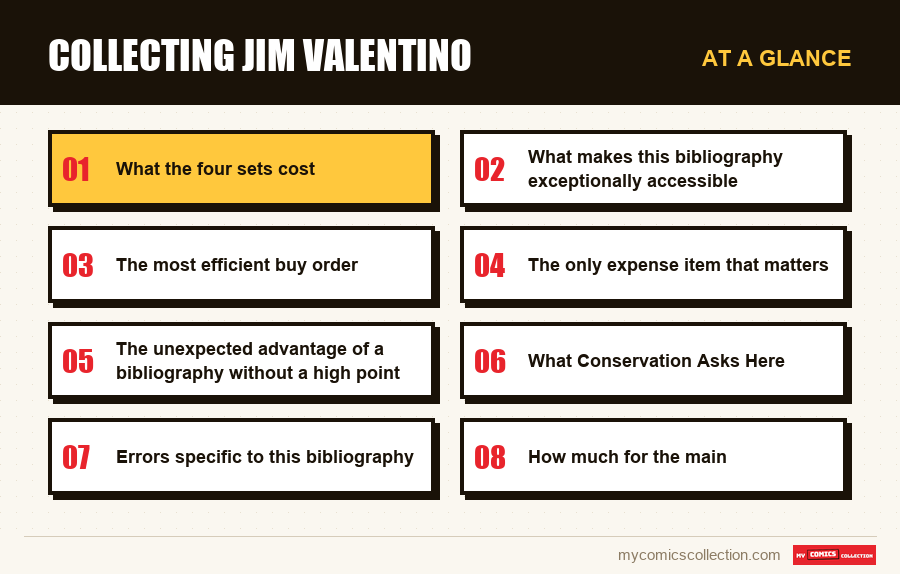
What the four sets cost
The values below come from a statement of fixed price advertisements from August 29, 2026: asking prices, gross and certified counted separately. They say what the sellers hope for, never what has changed hands.
The 1980s parody
90 ads raw, median $7.99, entries to 1,39 $. Only one certified ad overall.
It is his most personal work, and it is not the most expensive.
The space series
179 ads raw, median $6.98, several numbers to 0.99 and $1.00. Seven certified announcements.
His work followed the longest, and most abundant on the market.
The vigilante cycle
Four successive series, raw medians of $4.96 to $7.55, entries to $0.99. The certified portion ranges from 2 to 13 announcements depending on the series.
The late return
180 ads raw, median $5.12, entries to $1.00. At least eight covers for a single publication.
What makes this bibliography exceptionally accessible
Three absences come together, and it is their conjunction that is remarkable rather than each one taken separately.
No first appearance wanted. For most authors, one or two issues concentrate a demand which makes them inaccessible. Here, the statement does not show any.
No structuring certified market. One, two, four, seven, thirteen announcements depending on the set: certification has nowhere removed enough copies from the raw market to modify prices.
No depletion in progress. The considerable print runs of the period continue to fuel supply which exceeds demand in all segments.
The result is a bibliography flat from end to end, where no purchase is distinguished by its cost. It's comfortable, and that's also what's confusing: there is no objective, no room to aim for, no natural progression.
The absence of a key number changes the nature of the exercise. For most authors, a collection is built around a difficult piece that we end up obtaining.
Here, that is not possible. The collection can only be structured by the completeness of a chosen set, which requires deciding the objective yourself instead of letting it be determined by the market.
The most efficient buy order
It differs from chronological order, and it takes into account the fact that we still don't know if we are going to love.
A lot of parody first. This is where its own voice is heard, and at $1.39 each a few numbers are enough to tell if the register is right for you.
The space series next, in a mid-series batch. It is his most regular work, available at $0.99, and it shows the author in a regime of production rather than in a regime of invention.
The original vigilante series in third, and it alone: the three reminders add a confusion of identification without any counterpart in reading.
The rest last or never. The late return to eight covers is about the purchase of completeness, not discovery.
This order has one merit: it decreases interest at the same time as novelty, which allows you to stop at any time without missing the essentials.
The only expense item that matters
It must be named clearly, because it dominates everything else in this bibliography.
At unit prices between $0.99 and $1.39, shipping regularly costs several times the item shipped. A dollar issue sent alone costs five or six times its list price once shipping is added.
The consequence is mechanical: seeking the lowest unit price is the wrong strategy here. A seller who lists $2.50 per issue but ships twenty copies together is much cheaper than a $0.99 seller who takes one piece.
This is also what makes this bibliography more accessible than it seems for those who buy methodically, and more expensive than it should be for those who buy piecemeal.
Three or four well-chosen group orders are enough to cover the essentials of the work. Thirty individual orders will cost more for less results.
The unexpected advantage of a bibliography without a high point
The absence of the required part is considered a defect. However, it presents an advantage that collections structured around a key number never have.
On a high-point bibliography, the difficult piece absorbs a disproportionate share of the budget and attention. We devote months to it, we monitor it, and the rest of the work becomes a setting around it.
Nothing like that here. The budget is distributed evenly, so it covers everything: and the focus is on what books contain rather than what they cost.
It's a different collecting experience, closer to reading than to acquiring, and it's not certain that it's any less satisfying. Many collectors discovered along the way that they liked hunting more than books; here the question does not arise.
However, this requires accepting that there will be no moment of triumph. A complete collection by this author represents no achievement and will not impress anyone: it will only provide access to an author's journey documented from beginning to end.
What Conservation Asks Here
One last practical point, often neglected on inexpensive collections and yet decisive in the medium term.
These numbers cover two very different manufacturing regimes. Those from the 1980s come from self-publishing and use economical papers that brown and break when folded. Those from the 1990s are better printed but sometimes include cover effects (cutouts, embossing, cardboard) whose corners are quickly damaged.
Uniform storage therefore does not suit this set. The oldest need to be protected from light and handled flat; Effect covers require more rigid support than others.
The investment in protection quickly exceeds the value of the copies themselves, which raises a legitimate question: is it worth it on one-dollar issues?
The answer depends on what you're aiming for. To reread in twenty years, yes: the replacement cost is not the purchase price but the time to find the same issues. For a single reading, one box is more than enough.
Collecting this series?
Track what you own, what you are missing and what your collection is worth. 7 day trial.
Start my trial →Errors specific to this bibliography
L'achat à l'unité
The shipping far exceeds the price of the numbers. This is the only truly decisive parameter here.
The four “number 1s”
The vigilante cycle has four renumbered series. Buy the product number for invisible duplicates.
L'objectif jamais fixé
Without a difficult piece to target, a collection accumulates without ever being completed if its scope has not been decided.
The forgotten coupon
Some of the issues of the vigilante cycle included a detachable coupon, the absence of which is not always noted.
Finally, a word on the moment to buy, which does not arise here as elsewhere. None of the four groups shows any signs of tension: supply is continuous, medians low and stable, and there is no indication that waiting would cost an opportunity. Patience cannot therefore be paid for, unlike in tense markets where hesitating means giving up. We can build this collection over three years or three months, at the same price.
How much for the main
The order of magnitude deserves to be asked, since it is the main argument of this bibliography.
By purchasing in grouped lots at the prices noted, most of the four sets, enough to get a complete and documented idea of what this author has produced, are within a range that a single bound volume from another series would exceed.
This is an unusual proposition. For the price of an object, we obtain a route: three decades of work, two opposing registers, and the documented transition from artisanal self-publishing to the author structure.
The content still has to be interesting, and that's the only real question. The price is not a sufficient argument for reading anything: it simply makes the essay painless, which is already a great deal.
The reasonable method therefore consists of committing ten dollars before committing a hundred, which the structure of this market allows particularly well.
What to record
With a constrained budget on this bibliography, the decisive field concerns the order rather than the copy.
The actual cost per number, postage spread over the entire lot. This is the only honest measurement here: a copy posted at $0.99 in a shipment of two costs several dollars, while a copy posted at $2.50 in a shipment of twenty costs less than three. Without this calculation, we optimize the wrong figure.
It's also what allows you to know, after the fact, which sellers were worth your time: information that is worth money on a bibliography that can be purchased in packages.
The perimeter you have set for yourself, noted explicitly: which set you aim for completeness, and which you only buy in random batches. In the absence of a difficult piece to structure the collection, it is this written decision which serves as the objective.
These two fields do not describe any object. They describe a method of purchasing, and on a bibliography without a high point, it is the method that makes all the difference between a collection and a pile.
Frequently asked questions
The statement does not show any. Neither first appearance sought, nor certified structuring market: one to thirteen announcements depending on the sets -, nor current scarcity. It's a flat bibliography from start to finish, which is comfortable and confusing at the same time.
Five or six times its listed price if shipped alone. At these levels, shipping completely dominates the expense: a $2.50 seller who bundles twenty copies is much cheaper than a $0.99 seller who takes one piece. Looking for the lowest unit price is the wrong strategy here.
First the parody of the 1980s, where his own voice is heard best. The space series then, in a mid-series batch. The original vigilante series third, and this alone: the three relaunches only add identification confusion. The rest last, or never.
By deciding the scope yourself and writing it down: which set you aim for completeness, which you only buy in random batches. On most authors, the market designates the objective through a difficult piece; here it designates nothing, and accumulation without perimeter is never complete.
No: the prices recorded are explained by considerable print runs and by recognition given to its role as publisher rather than to its pages. But the price is not an argument for reading either: it only makes the attempt painless. Commit ten dollars before committing a hundred, which this market does particularly well.
How much does this lot actually cost you?
Postage spread, a $2.50 copy often beats a $0.99 copy.