Jeff Lemire leads two parallel careers, and the distinction changes the way we collect his work. Il draw and write his personal books:Essex County, Sweet Tooth, The Underwater Welder, Royal City, Trillium. He written only its genre series, entrusted to identified designers: Dustin Nguyen on Descender, Dean Ormston on Black Hammer, Andrea Sorrentino on Gideon Falls. A book whose drawing he signs is a unique author's object; a series he scripted is collected with two names.
This is the most useful and least often made distinction when approaching this bibliography.
A reader who liked Sweet Tooth for its trembling line and its washes will find none of that in Descender, beautiful but painted by someone else. A collector who stores both in the same place mixes two types of objects. This article separates the two sets and explains what the distinction actually implies.
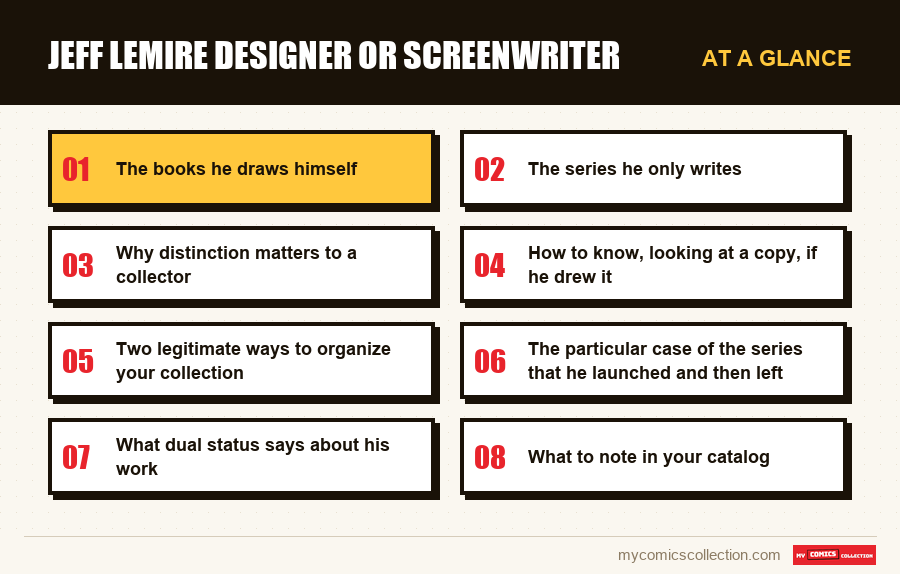
The books he draws himself
These are his intimate works, almost all autobiographical in fragments, and they bear an immediately recognizable graphic signature: a nervous line, deliberately imperfect, often enhanced with wash.
Essex County
The founding trilogy, entirely by his hand. This is where his style is established: angular faces, large black areas, stripped rural landscapes. Everything he draws next is already there.
Sweet Tooth
His longest series as a full-length author. The line becomes more confident as the issues go by, and the colored washes take on an increasing role: you can literally follow the evolution of a designer over forty issues.
The Underwater Welder
A unique volume in black and white, undoubtedly his most graphically mastered book. The constraint of the underwater camera produces very constructed pages, in contrast to the abundance of Essex County.
Royal City et Trillium
Two series that he draws entirely. Trillium pushes formal experimentation as far as possible (reversed pages, two-way reading) which an author can only attempt if he has both the story and the image.
The series he only writes
The other side is also abundant, and it is the one through which most readers discover it today. Here, he gives up drawing, and does so with remarkable consistency: he works again with the same artists on several projects.
Dustin Nguyen on Descender et Ascend. A full-length watercolor, without inking, which gives this science fiction an unexpected softness. This is the clearest example of a design that defines the identity of a series.
Dean Ormston on Black Hammer. A thick and dark line, inherited from British comics, which establishes the melancholic tone of the entire universe.
Andrea Sorrentino on Gideon Falls et Bone Orchard. The longest collaboration, and the most formally daring: exploded layouts, frames that dismember, effects impossible to obtain with classic cutting.
To which are added the derivatives of Black Hammer, each entrusted to a different designer, and its passage to major publishers, where the designer sometimes changes during the series.
Why distinction matters to a collector
The signature does not have the same meaning
On a book he draws, his signature completes the object. On a series that he is writing, a copy signed by the sole screenwriter remains incomplete in the eyes of the market: it is the double signature that is sought.
The original board does not always exist
There are original plates by him only on the books he draws. On others, the original belongs to the designer: an essential distinction if you're interested in this market.
Search by name misses half of the work
Many sellers index a series under the name of the designer, especially when the designer is renowned. Searching only for “Lemire” misses a significant portion of the ads.
The coherence of a collection depends on it
Bringing together “all of Lemire” does not have the same meaning depending on whether we are targeting the complete author, around ten books, or the screenwriter, which represents several hundred booklets.
How to know, looking at a copy, if he drew it
The cover is not enough: he sometimes signs the covers of series that he does not draw inside. Three quick checks remove any doubt.
The credits. Inside the cover or on the last page, the mention always distinguishes the scenario from the drawing. Two different names mean a collaboration, regardless of what the cover says.
The line itself. His drawing is recognizable: shaky lines, visible hatching, deliberately irregular inking. None of his regular collaborators work in this register: the gap is immediately visible.
The format. His full-length works most often appear directly in volume or in short series, while his screenplays feed into long monthly series. This is not an absolute rule, but a good first step.
The blanket trap. He sometimes draws the cover of an issue for which he only wrote the script, and suggests alternative covers for his own series. An ad praising “cover by Lemire” therefore says nothing about the content of the booklet.
It is the inside credits that are authentic, never the cover illustration, and never the title of a seller's ad either.
Two legitimate ways to organize your collection
There is no right answer, but you have to choose, and the choice determines the scale of the undertaking.
By full author. We only remember the books he writes et draw. The whole thing is coherent, finished, and fits on a shelf. It is the choice of readers who came to him through his graphic novels, and it is by far the simplest to complete.
By signing the script. We remember everything he wrote, drawing from whomever we want. The whole becomes vast, never really closed since he continues to publish, and it includes his work for major publishers.
This second set has a quality that the first does not have: it remains affordable. Booklets of independent series are available in abundance, and there is no obligation to acquire them in order or quickly.
A third way, often the most satisfactory in practice, consists of collecting the entire author's work exhaustively and only retaining from the scenarios the series that we really want to reread. This simply requires knowing, for each title, which category it falls into.
Collecting this series?
Track what you own, what you are missing and what your collection is worth. 7 day trial.
Start my trial →The particular case of the series that he launched and then left
A gray area deserves to be pointed out, because it regularly traps buyers: certain series change the designer during the course, and sometimes the screenwriter.
On long series, especially those published by major publishers, it is common for a designer to cover the first issues and then give way, without anything announcing this on the cover. Two consecutive copies of the same series can thus present unrelated designs.
The symmetrical case also exists: a universe that he created continues to be developed by other writers in derivatives. The name of the series remains its own, the story is no longer quite so.
For a collector, the consequence is concrete. The number, not the series, is the correct recording unit as soon as we leave graphic novels. Noting “series
What dual status says about his work
There is a fundamental reason for this separation, and it illuminates the reading.
The books he draws are almost all anchored in the same territory: rural Canada, silent families, mourning. The drawing is an instrument of intimacy: its claimed clumsiness serves the purpose, where a more polished line would betray it.
The series he writes are genre exercises: science fiction, superheroes, horror. They require readability and graphic virtuosity which he entrusts to others, more equipped for this. It is not a hierarchy but an assumed distribution.
This distribution is not a renunciation. Holding the story without holding the pencil requires writing differently: cutting out for another perspective, leaving empty areas that a designer will fill in better than an instructional guide. His genre scenarios are clearly written to be interpreted, not executed.
A reader who keeps this in mind chooses better. Looking for the emotion of graphic novels in genre series leads to disappointment, and the opposite too: those who come for science fiction will find Essex County lent et gris.
What to note in your catalog
A title alone is not enough to find the information later. Two fields preserve it.
The exact role.“Scenario and drawing” or “scenario only”. This is the data that allows, years later, to retrieve in one query the list of his complete works without having to reopen each volume.
The name of the designer. On the series he scripts, this is first-rate information: it determines the search for a missing copy, the value of a signed copy, and the very existence of an original plate.
Publishing, on graphic novels. His full-length works were often first published in separate volumes before being brought together. Without this clarification, two very different copies have the same title in a list.
A catalog which only records a title and an author will never answer the question “what do I have from him, from his hand?” ". The same catalog with these two fields responds instantly.
Frequently asked questions
Essex County, Sweet Tooth, The Underwater Welder, Trillium et Royal City constitute the heart of his complete author's work, to which are added several more recent graphic novels. All its genre series:Descender, Black Hammer, Gideon Falls: are on the other hand drawn by others.
No, and this is a common confusion. He sometimes designs the cover of issues for which he only wrote the script. Only the credits, inside the booklet, indicate who created the plates.
Yes, with a little practice. His drawing is characterized by deliberately shaky lines, irregular inking and large black areas, often completed with washes. None of his regular collaborators work in this register, which makes the distinction quite clear once you see a few pages.
Not quite. On a book of which he is the complete author, his signature is enough to make a successful autographed copy. On a series that he only wrote, the market is looking for the double signature of the screenwriter and the designer, more difficult to bring together since it involves crossing two people.
It depends entirely on what you're looking for, and the two sides have almost no mandatory readers in common. To discover the author at his most personal, his hand-drawn graphic novels are the direct route: a single volume is enough to know if his universe speaks to you, without committing to a series. For genre reading driven by spectacular drawing, its science fiction or horror series are more suitable, and can be read independently of each other.
Two careers, two ways of collecting
The exact role and name of the designer: two fields that answer “what do I have from his hand?” » in one request.