
The 3 essential Iron Man crossovers: Civil War (Tony Stark architect of the Superhuman Registration Act), Armor Wars (the personal crusade to protect one's technology) and Secret Wars 2015 (Tony facing the end of the multiverse).
Iron Man is the Marvel character whose crossovers best reflect the moral dilemmas of the modern era. Tony Stark is not simply a fighter in events: he is often the architect or catalyst. Civil War is his event as much as Captain America's, Armor Wars was born from his paranoia, and in AVX he makes the decisions that change everything. His intelligence places him at the center of strategic issues.
For a collector, Iron Man crossovers combine key issues with high value and rich continuity which rewards complete reading. The popularity of the MCU has also amplified demand on classic numbers. This guide identifies events where Tony Stark plays a central role and priority issues for your collection.
Civil War (2006-2007). The ultimate Tony Stark event
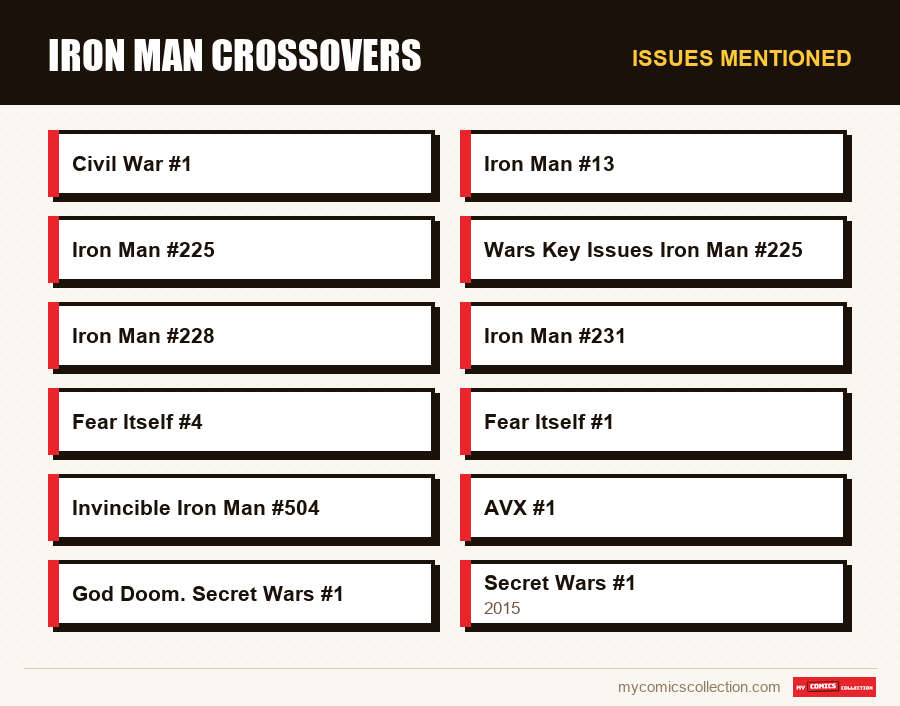
Mark Millar and Steve McNiven deliver a 7-issue event that divides the Marvel Universe into two camps. Tony Stark is the leader of the pro-registration camp, opposed to Captain America. It is an event that redefines the character: from hero to controversial authoritarian figure. Civil War #1 is a major key issue (€40-120 in 9.8 CGC), and #7 (indirect death of Captain America) completes the arc.
The essential tie-ins for Iron Man are Iron Man #13-14 (Civil War tie-ins) and the one-shot Civil War: The Confession. For the Iron Man key numbers, Civil War represents the defining moment of the modern character.
Armor Wars (1987-1988). The technological crusade
David Michelinie and Bob Layton orchestrate a 7-issue arc in Iron Man #225-231 where Tony Stark discovers his technology has been stolen and used by villains (and the government). He goes to war against anyone who uses derivatives of his armor, including allies. It's a seminal arc that defined Stark's technological paranoia for decades.
Armor Wars Key Issues
Iron Man #225 (start of Armor Wars): €30-70 in 9.8. Iron Man #228 (against Captain America): €20-50. Iron Man #231 (conclusion): €15-40. The complete arc #225-231 is an absolute must for any Iron Man collector.
Fear Itself (2011). The Ultimate Armor
Matt Fraction places Tony Stark in a sacrificial role: to forge weapons capable of defeating the Serpent, he breaks his sobriety and offers his sacrifice to Odin by drinking alcohol. This moment in Fear Itself #4 is one of the most poignant in the character's history. Tony then forges the Uru weapons which equip the Avengers for the final battle.
Fear Itself #1 (€10-25 in 9.8) and the Invincible Iron Man #504-509 tie-ins form the complete Iron Man arc of this event.
Avengers vs. X-Men (2012). The Fatal Decision
In AVX, Tony Stark attempts to destroy the Phoenix Force with a weapon and accidentally fragments it into five pieces, creating the Phoenix Five. This calculation error triggers the second half of the event. AVX #1 (€15-40 in 9.8) and the 12 issues of the main series contain essential Iron Man moments, notably his confrontation with Cyclops.
Secret Wars (2015). The End of Everything
Jonathan Hickman concludes his Avengers/New Avengers run with a 9-issue event where the multiverse dies and Doom rebuilds reality. Tony Stark is one of the survivors who faces God Doom. Secret Wars #1 (€25-70 in 9.8) launches the event, and the Invincible Iron Man tie-ins prepare for the post-Secret Wars status quo with Riri Williams.
Summary of values
Civil War #1: €40-120 (9.8). Iron Man #225 (Armor Wars): €30-70. Secret Wars #1 (2015): €25-70. AVX #1: €15-40. Fear Itself #1: €10-25. The MCU effect maintains strong demand for all Iron Man key issues.
Follow your Iron Man collection through each crossover. From Armor Wars to Secret Wars, manage your issues and identify missing ones with My Comics Collection.
Manage my Iron Man collectionIn what order to read and collect the Iron Man crossovers
The five events in this guide span nearly thirty years, and reading them in publication order shows how Tony Stark evolves: Armor Wars (1987-1988), Civil War (2006-2007), Fear Itself (2011), Avengers vs. X-Men (2012) and then Secret Wars (2015). It is also the simplest order for building a collection, because each event adds a layer to the same story.
Start with the most compact arc
Armor Wars unfolds entirely in the main series: Iron Man #225-231, seven issues written by David Michelinie and drawn by Bob Layton. No third-party title is needed, which makes it the easiest crossover to complete. It also establishes Stark's technological paranoia, which sheds light on every later event.
Miniseries first, tie-ins second
For Civil War, read the seven issues by Mark Millar and Steve McNiven, then add Iron Man #13-14 and the one-shot Civil War: The Confession, which round out Tony's point of view. Fear Itself follows the same logic: Matt Fraction's miniseries contains the sacrifice moment in issue 4, and Invincible Iron Man #504-509 gives the complete arc around the forging of the Uru weapons. For Avengers vs. X-Men, the twelve issues of the main series are enough to follow the confrontation with Cyclops and the mistake that fragments the Phoenix Force. For Secret Wars, Jonathan Hickman's nine issues conclude the multiverse, and the Invincible Iron Man tie-ins set up the aftermath with Riri Williams.
Points of caution for collectors
- The numbering can be confusing. Iron Man #225 belongs to the first series, whereas the Fear Itself and Secret Wars tie-ins appear in Invincible Iron Man. Check the title and volume before buying.
- Issue #1 attracts demand, not always reading interest. The first issue of an event sells more easily, but the decisive moments are often further in, such as issue 4 of Fear Itself.
- Complete by blocks. An incomplete arc loses its appeal: it is better to gather all seven issues of Armor Wars than a single isolated copy.
- Separate the event from its sequels. Each event has fallout in later series; wait until you own the event before chasing its consequences.
Following this order, you build a readable timeline of Tony Stark, from defending his technology to the end of the multiverse, without gaps in the reading.
Frequently Asked Questions
Civil War, where Tony Stark is the architect of the Superhuman Registration Act, Armor Wars, his personal crusade to protect his technology, and Secret Wars (2015), where he faces the end of the multiverse. Fear Itself and Avengers vs. X-Men complete the list of events in which he plays a central role.
Civil War (2006-2007) is a seven-issue event by Mark Millar and Steve McNiven in which Tony leads the pro-registration side against Captain America. Armor Wars (1987-1988), in Iron Man #225-231, is born of his paranoia: he sets out to destroy any technology derived from his armor. The first is collective, the second is a personal affair.
The essentials are Iron Man #13-14 and the one-shot Civil War: The Confession. They complete the main miniseries from Tony's point of view. For the character's key issues, Civil War is the defining moment of the modern Iron Man.
Matt Fraction gives him a sacrificial role: to forge weapons capable of defeating the Serpent, Tony breaks his sobriety and offers his sacrifice to Odin. That moment, in Fear Itself #4, is one of the most poignant in the character's history. He then forges the Uru weapons that equip the Avengers.
Tony tries to destroy the Phoenix Force with a weapon and accidentally fragments it into five pieces, creating the Phoenix Five. That miscalculation triggers the second half of the event. His confrontation with Cyclops is among the essential Iron Man moments in the twelve issues.