Building a coherent Hulk collection comes down to following three layers: the foundations of the Silver Age with Incredible Hulk #1 (1962, Stan Lee and Jack Kirby), the Wolverine turning point of the 1970s with issues #180 and #181, then the great modern sagas (Planet Hulk, World War Hulk, Immortal Hulk) which relaunched collector interest from the 2000s. The price rises sharply on the very first prints in very high CGC grade, while the majority of issues remain accessible in medium grade for those who simply want to read the story of the character.
The Hulk occupies a special place in Marvel history: unlike Spider-Man or the This seesaw trajectory has directly shaped the hierarchy of value of the comics that bear his name: certain founding issues have become museum rarities, while entire sections of the collection remain deliberately undervalued by the market, for lack of belonging to a clearly identified "first time".
For a collector who is just starting out or who is looking to structure an already started collection, understanding this editorial mechanism is more useful than any fixed price list. This guide therefore covers the history of the character number by key number, explains why certain titles concentrate most of the demand, and details the grading and rarity benchmarks verifiable via the CGC census. The objective is not to sell you a dream of automatic added value, but to give you the right criteria to distinguish a truly strategic comic from a simple nice issue to own.
Finally, because the rating of a Hulk comic moves with the character's relevance on screen as much as with the physical rarity of the paper, an entire section is devoted to the effect of cinematographic adaptations on secondary demand: a particularly marked phenomenon for this hero, who has experienced more reboots and recastings than most of the other pillars of the Marvel universe.
At the origins of the Hulk: a chaotic birth in full explosion of the Marvel universe
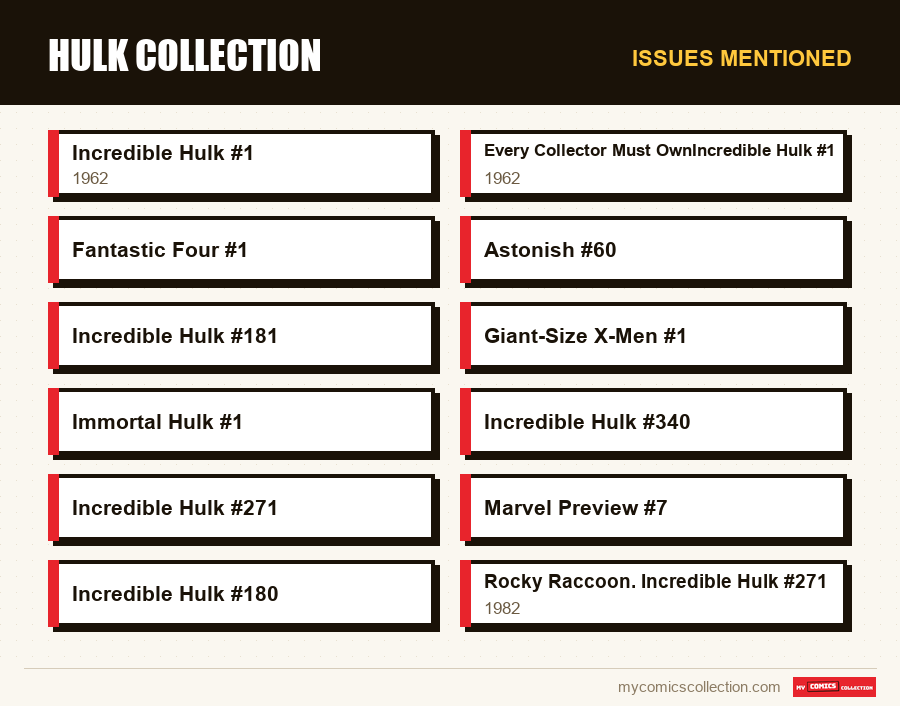
Incredible Hulk #1 appeared in April 1962, only a few months after Fantastic Four #1, in this pivotal period where Stan Lee and Jack Kirby laid the foundations of what would become the modern Marvel universe. The screenplay is by Stan Lee, the pencils are by Jack Kirby and the inking is by Paul Reinman. The story introduces Bruce Banner, a physicist trapped in the explosion of a gamma bomb he himself designed, as well as the characters who will structure his mythology for decades: Betty Ross, General Thaddeus "Thunderbolt" Ross and the young Rick Jones. It is a founding issue in the strict sense: it contains the complete origin of the character and the first appearances of his entire immediate narrative entourage.
A curious editorial detail distinguishes this issue from the rest of the collection: the Hulk is gray, not green. The printing process of the time produced an irregular and unsatisfactory color rendering in the eyes of Stan Lee, who had the character's color changed from the following issue to adopt the green which would become his definitive visual signature. This choice of coloring is therefore not a simple creative whim but a printing constraint assumed after the fact: a fact which explains why number 1 remains visually unique in the entire bibliography of the character and why the subsequent "grey Hulk" variants (in series like the Joe Fixit of the Peter David years) are often read as a direct homage to this very first printing.
The original 1962 series, however, did not have the commercial success of Fantastic Four or Spider-Man in its early days: it was canceled after only six issues, in 1963. The character then survived as a featured feature in other titles, notably Avengers and Fantastic Four, before returning to a regular series thanks to an editorial mechanism specific to the era: the split-book. It is this dotted path which explains why the Hulk collection of the Silver Age is more fragmented, and therefore more complex to map, than that of heroes launched directly solo.
Tales to Astonish: the second life of the green monster
After the cancellation of its first series, the Hulk returned to a regular series in October 1964, with Tales to Astonish #60. The title then becomes a "double feature" shared with Giant-Man, a frequent formula at Marvel in the Silver Age to keep two characters active without launching two separate series. The new adventures of the Hulk were initially scripted by Stan Lee and drawn by Steve Ditko, assisted with inking by George Roussos: an association which remains relatively rare in Ditko's bibliography, more associated with Spider-Man and Doctor Strange over the same period.
This issue 60 has a narrative importance that goes beyond the simple continuity of publication: it is there that the principle is established for the first time according to which the Hulk becomes Bruce Banner again when his anger subsides, a mechanism of transformation which will become central in the mythology of the character for the following decades. The series continued in Tales to Astonish until issue 101, before the title was renamed Incredible Hulk from issue 102: the series then reverting to the numbering that would become the backbone of the collection until the 1990s and beyond.
For a collector looking to cover this period, it is therefore necessary to keep in mind that "owning Hulk Silver Age" involves looking in two distinct series depending on the year: the original Incredible Hulk from 1962 (six issues), then Tales to Astonish from issue 60. This double numbering often surprises newcomers who think, wrongly, that the collection starts directly and continuously at issue 1 of 1962.
The Wolverine turning point: numbers 180 and 181, a tandem with reverse odds mechanics
The most commercially defining moment in the Hulk's entire publishing history came in 1974, with the arrival of a character who wasn't even originally intended as a mainstay of the Marvel Universe: Wolverine. Incredible Hulk #180, published in October 1974, ends with a teaser appearance of the character at the very end of the episode: a clawed silhouette which does not yet intervene in the plot but announces its arrival in the following issue. It is this "cameo" status which distinguishes #180 from #181 in the vocabulary of collectors, and which explains a significant difference in odds between the two issues despite their proximity to publication.
Incredible Hulk #181, released the following month in November 1974, contains the first complete appearance of Wolverine in a story in its own right, under the pen of Len Wein and Roy Thomas, with art by John Romita Sr. Wolverine fights the Hulk and the Wendigo before joining, a few months later, the new formation of the X-Men launched in Giant-Size X-Men #1: a springboard that will make him one of the most profitable characters in all of Marvel's history in terms of merchandising and adaptations. This later trajectory is the structural reason why #181 has established itself, over the decades, as one of the most sought-after Bronze era comics on the market, all series combined.
In terms of the CGC census, the relative rarity of this issue in very high grade explains part of its rating: at level 9.8, the number of certifications remains limited to a few dozen copies of all variants (universal grade and Signature Series combined), a low figure compared to the original print run, very superior, distributed on newsstands in the 1970s on paper poorly designed to last fifty years without yellowing or dogearing. Auctions illustrate this tension between scarcity and demand: a CGC 9.9 sold for $150,000 in 2011, a CGC 9.8 fetched $146,000 in a record sale, while a later example in the same grade sold for $50,969 in April 2025: a gap that shows how wildly the market for very high grades can fluctuate. from one sale to another depending on the context and the buyers present that day.
#180, for its part, remains much more accessible in intermediate grades, around $150 for a copy in fair condition, while being able to reach heights comparable to #181 in the very best conditions: a CGC 9.8 copy sold for $40,800 in June 2021. The logic of the market here is consistent with the rest of the key comics sector: the "real" first appearance captures the majority of the rarity premium, but the teaser which immediately precedes it retains significant value as long as the grade is impeccable.
The great modern sagas: Planet Hulk, World War Hulk and the Immortal Hulk relaunch
After decades of continuous publication but without a collector's peak comparable to the Wolverine era, the Hulk franchise experienced a second editorial wind in the mid-2000s thanks to screenwriter Greg Pak. The saga Planet Hulk, published in Incredible Hulk (volume 2) #92 to #105 between 2006 and 2007, with Carlo Pagulayan and Aaron Lopresti on the drawings, sends the character to the planet Sakaar after his forced exile by the Illuminati: a group of Marvel heroes, including Iron Man, Reed Richards and Doctor Strange, who considers the Hulk too dangerous to stay on Earth. Issue 92 ranked 48th on the Diamond bestseller list in February 2006 with around 39,000 copies sold, a solid figure for a title which was then no longer considered a commercial heavyweight in the Marvel stable.
The direct sequel, World War Hulk, published in 2007 as a five-issue mini-series still by Greg Pak, with John Romita Jr. drawing, capitalizes on the anger of the character returning to Earth to take revenge on those who exiled him. The first issue of this miniseries topped the Diamond Comic Distributors sales chart for the month of June 2007, with approximately 178,302 copies sold: a result which confirms that the Pak saga has permanently repositioned the Hulk as a commercially competitive franchise, more than a decade after its Wolverine peak of the 1970s.
The third modern milestone to know is Immortal Hulk #1, published in August 2018 by Al Ewing with art by Joe Bennett, at a cover price of $4.99. This relaunch, hailed by critics for its decidedly horrific turn, notably introduced the character of Jackie McGee and generated immediate collector demand upon its release, with numerous CGC 9.8 graded copies actively traded on the secondary market from the first months of marketing. Unlike the milestones of the Silver and Bronze Ages, Immortal Hulk illustrates a more recent phenomenon: that of a first issue which becomes an object of speculation upon its publication, driven by critical enthusiasm rather than by a first appearance of a third character.
Collecting this series?
Track what you own, what you are missing and what your collection is worth. 7 day trial.
Start my trial →A cover that has become iconic: Incredible Hulk #340 and the Todd McFarlane paw
Not all key numbers owe their status to a first appearance. Incredible Hulk #340, published in February 1988 under the pen of Peter David, owes its notoriety almost entirely to its cover, drawn by Todd McFarlane then in full rise at Marvel: a few years before he became one of the most influential artists in American comic books with Spider-Man then Spawn. The composition shows the Hulk from the front, the reflection of Wolverine visible in his claws extended towards the reader, a simple graphic idea but which has become one of the most reproduced and parodied covers in the entire history of the character.
In terms of price, this issue clearly illustrates the difference between a "narrative key comic" and an "iconographic key comic": without a first appearance to its credit, it remains significantly more accessible than issues 180-181, with copies in grades 8.5 to 9.4 which generally trade between 50 and 65 dollars, and modest grades around 3.0 which can be exchanged for around fifteen dollars. A CGC 9.8 copy, on the other hand, reached $740 during a sale in 2019 - proof that even a "non-first" issue can see its value take off significantly once the quality of conservation becomes exceptional and the cover itself is sufficiently identifiable to attract an audience beyond just comic book readers.
Rocket Raccoon before the Guardians: the mark left by Incredible Hulk #271
Incredible Hulk #271, published in May 1982, holds a special place in the collection because it is not technically the very first appearance of Rocket Raccoon: that one dates back to 1976, in Marvel Preview #7, under the name "Rocky Raccoon", but rather its first appearance in a mainstream monthly series and its first cover. This status of "first appearance in a regular comic book" is enough to make it an issue sought after by collectors specializing in character debuts, especially since the cinematic success of Guardians of the Galaxy has considerably broadened the audience interested in this secondary character who has become cult.
The values observed remain modest compared to Wolverine milestones: a CGC 9.8 copy sold for $1,250 in 2014, while a grade 2.0 copy sold for $69 in 2019. This gap between "absolute first appearance" outside the regular collection and "first appearance in the main title" is a frequent point of vigilance for buyers new to the key comics market: you should always check whether the issue you are coveted corresponds to the character's real first time or only to his first appearance in a particular series, the two not having at all the same impact on the rating.
The impact of adaptations on the rating
The Hulk is one of the Marvel characters whose cinematic journey has most directly influenced the perception of the secondary market, precisely because this journey has been more bumpy than that of most of the other headliners in the stable. The first feature film, directed by Ang Lee and released in 2003, received a mixed critical and public reception, which temporarily dampened collector interest in the franchise outside of the hard core of historical readers. Marvel Studios responded in 2008 with The Incredible Hulk, worn by Edward Norton, explicitly thought of as a reboot intended to erase the image left by the 2003 film: a performance hailed at the time by some fans as the most faithful version of the character ever brought to the screen, even if the film remains today classified among the least central in the filmography of the Marvel Cinematic Universe.
The real tipping point came in 2012, when Mark Ruffalo took over the role for the first Avengers film, after Edward Norton left the cast. The reception, initially skeptical, turns around from the scene where the character pronounces his now cult line about his permanent anger; Ruffalo then imposes an interpretation which will permanently establish the Hulk as a recognizable pillar of the MCU over the following decade, with a gradual evolution of the relationship between Bruce Banner and his alter ego which contrasts markedly with the more monolithic tone of the two previous films. This standardization of the character on screen has had a measurable effect on the comics market: issues associated with narrative milestones easily identifiable by a non-reading public: the very first appearance of the character, or visually strong covers like that of #340 - benefit structurally from a broader demand than episodes purely internal to the continuity of the comics, a classic phenomenon observed on almost all characters who have experienced mainstream cinematic exposure.
For a collector, the practical lesson of this turbulent history is twofold. On the one hand, we should not expect a cinematic release to automatically increase the rating of all the issues linked to the character: the effect almost always focuses on a handful of emblematic milestones (first appearances of third-party characters who have become popular, iconic covers) rather than on the entire catalog. On the other hand, the sensitivity of the Hulk market to the ups and downs of his screen career means that it is better to build your collection on the basis of the actual editorial interest of the issues rather than on a speculative bet linked to a future release, the impact of which remains by nature unpredictable.
Buying guide
Before investing in a key issue of the Hulk collection, a few concrete checks allow you to avoid unpleasant surprises and buy at the right price:
- Always distinguish a “real” first appearance from a simple teaser or cameo: #180 (Wolverine cameo) and #181 (first full appearance) perfectly illustrate this status gap, which is directly reflected in the rating.
- Systematically check whether it is a newsstand copy (newsstand) or distributed in a comic shop (direct edition) for issues published after the mid-1970s: newsstand prints are often rarer at very high grades, which can cause the value to vary significantly from one copy to another for the same issue and the same apparent grade.
- For Silver Age issues like Incredible Hulk #1, carefully examine the condition of the spine and corners: the paper of the period, more acidic, degrades more, and the price difference between two neighboring grades can represent tens of thousands of dollars on the very first issues.
- Do not confuse "absolute first appearance of a character" and "first appearance in a specific series": Rocket Raccoon is the most telling example, with a real debut in 1976 in Marvel Preview #7 and a first appearance in the Hulk title only in 1982.
- For recent issues like Immortal Hulk #1, favor the first identifiable prints ("first printing" or no mention of reprinting): later prints of the same issue, which are more common, sell for significantly less.
- Always compare several recent sales rather than a single displayed price: the rating of key comics fluctuates quickly, particularly on high grades where the number of transactions remains low and each sale can significantly move the average.
- If you manage several issues and series in parallel, keeping an up-to-date inventory of your grades, editions and provenance greatly facilitates tracking the overall value of your collection over time.
To quickly estimate the price of a specific number that you own or are considering purchasing, our estimator based on current eBay listings remains the quickest tool: simply indicate the series, number and condition to obtain a low, median and high range built on current eBay listings rather than on prices displayed in store.