
In short
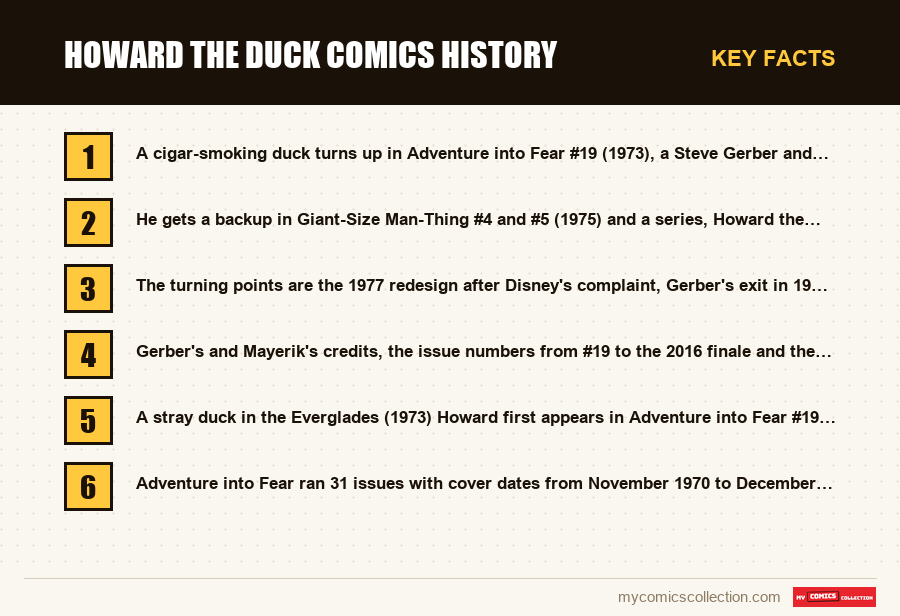
A cigar-smoking duck turns up in Adventure into Fear #19 (1973), a Steve Gerber and Val Mayerik story, and becomes Howard the Duck. He gets a backup in Giant-Size Man-Thing #4 and #5 (1975) and a series, Howard the Duck #1 (1976), where Gerber writes 27 issues. The turning points are the 1977 redesign after Disney's complaint, Gerber's exit in 1978 and the lawsuit settled in 1982, and the 2015 relaunch by Chip Zdarsky and Joe Quinones.
Few Marvel characters began as less of a plan than a cigar-smoking duck dropped into the Florida swamp beside a mute muck monster. Howard the Duck began as a bit player, and instead he outlived the feature that introduced him, sparred with a publisher over the way he looked, and ended up at the center of a fight over who owned him. His history is short on continuity and long on collisions between a writer, an editor, a rival company and a court.
Gerber's and Mayerik's credits, the issue numbers from #19 to the 2016 finale and the Disney and court dates were each checked against published records; why the duck outlasted his own controversies is our reading, and nothing from the pages or any price is quoted.
A stray duck in the Everglades (1973)
Howard first appears in Adventure into Fear #19, cover-dated December 1973, drawn by Val Mayerik from a Steve Gerber script. He is a secondary character in the Man-Thing feature, a cynical, cigar-smoking anthropomorphic duck in a horror book. The story sets him up with a magical explanation: the demon lord Thog the Nether-Spawn drops him into the Florida Everglades, where he runs into the swamp creature. Gerber based the character very loosely on a college friend, Howard Tockman.
The host series matters for understanding the debut. Adventure into Fear ran 31 issues with cover dates from November 1970 to December 1975, carried the cover title Fear for its first nine issues, and became Adventure into Fear with #10 (October 1972). Man-Thing led it from #10 through #19, and the Howard issue is the last of that stretch. In other words, the duck arrives at the moment a horror feature is about to hand the book to someone else. Our Man-Thing history follows the creature's own path; here the question is how a joke character in the margins of that story turned into a lead.
He began as a bit player, and readers soon showed he was more than that. That sequence, extra first and star later, is the template for the rest of his career. Every revival since has had to answer the same question the first reader asked: what is a talking duck doing in a world of capes and monsters, and how long can the joke carry a book?
Giant-Size Man-Thing and a backup of his own (1975)
The next step is Giant-Size Man-Thing #4 and #5, published in 1975, where Howard gets a backup feature. These oversized issues of the Man-Thing spinoff are where Gerber begins to use the duck on his own terms. The backup has him facing Garko the Man-Frog, and it sits among a group of horror parodies that Gerber uses to poke at the genre he was working in. The format fits the character, because a backup feature suits fast satire in a way that a lead feature built around a silent monster does not.
For a collector this pair of issues is the bridge between the debut and the series, and it is easy to skip. The debut is a supporting role inside a horror book, the series is a satire of everything around it, and the two Giant-Size issues show the point where Gerber is already treating Howard as a lead. They are also the reason a tidy Howard shelf starts before volume one of his own title, with the swamp books that surround it.
Howard the Duck #1 and the Gerber and Colan years (1976 to 1978)
The series launches with Howard the Duck #1, cover-dated January 1976. Gerber writes the run, 27 issues in all, the first cover is by Frank Brunner, and Gene Colan becomes the regular penciler with #4. Colan's presence changes the tone: a veteran best known for moody, shadowed pages brings a heavy atmosphere to a book about a duck, and the contrast between how serious the drawing looks and how absurd the situations are is a large part of the series' character. Colan also drew the newspaper strip, which ran from June 6, 1977, to October 29, 1978.
The book establishes a supporting cast quickly. Beverly Switzler, an artists' model from Cleveland, is Howard's near-constant companion and occasional girlfriend, and she appears in the background of the very first issue's cover. The villains are as odd as the premise. Dr. Bong is Lester Verde, a former tabloid reporter who uses a bell-shaped helmet to reorder reality, whose main goal is to marry Beverly, and who at one point turns Howard into a human. The Kidney Lady is a recurring antagonist who believes the soul lives in the kidneys and attacks whatever she sees as a threat to them; she is one of Howard's seatmates on a bus full of cultists. None of these characters belongs in a standard superhero book, which is exactly the point.
The run shows why the series is remembered as an author's book rather than a franchise: Gerber used it to comment on the culture around him, and the duck was a vehicle for irritation and bewilderment more than for action.
Howard for president: the 1976 campaign
The best-known stunt of the Gerber years is Howard's candidacy in the 1976 U.S. presidential campaign. In the story, a fictional All-Night Party nominates him under the slogan "Get Down, America!", and in the story he draws thousands of write-in votes before a doctored-photo sex scandal derails the campaign. The stunt sits in the series at the same time as the real election, which gave the book a topical hook.
It also shows what the series does better than its contemporaries: it uses the logic of a superhero world to examine the nonsense of ordinary life. The scandal that ends the campaign has no costumed villain behind it, and that is the lesson Gerber seems to be drawing. For a reader tracing the character through time, this is the high-water mark of the first volume, the stretch in which the book is most obviously a commentary and least a gag.
Disney, deadlines and Gerber's exit (1977 to 1979)
Trouble arrives in 1977, when Disney contacts Marvel about the character's resemblance to Donald Duck. Marvel agrees to a redesign by Disney artists, and one of the most visible changes is that Howard will wear pants. For collectors this is a useful dating tool: the look of the character on a cover or inside an issue tells you which side of that decision you are holding, and it explains why the earliest appearances read so differently from the later ones.
The second problem is internal. In 1978 Gerber is removed from the comic over chronic deadline problems, and his final issue is #27, cover-dated September 1978. Other writers take over, among them Marv Wolfman, Mary Skrenes, Mark Evanier and Bill Mantlo. From issue #30 Mantlo restores the status quo and brings Beverly Switzler back, which reads as an attempt to put the book back on the footing readers knew. Our reading is that this stretch is where the title stops being an author's statement and becomes a property that others are asked to keep running.
The next change is a format shift. Issue #31, cover-dated May 1979, is the final color issue, and the character moves to a black-and-white magazine that Mantlo writes and that is canceled after nine issues. The two formats are different objects on the shelf, and keeping them apart is one of the basic habits for anyone building a run.
The lawsuit and the return of the comic (1980 to 1986)
The legal dispute is the other half of the story. On August 29, 1980, Gerber sues Marvel's parent company, Cadence Industries, claiming that he alone owns the character. The suit is settled on September 24, 1982: Gerber acknowledges that the work was work-for-hire, Cadence is found to own the character, and the court dismisses the case on November 5, 1982. The outcome fixes the rule that governs much of Marvel's character history from that era, in which the company owns the creation even when the writer's voice is the reason readers cared.
With ownership settled, the original series returns. Howard the Duck #32 appears in January 1986, resuming the first volume's numbering after the magazine and a long silence. The long pause is visible in the numbers: the book that ended with a color issue in 1979 resumes as if nothing happened, which is useful to know when you are reading a run in order and wondering why the cover look changes.
Do you collect this series?
Track what you own, what you are missing and what your collection is worth. 7-day trial.
Start my trial →
The 1986 film and a long hiatus (1986 to 2000)
The next peak is the 1986 live-action film. Howard the Duck #33 is released in October 1986 to coincide with it, and Marvel publishes an adaptation in Marvel Super Special #41 (November 1986) together with a three-issue comic series. Chip Zien provided Howard's voice, several stunt performers, including Ed Gale, portrayed him, and Lea Thompson played Beverly Switzler. The film was a critical and commercial failure.
For the next decade he turns up in guest spots rather than in a title of his own. Gerber brings him back in The Sensational She-Hulk #14 to #17 in 1989, and Howard appears in Spider-Man Team-Up #5 (December 1996) and Ghost Rider volume 3 #81 (January 1997). This is the era in which the duck is a cameo, a character who can drop into another book for a few pages and who works best as a visitor.
Gerber's MAX return and the Zdarsky relaunches (2001 to 2016)
In 2001 Gerber returns to write a six-issue Howard the Duck miniseries for Marvel's MAX imprint, illustrated by Phil Winslade and Glenn Fabry. It brings the character's creator back to him in a new format after the legal fight, and the adult imprint gives him a freer hand than the Disney-shadowed 1970s allowed. Cameos continue afterward in She-Hulk volume 2 #9 (2005) and volume 3 #3 (2006). In 2007 comes Howard the Duck volume 4, a four-issue miniseries by Ty Templeton and Juan Bobillo.
The latest sustained push in this history is by Chip Zdarsky and Joe Quinones. A volume 5 series starts in March 2015 and runs five issues, and a volume 6 reboot begins with #1 in November 2015 and ends with its eleventh issue in October 2016. Our Zdarsky guide covers the writer's wider career. Between those volumes and the earlier ones, the numbering is a trap: the same title has been restarted at #1 several times.
A screen career in cameos
On screen the character is best known for the 1986 film, and decades later he appears again in the live-action Guardians of the Galaxy (2014), where he is a living exhibit in the Collector's museum and is seen in a post-credits scene drinking with the Collector and Cosmo. In 2014 the director said Howard could reappear as more of a character.
The key issues across his history
- Adventure into Fear #19 (1973): Howard debuts as a secondary character in the Man-Thing feature, by Steve Gerber and Val Mayerik.
- Giant-Size Man-Thing #4 and #5 (1975): Howard gets his own backup feature, featuring Garko the Man-Frog.
- Howard the Duck #1 (1976): the series launches, with Gerber writing and a Frank Brunner cover.
- Howard the Duck #4: Gene Colan becomes the regular penciler.
- Howard the Duck #27 (1978): Gerber's final issue as writer.
- Howard the Duck #33 (1986): released in step with the film, alongside the adaptation in Marvel Super Special #41.
- Howard the Duck MAX #1 (2001): Gerber, Phil Winslade and Glenn Fabry begin a six-issue miniseries.
- Howard the Duck volume 6 #1 (2015): Chip Zdarsky and Joe Quinones relaunch the title.
How to follow Howard in a collection
The method is to separate the objects. Start with the debut in Adventure into Fear #19, add Giant-Size Man-Thing #4 and #5, then take the original series from #1 to #27 as the Gerber core and treat the later issues of the first volume as a separate chapter. The black-and-white magazine is its own run and should not be shelved by issue number alongside the color title. After that, keep each later volume on its own: the 2001 MAX miniseries, the 2007 miniseries and the two 2015 volumes all restart the numbering, so check volume, year and cover look before you accept a number.
Because the character was redesigned in 1977, a quick check of how Howard is drawn tells you which period a copy belongs to. If you are building a Man-Thing and Howard shelf together, our guides to the Man-Thing debut and the comic ages help place each book in its period.
Frequently asked questions
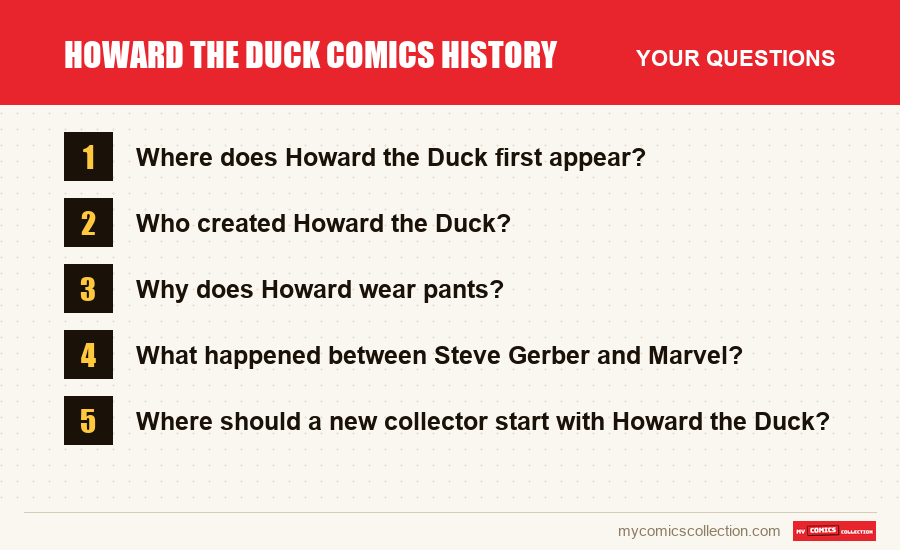
Howard first appears in Adventure into Fear #19, cover-dated December 1973, as a secondary character in the Man-Thing feature. Steve Gerber wrote the story and Val Mayerik penciled it. A demon lord drops him into the Florida Everglades, where he meets the swamp creature.
Writer Steve Gerber and penciler Val Mayerik created him. Gerber based the name, very loosely, on a college friend named Howard Tockman. Gene Colan became the regular penciler on the series from issue #4, and Colan also drew the newspaper strip that ran in 1977 and 1978.
In 1977 Disney contacted Marvel about the character's resemblance to Donald Duck, and Marvel agreed to a redesign by Disney artists. One of the key changes was that Howard would wear pants. The change affects how early and later issues look on the shelf.
Gerber was removed from the comic in 1978 over deadline problems, and his last issue was #27. In 1980 he sued Cadence Industries, Marvel's parent company, claiming he owned the character. The case was settled in 1982 with Gerber acknowledging work-for-hire, and Cadence was found to own Howard.
Start with Adventure into Fear #19 and Giant-Size Man-Thing #4 and #5, then read Howard the Duck #1 to #27 for the Gerber core. After that, treat the magazine, the 2001 MAX miniseries and the 2015 volumes as separate runs, since the numbering restarts several times.
If you own an issue from the Gerber run of Howard the Duck, an estimate shows what your copy is worth today.
Estimate my comic