How many Venom comics are there? We count seven main Venom series, every series counted from Venom: Lethal Protector in 1993 to the volume launched in December 2024 as All-New Venom. The longest is the 2011 volume, with forty-two issues not counting the .1 issues. The legacy numbering, restored at #150 in 2017, resumed at #250 in 2025, at the eleventh issue of the current volume. The 1990s miniseries, annuals, and spinoffs are counted separately.
Asking a symbiote collector this question is like asking for a table rather than a number. Venom has lived in six-issue miniseries, in short volumes relaunched every two or three years, and then in a legacy sequence that glued several relaunches together under a single counter. Every cover shows a number, but not always the same kind of number.
As always on this guide, only verified information (creators, issues, dates) is stated as fact; the analysis is our own, with no reproduction of panels or protected dialogue.
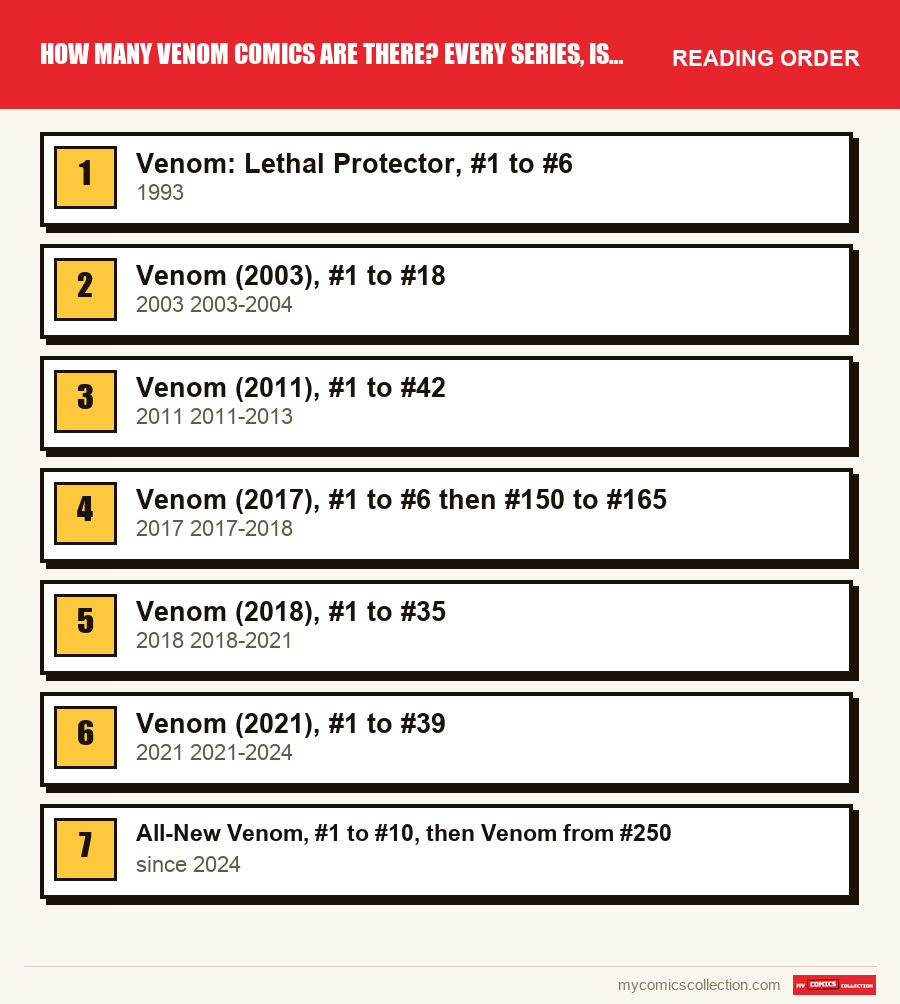
Series 1: Venom: Lethal Protector, #1 to #6 (1993)
The limited series runs from February to July 1993 and has six issues. All six scripts are by David Michelinie; the pencils pass from Mark Bagley, on the first three issues, to Ron Lim, on the last three. On inks, Sam de la Rosa signs all six issues and Al Milgrom works on the first four.
This short format sets the tone for the decade: the character gets a series under his own name before he gets a monthly title. Our analysis of Lethal Protector and its value details what buyers look for in these six single issues.
One quirk to know before you start adding: after this title, Marvel follows with many miniseries through January 1998, among them Venom: Separation Anxiety. None of them shares a boundary with the later volumes, and we cover them further down, in the section on spinoff series.
Series 2: Venom (2003), #1 to #18 (2003-2004)
The first monthly volume of the twenty-first century begins in June 2003 under Marvel's Tsunami imprint and ends in November 2004. Daniel Way writes all eighteen issues. The story follows Patricia Robertson, who faces a clone of the symbiote: the center of gravity leaves Eddie Brock.
Francisco Herrera draws issues 1 to 5 and 11 to 13, Paco Medina issues 6 to 10, and Skottie Young issues 14 to 18. Its short run makes it an easy stage to complete, as long as you do not confuse it with the later relaunches that carry the same bare title, Venom, and also restart at issue 1.
Series 3: Venom (2011), #1 to #42 (2011-2013)
Launched in 2011 and closed in 2013, this series puts Flash Thompson under the mask, in the version known as Agent Venom. Rick Remender writes issues 1 to 22, then Cullen Bunn takes over the scripting from issue 23. Tony Moore, Tom Fowler, and Lan Medina draw the Remender period; Thony Silas draws Cullen Bunn's.
It is the longest of all the series in this guide: forty-two issues, plus issues #13.1 to #13.4 and #27.1, which are not part of this count. If you include those five tie-in issues, the volume rises to forty-seven single issues, and it all depends on your collecting rule. The Rick Remender hub gathers the writer's other series.
Series 4: Venom (2017), #1 to #6 then #150 to #165 (2017-2018)
The series is part of the Marvel NOW! 2.0 wave. For six issues, the protagonist is Lee Price; Mike Costa writes most of the volume, with Gerardo Sandoval on pencils and inks for the early issues. The series then switches to the historical numbering: it restarts at issue 150, with Eddie Brock once again host of the symbiote, and Mike Costa concludes with issue 165. Cullen Bunn writes issues 162 and 163, and Mark Bagley draws issues 155 to 158, among others.
For a tally, this series is the classic trap: two tiers within one title, a first numbering from 1 to 6 and a second from 150 to 165. That makes twenty-two issues in total, provided you agree to group them.
Series 5: Venom (2018), #1 to #35 (2018-2021)
In the Fresh Start wave, Donny Cates writes issues 1 to 12 and 16 to 35, and Cullen Bunn signs issues 13 to 15. Ryan Stegman draws issues 1 to 6, 9 to 11, and 35. The volume focuses on Eddie Brock and introduces Dylan Brock as well as Knull, two names that collectors find on most modern key issue lists.
The volume restarts at issue 1 after Mike Costa's #165: for anyone following the overall counter, these thirty-five issues are the first piece of the gap between #165 and #250. See the Donny Cates and Ryan Stegman hubs for their other collaborations.
Do you collect this series?
Track what you own, what you are missing and what your collection is worth. 7-day trial.
Start my trial →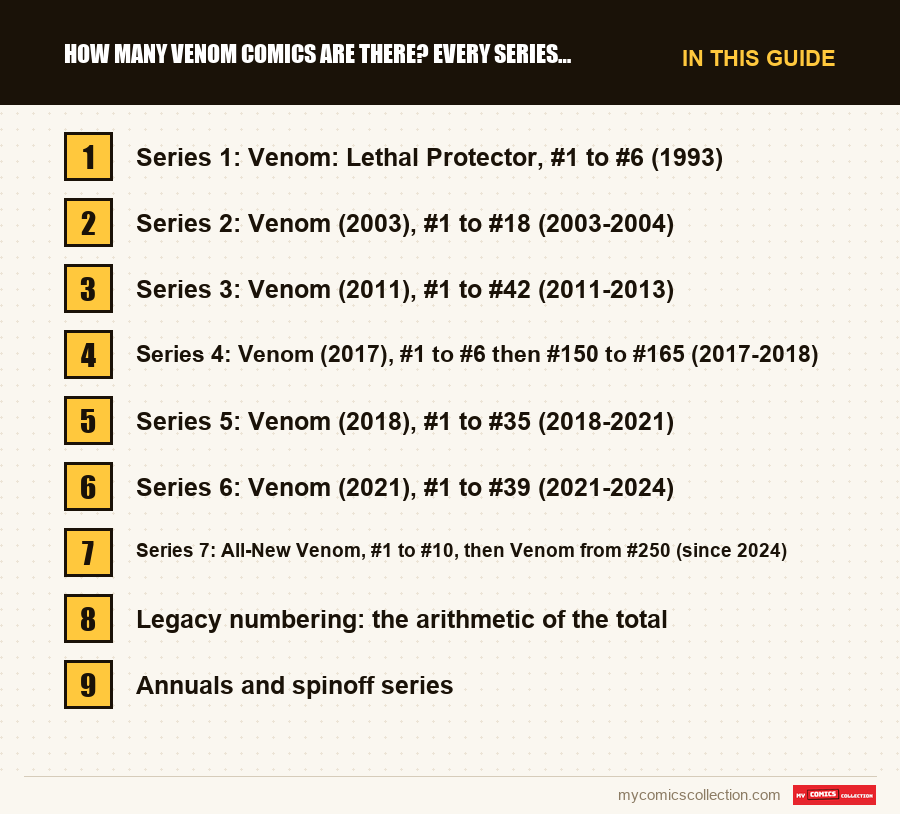
Series 6: Venom (2021), #1 to #39 (2021-2024)
A new volume starts in the fall of 2021 and lasts until November 2024. Al Ewing and Ram V launch the series together, Torunn Grønbekk writes several issues from #23 on, and Bryan Hitch draws issues 1 to 16. The story makes Dylan Brock the new Venom: the symbiote's host therefore changes from one monthly series to the next, which matters if you shelve by character rather than by title.
At thirty-nine issues, it is the second longest series in the set, behind the 2011 run. It also restarts at issue 1 and fits, for the overall counter, between #165 and #250.
Series 7: All-New Venom, #1 to #10, then Venom from #250 (since 2024)
This volume opens in December 2024 under the title All-New Venom, with Al Ewing on script and Carlos Gómez on pencils. The first ten issues carry that title; the eleventh goes back to the bare title Venom and the historical numbering, showing #250 in 2025. Al Ewing writes issues 250 to 256, then Charles Soule takes over at issue 257.
Like the 2017 volume, this one combines two tiers under one series: ten issues of All-New Venom, then a run that starts at 250. Shelve them together, right after the Dylan Brock volume, and not with the miniseries.
The series is still open as we write: we give no last issue, because any endpoint written here would be out of date by the next retailer order. That is also why no overall total can be shown in a stable way; the only figure that stays accurate is that of each closed series.
Legacy numbering: the arithmetic of the total
Venom's legacy counter appeared in 2017, when Mike Costa's volume dropped its issue 6 to resume at issue 150. The counter stops at #165 in 2018, then reappears at #250 in 2025. In between, three series restarted at 1 fill the gap: Donny Cates's thirty-five issues, the thirty-nine of the 2021 volume, and the ten of All-New Venom. Checking the arithmetic: 165 plus 35 makes 200, plus 39 makes 239, plus 10 makes 249, and the next issue is indeed 250.
What this arithmetic does not say is where the 150 comes from. The series above, added up without the .1 issues, give eighteen, forty-two, and six issues for the three earlier volumes, for sixty-six in all: the legacy counter is therefore an editorial convention, not a sum you can redo from the list. Our recommendation is to note both numbers for each cover when they exist.
Four ways of counting therefore coexist. The Marvel counter, past 250; the volumes, for comparing series with each other; the issues, which include or exclude the .1 issues; and the collector's own, who decides whether or not to include the miniseries.
Annuals and spinoff series
Venom's spinoffs are numerous and our survey remains partial. Between February 1993 and January 1998, Marvel publishes many Venom miniseries; Separation Anxiety is one of them. Venom: Space Knight, a thirteen-issue series published in 2016, shelves next to the monthly volume of the time rather than with the miniseries.
Other titles join in: Venomverse in 2017, Venom 2099 in 2019 as a one-shot, and a Symbiote Spider-Man miniseries. For annuals and special issues, our article on the Venom annuals and specials offers a reading guide.
Decide early where the boundary lies. Strictly shelving the seven main series leaves out many titles; a broad approach, spinoffs included, becomes a multi-year project. Both choices are defensible, but the first makes the catalog easier to read.
Another point of method: the 2011 .1 issues slot in between the full-numbered issues. They carry a decimal number that does not add up with the full issues. Five single issues of this kind therefore add five slots in a binder, but zero to the count of forty-two.
One last trap involves identically titled runs. The 2003, 2011, 2017, 2018, and 2021 volumes are all called Venom, as is the continuation of the volume opened in 2024; it is the launch year and the number that tell them apart, not the name. When you look for a specific issue, always write the launch year next to the number, otherwise you may buy the wrong single issue.
Completing the series: where to start
Start with the shortest and oldest: the six issues of Lethal Protector, then the 2003 volume. They shelve quickly and give you a sense of progress. Continue with the 2011 series, which is the longest and whose tie-in issues call for vigilance.
For the legacy volumes, use a two-column grid: volume number and legacy number. That way no duplicate slips into your binder and no gap goes unnoticed between 150 and 165, or after 250. Also check the cover variants, because a single series can have several versions of the same issue.
Once the modern series is complete, work back toward the older titles. This progression, from newest to oldest, keeps you from tying up a buying budget on a few expensive 1990s issues before you have filled the cheap gaps. Also note each volume's creative team, because writer changes, like those of 2011 at issue 23 or of 2018 at issues 13 to 15, structure how a volume is read and shelved.
Finally, set a written rule for the .1 issues, annuals, and miniseries, then stick to it: it is what will tell you, six months from now, whether your collection is complete. For the reading order, the page on where to start reading Venom helps you choose the first series to buy.
Frequently asked questions
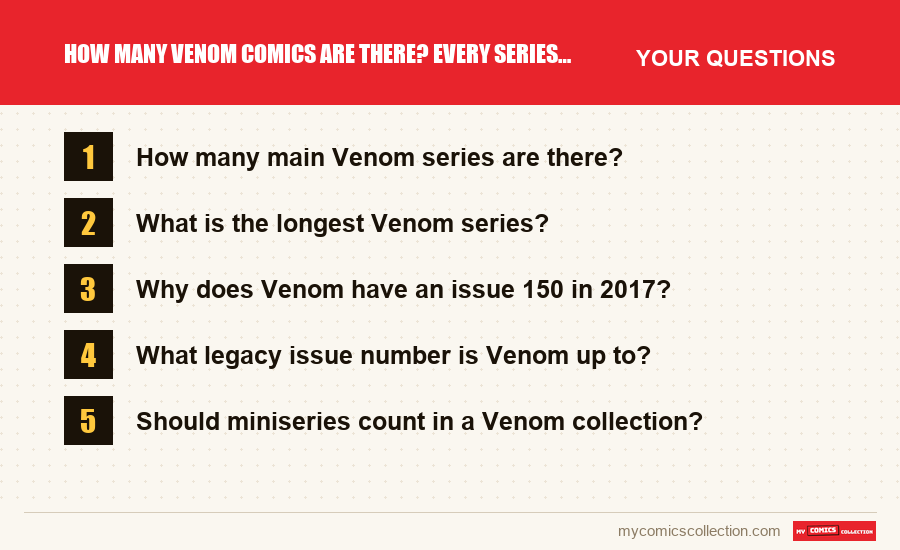
We count seven: Lethal Protector in 1993, the 2003 volume, the 2011 one, the 2017 one, the 2018 one, the 2021 one, then the volume opened in 2024 as All-New Venom, which became Venom at #250. The 1990s miniseries and the spinoffs come on top of that.
The volume launched in 2011 with forty-two issues, by Rick Remender and then Cullen Bunn. It beats the 2021 series at thirty-nine issues, as well as the 2018 one at thirty-five. The .1 issues are counted separately, which can change the ranking depending on your rule.
In 2017 Marvel restored a legacy counter: Mike Costa's series, which started at issue 1, resumed at issue 150. That number is not the sum of the previous volumes, since eighteen, forty-two, and six make sixty-six. It should be read as a publisher convention.
The counter has passed 250: it resumed at that number in 2025, at the eleventh issue of the volume opened in 2024. You get that figure by adding to Mike Costa's #165 the thirty-five issues of Donny Cates, the thirty-nine of the 2021 volume, and the ten of All-New Venom. Since the series is open, we do not fix a last issue.
That is a personal decision. The 1990s miniseries, like Separation Anxiety, belong to no monthly volume. If you leave them out, you follow seven series; if you include them, the project extends to many additional titles, with more issues to hunt down.
Not sure what a Venom issue, a legacy-numbered issue, or a .1 tie-in issue is worth? Get it appraised before you fill a gap.
Estimate my comic