There is no single counter for how many Superman comics there are: nine series or numbering runs follow one another in the Superman line since 1939, and Action Comics, born in 1938, is a second lineage in its own right. The longest is Action Comics, whose issue #1000 came out in 2018. The total changes depending on whether you count Adventures of Superman, the #0 issues and the annuals.
A collector who asks "how many Superman comics are there?" runs into two titles that have shared the character for more than eight decades. Action Comics introduces Superman in 1938, Superman takes over in 1939, and each of the two has had its relaunches, its renumberings and its returns to the past.
As always in this guide, we only state verified facts (creators, issue numbers, dates); the analysis is our own, with no reproduction of protected art or dialogue.

Series 1: Superman, #1 to #423 (1939-1986)
Superman has a year of newsstand life behind him when his own title, Superman #1, comes out in 1939 from his creators Jerry Siegel and Joe Shuster, while Action Comics keeps on publishing. This series runs for almost half a century, up to issue #423 in 1986, and crosses the Golden Age with Wayne Boring, then the Silver Age of the 1960s dominated by Curt Swan, the definitive artist of the character.
Issue #423 carries the first part of the farewell story imagined by Alan Moore, with Curt Swan on pencils: two issues that close the old continuity just before the 1986 reboot. That 1986 issue therefore ends the series under its original title without stopping its counter.
Series 2: Adventures of Superman, #424 to #649 (1987-2006)
Here is the trap that catalogs set: Adventures of Superman is not a new series, it is the 1939 Superman title renamed, which continues the numbering at #424 in 1987. In 1986, DC remodels its hero after the maxi-series Crisis on Infinite Earths and entrusts the relaunch to John Byrne, while Marv Wolfman and Jerry Ordway launch Adventures of Superman: the old counter carries on under another name.
This series runs to #649, in 2006, which is 226 issues. It is an integral part of the great monthly saga of the 1990s, when the character's titles followed one another at the pace of a weekly story. If you shelve by cover title, these issues go on a separate shelf; if you shelve by continuous numbering, they extend Superman #423.
Series 3: Superman, #1 to #226 (1987-2006)
The second volume of Superman starts again from zero in 1987, written and drawn by John Byrne for his relaunch. It runs to #226, in April 2006, when the Infinite Crisis event resets the numbering of the two parallel titles. This is the series that carries "The Death of Superman": the 1993 issue #75 remains a highly sought-after key issue for collectors.
Our feature on John Byrne comics details his work on Superman. Note that this series has the same number of issues as Adventures of Superman: 226 each, both ending the same month, April 2006.
Series 4: Superman, #650 to #714 (2006-2011)
In May 2006, the title picks up the historical numbering of the first volume with #650: DC drops the name Adventures of Superman and goes back to the plain title Superman. Kurt Busiek writes the series from #654, with Carlos Pacheco on art, before James Robinson takes over from #677 to #700, from 2008 to 2010.
J. Michael Straczynski, with Eddy Barrows, opens the Grounded arc at #701, and the series stops at #714, in October 2011, the last issue before the New 52 relaunch. These 65 issues should be tracked separately in your inventory, because their original home is the first volume.
Series 5: Superman, #1 to #52 (2011-2016)
With the New 52 of 2011, DC relaunches all of its titles from scratch and Superman starts again at #1. The count for this series is the most ambiguous of the bunch: it has issues 1 to 52, but also a #0 and four .1 issues, from 23.1 to 23.4, which come out apart from the main numbering, making 57 single issues in all.
If you are looking for "the complete series," ask yourself whether you want those off-sequence issues. A collector who sticks to the regular numbering will stop at #52, which closes the series in 2016, before the hero's return under Rebirth.
Series 6: Superman, #1 to #45 (2016-2018)
Rebirth brings Superman back in a familiar format: Peter J. Tomasi writes and Patrick Gleason draws the series, which begins with a new #1 in 2016. It stops at #45, in April 2018, just before the relaunch handed to Brian Michael Bendis.
For those who read in order, our advice on the Superman reading order puts these issues back into the flow of the era, with the bridges to Action Comics.
Series 7: Superman, #1 to #32 (2018-2021)
Brian Michael Bendis launches a fifth volume in July 2018, which ends in June 2021 at #32. He also writes Action Comics from #1001, which gives him control of both titles at once for a few months.
This volume is short and easy to complete: thirty-two issues in three years. Collectors shelve it right after the Tomasi and Gleason series, which it follows directly.
Series 8: Superman: Son of Kal-El, #1 to #18 (2021-2022)
In July 2021, the Superman series gives way to Superman: Son of Kal-El, written by Tom Taylor and drawn by John Timms. It runs eighteen issues plus an annual, and ends in December 2022.
This change of title is exactly the kind of detail that skews a count: if you filter on "Superman," this series does not always show up, even though it holds the same editorial place as the earlier volumes.
Do you collect this series?
Track what you own, what you are missing and what your collection is worth. 7-day trial.
Start my trial →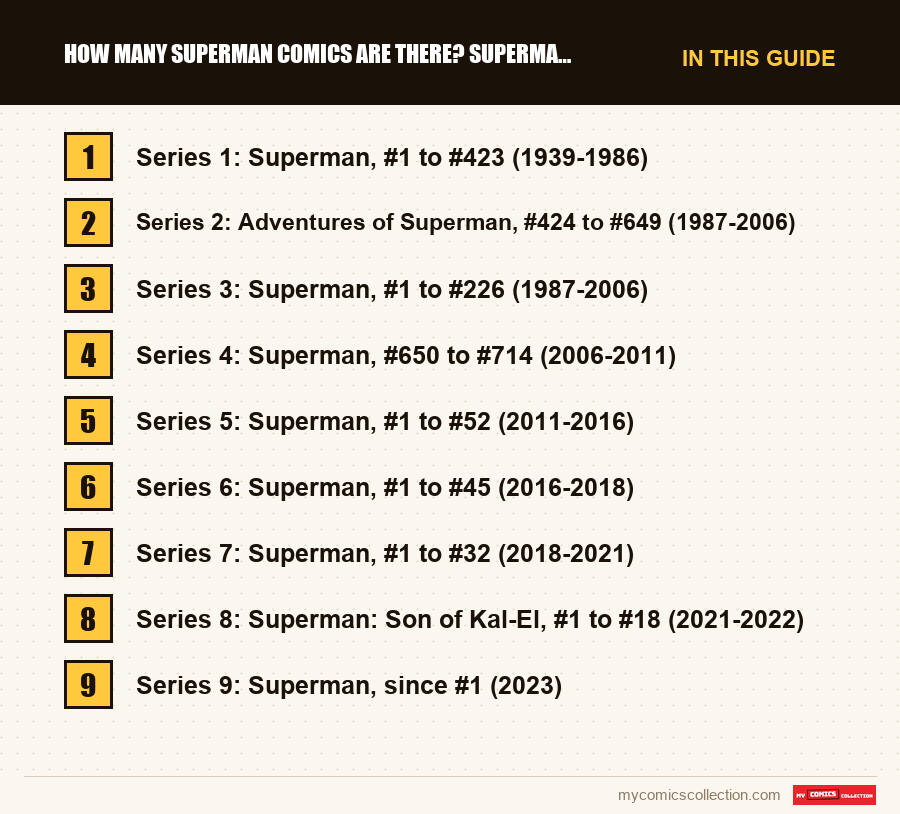
Series 9: Superman, since #1 (2023)
The Superman title takes back its original name in February 2023, with Joshua Williamson on script and Jamal Campbell on art, and restarts at #1. We give no end date: the series is ongoing, and its counter moves forward every month.
For anyone who wants to follow a current volume, that is an advantage: the run is short, the first issues are easy to find, and you can follow the opening storylines without having to dig back through eight decades.
Action Comics: the second half of the count
A "Superman" total that leaves out Action Comics is incomplete: this is the magazine where the character was born. The title has remained the hero's great showcase, with its own volumes, its own relaunches and its own issue #1000. Here are its three main series.
Series 10: Action Comics, #1 to #904 (1938-2011)
Issue #1 went on sale on April 18, 1938, with a cover dated June 1938: this is where Jerry Siegel and Joe Shuster bring Superman to the newsstands. The original series stops at #904 in October 2011; outside that sequence, it also has a #0, a #1,000,000 and thirteen annuals.
Among the creators who marked this long series: Wayne Boring from 1942, Curt Swan from the 1960s, John Byrne arriving at #584 in 1987, George Pérez at #643 in 1989, Greg Rucka and Eddy Barrows at #875 in 2009. Our guide to Action Comics key issues selects the milestones of this period.
Series 11: Action Comics, #1 to #52 (2011-2016)
The New 52 of 2011 start from zero. Grant Morrison writes the #0 and issues 1 to 18, with Rags Morales on art. Andy Diggle and Tony Daniel take over at #19, Scott Lobdell signs issues 22 and 23, then Greg Pak and Aaron Kuder arrive at #25 in January 2014. The series ends at #52 in July 2016.
Like Superman, this series has a #0 and four issues numbered 23.1 to 23.4: fifty-two issues in sequence, plus five off-sequence issues, plus three annuals. The Grant Morrison run, from #0 to #18, is shelved separately if you follow a writer rather than a title.
Series 12: Action Comics, #957 and beyond (since 2016)
In 2016, Action Comics goes back to its historical numbering at #957, as part of Rebirth. The arithmetic is clear: 904 issues of the first series plus 52 of the second make 956, so the next one carries the number 957. Issues 0, 23.1 to 23.4 and the #1,000,000 are not counted in this calculation.
Dan Jurgens writes most of issues 957 to 1000. Issue #1000, released on April 18, 2018, celebrates the eightieth anniversary of the first issue. Brian Michael Bendis writes issues 1001 to 1028, then Phillip Kennedy Johnson writes issues 1029 to 1060, and Mark Waid follows at #1070.
Legacy numbering: the arithmetic of the total
The two titles do not use the same logic, and that is what makes the total tricky. For Action Comics, the legacy numbering is easy to rebuild: 904 issues up to 2011, 52 during the New 52, then #957 in 2016. The #1000 of 2018 is therefore the result of an honest addition, provided you do not count the #0 and .1 issues.
For Superman, the first volume totals 714 numbered issues: 423 issues of Superman up to 1986, 226 of Adventures of Superman from 1987 to 2006, then 65 issues of Superman from 2006 to 2011. Take out Adventures of Superman and 488 issues remain that carry the title Superman alone. The later volumes start again at #1 on the cover, but DC still marked the milestone: issue #34 of the Rebirth volume was presented as the 800th issue of the series, which is 714 + 52 + 34.
The rule we follow: count off-sequence issues (0, .1, annuals) separately, state the cover title for each series, and never add together two series that overlap. A global "all series" sum only makes sense for a specific project, for example completing every issue that carries the name Superman on the cover.
Annuals and spin-off series
Annuals are yearly special issues with separate numbering. Action Comics has thirteen for its first volume, three for the New 52 and two for the period that returns to the historical numbering. Superman has its own too, but we do not tally them all.
Four titles orbit the two series and stay outside our count: Superman: The Man of Steel, the monthly of the 1990s; Superman's Pal Jimmy Olsen and Superman's Girl Friend, Lois Lane, centered on the hero's circle; and DC Comics Presents, where he met other characters. We make no claim to completeness: the hero's family of titles spread over several decades and each one has its own numbering.
The events that cross several titles, from Crisis on Infinite Earths in 1985 to Infinite Crisis in 2006, change nothing in the count: their chapters appear in separate series, and only the issues published in Superman or Action Comics go into your table.
Completing the run: where to start
Start by choosing your scope: only Action Comics, only Superman, or both. Then build a table with one row per series, the numbering, the start year and the end year, and a column that separates regular issues, #0 and .1 issues, and annuals. This table keeps you from buying the same single issue twice under two different titles.
Work in blocks rather than in order. Recent volumes are easy to find; Golden Age issues take patience and a separate budget. A proven method is to complete the short series first (the Bendis volume, Son of Kal-El), then tackle the long series in chunks of ten issues.
For older issues, compare the condition of each copy before buying, and prefer those with a clear grade; for recent issues, the choice comes down mostly to cover and print run. Our free estimate helps you place an issue before adding it to your list.
Frequently asked questions
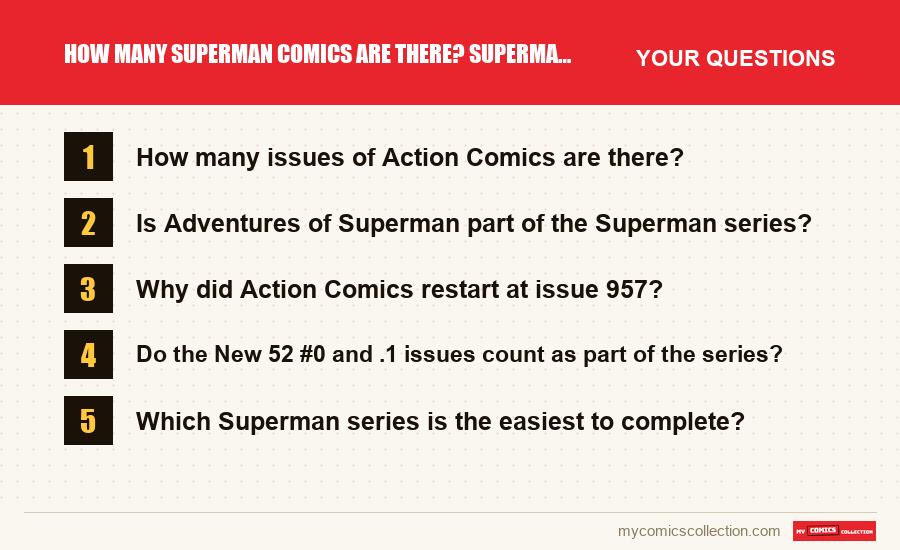
Between 1938 and 2011, the first series runs to #904 and adds an off-sequence #0 and #1,000,000. The New 52 add 52 more, then the historical numbering resumes at #957 in 2016 and reaches #1000 in 2018. The total therefore depends on which off-sequence issues you agree to count.
In terms of numbering, yes: it is the 1939 Superman title renamed, running from #424 to #649 between 1987 and 2006. In terms of the cover, it is a different title. It all depends on how you shelve your collection, by name or by continuous numbering.
Because in 2016 DC gave up the New 52 restart numbering and went back to the historical numbering. The first series has 904 issues, the second 52, which makes 956: the next issue is therefore #957. That is what lets the title reach #1000 in 2018.
They sit outside the main numbering. The 2011 Action Comics series has issues 1 to 52, plus a #0 and four issues from 23.1 to 23.4. A collector aiming for the regular run can skip them, while a completist will hunt for them separately.
Among the recent volumes, Superman: Son of Kal-El has eighteen issues and an annual, and the Brian Michael Bendis volume has thirty-two issues. These are the two shortest series on the list, so the quickest to put together as a first step.
Did you find an old issue of Superman or Action Comics? Get an estimate before deciding where to shelve it.
Estimate my comic