Collecting Action Comics realistically in 2026 involves targeting affordable runs (#200-600 at $5-30 per issue), modern key issues (#775, #858, #1000), and accepting that the first 100 issues (Golden Age) are out of reach for most budgets.
Action Comics is the longest uninterrupted comic book series in history, with more than 1,070 issues published since June 1938. Superman first appeared in Action Comics #1, making it the most historically significant series in the medium. But collecting Action Comics in its entirety is a daunting challenge, and potentially ruinous if you don't plan intelligently.
This guide offers a strategic approach to building a satisfying and coherent Action Comics collection, by identifying priority runs, accessible key issues and holes that are better to accept rather than spend the money to fill.
Breakdown by era: understanding the geography of Action Comics
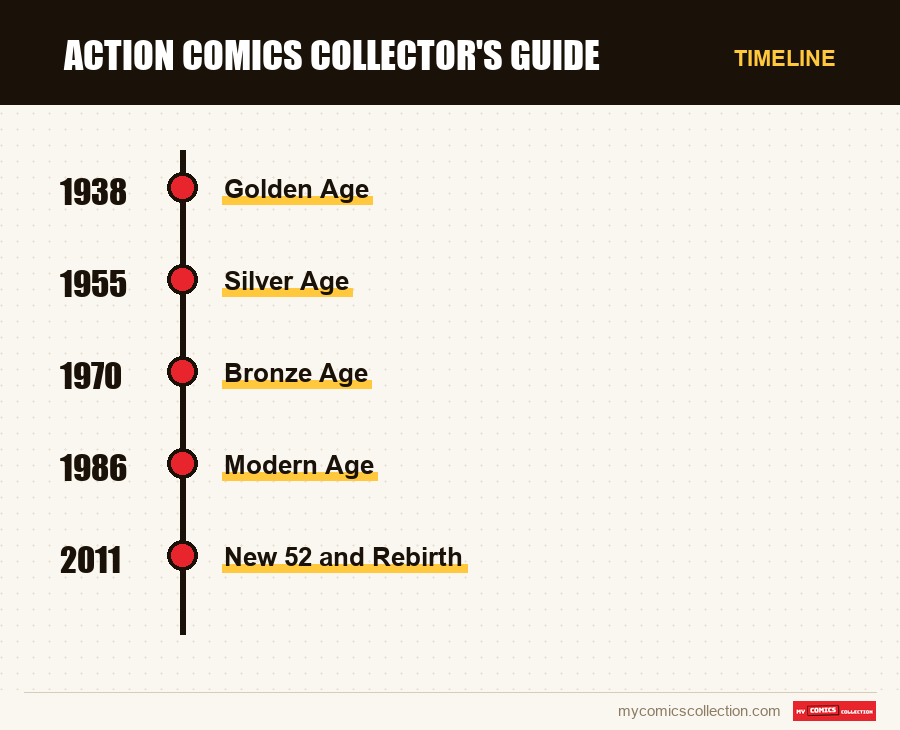
Golden Age (#1-200, 1938-1955)
The first 200 issues cover the Golden Age of Superman. Action Comics #1 (June 1938) is the most expensive comic in the world, with a record 6 million dollars in 2024 for a CGC 8.5. Even an incomplete copy without a cover can fetch $50,000. #2-50 are worth between $500 and $50,000 depending on condition and number.
For the vast majority of collectors, this era is inaccessible. The recommended strategy: acquire a few symbolic numbers in modest grades (2.0-4.0) if the budget allows, or settle for reproductions and TPBs to appreciate the content.
Silver Age (#201-400, 1955-1970)
The Silver Age of Action Comics offers a better accessibility/historicity ratio. Current numbers (#201-250) are between $20 and $80 in grade VG-FN. Notable key issues include:
Action Comics #242 (1958): First appearance of Brainiac and the Bottled City of Kandor. CGC 6.0: $2,000-3,000. CGC 4.0: $800-1,200.
Action Comics #252 (1959): First appearance of Supergirl (Kara Zor-El). CGC 6.0: $3,000-5,000. CGC 4.0: $1,500-2,500. A major key issue that benefits from the cinematic popularity of Supergirl.
Action Comics #340 (1966): First appearance of Parasite. CGC 9.0: $200-300. More accessible than the keys from the 50s.
Bronze Age (#401-583, 1970-1986)
The Bronze Age is the sweet spot for the Action Comics collector. Common numbers are between $3 and $15 in VF/NM, which allows you to quickly build complete runs. The key issues remain affordable:
Action Comics #484 (1978): Superman vs. Earth-2 doubles, classic cover. NM: $15-25.
Action Comics #521 (1981): First appearance of Vixen. CGC 9.8: $300-500. NM raw: $40-60.
Action Comics #583 (1986): “Whatever Happened to the Man of Tomorrow?” Part 2 by Alan Moore. CGC 9.8: $150-250.
Modern Age (#584-904, 1986-2011)
After John Byrne's reboot, Action Comics resumes at #584 with a new direction. The current numbers of this era are worth between $1 and $5, which allows you to complete entire runs for a few dozen dollars.
Action Comics #584 (1987): First post-Crisis issue by John Byrne. NM: $8-12.
Action Comics #775 (2001): "What's So Funny About Truth, Justice & the American Way?" by Joe Kelly. One of the best Superman stories ever written. CGC 9.8: $80-150. NM raw: $20-35.
Action Comics #812 (2004): First appearance of the new Supergirl (Kara) in Superman/Batman, but the buzz also benefits this era of Action Comics.
New 52 and Rebirth (#0-1070+, 2011-present)
Action Comics was renumbered to #1 in 2011 for the New 52 (by Grant Morrison), then returned to its historical numbering with #957 in 2016 (Rebirth). The number #1000 (2018) is a major milestone:
Action Comics #1000 (2018): Multiple variant covers. The main cover by Jim Lee trades at $15-25 in NM. Variant 1930s-1990s decade covers are worth $20-50 each. The Boutique Exclusive variant can reach $100-200.
Collecting this series?
Track what you own, what you are missing and what your collection is worth. 7 day trial.
Start my trial →Budget strategy: create a priority run
Here is a realistic approach for a budget of $500-2,000 spread over 12-24 months:
Phase 1 (months 1-6): Acquire Action Comics #584-700 as a bundle. These issues regularly sell in lots of 50-100 copies for $50-150 on eBay. You will get the Byrne run, the Stern run, and the start of the Jurgens run.
Phase 2 (months 7-12): Complete #700-904 and modern key issues (#775 in CGC, #1000 with selected variants).
Phase 3 (months 13-24): Go back to the Bronze Age, targeting #400-583. Buy in batches when possible, then fill in the gaps individually.
Phase 4 (long term): Target one or two Silver Age key issues in modest grade (Action Comics #252 in CGC 3.0-4.0, for example).
Acceptable gaps: knowing when not to buy
A smart collector accepts some holes in his collection rather than going broke:
Action Comics #1-50: Unless you have exceptional financial assets, these issues will never be part of your physical collection. No shame in replacing them with quality reprints.
Numbers in poor condition: Better a hole in the collection than a grade 0.5 copy that disintegrates. Wait for a copy in acceptable condition (3.0+) rather than buying anything to "check the box".
Speculative variants: Modern variant ratios (1:100, 1:500) are often overpriced upon release and lose 50% of their value in 6 months. Patience.
Tools to track your progress
With over 1,070 numbers, manual tracking is impossible. Use a collection management app that allows you to mark each number owned, identify missing ones and track the total value of your run. “Issue by issue” viewing is essential for a title as long as Action Comics.
Set quarterly goals (for example: “complete run #600-650 this quarter”) and celebrate each completed run. The satisfaction of seeing a progress bar go from 80% to 100% over a range of issues is one of the unique pleasures of collecting Action Comics.
Do you own Superman comics? Estimate the value of your collection for free to know their current rating.
Frequently Asked Questions
It is the longest uninterrupted comic series in history, with more than 1,070 issues published since June 1938. It was renumbered at #1 in 2011 for the New 52, then returned to its historical numbering with #957 in 2016.
Action Comics #1 (June 1938), where Superman first appears. Even an incomplete copy without a cover reaches very high sums: the Golden Age is out of reach for most budgets.
The Bronze Age (#401-583) is the best starting point: common issues are affordable and let you build complete runs quickly. The modern era (#584-904) also works for filling in cheaply.
Action Comics #775 (2001, "What's So Funny About Truth, Justice & the American Way?" by Joe Kelly) and #1000 (2018) are good markers. In the Silver Age, #242 (Brainiac and Kandor) and #252 (Supergirl) are the big keys.
No, a smart collector accepts some holes rather than going broke. The earliest Golden Age issues can be replaced by quality reprints, and it is better to wait for a copy in acceptable condition than to buy a degraded one.