How many Spider-Man comics are there beyond Amazing Spider-Man? We count nine main series devoted to Spider-Man since the 1968 magazine, and the longest is Peter Parker, the Spectacular Spider-Man followed by The Spectacular Spider-Man, with 263 issues from 1976 to 1998. The runs detailed below add up to 614 regular issues, not counting annuals and #-1 issues. The 2017 series switched to legacy numbering at its seventh issue, which became #297.
When people talk about collecting Spider-Man, they think first of the series that has carried his name since 1963. Yet hundreds of single issues came out alongside it: a second monthly magazine launched in 1976, a title that lived for ten years in the shadow of the first, the series handed to Todd McFarlane in 1990, and returns to the Sensational or Friendly Neighborhood brands. This guide lines them up one by one, in the order they started.
As always in this guide, only verified information (creators, issue numbers, dates) is stated as fact; the analysis is our own, with no reproduction of protected art or dialogue.
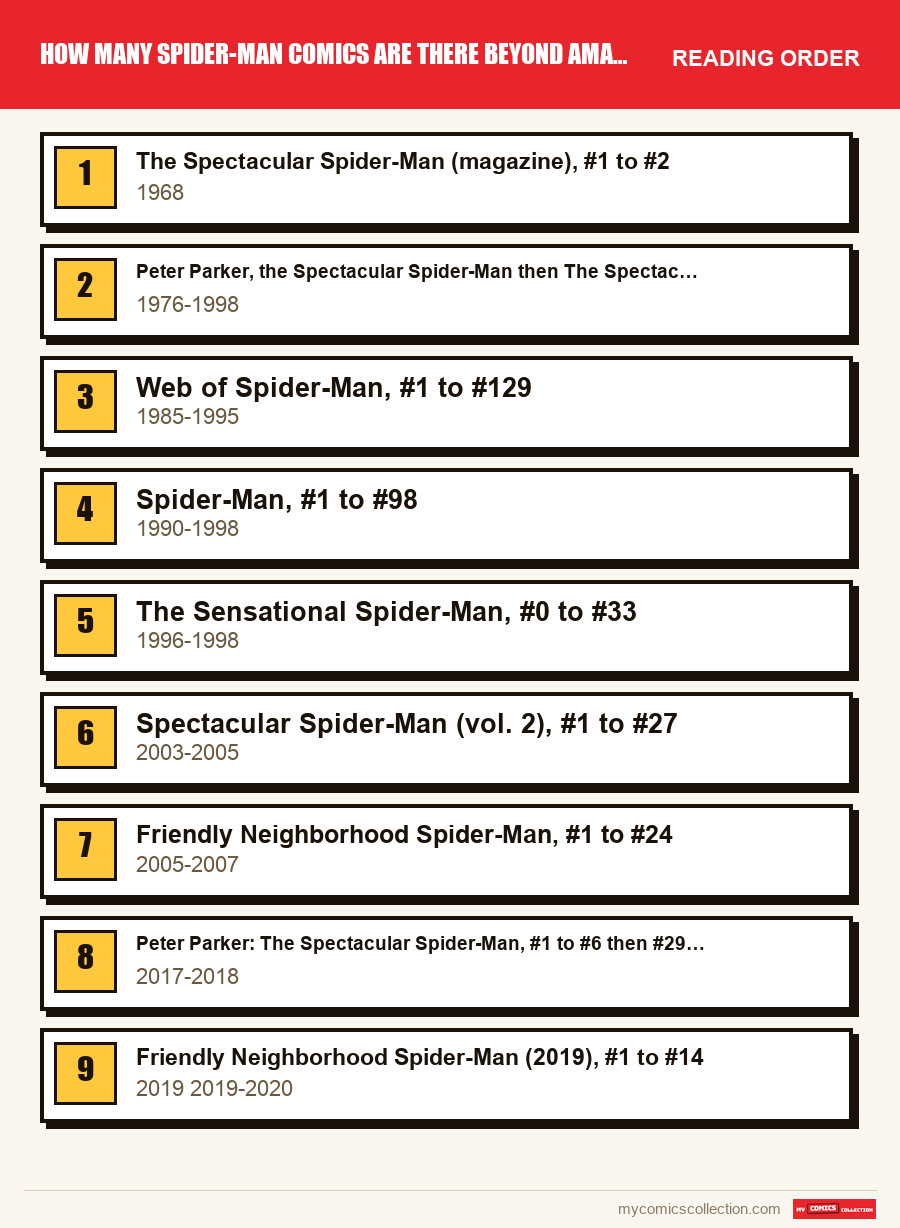
Series 1: The Spectacular Spider-Man (magazine), #1 to #2 (1968)
The shortest series in this guide is not a comic book in the usual sense. Two black-and-white issues, spread from July to November 1968 and both scripted by Stan Lee: that is the entire magazine. Its magazine format keeps it apart from the monthly series: it is part of the numbering of none of the series that follow.
For a collector, these two issues form a small chapter of their own. They already carry the title The Spectacular Spider-Man, the one the monthly series would take up twenty years later, which creates classic confusion when you enter an issue in an inventory: always check the format and the year before you validate a record.
Series 2: Peter Parker, the Spectacular Spider-Man then The Spectacular Spider-Man, #1 to #263 (1976-1998)
Launched in December 1976 by Gerry Conway, then the writer of Amazing Spider-Man, with Sal Buscema and Mike Esposito on art, this monthly series remains the longest of the Spider-Man spinoff series: 263 issues, plus a #-1 issue and fourteen annuals. Conway and Archie Goodwin share the writing until the summer of 1977, then Bill Mantlo settles in for several years.
The full title, Peter Parker, the Spectacular Spider-Man, stays in force through #133. With #134, dated January 1988, "Peter Parker" disappears from the cover and the series becomes The Spectacular Spider-Man. This switch does not reset the numbering: it is the same series, which is what matters for the total.
Roger Stern writes issues 43 to 61, in 1980 and 1981; Peter David writes from 1985 through #136, in 1988; Al Milgrom handles issues 90 to 100. Sal Buscema comes back to draw the series from early 1988 to late 1996. J. M. DeMatteis writes from mid-1991 to mid-1993 and then again until May 1998, and Luke Ross stays on the series until its end, in November 1998.
The series thus spans nearly twenty-two years under a single count, which makes it a uniform field for collecting: the 1976 issue #1 and the key issues each have their own dedicated page.
Series 3: Web of Spider-Man, #1 to #129 (1985-1995)
Web of Spider-Man runs from April 1985 to October 1995: 129 issues and ten annuals, from 1985 to 1994. Louise Simonson writes the first three issues, and Greg LaRocque draws the first four. The series changes writers often: Danny Fingeroth, David Michelinie, Peter David, then Gerry Conway on issues 50 to 70.
The most consistent artist is Alex Saviuk, present on a large share of issues 35 to 120, with Steven Butler at the end. In the middle of the decade, Terry Kavanagh holds the writing on issues 97 to 120, and then Todd DeZago finishes the series with issues 126 to 129.
Annual #2 brings together Ann Nocenti, Arthur Adams and Mike Mignola. After #129, the title is renamed Web of Scarlet Spider and restarts at #1: four issues appear before cancellation. A second volume of Web of Spider-Man also exists, twelve issues from December 2009 to November 2010, an anthology that replaces Amazing Spider-Man Family. We do not fold it into the main series, because its format is that of a collection of short stories; issue #1 has its own page.
Series 4: Spider-Man, #1 to #98 (1990-1998)
In August 1990, Todd McFarlane writes and draws Spider-Man #1, with the "Torment" arc. He stays in charge through #16, dated November 1991, an issue printed in landscape format. The series runs 98 issues, plus a #-1 issue inserted between #81 and #82, and ends in November 1998.
From #75, in December 1996, the cover reads Peter Parker: Spider-Man. The change affects only the cover: the postal indicia keeps Spider-Man through #98. In a database, therefore, enter the original title and note the cover subtitle in a comment.
For this series, our page on McFarlane and Spider-Man details the sought-after issues, and the creator has his own hub.
Series 5: The Sensational Spider-Man, #0 to #33 (1996-1998)
Launched in January 1996, The Sensational Spider-Man runs until November 1998. It comprises 35 issues: #0 through #33, plus a #-1 issue titled "Flashback," published in July 1997 between #17 and #18. Dan Jurgens writes issues 0 to 6, then Todd DeZago takes over from #7 to #33, with Mike Wieringo among the artists.
The #0 is a very real issue of the series: you have to count it if you want a complete total of regular issues. In our addition it is included, which gives 34 issues for the range #0 to #33. The #-1 issue stays outside the count.
This series should not be confused with Marvel Knights Spider-Man, which, in February 2006, with its #23, leaves the Marvel Knights imprint and becomes The Sensational Spider-Man (vol. 2). We do not count this second volume in the nine series, since we do not detail its runs.
Series 6: Spectacular Spider-Man (vol. 2), #1 to #27 (2003-2005)
Marvel brings the title back into circulation in September 2003, without the article "The." This second series lasts 27 issues until June 2005. Paul Jenkins writes everything, except for issues 23 to 26, by Samm Barnes. Humberto Ramos and Mark Buckingham are the main artists, while Damion Scott draws the "The Lizard's Tail" arc.
Its numbering restarts at 1 and poses no counting difficulty. It is a short series, one that collectors readily group with the Paul Jenkins era rather than with the 1976 run.
Do you collect this series?
Track what you own, what you are missing and what your collection is worth. 7-day trial.
Start my trial →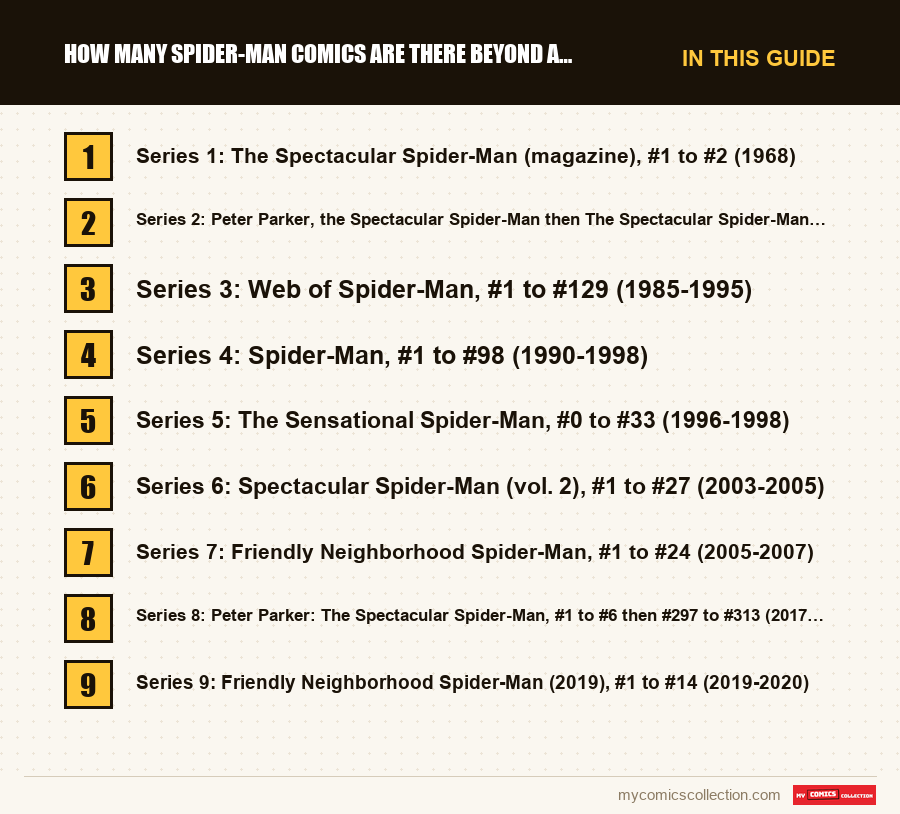
Series 7: Friendly Neighborhood Spider-Man, #1 to #24 (2005-2007)
This monthly series starts in late 2005 and lasts until November 2007: twenty-four issues, plus one annual. Peter David is the main writer, with Mike Wieringo then Todd Nauck among the series' artists. Count it among the series of that period when Spider-Man headlines several titles at once.
Series 8: Peter Parker: The Spectacular Spider-Man, #1 to #6 then #297 to #313 (2017-2018)
Chip Zdarsky launches this series in June 2017 with Adam Kubert on art, under the old full title. After six issues, it moves to legacy numbering as part of Marvel Legacy: the seventh issue carries #297. Zdarsky writes through #310, then Sean Ryan handles issues 311 to 313, the last three being tied to the Spider-Geddon event. The series ends in December 2018 with 23 issues and one annual. The creator has his own page.
Series 9: Friendly Neighborhood Spider-Man (2019), #1 to #14 (2019-2020)
The same title returns in March 2019 from the pen of Tom Taylor, with Juan Cabal on art. Fourteen issues appear through February 2020. For an inventory, note it as a volume distinct from the 2005 one, because the two #1 issues have nothing to do with each other.
Legacy numbering: the arithmetic of the total
The 2017 #297 is a cumulative number, and the math checks out: 263 issues for the 1976 to 1998 series, 27 for the 2003 to 2005 one and 6 for the start of the 2017 series add up to 296. The next issue therefore becomes #297, and the series then runs to #313. The 1968 magazine stays outside this count. Remember the lesson: a high number on a cover does not tell you how many single issues actually came out under one title.
Here is the full addition of the runs written above: 2 + 263 + 129 + 98 + 34 + 27 + 24 + 23 + 14 = 614 regular issues, with the 2017 series counting for 6 + 17 = 23 single issues. It excludes the #-1 issues (one each in series 2, 4 and 5), the annuals and the four issues of Web of Scarlet Spider.
Annuals and spinoff series
Annuals count as a chapter of their own. The 1976 series has fourteen, Web of Spider-Man ten, from 1985 to 1994. We do not detail those of the other series and make no claim to be exhaustive. Depending on whether you add them or not, the total changes noticeably: always write in your inventory whether your figure includes them.
Spinoff series, such as Web of Scarlet Spider or the second Web of Spider-Man of 2009-2010, are shelved separately. For the other titles of the Spider-Man universe, see the history of Spider-Man in comics.
Completing the run: where to start
Do not try to complete ten series at once. Pick an era: the years 1976 to 1998 for the Conway series, or the 1990s for the McFarlane period. Then draw up the list of missing issues from the runs of each series, marking the #0 and #-1 issues separately.
Start with the ordinary issues, which are the easiest to find, then tackle the annuals. Leave the #1 issues and those that carry an event for last. Before you buy, check the exact title and volume: two #1 issues of Friendly Neighborhood Spider-Man exist, and a 1968 issue carries the title The Spectacular Spider-Man. For the reading itself, the reading guide gives an order; for an overview, the blog gathers our other features.
Frequently asked questions
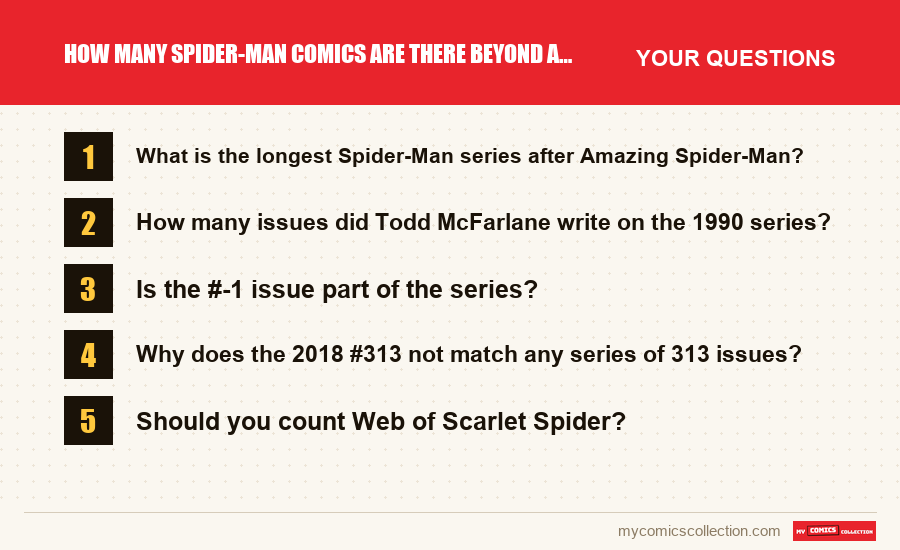
Among those we detail, it is Peter Parker, the Spectacular Spider-Man, which became The Spectacular Spider-Man at #134: 263 issues from December 1976 to November 1998, with a #-1 issue and fourteen annuals. Web of Spider-Man follows with 129 issues, ahead of the 1990 Spider-Man and its 98 issues.
Todd McFarlane wrote and drew Spider-Man from #1, in August 1990, through #16, dated November 1991. The series then continues to #98, in November 1998, with other teams. Issue #16 is printed in landscape format.
It is a special issue slotted into three series in this guide: the 1976 series has one #-1 issue, Spider-Man places one between #81 and #82, and Sensational in July 1997 between #17 and #18. It does not enter our totals, but you need to hunt for it if you want a run with no gaps.
Because it is a cumulative number. The 263 issues from 1976 to 1998, the 27 from 2003 to 2005 and the first six of the 2017 series add up to 296: the series then resumes at #297 and stops at #313, for 23 single issues in all. The cover therefore gives you a numbering marker, not a count of single issues published under one title.
This four-issue series continues Web of Spider-Man after #129, in October 1995, with numbering restarted at #1. We leave it out of the main addition, because it changes title and restarts from zero, but a detailed inventory can shelve it next to the series it came from.
Your Spider-Man issues beyond Amazing, from the 1968 magazine to the 1990s series, deserve a precise estimate before resale.
Estimate my comic