How many Detective Comics issues are there? Detective Comics began in March 1937 and runs through two volumes: #1 to #881 until 2011, then #1 to #52 in the New 52 era. In 2016, DC restored the historic counter with a #934, which is 881 plus 52 plus one. Issue #1000 came out on March 27, 2019, and #1075 carries a December 2023 date.
Few titles can claim numbering as continuous as Detective Comics. The magazine even gave its name to the publisher: DC stands for Detective Comics. This article follows its counter from #1 to today, explains why a detour back to #1 in 2011 did not prevent the return to the historic number, and shows how to set up the right addition before starting a collection.
As always in this guide, only verified information (creators, issue numbers, dates) is stated as fact; the analysis is our own, with no reproduction of protected art or dialogue.
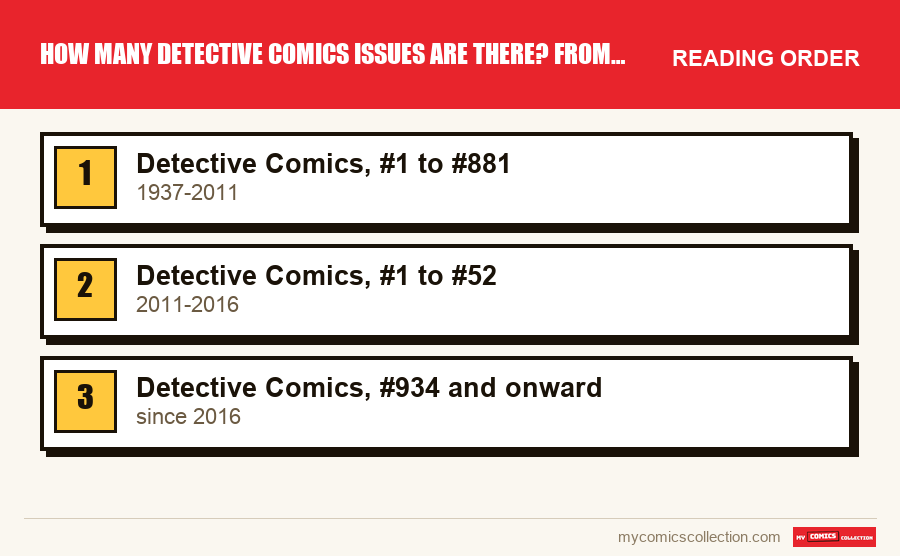
Series 1: Detective Comics, #1 to #881 (1937-2011)
Issue #1 dates from March 1937. Vin Sullivan was its first editor, and the magazine then gathered a variety of crime stories. Batman only arrives with #27: the issue came out in March 1939 under a May cover date, and its lead story is credited to Bill Finger on script and Bob Kane on art. Our page on #27 and the first appearance of Batman details this issue and its importance for collectors.
The first volume ends in October 2011 with #881, when DC launches its New 52. It includes twelve annuals, counted separately. Catalogs sometimes add the #0 and the #1,000,000, which brings the list to 883 entries: this is the first place where two different "totals" coexist for a single volume.
More than seventy years of history fit into this counter. From #471 to #476, between 1977 and 1978, for example, Steve Englehart and Marshall Rogers give the title one of its most famous stretches, which includes the Joker story titled The Laughing Fish, covered by our page on #475 and the Laughing Fish. The same volume also houses older milestones, such as #38, where Robin makes his entrance, presented on our page dedicated to Robin.
These landmarks are enough to show that this volume cannot be read in one sitting: between the #1 of 1937, the #27 of 1939 and the #881 of 2011, three ages of American publishing follow one another, each with its own format, page count and market.
One last word on this first volume: it contains the oldest annuals of the lineage, and it is also the one targeted by most searches for a full completion. Counting it properly means separating the regular run, the out-of-sequence issues and the annuals, without mixing the three columns.
Keep in mind, too, that this first volume serves as the foundation of every later count: the 2016 restart builds on its final boundary, #881. If that number were disputed, the whole addition that follows would shift with it, which is why it pays to note it clearly at the top of your inventory before attaching the following volumes.
Series 2: Detective Comics, #1 to #52 (2011-2016)
In September 2011, Detective Comics restarts at #1 as part of the New 52. Tony Daniel writes and draws the first twelve issues. From #13, John Layman takes over the script and Jason Fabok the art. Both then leave the series to work on Batman Eternal, and Brian Buccellato and Francis Manapul take over the title.
The second volume has fifty-two regular issues, from #1 to #52. It also contains a #0 and four issues numbered 23.1 to 23.4, as well as three annuals. It ends in July 2016, just as the DC Rebirth program reshuffles the deck.
This is the volume that makes the math interesting: every collector of the continuous series must first decide whether these fifty-two single issues, published under a different counter, belong in their journey. They were officially folded back into the 2016 numbering, as the next section explains.
Series 3: Detective Comics, #934 and onward (since 2016)
In June 2016, under the DC Rebirth banner, Detective Comics returns to the historic numbering with a #934. The calculation is clear: 881 issues from the first volume, 52 from the second, so 933, and the next one is called #934. The .1 to .4 issues and the #0 are not part of this addition.
James Tynion IV writes the start of this third cycle, from #934 to #981 in May 2018; Eddy Barrows and Alvaro Martinez draw its first issues. Since #934, the title has come out twice a month, with a weekly stretch from #1047 to #1058.
Issue #1000 came out on March 27, 2019, in the middle of the celebration of Batman's eightieth anniversary. This 160-page issue brings together several creators around the character. Peter Tomasi is then the regular writer from #994 in December 2018 to #1033 in December 2020, which means his work spills over on both sides of the milestone. Mariko Tamaki succeeds him from #1034 under the Infinite Frontier label, then Ram V and Rafael Albuquerque are announced in April 2022 for #1062. As for #1075, it carries a cover date of December 2023.
A few boundaries translate into reading volumes. The Tynion run covers forty-eight issues, from #934 to #981. Tomasi's, from #994 to #1033, represents forty. The weekly stretch from #1047 to #1058 gathers twelve. Between #934 and #1000, there are sixty-seven single issues; between #934 and #1075, one hundred and forty-two. These small calculations help plan a purchase in blocks rather than issue by issue.
To frame the collection from a practical standpoint, our collecting guide to Detective Comics helps you choose between the eras before filling the gaps.
The writer handoffs of this period follow a readable pattern: Tynion from #934 to #981, Tomasi from #994, Mariko Tamaki from #1034, then Ram V with Rafael Albuquerque from #1062. Between #981 and #994, twelve issues entrusted to other teams are slotted in. For a collector, remembering these boundaries amounts to having a reading plan in blocks, each tied to an identifiable creative team.
Do you collect this series?
Track what you own, what you are missing and what your collection is worth. 7-day trial.
Start my trial →
Legacy numbering: the arithmetic of the total
The 2016 rule is simple to state but worth setting down in black and white, because it explains why a #934 from 2016 is not an issue of the second volume.
- First volume, #1 to #881: 881 regular issues.
- Second volume, #1 to #52: 52 regular issues.
- 2016 numbering: 881 plus 52 makes 933, so the next issue carries the number 934.
- Out-of-sequence issues: the #0 and the #1,000,000 for the first volume, the #0 and the .1 to .4 for the second. They are excluded from the legacy calculation, even though they do exist on the newsstand.
In other words, the #1000 of 2019 is indeed the thousandth issue of the lineage as reconstructed, even though the 52 issues of the second volume carry a different counter on the cover. And the line you write down for an inventory depends on what you decide to keep: 881 for the first volume alone, 933 for the two volumes in sequence, or 883 if you add the out-of-sequence issues of the first volume.
The check is easy: 881 plus 52 plus 142 makes 1075, the December 2023 issue, because the restored lineage counts 142 single issues from #934 to #1075 inclusive. If you follow only the restored lineage, the total is therefore calculated by subtraction, the high boundary minus 933, which saves you from recounting the first two volumes with every new release.
The point to watch for the buyer is dating: a #1 from 2011 and a #1 from 1937 have nothing in common, and a #934 matters mostly as the relaunch issue of the historic numbering.
Annuals and spin-off series
The first volume of Detective Comics has twelve annuals, the second three. The restored numbering period has five. They do not fit into the main sequence and deserve their own column in an inventory spreadsheet.
A family of titles has grown around the main series: Batman, which has its own counter and its own relaunches, but also series devoted to the family of characters, such as Batgirl, whose first appearance is in #359 (see our page on the first appearance of Batgirl). We make no claim to be exhaustive: each spin-off series has its own boundaries and is counted separately.
Some stories are also serialized across several titles at once. In that case, the safest course is to rely on the published reading order rather than on the issue boundary alone.
Completing the series: where to begin
The main challenge of Detective Comics is its sheer size. Here is a method that avoids the common mistakes.
- Break the series into three blocks: #1 to #881, the second volume from #1 to #52, then the restored lineage from #934. Each block has its own pace, its own search costs and its own difficulties.
- Start with the block you can finish. The second volume is the most compact, and the recent lineage is easier to find than the older releases.
- Set aside the key issues: #1, #27 and #38 belong to a market of their own, and it is better to treat them as goals separate from the ongoing series.
- Decide as soon as you open your spreadsheet what to do with the #0, #1,000,000 and .1 to .4 issues of each volume, then stick to it.
- Note the cover date and the volume of each copy: a #1 can mean two very different objects.
One last precaution concerns reprints: a collected edition that reprints issues of the series does not replace the single issues in your grid. To mix single issues and trade paperbacks, plan a column dedicated to format: each row then points to a specific object, and your real gaps show up clearly.
You will find in the Batman hub the other series to consider in parallel, especially if you want to follow the character beyond this single title.
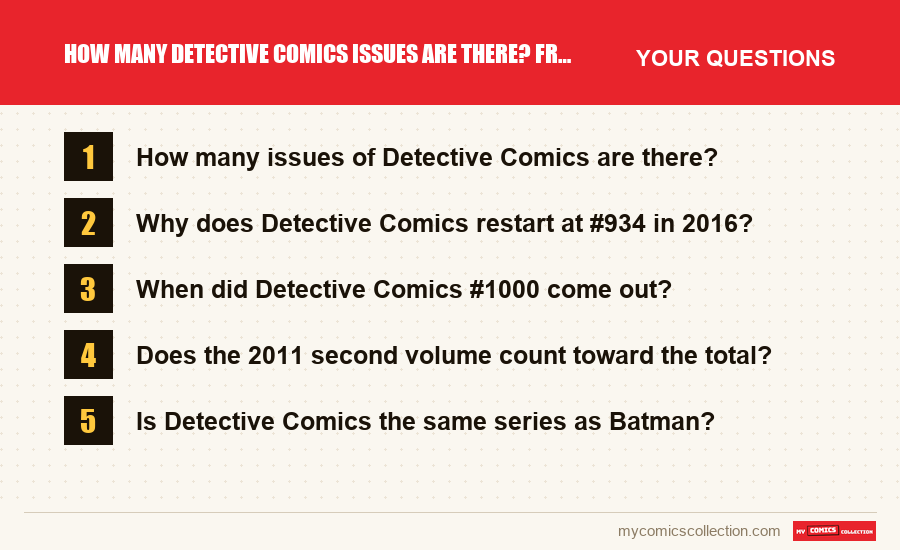
Frequently asked questions
The first volume has 881 regular issues, from #1 in 1937 to #881 in 2011. The second has 52, from #1 to #52. In 2016, DC resumes the historic numbering at #934 (881 plus 52 plus one); #1000 comes out in 2019 and #1075 in December 2023. Annuals are counted separately.
Because DC added the 881 issues of the first volume and the 52 of the second launched with the New 52, which makes 933, and gave the next issue the number 934. The DC Rebirth program thus restored the historic numbering without erasing the fifty-two single issues from 2011 to 2016.
On March 27, 2019, for Batman's eightieth anniversary, whose first appearance goes back to #27 in 1939. This 160-page issue brings together several creators. Peter Tomasi had been the series' regular writer since #994 in December 2018.
Yes, for its fifty-two regular issues: they are folded into the 2016 numbering, which jumps from 881 to 934 by including them. The #0 and issues 23.1 to 23.4 of this volume stay outside that addition, and you decide whether or not to add them to your own list.
No. Detective Comics dates from 1937 and its #27 sees Batman born in 1939, while the Batman series starts in 1940 with its own counter. Completing one does not complete the other; their volumes, relaunches and annuals are counted separately.
Is an older Detective Comics or an issue from the lineage restored in 2016 sitting in your collection? Get a first estimate.
Estimate my comic