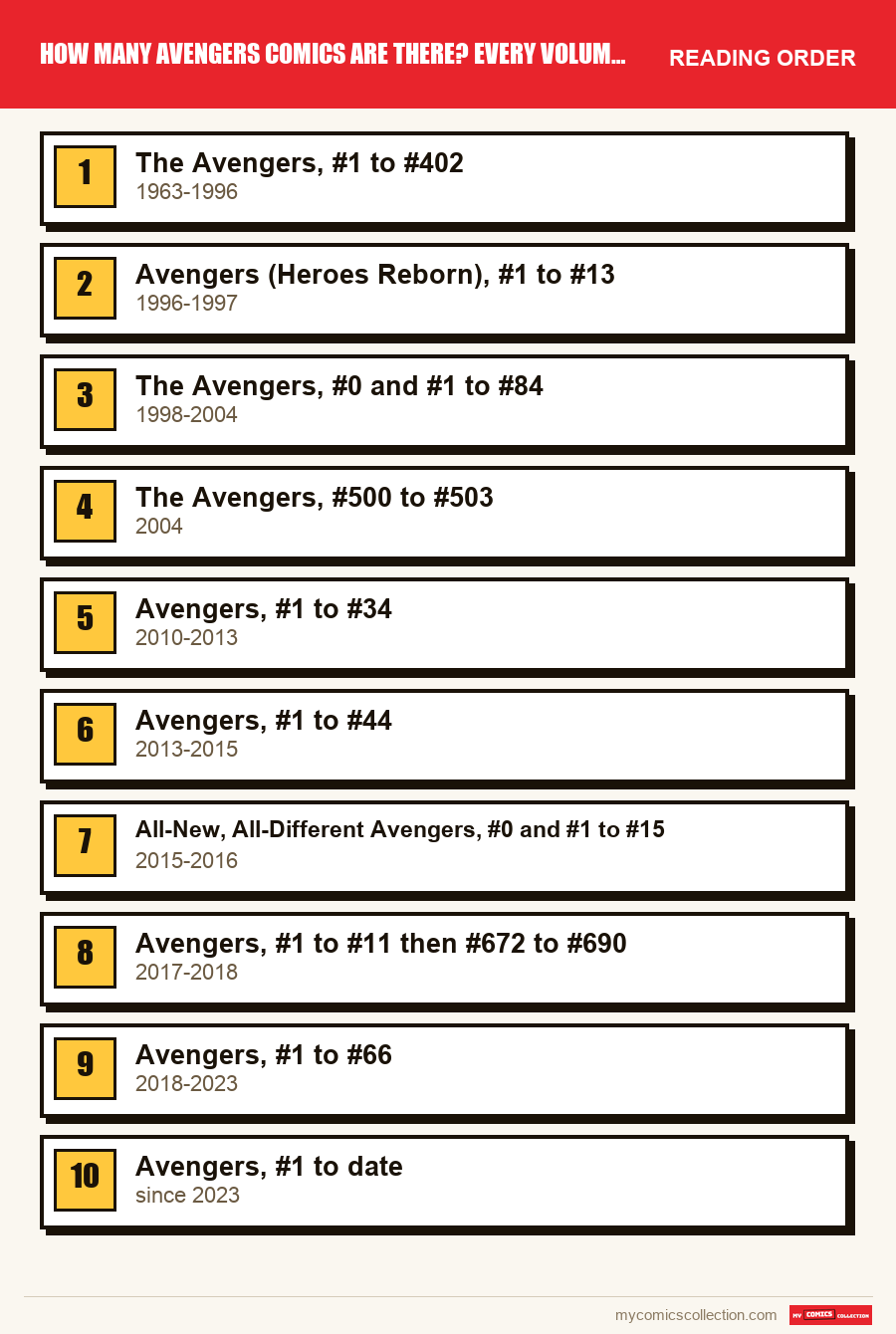
How many Avengers comics are there? We count nine volumes of the main series since September 1963, from The Avengers #1 to the volume launched in 2023, plus the 2004 return of #500 to #503: ten successive blocks. The longest is the first, from #1 to #402. The 2017 volume switches to legacy numbering partway through, from #672 to #690; annuals, #0 issues and .1 issues are left out of the count.
Asking how many Avengers comics exist means asking three questions at once: how many volumes, how many issues per volume, and how far you extend the family of titles. Between 1963 and today, the series has been interrupted, relaunched in a parallel universe, renamed, renumbered and then put back on its historical track: the count on your shelf almost never matches the one on the cover.
As always in this guide, only verified information (creators, issue numbers, dates) is stated as fact; the analysis is our own, with no reproduction of protected pages or dialogue.
Series 1: The Avengers, #1 to #402 (1963-1996)
The series was born in September 1963. Stan Lee wrote the first thirty-four issues, Jack Kirby drew the first eight, and then Don Heck and John Buscema took over. Roy Thomas succeeded him as writer from #35 to #104, a stretch that makes him the keeper of the first era: under his pen the team's lineup was renewed in a lasting way.
The rest of this volume is a parade of writers: Steve Englehart, Jim Shooter, Roger Stern, John Byrne, Bob Harras and then Terry Kavanagh. George Pérez, Steve Epting and Mike Deodato are among the artists who left their mark on it. The volume ends at #402 in September 1996 and has twenty-three annuals, which we set aside.
With its four hundred and two issues, this volume remains the longest block of the whole lineage: on its own, it weighs more than the other eight blocks combined, annuals excluded. The sum is simple: 13, 84, 4, 34, 44, 15, 30 and 66 give 290 issues for all the other blocks, without the 2023 volume. Compared with a series of the same age, it is a long-haul project, best planned by writer eras rather than by single issues.
If you are interested in the opening of the collection, the 1963 first issue and the analysis of the original series give the editorial context.
Series 2: Avengers (Heroes Reborn), #1 to #13 (1996-1997)
In November 1996, Marvel handed the Avengers to outside creative teams as part of Heroes Reborn. The thirteen issues take place in a recreated universe rather than in the usual continuity. Rob Liefeld and Jim Valentino launched the story, then Jeph Loeb wrote issues 2 to 7, Walt Simonson issues 8 to 12 and James Robinson #13, with Liefeld, Chap Yaep, Ian Churchill and Michael Ryan on art.
The series stopped in November 1997, when the characters returned to the main universe. It still counts toward the legacy count, which explains what follows: the next volume continues a total that includes these thirteen issues. Our Heroes Reborn reading order covers the event in detail.
Series 3: The Avengers, #0 and #1 to #84 (1998-2004)
February 1998: The Avengers started over at #1 with Kurt Busiek writing and George Pérez drawing. Busiek wrote #0 and most of issues 1 to 56, Pérez drew the majority of issues 1 to 34, and Jerry Ordway drew issues 16 to 18. Geoff Johns then took issues 57 to 76 and Chuck Austen issues 77 to 84, with Stuart Immonen, Alan Davis, Olivier Coipel and Kieron Dwyer among the artists.
The volume ends in August 2004 at #84, with four annuals. The covers also show the historical numbering, that of the 1963 lineage, and this mechanism is what sets up the return to #500. The volume serves as a bridge between the old series and Bendis's relaunches: Busiek and Pérez reinstalled the classic figures there, while Johns and Austen prepared the scattering of the team.
Series 4: The Avengers, #500 to #503 (2004)
In September 2004, the series resumed its original numbering with #500. Brian Michael Bendis wrote all four issues, #500 to #503, and David Finch drew them. This is the finale known as Avengers Disassembled, which dissolves the team and opens the way for Bendis's new titles. Our Avengers Disassembled reading order gives the chronology.
These four issues count as the end of the historical volume: add them to the first volume, from #1 to #402, and you get a chain that runs up to #503 with a gap in the numbers, from #403 to #499, which series 2 and 3 fill.
Series 5: Avengers, #1 to #34 (2010-2013)
After New Avengers, Mighty Avengers, Dark Avengers and Avengers: The Initiative ended in 2010, Marvel launched a single new title. It starts in July 2010 and ends in January 2013, with thirty-four issues plus #12.1 and #24.1 and one annual. Bendis wrote the whole run, John Romita Jr. drew the launch, joined by Daniel Acuña, Walt Simonson and Brandon Peterson.
This is the volume of the transition period: the team gets its central figures back there, and single-digit numbering replaces the historical landmarks.
Series 6: Avengers, #1 to #44 (2013-2015)
The February 2013 launch handed the series to Jonathan Hickman, who wrote it from #1 to #44, with Nick Spencer on issues 12 to 17. Jerome Opeña opened the series; Adam Kubert, Mike Deodato and Salvador Larroca drew the following eras. The volume stops in June 2015 and includes two intermediate issues, #34.1 and #34.2, plus one annual.
Fans of Hickman's work will find in the key issues of his run the landmarks to watch for before completing this block.
Series 7: All-New, All-Different Avengers, #0 and #1 to #15 (2015-2016)
As part of the late 2015 relaunch, the series took the title All-New, All-Different Avengers. It runs from December 2015 to December 2016, with a #0, fifteen regular issues and one annual. Mark Waid wrote the whole run; Mahmud Asrar and Adam Kubert drew it.
The brevity of this volume makes it an easy block to complete, as long as you do not forget the #0, which many lists overlook.
Do you collect this series?
Track what you own, what you are missing and what your collection is worth. 7-day trial.
Start my trial →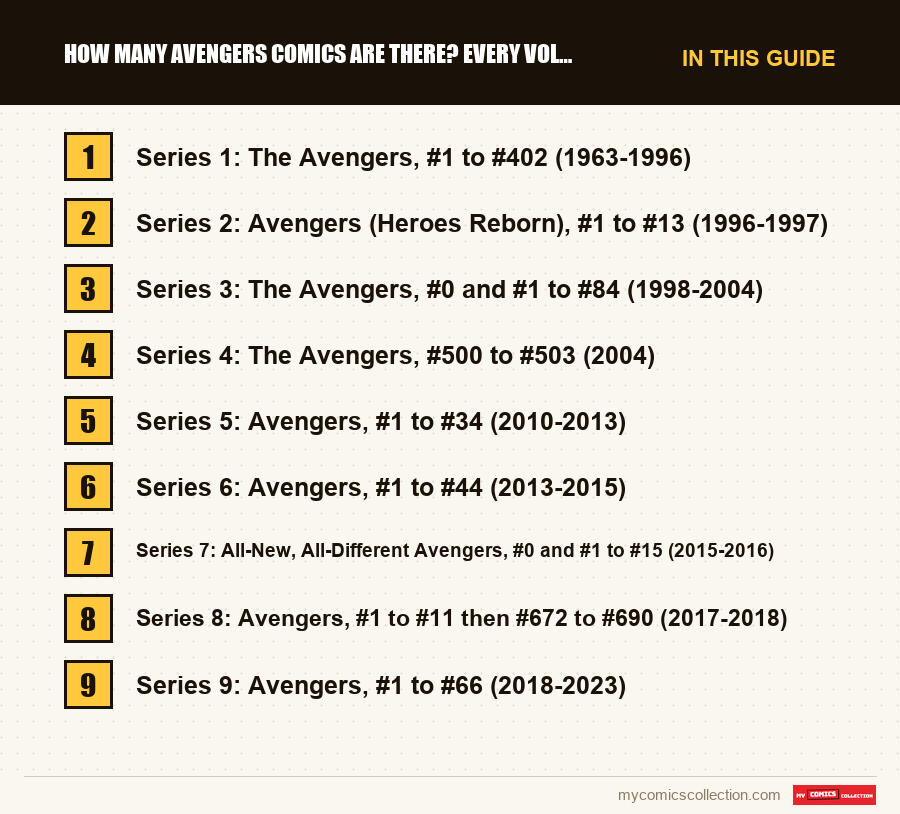
Series 8: Avengers, #1 to #11 then #672 to #690 (2017-2018)
January 2017: new volume, new #1, still under Mark Waid's pen. It continues until June 2018. Mike del Mundo drew most of the early issues, Phil Noto drew #7 and #8, and Barry Kitson and Mark Bagley drew the .1 issues.
With the 2017 Marvel Legacy relaunch, the volume drops its own numbering after #11 and continues straight on at #672, up to #690. These nineteen issues are new single issues, not a second label stuck on #1 to #11: the volume therefore has thirty regular issues, plus five .1 issues, from #1.1 to #5.1, and a #1.MU.
Series 9: Avengers, #1 to #66 (2018-2023)
In July 2018, Jason Aaron launched a new volume with Ed McGuinness on art. He wrote it for sixty-six issues, until May 2023, with David Marquez, Javier Garrón and Ivan Fiorelli among the artists. The boundary is clear: from #1 to #66, that is sixty-six single issues by one writer, more than Hickman's forty-four.
Series 10: Avengers, #1 to date (since 2023)
The last volume we track starts in July 2023 with Jed MacKay writing and Carlos Villa drawing, joined by Ivan Fiorelli on issues 5 and 6. Its first arcs have been collected in trade paperbacks: The Impossible City for issues 1 to 6, Twilight Dreaming for issues 7 to 11, Blood Hunt for issues 12 to 16 and Storm for issues 17 to 23. Since the volume is still ongoing, we do not give it a final boundary.
Legacy numbering: the arithmetic of the total
The calculation that justifies #500 fits in one line: 402 issues of the historical volume, plus 13 of Heroes Reborn, plus 84 of the 1998 volume, make 499, so the next issue is called #500. Annuals and the #0 do not count in this sum.
If we now add up the boundaries of this guide, 402, 13, 84 and 4 for issues 500 to 503 make 503 regular issues up to 2004. You then add 34, 44, 15, 30 (11 plus the 19 issues from #672 to #690) and 66 for the following volumes, for 692 regular issues in total, without the 2023 volume that is still open. This figure excludes the two #0 issues, the intermediate issues (#12.1, #24.1, #34.1, #34.2, #1.1 to #5.1, #1.MU) and all the annuals: it moves by several dozen depending on what you accept.
Legacy numbering was used a second time from #672 to #690 during the Legacy phase, this time without a double counter: these single issues carry only their historical number. To shelve them, attach them to the 2017 volume, right after #11.
Annuals and spinoff series
The first volume produced twenty-three annuals, the 1998 volume four, then one annual for each of the 2010, 2013 and 2015 volumes. They serve as ground for stories that are sometimes important: our guide to the key annuals and specials lists several.
Around the main series orbit New Avengers, Mighty Avengers, Dark Avengers, Avengers: The Initiative, and also West Coast Avengers. For a collector, the trap lies in the neighboring titles: New Avengers has several volumes, and the name Avengers turns up in series of very different formats. These titles have their own numbering and do not add up to that of the parent series; we do not claim to give an exhaustive list. The New Avengers volumes and their equivalents are better shelved in a separate section.
Completing the series: where to start
The simplest approach is to decide on a boundary before you look for anything: a collection by volume, or a collection by creative team. The modern volumes, from #1 to #34 for the 2010 one or from #1 to #44 for the 2013 one, are completed quickly and give a first feeling of achievement. Keep the historical volume for last: it is long, and its oldest issues are the ones where condition and authenticity call for the most checking.
Keep a two-column table: the regular issues of each volume on one side, the #0 issues, the .1 issues and the annuals on the other. Before buying, compare the printed number and the cover year with the catalog entry. The Avengers collecting guide and the major artists of the series help you decide which block to start your search with.
Frequently asked questions
Nine volumes of the main series since 1963, from the first volume to the one launched in 2023, plus issues #500 to #503 from 2004, which extend the first. Spinoff titles, such as New Avengers or Mighty Avengers, are separate series and are not counted here.
The math is simple: the 1963 volume stops at #402, Heroes Reborn adds thirteen issues and the 1998 volume eighty-four, which leads to #499. The next issue is therefore called #500, in September 2004, with Brian Michael Bendis and David Finch on the story that scattered the team.
Yes. During the Marvel Legacy period, the 2017 volume goes from #11 to #672 and continues up to #690 in June 2018: these are nineteen new single issues, which are added to the first eleven issues of the same volume.
They are shelved in a separate list: twenty-three for the 1963 volume, four for the 1998 one. Consider the series complete when all the regular issues are there, then pick the annuals one by one, based on the story they tell and the room you have left.
The 2015-2016 volume, from #1 to #15 with its #0, is finished in a few purchases; the 2017-2018 one, from #1 to #11 then from #672 to #690, takes thirty. The volumes by Jonathan Hickman, from #1 to #44, and by Jason Aaron, from #1 to #66, take more patience but remain far from the four hundred and two issues of the 1963 volume.
Once you have identified your Avengers volumes, get an estimate for the copy you own or are being offered.
Estimate my comic