The Heroes Reborn (1996) reading order covers all four series in order: Avengers, Captain America, Fantastic Four and Iron Man, 12 issues each, published in 1996 and 1997 by the studios of Jim Lee and Rob Liefeld, plus a 13th and final issue by James Robinson in every title. Read the end of Onslaught first, then the four series in parallel, month by month, and finish with Heroes Reborn: The Return by Peter David and Salvador Larroca.
In 1996, Marvel handed four of its flagship titles to the studios of Jim Lee and Rob Liefeld, two artists who had left the company to found Image Comics. The result is one of the most debated moves in the publisher's history, and a headache for today's reader: four parallel series, creative teams that change along the way, satellite one-shots, a final crossover and a return to the main universe to piece together. This article is your road map.
As always in this guide, we state only verified information (creators, issue numbers, dates); the analysis is our own, with no reproduction of protected pages or dialogue.
What to read first
The starting point is not a series but an event: Heroes Reborn grows out of the battle against Onslaught. In the story, young Franklin Richards unwittingly carries the heroes involved into a pocket universe during that fight, which is why the four series start from scratch, with no continuity from what came before. So there is no strict editorial prerequisite, but a few reference points help you gauge the gap.
- The end of the Onslaught crossover, which sets the stage: our Onslaught reading order walks through the issues to read in sequence.
- The Mark Waid and Ron Garney run on Captain America, which the 1996 version abruptly replaces: the contrast says a lot about the editorial gamble.
- An earlier series of your choice among Avengers, Fantastic Four and Iron Man, only if you want to compare the tone before and after.
A reader who only knows the movies can start right away with issue #1 of each series: the story presents itself as a fresh start, with its own versions of the characters.
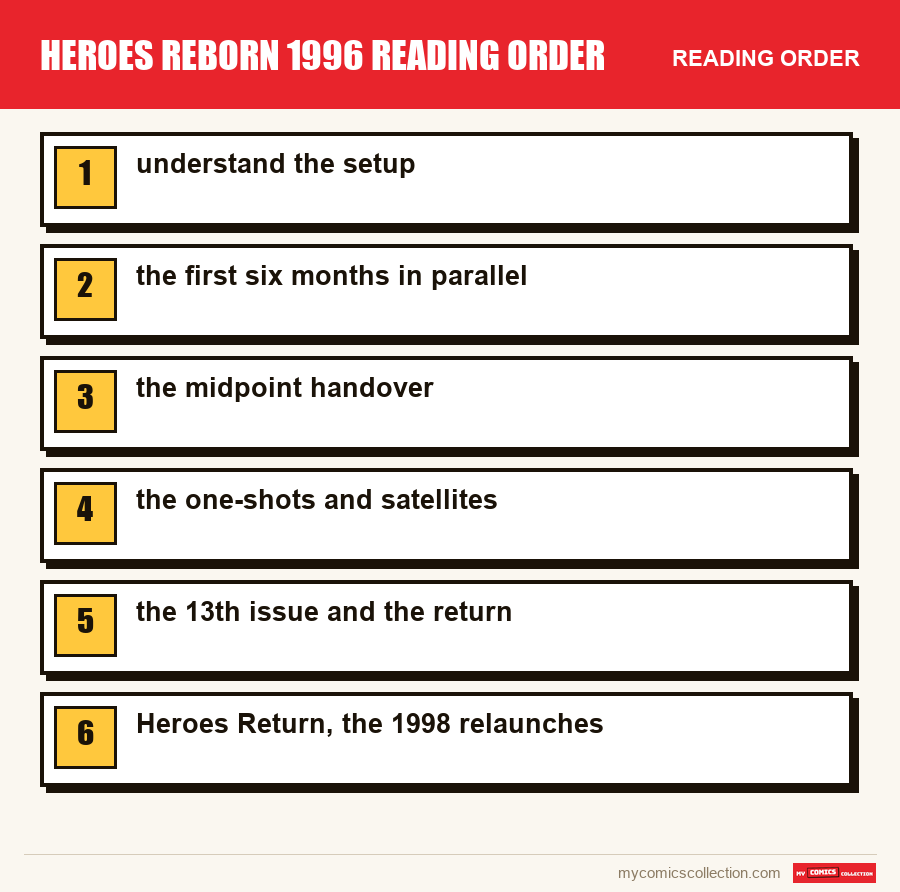
Phase 1: understand the setup
Before opening an issue, keep the architecture of the whole operation in mind. Marvel outsources four series to outside studios: Jim Lee's WildStorm studio produces Fantastic Four and Iron Man, while Rob Liefeld's Extreme Studios produces Captain America and Avengers. Each series was meant to run 12 issues. All four titles are "volume 2" series: their numbering restarts at 1, so check the volume carefully on labels and in catalogs.
Two opening issues complete the setup: Heroes Reborn #1/2, then the one-shot Marvel Spotlight: Heroes Reborn/Onslaught Reborn #1, which extends the adventure. They are not essential to follow the story, but they belong to the complete collection. The four series each run on their own for twelve months; all the titles come together only in the last issue, with the "World War III" crossover described in Phase 5.
Phase 2: the first six months in parallel
Read issues #1 to #6 of the four series by alternating, rather than one series after another. That is the original publication rhythm, and it is how you pick up the links between the titles. Here is what each team delivers in this phase.
- Fantastic Four (vol. 2) #1 to #6: the flagship series of Jim Lee's WildStorm studio; these six issues alone make up the first collected edition, from 2000.
- Iron Man (vol. 2) #1 to #6: the second title entrusted to WildStorm, which reinvents Tony Stark in the pocket universe.
- Captain America (vol. 2) #1 to #6: plots by Rob Liefeld, script by Jeph Loeb, for Extreme Studios.
- Avengers (vol. 2) #1 to #6: plots by Rob Liefeld; Jeph Loeb writes the dialogue for issues #4 to #7, drawn by Chap Yaep and Ian Churchill.
These six months show the studios' approach most clearly: highly stylized art, exaggerated silhouettes, pages with few panels. Whether you like it or not, this first half shows what Marvel wanted when it went to these two studios, in a market then heavily driven by launches and relaunches.
Phase 3: the midpoint handover
At the midpoint, the structure changes. Marvel ends Rob Liefeld's contract after six issues, citing disappointing sales, and hands his two series to Jim Lee's studio. Walt Simonson then takes over Avengers, which moves to WildStorm. For the reader, the consequence is simple: in their second half, Captain America and Avengers are finished by a different hand than the one that launched them.
So read issues #7 to #12 of each series, still alternating. The switch is a good moment to look at the covers: they show how much the visual direction shifts from one issue to the next. On Avengers, the move to Walt Simonson is the most visible change, since the series leaves Rob Liefeld's studio for Jim Lee's.
Phase 4: the one-shots and satellites
Several one-shots orbit the four series. There are seven: Ashema, Doom, Doomsday, Masters of Evil, Rebel, Remnants and Young Allies, all numbered #1 and collected in 2009 in the trade paperback Heroes Reborn: The Return. They broaden the pocket universe by giving a place to characters without a dedicated series, such as the Avengers' enemies or the younger generation of heroes.
Slot them in where the theme calls for it rather than at a precise date: Doom after the first issues of Fantastic Four, Masters of Evil after Walt Simonson takes over Avengers, Young Allies and Rebel as breathers between two blocks. The exact publication order is not essential: these are short stories, readable on their own.
Phase 5: the 13th issue and the return
Each series gets a 13th issue written by James Robinson, which serves as the conclusion. Together, these four issues form the "World War III" crossover, where the heroes of the pocket universe meet the WildStorm characters: this is the part not to miss. Read all four in a row, in series order, once you have finished issue #12 of each.
Next comes Heroes Reborn: The Return, a four-issue miniseries dated December 1997, written by Peter David and drawn by Salvador Larroca. It brings the heroes back to the main universe. Read it after the four 13th issues, before the relaunches. For the writer, see also our page on Peter David.
Do you collect this series?
Track what you own, what you are missing and what your collection is worth. 7-day trial.
Start my trial →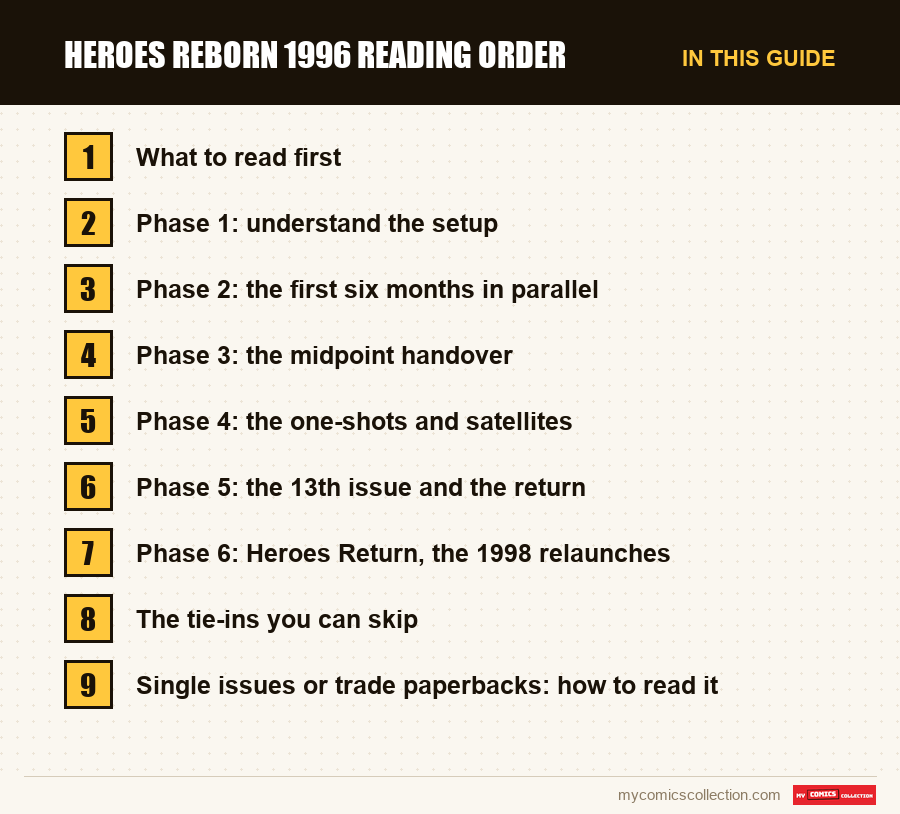
Phase 6: Heroes Return, the 1998 relaunches
The return to the main universe comes with a wave of relaunches numbered 1, which catalogs group under the name "Heroes Return". The publication order is as follows: Fantastic Four vol. 3 #1 and Captain America vol. 3 #1 in January 1998, then Avengers vol. 3 #1 and Iron Man vol. 3 #1 in February 1998. Thor vol. 2 #1 follows in July 1998 and replaces the numbering of Journey into Mystery #521.
If you want the logical continuation of the story, read at least issue #1 of each relaunch: they are entry points designed for a reader coming out of the event. Your character guides then take over: the Avengers reading guide and the Fantastic Four one place each run in context.
The tie-ins you can skip
The one-shots in Phase 4 are optional. None of them is needed to understand any series: each develops a character or an angle without changing the storyline of the four titles. If you are reading for the story, skip them; if you are completing a collection, they are worth hunting down, since they are part of the full set listed in the catalog.
The Onslaught Reborn miniseries, launched in 2006 in five issues by Rob Liefeld and Jeph Loeb, is a late sequel that revisits this pocket universe. It assumes you know the four original series, and it does not fit in the chronological reading: save it for the end, or ignore it.
Finally, Heroes Reborn #1/2 and the Marvel Spotlight mentioned above serve as opening and coda: read them if you have them on hand, without worrying about tracking them down at all costs.
Single issues or trade paperbacks: how to read it
To read the event, a trade paperback is more convenient than some twenty single issues. The collected-edition catalog lists one volume per series: Heroes Reborn: Avengers, Heroes Reborn: Captain America and Heroes Reborn: Iron Man, released in 2006 and each collecting issues #1 to #12 of volume 2, as well as Heroes Reborn: Fantastic Four, also from 2006, with a second edition in August 2018. An older first volume, Fantastic Four: Heroes Reborn (2000), collects only issues #1 to #6.
The final miniseries exists as Return of the Heroes (1999) and as a 2009 trade paperback, Heroes Reborn: The Return. Onslaught Reborn has its own collected edition from 2008. These reference points let you rebuild the whole set, with four series trades plus one for the conclusion, without buying the single issues.
The method is simple: choose your reading mode before you start. With trades, read one full volume before moving to the next; the cross-title coordination is less noticeable, but each hero's story reads more clearly. With single issues, alternate by month, and keep the Phase 2 and Phase 3 lists within reach. Either way, always finish with James Robinson's 13th issues and with The Return.
For collectors, the distinction matters on the shelf too: a modern trade does not replace the 1996 issues, which fans of this period hunt for, and each volume's page count reminds you that only issues #1 to #12 appear in it.
The key issues to know
The idea of a key issue is a special one here. These are not first appearances of characters, since they all already existed, but issues that mark moments in the operation.
- Issue #1 of each of the four series: they symbolize the launch, and the set is often sought as a four-cover run.
- Captain America (vol. 2) #1: it directly follows Captain America #454, the last issue of the first series, making it the hinge between the Mark Waid run and the Extreme Studios version.
- The second-half issues of Captain America and Avengers: the takeover by Jim Lee's studio described in Phase 3.
- James Robinson's 13th issues, which make up "World War III": concluding print runs, often overlooked by collectors who stop at issue #12.
- Heroes Reborn: The Return #1: the start of the return, worth having to complete the run.
- Fantastic Four vol. 3 #1 and Captain America vol. 3 #1 from January 1998: post-event relaunches, to be paired with the two others from February.
To estimate a 1996 copy, work by comparison: match your issue's condition against copies already sold of the same issue, identifying the variant carefully. A series #1 is compared with other #1s, not with a concluding issue. Our Captain America reading guide helps place this issue in the character's run.
Recap: the complete order
- Onslaught: the end of the crossover, for context.
- Heroes Reborn #1/2 and Marvel Spotlight: Heroes Reborn/Onslaught Reborn #1.
- Fantastic Four (vol. 2) #1 to #6, alternating with Iron Man (vol. 2) #1 to #6.
- Captain America (vol. 2) #1 to #6, alternating with Avengers (vol. 2) #1 to #6.
- The one-shots Ashema, Doom, Doomsday, Masters of Evil, Rebel, Remnants, Young Allies (optional).
- The four series, issues #7 to #12, alternating.
- The 13th and final issue of each series, by James Robinson: the "World War III" crossover.
- Heroes Reborn: The Return #1 to #4.
- The relaunches: Fantastic Four vol. 3 #1 and Captain America vol. 3 #1, then Avengers vol. 3 #1 and Iron Man vol. 3 #1, then Thor vol. 2 #1.
Frequently asked questions
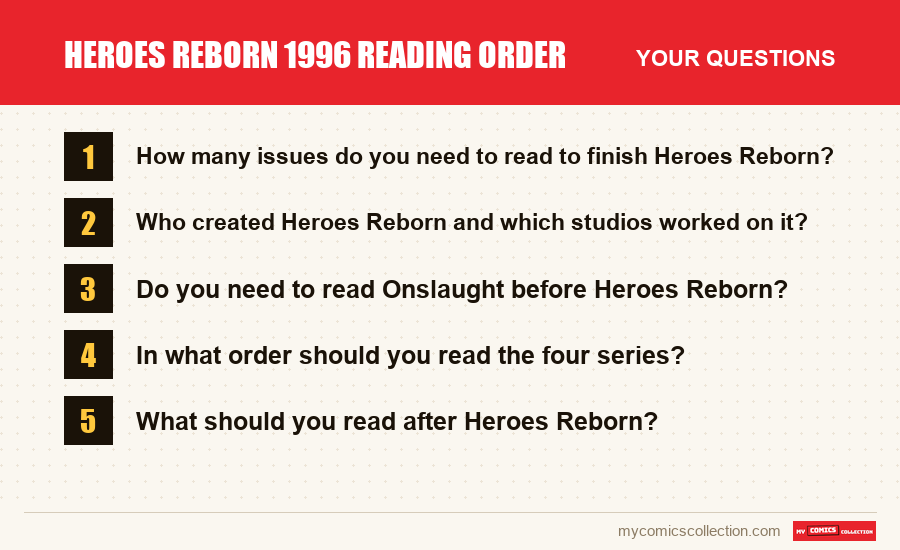
The four series run 12 issues each, so 48 single issues, plus the four 13th issues by James Robinson and the four issues of The Return. The one-shots are optional. In trade paperbacks, that comes to four volumes, plus the final miniseries.
The project pairs Marvel with two studios founded by alumni of the company: Jim Lee's, which produced Fantastic Four and Iron Man, and Rob Liefeld's, which launched Captain America and Avengers. After six issues, Jim Lee's studio took over both of Rob Liefeld's titles.
It is not required, but it is recommended: Heroes Reborn begins when the heroes are sent to a pocket universe after the battle against Onslaught. Reading the end of the crossover gives you the context; the four series can also be understood without it.
Alternate month by month, reading issue #1 of each series, then the #2s, and so on up to #12. That is the original publication rhythm, the one that brings out the bridges between the titles. With trades, read one full volume at a time.
Move on to Heroes Reborn: The Return, by Peter David and Salvador Larroca, then to the 1998 relaunches: Fantastic Four vol. 3, Captain America vol. 3, Avengers vol. 3, Iron Man vol. 3 and Thor vol. 2. Each issue #1 works as an entry point.
Found a 1996 issue #1 in a box of single issues? Have it appraised before you decide how to store it.
Estimate my comic