The Avengers Disassembled reading order is four single issues, Avengers #500 to 503, subtitled "Chaos," published from August 2004 to January 2005 by Marvel: Brian Michael Bendis writing, David Finch on art, and an epilogue, Avengers Finale #1. Read the four issues of the arc first, then Avengers Finale, then New Avengers #1. The tie-ins from other series (Iron Man, Thor, Captain America, The Spectacular Spider-Man) are optional and are read separately.
Four issues are enough to close the Avengers series as it existed, before another one takes over. This guide spells out what to read before, during and after, and separates the core of the event from the stories orbiting it.
As always in this guide, we state only verified information (creators, issue numbers, dates); the analysis is our own, with no reproduction of protected pages or dialogue.
What to read before Avengers Disassembled
No prelude is required to read the Avengers #500-503 arc: it was designed as a conclusion, and a reader who knows the team's longtime members is all it takes. If you still want to enter the series with a minimum of bearings, three reads help.
The first is an overview: the Avengers reading guide lines up the major periods and shows what the 2004 arc closes. The second concerns Wanda Maximoff's thread, because the arc touches closely on her lost children; the Scarlet Witch reading guide gives you the milestones. The third is the current state of the members, for example Tony Stark, whose situation as Secretary of Defense matters in the tie-ins.
Spoiler warning: the event is destructive for the team, several characters disappear and an emblematic location is destroyed. If you want to discover it knowing nothing, skip straight to the next phase.
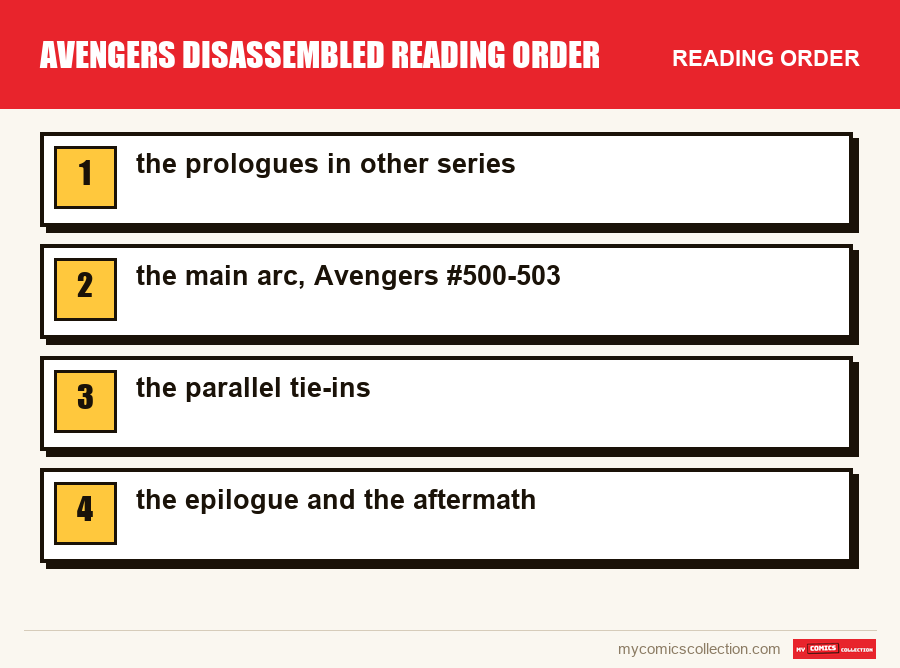
Phase 1: the prologues in other series
The solo series of the time published arcs that set up the event. They are read before the main arc or, better, after it, because they then take on the sense of a flashback.
- Captain America and the Falcon #5-7, written by Christopher Priest and drawn by Joe Bennett, billed as a prologue.
- Iron Man (vol. 3) #84-85, written by John Jackson Miller and Mark Ricketts, drawn by Tony Harris and Jorge Lucas, a prologue; issues #86-89 form the follow-up, on the aftermath side.
- The Spectacular Spider-Man (vol. 2) #15-20, written by Paul Jenkins and drawn by Humberto Ramos, Paco Medina and Michael Ryan, also billed as a prologue.
- Thor (vol. 2) #80-81, written by Mike Oeming and drawn by Anil Prasad, the prologue to the Asgardian part.
None of these arcs is necessary to understand the story told by Brian Michael Bendis. They serve those who want to see how each hero arrives at the moment of the break.
Phase 2: the main arc, Avengers #500-503
The Avengers #500-503 arc, titled "Chaos," is the core of the event. Brian Michael Bendis writes it, David Finch draws it. Publication runs from August 2004 to January 2005. It appears in the Avengers series just as its original numbering reaches issue #500, which gives the arc the status of a closing chapter.
Read the four issues in one sitting. There is no internal branching: each issue leads to the next, and the storytelling rests on a chain of incidents that you only understand by seeing the whole run. We do not go through the plot, to preserve the surprise: the turning points of "Chaos" are better discovered page by page, in David Finch's art.
A practical tip for collectors: issue #500 is a round number, which gives it a particular presence in a long-running series. Keep that in mind when hunting for copies of the arc, and preferably look for all four issues together.
To place the period, keep in mind the few dates that structure this guide: the arc runs from August 2004 to January 2005, New Avengers #1 comes out in December 2004, so even before the event's end date, and Young Avengers begins in February 2005. This overlap is a reminder that release order is not the recommended reading order.
Phase 3: the parallel tie-ins
Two series tell stories that unfold in parallel with the main arc. The first is Thor (vol. 2) #82-85, written by Mike Oeming and drawn by Anil Prasad: it follows the Asgardian part, which takes place at the same time as Bendis's arc. The second is Excalibur #8, billed as parallel.
For a reader of the main arc, the right place for these reads is after the four issues of Avengers, without going back and forth. The Thor reading guide lets you place the Asgardian arc within Mike Oeming's run. Stormbreaker: The Saga of Beta Ray Bill, which does not carry the event's banner, directly extends the Thor tie-ins; it is a separate read, reserved for those who enjoyed the follow-up.
If you read in single issues, shelve them by block rather than by date: a prologue block, the arc, then the aftermath block. This organization also makes any eventual resale easier, because each block sells or gets appraised as a coherent set.
Phase 4: the epilogue and the aftermath
After the arc, Avengers Finale #1, written by Brian Michael Bendis, closes the series. Thirteen artists follow one another in it, among them Jim Cheung, Steve McNiven, George Pérez and Darick Robertson, and Olivier Coipel draws the flashbacks.
The immediate follow-up is New Avengers #1, published in December 2004, with Bendis and Finch still at the helm; the series replaces Avengers. This handoff is the real starting point of the Bendis era on the Avengers, whose course the "where to start" guide traces. Young Avengers arrives in February 2005: Allan Heinberg writes, Jim Cheung draws, and the series offers a look at new heroes.
The aftermath arcs in the other series are read after the epilogue:
- Iron Man (vol. 3) #86-89, the aftermath for Tony Stark.
- Captain America (vol. 4) #29-32, written by Robert Kirkman and drawn by Scot Eaton.
- Fantastic Four #517-519, three issues by Mark Waid (writing) and Mike Wieringo (art).
- What If? Avengers Disassembled #1, a one-issue variation.
Do you collect this series?
Track what you own, what you are missing and what your collection is worth. 7-day trial.
Start my trial →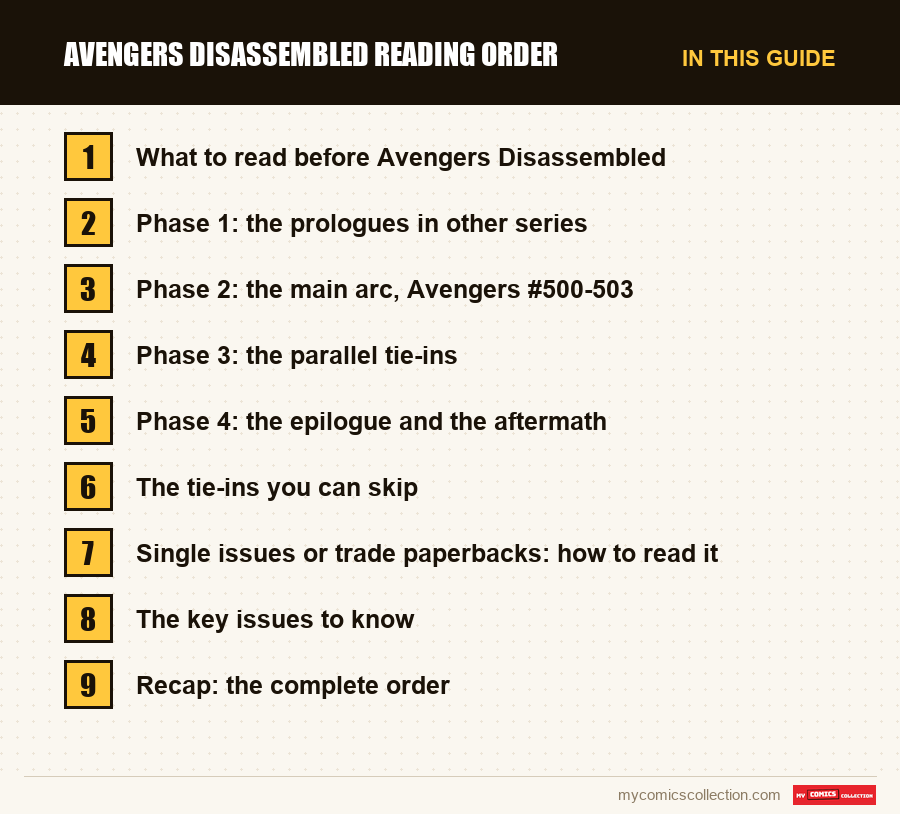
The tie-ins you can skip
No tie-in is mandatory. The four issues of Avengers and the epilogue are enough to tell the story. The arcs of Captain America and the Falcon, Iron Man and The Spectacular Spider-Man are series stories that take advantage of the attention on the event to attach their own plot; they read well independently, and a series you already follow can host them like any other arc.
The Fantastic Four and Captain America (vol. 4) tie-ins mainly serve as extensions for readers of those series. What If? Avengers Disassembled is a curiosity: save it for the end, once you have read the reference version.
You can also ignore later references to "Disassembled": the term will come back, for example in New Avengers #21-25 or Avengers: The Initiative #21-25, but those arcs belong to other eras.
Single issues or trade paperbacks: how to read it
For reading, the simplest option is a trade paperback. The Avengers Disassembled volume, published in February 2005, collects the main arc and Avengers Finale, and a separate volume, Avengers Disassembled: Iron Man, Thor & Captain America, published in April 2009, collects the arcs from the side series. This split mirrors our breakdown well: the first is the baseline read, the second is the bonus. Before that gathering, each side series had had its own volume: Avengers Disassembled: Thor (#80-85) and Avengers Disassembled: Captain America in December 2004, Avengers Disassembled: Iron Man (#84-89) in January 2007.
In single issues, the four issues of the arc turn up in complete runs; the appeal is getting the period covers and keeping issue #500 in its original condition. The epilogue issue Avengers Finale #1 is an object apart, in one-shot format, and is easy to spot by its thirteen-artist credit.
In every case, read the volume's table of contents before buying, to check the issues it contains: a volume that stops at #503 does not necessarily include Avengers Finale #1. If you are building your collection from the French edition, compare the start and end of the volume against the boundaries of this guide.
The key issues to know
Avengers #500 tops the list: the round numbering, the opening of the arc and the approach of a series' end give it a natural place on key issue lists. Issues #501 to 503 follow, with the concluding issue last. To judge them, compare the condition of the spine and corners, which is more fragile on a 2004 single issue that has been reread.
Avengers Finale #1 comes next: the closing issue, thirteen artists, a handoff role. Its distinction lies in the artist lineup rather than a first appearance, and that is a good criterion for deciding whether a copy is worth keeping in high-grade condition.
New Avengers #1, published in December 2004, rounds out the list: the opening of the new series. For the general method of spotting key issues in a saga, see the guide to key Avengers annuals and specials, which explains how to tell a regular series issue from a special.
Method: gather completed sales for each issue, note the exact condition, then compare the four issues of the arc against each other; the gap between #500 and #503 shows whether the market values the opening or the conclusion, and keeps you from paying for all four at the first issue's rate.
Recap: the complete order
- Captain America and the Falcon #5-7 (optional prologue)
- Iron Man (vol. 3) #84-85 (optional prologue)
- The Spectacular Spider-Man (vol. 2) #15-20 (optional prologue)
- Thor (vol. 2) #80-81 (optional prologue)
- Avengers #500-503, the "Chaos" arc
- Thor (vol. 2) #82-85 and Excalibur #8 (parallel stories)
- Avengers Finale #1
- New Avengers #1 (published in December 2004)
- Iron Man (vol. 3) #86-89, Captain America (vol. 4) #29-32, Fantastic Four #517-519
- Young Avengers (February 2005) and What If? Avengers Disassembled #1, as bonuses
Frequently asked questions
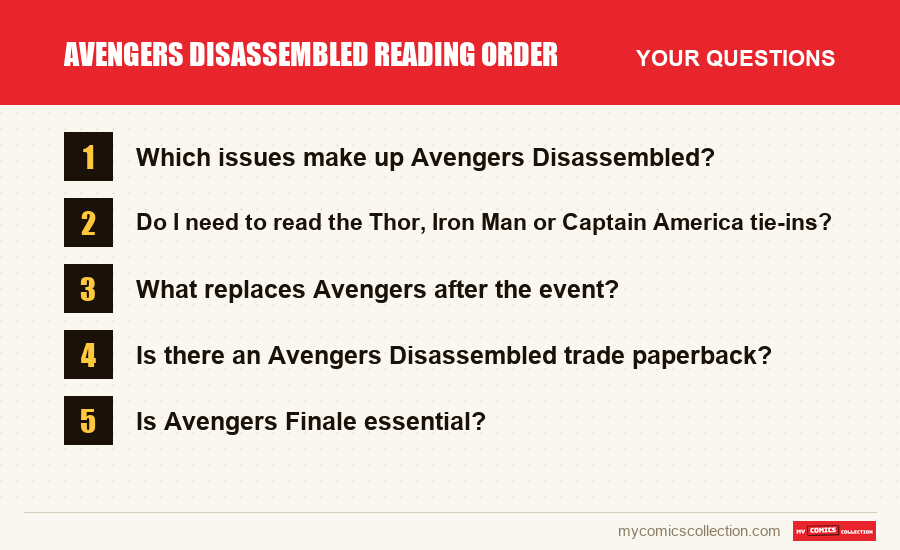
The core is Avengers #500 to 503, with Brian Michael Bendis and David Finch, completed by the epilogue Avengers Finale #1. The whole thing was published between August 2004 and January 2005. The other series published prologues and follow-ups, all optional.
No, the main story stands on its own. The Thor, Iron Man and Captain America arcs mainly interest readers of those series. If you do read them, put the prologues before or after the arc, and the parallel stories after the four issues of Avengers.
The New Avengers series, launched in December 2004, takes over with Brian Michael Bendis and David Finch still at the helm. Young Avengers, with Allan Heinberg and Jim Cheung, begins in February 2005 and rounds out the reading.
Yes, the Avengers Disassembled volume (February 2005) collects the main arc and the epilogue, and a separate volume, Avengers Disassembled: Iron Man, Thor & Captain America, published in April 2009, gathers the tie-ins. Always check the table of contents before buying, because editions vary by country.
This one-shot by Brian Michael Bendis, in which Jim Cheung, Lee Weeks, Alex Maleev and ten other artists pass the baton, closes the historic Avengers volume. It is read after the Avengers #500-503 arc and before New Avengers #1. Without it, the complete order of the period stays incomplete.
Do you own Avengers #500 or Avengers Finale #1? Get the condition and value of your copies estimated before you shelve them.
Estimate my comic