
In short
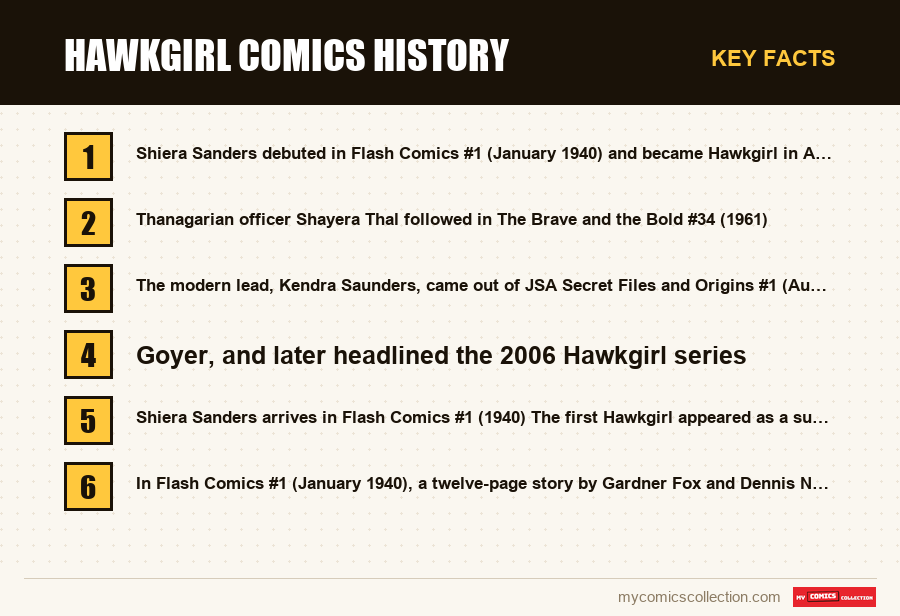
Hawkgirl is not one character but three women who share a costume. Shiera Sanders debuted in Flash Comics #1 (January 1940) and became Hawkgirl in All Star Comics #5 (1941). Thanagarian officer Shayera Thal followed in The Brave and the Bold #34 (1961). The modern lead, Kendra Saunders, came out of JSA Secret Files and Origins #1 (August 1999) from James Robinson and David S. Goyer, and later headlined the 2006 Hawkgirl series.
If a catalog search for "Hawkgirl" returns a confusing spread of years, that is not an error. Different women have worn the wings in different decades, and the character's story is the story of DC reassigning, merging and restoring them.
Credits and issue numbers here were confirmed one by one, whereas the shelf-building tips are our own analysis, and a cover month shows up only when it was confirmed.
Shiera Sanders arrives in Flash Comics #1 (1940)
The first Hawkgirl appeared as a supporting figure rather than a hero. In Flash Comics #1 (January 1940), a twelve-page story by Gardner Fox and Dennis Neville presented both Hawkman and Shiera Sanders. She is the companion of archaeologist Carter Hall, not yet a costumed hero.
That detail shapes how collectors should talk about her. When someone calls Flash Comics #1 "Hawkgirl's first appearance", the statement is accurate for Shiera Sanders the person, yet she is not yet Hawkgirl the costumed hero. The key issue is shared with Hawkman, so one copy serves both searches, and it is covered in more detail in our Hawkman where-to-start guide.
Becoming Hawkgirl: All Star Comics #5 (1941)
Shiera put on the wings in All Star Comics #5, dated 1941. Her costume was drawn by Sheldon Moldoff and based on the Hawkman design that Neville had created the year before. The cover year is the figure to cite.
The step matters because it turns the girlfriend into a partner. In the Golden Age book the Halls are a pair, and the Justice Society setting places Hawkgirl in the same world as Hawkman, who had joined the team in All Star Comics #3 (Winter 1940). For a collector assembling the Golden Age Justice Society run, issue #5 is the one that shows her transformation.
What changes for the character is category. She stops being a name in a supporting cast and becomes a winged figure with her own costume, which is the identity every later Hawkgirl inherits, whether by reincarnation, replacement or retelling.
Shayera Thal and the Thanagarian pair (1961 to 1981)
The Silver Age built a second Hawkgirl from scratch. In 1961 a new couple landed: The Brave and the Bold #34 sends two Thanagarian police officers, Katar Hol and Shayera Thal, to Earth. The credits for the issue are Gardner Fox and Joe Kubert, and Shayera appears in costume from her first page. On Earth the pair pose as museum curators Carter and Shiera Hall.
The new Hawkgirl was a professional, not a companion: a police officer in her own right. She stayed in her partner's shadow in terms of billing, though, and the Justice League of America made that visible. Hawkman joined the League in issue #31 in 1964, but she was not offered membership because only one new member could be admitted at a time. She joined the team in issue #146 in 1977, after the roster limit had been lifted.
In 1981 she was renamed. In the World's Finest Comics backup feature starring Hawkman, she took the name Hawkwoman. That is why a search for the 1960s and 1970s Thanagarian partner may require both names, and why the Silver Age and post-1981 entries can sit under different headings in a catalog.
The same decades appear in the Hawkman story told in our where-to-start guide, which is the best place to see the 1964 Hawkman series and its merger with The Atom.
Crisis, Limbo and the substitute Hawkwoman (1985 to 1989)
Crisis on Infinite Earths merged the separate Earths, so the Golden Age and Silver Age Hawkgirls now shared one world. A one-shot, Last Days of the Justice Society, sent most Golden Age Justice Society members, Hawkman and Hawkgirl included, into Limbo. To fill the gap, DC introduced Sharon Parker as a new Hawkwoman while the original Hawkgirl was away. Behind these shifts lies the 1985 crossover, and the guide to Crisis on Infinite Earths explains why.
For the character this is a period of displacement. The wings are still around, but each version is either in exile or standing in for another. A collector who reaches this stretch should expect the continuity to feel like a set of workarounds rather than a story, and that is a fair description of the editorial situation.
Hawkworld and Zero Hour: the wings are merged (1989 to 1994)
Hawkworld began in 1989 as a three-book series by Timothy Truman that revised the Silver Age origins of the Thanagarian Hawks. It became an ongoing series, and DC rebooted Hawkman continuity after it, which left the Silver Age adventures of the pair without a clear place and set off a chain of continuity repairs.
Then came Zero Hour: Crisis in Time! in 1994. The event merged the Golden Age Hawkgirl with Katar Hol and the Golden Age Hawkman into a new persona. In practical terms, three characters collapsed into one.
Kendra Saunders and JSA (1999)
The modern Hawkgirl is Kendra Saunders. She debuted in JSA: Secret Files and Origins #1, dated August 1999, in the lead-up to the revival of the Justice Society monthly. James Robinson and David S. Goyer created her, with artist Scott Benefiel on that issue. Her origin is unusual: Kendra, a young Latina woman, dies by suicide, her soul departs, and the soul of her great-aunt Shiera Sanders Hall enters her body, making her a "walk-in". Her grandfather, Speed Saunders, trains her as the new Hawkgirl.
She grows inside the monthly JSA, a title that lasted from August 1999 to September 2006 across 87 issues. Robinson and Goyer launched it, Goyer later co-wrote with Geoff Johns, and Johns continued alone. Her early story involves the Fate-Child, who is actually her own reincarnated son, Hector Hall. Her debut sits in the Secret Files issue that carries the creator credits, so file it there rather than under the first issue of the monthly.
This chapter is the reason most readers today picture a young, uncertain Hawkgirl who is also the heir of a Golden Age woman. It is a natural entry point, and our Hawkgirl where-to-start guide lays it out as the first stop.
Do you collect this series?
Track what you own, what you are missing and what your collection is worth. 7-day trial.
Start my trial →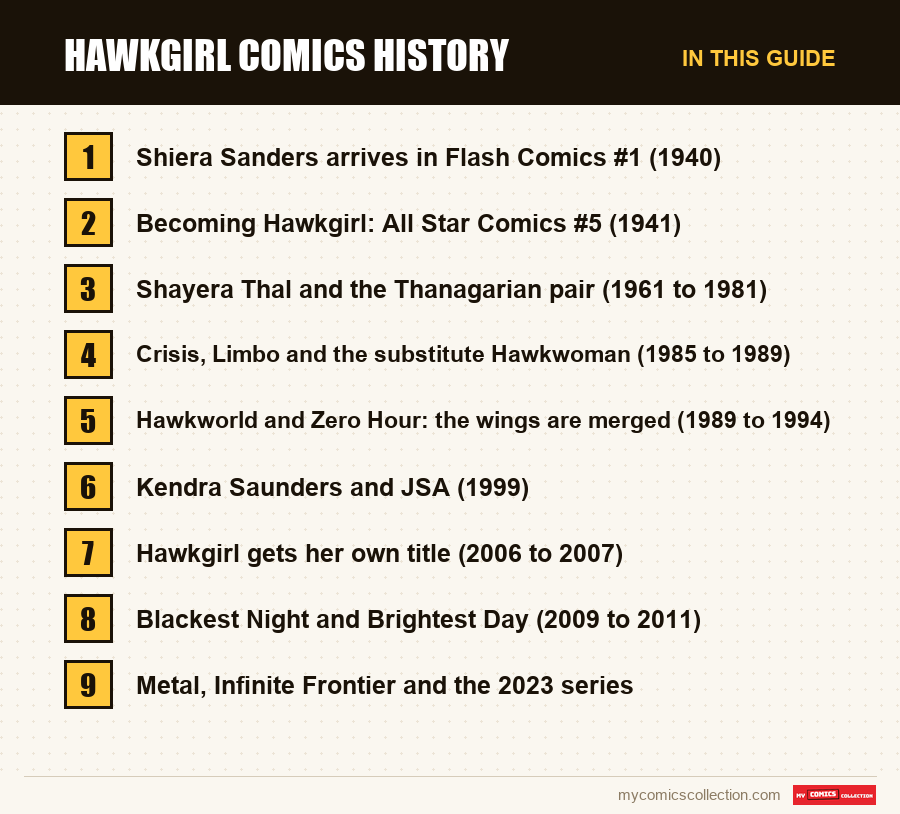
Hawkgirl gets her own title (2006 to 2007)
The 2002 Hawkman series, which James Robinson and Geoff Johns launched with artist Rags Morales, changed identity in 2006. At issue #50, during the "One Year Later" relaunch, the book took the name Hawkgirl, put Kendra where Hawkman had been, and handed the art and script to Walt Simonson and Howard Chaykin. It ended with issue #66 in July 2007.
The effect on the character is a promotion: a Hawkgirl now headlines a book. The numbering is the trap. Because the series kept its original count, a title called Hawkgirl starts at #50, and anyone filing by title will find the run beginning mid-sequence. Our Geoff Johns author page gives the wider context of the writer behind the Justice Society revival.
Kendra also served in the Justice League of America, then left the team after injuries sustained in Final Crisis, as shown in the second Justice League of America series, issues #30 and #31 (2009).
Blackest Night and Brightest Day (2009 to 2011)
The late 2000s were harsh on the family. In Blackest Night #1 (July 2009), Kendra is impaled by Sue Dibny and is later reanimated as a Black Lantern. Both Hawks are resurrected by the white light in the final battle, in issue #8. The sequel, Brightest Day, follows that thread in a storyline that includes Hath-Set's schemes and the Elementals arc, in which Hawkman and Hawkgirl become Elementals of air.
The 2011 New 52 then reshuffled the cast again, and a reimagined Kendra shows up in Earth 2, on the cover of issue #4 (October 2012). The pattern repeats: whenever DC resets, a different Hawkgirl moves to the front.
Metal, Infinite Frontier and the 2023 series
Kendra resurfaced in Dark Nights: Metal #1 (August 2017) as leader of the current Blackhawks, and Barbatos later transformed her into Lady Blackhawk; and in Justice League volume four #7 (September 2018) she appears with Nth Metal wings. Shayera returns too: Dark Crisis #2 (September 2022) counts her among the Justice Society.
Under the Infinite Frontier banner, Kendra was once again a core member of the Justice League series written by Brian Michael Bendis, and in 2023 she received an ongoing solo series by Jadzia Axelrod and Amancay Nahuelpan, set in Metropolis. It is the most recent entry point and a practical first read for a newcomer.
One trap deserves a separate warning. The Hawkgirl of the animated Justice League series is a reworked Shayera: a member of the Thanagarian armed forces who came to Earth as an advance scout and spy, wields an Nth Metal mace and has a romance with John Stewart. In the comics Shayera is a police officer, so the cartoon version is not the one you will find in the back-issue bins.
The key issues across her history
- Flash Comics #1 (January 1940): Shiera Sanders debuts alongside Hawkman, created by Gardner Fox and Dennis Neville.
- All Star Comics #5 (1941): Shiera becomes Hawkgirl in a costume by Sheldon Moldoff.
- The Brave and the Bold #34 (1961): Shayera Thal reaches Earth with her partner, a Thanagarian officer on assignment.
- Justice League of America #146 (1977): Hawkwoman joins the League after the roster limit is lifted.
- Hawkworld (1989): Timothy Truman's retelling of the Thanagarian pair.
- JSA: Secret Files and Origins #1 (August 1999): Kendra Saunders debuts, by James Robinson and David S. Goyer.
- Hawkman #50 (2006): the series is retitled Hawkgirl, with Walt Simonson and Howard Chaykin.
- Blackest Night #1 (July 2009): Kendra is killed and returns as a Black Lantern.
How to follow Hawkgirl in a collection
Decide first which woman you are collecting. For Shiera, the Golden Age comes down to Flash Comics #1 and All Star Comics #5. For the Thanagarian, open with the 1961 The Brave and the Bold issue, then the Hawkworld material. For Kendra, the 1999 JSA series, the 2006 Hawkgirl run and the 2023 solo series are the core.
Three habits keep the shelf in order. File by identity as well as by title, since "Hawkgirl", "Hawkwoman" and "Hawkman" overlap. Record the series volume and cover year for every entry, because several books share the same title. And treat the renumbered Hawkgirl run as part of the Hawkman sequence, since it begins at #50 and ends at #66. For the Golden Age portion of the set, our Black Canary guide shows how another Flash Comics feature is handled, and the Power Girl history follows another Justice Society heroine.
Frequently asked questions
It depends on the wearer. Shiera Sanders appears in Flash Comics #1 (January 1940) and takes the Hawkgirl name in All Star Comics #5 (1941). Shayera Thal belongs to the 1961 Thanagarian pairing in The Brave and the Bold #34. Kendra Saunders debuts in JSA: Secret Files and Origins #1 (August 1999).
Shiera Sanders is the Golden Age Hawkgirl, partner of Carter Hall. Shayera Thal is a Thanagarian police officer, partner of Katar Hol, who later takes the name Hawkwoman. Kendra Saunders is the 1999 version, a "walk-in" whose body carries the soul of Shiera Sanders Hall, her great-aunt.
Yes. The 2002 Hawkman series was retitled Hawkgirl with issue #50 in 2006, with Walt Simonson and Howard Chaykin, and ended at #66 in July 2007. A solo series by Jadzia Axelrod and Amancay Nahuelpan followed in 2023, set in Metropolis.
No. The Hawkgirl of the animated Justice League series is a reworked Shayera, a Thanagarian military scout and spy who wields an Nth Metal mace and falls for John Stewart. The comic-book Shayera is a police officer, and none of the comic-book Hawkgirls matches that portrayal, so search by comic title, not by cartoon memory.
For the modern character, start with the 1999 JSA series by James Robinson and David S. Goyer, then the 2006 Hawkgirl run. For a self-contained read, try the 2023 solo series. Readers after Shayera can pair that 1961 issue with Hawkworld.
Holding a Flash Comics or All Star Comics issue that features Hawkgirl and curious where it stands?
Estimate my comic