In short
Hammerhead first appears in The Amazing Spider-Man #113, cover-dated October 1972. Gerry Conway wrote the issue, and Conway and John Romita Sr. are credited as the character's creators. He is a pinstriped 1920s-style mob boss with a flat steel skull, introduced in a gang war with Doctor Octopus that runs from #113 through #115.
Most villains debut with a costume and a grudge against the hero. Hammerhead debuts with a business. The Amazing Spider-Man #113 opens a war between two criminal operations, Doctor Octopus on one side and Hammerhead's mob on the other, with Spider-Man caught in the middle. That structure makes the issue unusual among Spider-Man debuts, and it is the number collectors look for under the name "Hammerhead first appearance."
Writer, cover date, creator credits, the arc and the later Hammerhead stories were confirmed against published listings. How the gang war is structured, why it suits a collector and the inspection routine are our own judgment, and no art or dialogue is reproduced.
The identity of The Amazing Spider-Man #113
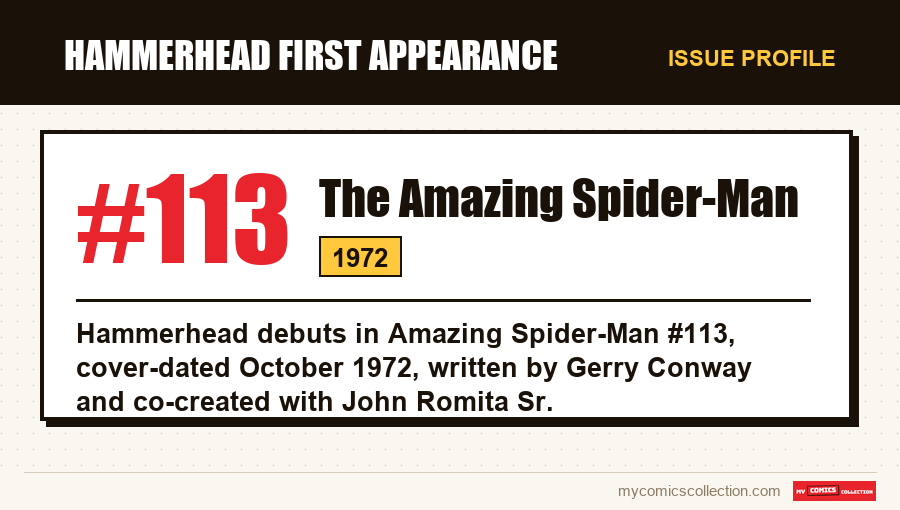
The issue carries an October 1972 cover date, and Gerry Conway is credited as writer. It opens a three-part run that continues through #114 and #115, and the three numbers together tell one story: a gang war between Doctor Octopus and Hammerhead, with Spider-Man caught between them, which ends with Hammerhead fleeing the country. Collectors who want the full arc should think of #113 as the first chapter rather than a standalone.
John Romita Sr. is credited with creating the character alongside Conway, and the look that made Hammerhead recognizable is his contribution. When you compare copies, remember that the cover date is October 1972 and that the number belongs to the early Conway stretch of the series.
The story is collected in Essential Spider-Man Vol. 5, which gathers The Amazing Spider-Man #90 to #113, so the debut is the last issue in that book and the rest of the gang war opens Vol. 6, which starts at #114. A collected edition is the cheapest way to read the story, and it is a different object from the 1972 comic. The indicia and the cover date are the quickest way to tell them apart in a listing.
How Hammerhead is introduced
The debut is built around a rivalry rather than a duel, and that is what makes the issue distinctive. Doctor Octopus and Hammerhead want the same underworld, and Spider-Man spends the arc caught between two sides that are each happy to see him hurt the other. Our reading is that the book introduces Hammerhead through what he runs as much as through what he does, so that by the end of the three issues the reader understands him as the head of an organization, not a lone brawler.
The war does not end with Hammerhead in a cell. By the close of #115 he flees the country, which leaves the door open for a return, and the series uses that door more than once. For a collector, that open ending is part of the appeal: the debut does not resolve the character, it sets him loose.
The flat head is explained in later stories. After a beating in a Bowery alley, the surgeon Jonas Harrow replaced much of his skull with a strong steel alloy, which gave him his nickname and a silhouette that reads at a glance.
His style is a throwback. He dresses and talks like a 1920s gangster, a manner the stories trace to a poster for a gangster film he saw while unconscious, and that look is a deliberate contrast to the costumed villains who fill the rest of the series. In a book where Octopus wears a harness and tentacles, a man in a suit who simply owns the room is a different kind of threat.
What Spider-Man is going through in #113
The issue sits at a turning point for the title. Stan Lee had handed the writing to Gerry Conway, who was 19 at the time, and Conway went on to script the series through 1975, covering issues #111 to #149. Issue #113 is therefore the third number of a run that would include some of the most discussed stories in the book's history.
That placement matters for a collector because it puts the number in a sequence. A reader who starts at #111 sees a new writer finding his footing, and by #113 that writer is confident enough to add a new crime boss to the cast and pit him against one of Spider-Man's oldest enemies. Our view is that the gang war reads best as part of that opening stretch rather than as an isolated debut.
It also explains why the Hammerhead arc feels like it belongs to the series rather than being bolted onto it. Conway was building a street-level world around Peter Parker, and a gangster who owns a mob fits that world better than another costumed inventor would. The character arrives as one more pressure on a hero who already has plenty.
Who created Hammerhead, and why
Gerry Conway and John Romita Sr. are credited as the creators of Hammerhead. Conway has said that he was influenced by the Big Man and Crime-Master, two earlier gangster figures in the book, while John Romita, in his words, came up with an interesting look. That division is useful: the idea of a mob boss who stands apart from the costumed villains came from the writer, and the flat-headed silhouette that makes the character recognizable came from the artist.
The editorial moment is the early Conway period of the title. A young writer was taking over a series with a long history, and the book was moving toward the stories that would define the decade. Our guide to where to start with Gerry Conway follows his work across the series, and the author page lists the rest.
The choice to build a villain from the gangster tradition rather than from science or armor is a sign of where the series was going. The Kingpin had already established the crime-boss model, and Hammerhead is a second version of it, with a different look and a different relationship to violence. The result is a character who gave the series a street-level counterpart to its more fantastic villains. For the larger crime-world context, see our guide to the Kingpin's universe.
Do you collect this series?
Track what you own, what you are missing and what your collection is worth. 7-day trial.
Start my trial →
Why #113 is a key issue
The case for #113 is simple. The number introduces a mob boss who stayed in Spider-Man's underworld through the Bronze Age and into recent volumes. He is a mob boss with a visual hook that works on a cover, and writers keep returning to him.
The record after the debut is long. The Amazing Spider-Man #130 and #131 bring a rematch with Doctor Octopus near an atomic reactor. In #157 to #159, Hammerhead kidnaps Aunt May, and the arc ends with his helicopter falling into the Hudson. He fights the Human Torch in an exoskeleton in Fantastic Four #233. In #284 to #288 he is nearly assassinated by the Arranger, and in #575 he is rebuilt by Mister Negative. Doctor Octopus recruits him for Origin of the Species in #642, and volume 6 #31 (October 2023) puts him at the wedding of Randy Robertson and Janice Lincoln.
Notice what that list says. A debut number is valued for what it started, and #113 started a rivalry with Doctor Octopus that runs through much of the following years, along with a character who could be rebuilt and returned as needed. A fair assessment is that #113 belongs to the middle tier of Spider-Man debuts. It is not a number that defines the franchise, and it is a number that a serious villain collector will want.
Numbers that get confused with #113
The most common mistake is to confuse #113 with its neighbors. Issues #114 and #115 continue the same gang war, and a listing that says "Hammerhead" without a number could be pointing at any of the three. Only #113 is the debut, and the cover date, October 1972, is the quickest check.
A second confusion is with the issues that follow. In the numbers that come after, Spider-Man faces other major villains, and the Hammerhead arc can be mistaken for something larger in the series. Issue #129 is covered separately in our guide to the Punisher issue, and the death of Gwen Stacy in #121 has its own guide. Neither of those is the Hammerhead debut, and a collector who wants all three needs to buy them separately.
The collected edition named earlier is the third source of error. Essential Spider-Man Vol. 5 contains the story, and it is a different object from the 1972 issue. Check the title on the cover, the indicia and the date before you treat any listing as the original.
Inspecting a 1972 copy
Begin with the spine of the October 1972 book: stress lines, color breaks, a roll, rusted or swapped staples. Then test the cover attachment at both staples. Re-glued covers show a tacky sheen where the adhesive sat and a faint step along the fold.
Look at the cover's surface under a raking light. Gloss changes can show a cleaning treatment or color touch, and a surface that looks too perfect for its age deserves a question. Check the corners for blunting, the top edge for small tears, and the back cover for writing, stamps or coupon cuts.
If the copy sits in a holder, the label tells half the story: restoration grade notes, page quality and any signature line. Compare the label with images of both sides. If the book is loose, ask for clear shots of centerfold, corners and back cover, and put the pressing and cleaning question to the seller directly.
Decide early whether you want only the debut or the trio. Choosing #114 and #115, aim for the same condition tier as #113 so the three look like one run. A copy you already own can go through the free comic valuation first.
Where to go after the debut
For a collector who wants to follow Hammerhead past #113, the best stops are few. The rest of the arc in #114 and #115 completes the gang war. The rematch in #130 and #131 is the next major use of the character, and the stretch from #157 to #159 gives him a darker role as a threat to Aunt May. The later numbers from #284 to #288 and #575 show how later writers rebuilt him for new eras.
Other Bronze Age numbers near #113 appear in the Amazing Spider-Man key issues list, and the Spider-Man hub links every villain page.
Frequently asked questions
Hammerhead first appears in The Amazing Spider-Man #113, cover-dated October 1972. Gerry Conway wrote the issue, and Conway and John Romita Sr. share credit for creating the character. The story continues in #114 and #115, but only #113 carries the debut.
Gerry Conway and John Romita Sr. created Hammerhead. Conway has said he was most directly influenced by the Big Man and the Crime-Master, while Romita came up with the look. The flat steel skull and the pinstriped 1920s gangster style are what make the character recognizable on a cover.
He arrives as the boss of a mob at war with Doctor Octopus, with Spider-Man caught between the two sides. The gang war runs from #113 through #115 and ends with Hammerhead fleeing the country, free to return in later stories.
The next stops are #114 and #115, the rematch with Doctor Octopus in #130 and #131, and the Aunt May story in #157 to #159. Later numbers include #284 to #288, when the Arranger nearly assassinates him, #575, and the Origin of the Species storyline in #642.
Yes. The story appears in Essential Spider-Man Vol. 5, which collects The Amazing Spider-Man #90 to #113. It is a different object from the 1972 comic, so check the cover, the indicia and the date before treating any of them as the original issue.
Own a copy of The Amazing Spider-Man #113 or another Bronze Age Spider-Man key? Get an estimate based on its condition.
Estimate my comic